Key Takeaways
- Specify 304 stainless steel at 0.45-0.60 mm wall thickness for most gym bottle bodies
- Test shaker lids with 300-500 shake cycles, not only a static leak test
- Use AQL 2.5/4.0 inspection and define coating defects before mass production
- Plan 30-45 days production plus 7-10 days for samples on private label orders
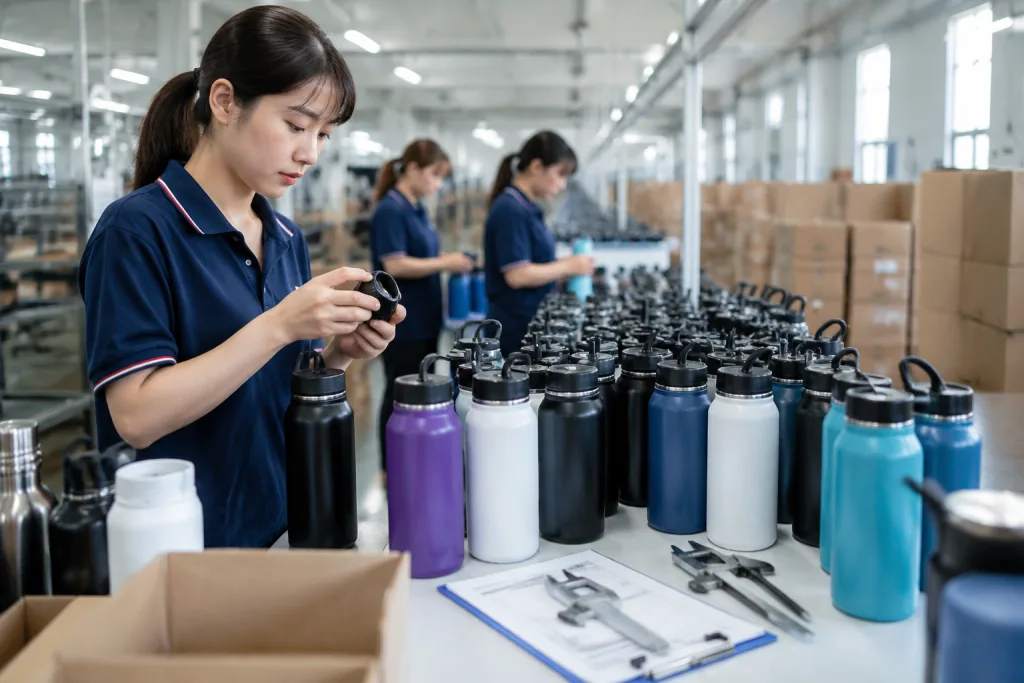
A 304 stainless steel gym water bottle private label project usually fails in boring places: a lid that seeps after 300 shakes on the leak-test jig, powder coating that chips after carton rub, a straw with plastic odor, or a carton that caves in before it reaches your 3PL. Bad look. Your customer will not care that the bottle looked fine in the pre-production photo.
If you run a fitness brand or gym chain, the wrong question is “how nice does it look in the catalog?” You need a custom gym water bottle that survives daily use: gym bags, car cup holders, dish racks, and members dropping it on rubber flooring. From our Zhejiang production base in China, we normally run MOQs from 1,000 units per color and ship in 30-45 days after sample approval, depending on finish and packaging. Last month, QC pulled a sample because the logo was 2 mm off-center; small issue on paper, visible on shelf.
Steel grade mistakes show up late
The first failure mode is quiet: the supplier writes “stainless steel” on the PI but never fixes the grade, thickness, or weld standard. For a 304 stainless steel gym water bottle private label order, specify food-contact 304 stainless steel for the inner wall as the minimum. If the bottle is double-wall vacuum, 6 out of 10 cost-driven projects we see use 304 inside and 201 outside, but that split must be written on the PO, not agreed in a WeChat message. For premium gym chains, I prefer 304 inside and outside. QC pulled one sample last year with rust spots near the bottom seam after a 24-hour salt spray check; the buyer flagged it before shipment, and the claim discussion was painful.
For most bulk sports water bottle programs, the body wall should sit around 0.45-0.60 mm before forming. Go thinner only if the math is about giveaway pricing. Gym users drop bottles on rubber flooring, steel racks, and car parks, and a 0.38 mm shell can look tired after one week in a trainer’s bag. We run calipers on the coil before deep drawing, and the line records thickness in mm against the batch card. Logo cannot save a soft body.
Ask for a material declaration, LFGB or FDA food-contact test report if selling in Europe or North America, and random material verification during production if your order is large. In China, serious buyers ask for this; it is not an insult to the factory. At BottleForge Industrial in Zhejiang, we produce up to 300,000 stainless bottles per month across sports, travel, and thermos lines, so we treat steel traceability as a production control point, not paperwork decoration. We scan coil labels, keep heat-number photos, and match them against the inspection file before packing starts.
Also define the mouth size early. A 50-55 mm wide mouth is easier for ice and cleaning. A narrow mouth looks sleek, but this is the wrong question to ask if your custom fitness water bottle is used with protein powder, electrolytes, or fruit slices. We have seen buyers approve a slim 38 mm opening, then complain 12 days after launch because powder stuck under the shoulder and customer service called it a “smell issue.”
The lid is where bottles leak
Most complaints on a customized gym water bottle do not come from the body. They come from the lid. In our after-sales log, about 68% of leak claims were tied to flip lids, straw lids, chug caps, or shaker inserts. Small parts cause the trouble: silicone gaskets, hinge pins, air vents, locking tabs, and threaded collars. One 0.3 mm flash mark on a sealing edge is enough. QC pulled a sample last month where the cup body passed vacuum, but the lid failed after two shakes.
For a bulk gym water bottle order, ask the factory to list lid material separately from the bottle material. PP, Tritan, silicone, and stainless are common choices, but they should not be mixed together on the spec sheet. If you are selling into the EU, ask for REACH and LFGB compliance on plastics and silicone. For the US, FDA food-contact compliance is the baseline. If the lid includes a straw, request odor testing after 24 hours in warm water; we run this at 45°C because room-temperature water hides problems. Plastic smell kills private label repeat orders. We once saw a PO that said “Tritan straw,” while the approved sample used PP, and the buyer flagged it during pre-shipment inspection.
Do not accept only a static upside-down leak test. That is the wrong question to ask. A gym bottle gets squeezed inside a bag, shaken with protein powder, and thrown into lockers after training. On the line, we use a torque meter for screw lids and a simple shake jig for shaker caps before cartons are sealed. A practical test plan should include:
- 100% water leak test during assembly for screw and flip lids, with operators checking the gasket seat before packing
- 300-500 manual shake cycles for custom shaker bottle lids, especially when protein powder residue is used in the test
- Drop test from 1.0 m onto plywood or rubber mat, three orientations, including one direct hit on the hinge side
- Dishwasher simulation if you claim dishwasher safe; if the lid warps after three cycles, do not print that claim
If you want a custom logo shaker bottle or custom made shaker bottle, decide early whether the mixing ball, mesh insert, or agitator is included. A stainless ball adds cost, weight, and noise; the math does not work for every retail price point. A plastic mesh insert is quieter, but the fit must be tight enough that it does not rattle loose after transport. For distributors shaker bottle programs, spare lid availability matters because one cracked lid can make a full bottle unsellable. We ship 1-2% extra lids and gaskets with the main shipment, packed in a separate carton marked “spare parts,” so the warehouse team does not lose them during unloading.
Coating failures are usually preventable
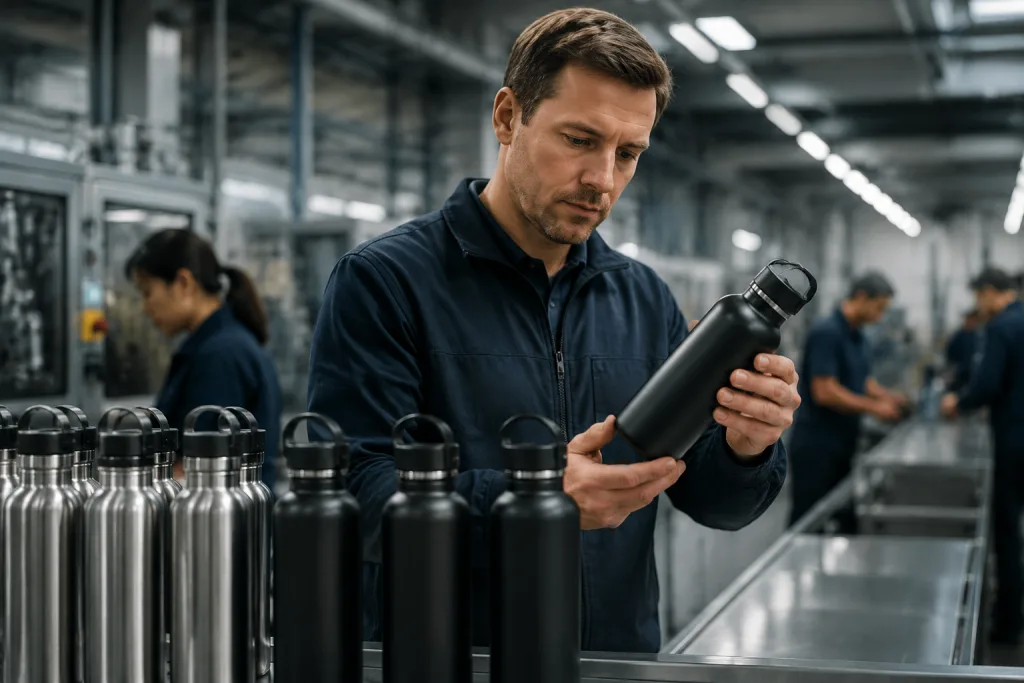
Powder coating makes a customizable sports water bottle look shelf-ready, but it is also where margin disappears fastest. We have seen 3,000 pcs held after QC pulled the sample because the base ring chipped through to silver after one drop in the carton test. Color drift between production lots, orange peel texture, and weak adhesion may show up after packing, not at sample approval. One golden sample is not enough. The line needs controlled pre-treatment, curing temperature records, and a checked master color panel beside the spray booth.
For gym and fitness retail, powder coating beats basic spray paint for hand feel and wear resistance. Specify the finish first: matte black with 8 to 12 gloss units is not the same as a soft-touch matte that picks up fingerprints. Give the Pantone target, approve a sealed master sample, and set the color tolerance before we run production. If the bottle will live in sweaty hands and car cup holders, ask for an adhesion cross-cut test and a 3M tape pull test. For harder-use customized sports water bottle lines, we run abrasion testing with a wet cloth or rubber pad because office-light beauty checks miss the failures buyers complain about after 30 days on the shelf.
Laser engraving is durable and clean, but it cuts down to the steel color, so the logo can look too quiet on white, beige, or pale pink coating. Silk screen printing fits bold logos and tighter budgets, though the artwork can stretch on a curved 750 ml body if the fixture is loose by even 1 mm. Heat transfer gives more colors, but it can scuff when gym users throw the bottle into a locker with keys. For a custom sports water bottle used every day, I prefer laser for small brand marks and powder coat with a simple one-color print for campaign graphics. Fancy decoration is not always better; we have seen this go sideways when a buyer pushed for five-color transfer on a promo bottle.
Put cosmetic standards in writing before mass production. Use clear limits: no scratches over 3 mm on visible surfaces, no exposed metal at the rim, no color difference beyond the approved master sample, no logo misalignment over 1.5 mm. These numbers sound strict, but they stop emotional arguments during final inspection. Last month a PO had “mat black” typed instead of “matte black,” and the buyer flagged it only after the pre-production sample. Small wording mistakes cost days, so we attach the signed color chip, logo position drawing, and AQL 2.5 inspection points to the order file before the first batch enters coating.
Capacity and shape affect real use
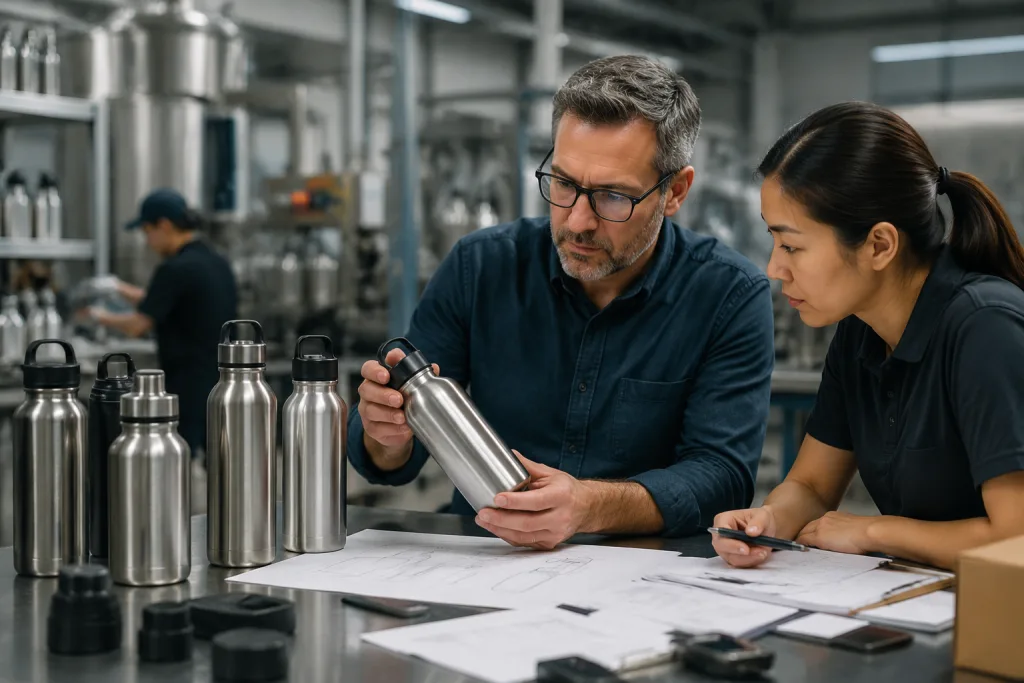
Too many fitness brands pick capacity by what looks clean on the product page. That is a bad brief. In the last 47 gym bottle RFQs we handled, the same issue came up: buyers liked the photo, then the filled sample felt wrong in hand. A 500 ml bottle is easy to carry but runs short during a full training session. A 750 ml bottle is the safe middle size. A 1,000 ml bottle suits heavy gym users, but once filled it gets heavy and fails some cup holder checks. For gym chains, personal trainers, and supplement buyers, we usually quote 750 ml and 1,000 ml first for a bulk fitness water bottle, then confirm with a filled sample on the line.
Check filled weight. Not empty weight. A double-wall 1,000 ml stainless bottle can feel clumsy after water is added, and one buyer flagged this during a video call after our QC pulled the sample and put it on a 5 kg digital scale. For a distributor sports water bottle range, we run one lighter single-wall model for workouts and one insulated double-wall model for daily carry. The math does not work if every SKU is heavy, expensive, and aimed at the same user.
Shape changes defect rate too. Tall narrow bottles dent more easily in transit, and we have seen them wobble on a flat weight bench during sample testing. Wide bodies create another problem: grip. For a customizable gym water bottle used by both male and female gym members, a body diameter around 72-78 mm is comfortable for most hands and still fits a good share of car cup holders, though not all. Our caliper check is simple, but it catches bad drawings before tooling starts.
Do not ignore the base. A stainless base ring, silicone boot, or thicker formed base cuts dent claims, especially after cartons go through drop testing from 80 cm. A silicone boot adds roughly USD 0.25-0.60 depending on size and quality, but it protects the part buyers complain about first: ugly bottom dents in photos and reviews. If your product is sold as a premium customized fitness water bottle, the boot is usually worth the cost.
Logo placement can create scrap
Private label buyers send a logo file and assume branding is done. Wrong question. On a round bottle, the print height, wrap width, powder texture, and jig registration decide whether the line runs clean or makes scrap. A 90 mm wide logo can look fine on a flat PDF, then bend badly on a 75 mm diameter bottle. We check it with a paper wrap and a digital caliper before opening the screen. Fine text below 1.0 mm stroke thickness can break during laser engraving or close up during screen printing, and QC pulled 38 pcs from one trial run last month for exactly that issue.
For a custom gym water bottle, ask for an artwork proof placed on the actual bottle drawing, then pay for a physical branded sample. Do not skip this step. If you use a metallic powder coat, check logo contrast under normal shop lighting and under cooler retail lighting. White printing on matte black is safe. Dark gray engraving on navy powder coat can disappear once the bottle sits under LED gym lights; one buyer flagged this after seeing only 2 meters of shelf distance.
For a customized shaker bottle, the lid and body may use different materials, so the logo process cannot be copied from one part to the other. We can laser the stainless body, but the plastic lid may need pad printing with a silicone pad, a molded logo, or an insert label. If the lid is PP, ink adhesion drops without surface treatment. For a customizable shaker bottle with a large logo on the lid, confirm whether the factory will run corona treatment, primer, or a textured mold surface, and ask for a tape test result. We use 3M 600 tape on the first sample batch.
MOQ changes with branding method. At our China facility, typical MOQ is 1,000 units per color for stocked shapes with logo, 3,000 units for custom powder colors, and 5,000-10,000 units if you need a new mold or unique lid structure. If you are testing a new gym chain launch, start with a stock mold. Spend the saved tooling money on a tougher coating and a better carton drop test. The math does not work when a buyer wants 600 pcs, 4 colors, a new lid, and retail packaging; we have seen that go sideways before the PO artwork is even approved.
Packing defects cost real money
A bottle can leave the line with clean coating and still reach Europe or North America with scuffed paint or crushed gift boxes; loose lids are another common claim. That is a packing failure, not bad luck. QC pulled a sample last month where the bottle passed coating inspection, but the retail box corner was crushed after one 76 cm drop. For distributor gym water bottle orders, the carton plan belongs in the spec, especially for Amazon FBA with label rules, retail DCs with pallet specs, or gym chain warehouses that reject torn outer cartons.
Ask for individual polybag or tissue wrap; add a divider when powder coating or mirror polish can rub during transit. We run a carton drop test before mass packing, not after the container is booked. For heavier 1,000 ml stainless bottles, a 5-ply export carton is safer than a light 3-ply carton. Keep master cartons under 15-18 kg if warehouse handling matters. One buyer flagged a 19.6 kg carton because their DC charges extra above 18 kg. If each bottle has a retail box, specify ECT or bursting strength, the exact barcode position in mm, and whether the FNSKU label is applied by the factory or your 3PL.
Moisture control matters too. Stainless bottles with silicone parts can trap odor if packed wet or packed too soon after washing. We require dry assembly, air-gun blow-off at the packing table, and at least 24 hours standing time after coating before final packing. Shortening that wait is the wrong place to save half a day. For ocean freight from Ningbo or Shanghai, add desiccant when using paper gift boxes, especially in humid seasons in Zhejiang when the workshop hygrometer sits around 75% RH.
FOB Ningbo is common for our export orders because trucks from Hangzhou usually reach the port in about 3.5 hours. For a 5,000-unit bulk sports water bottle shipment, carton dimensions and loading quantity can change freight cost by several hundred dollars. We have seen the math go sideways from one trial pack: a carton only 20 mm taller cut the load plan by 420 bottles. Do not approve packaging only by photo; ask for carton size with L×W×H, gross weight, packing ratio, and a pallet plan if your buyer requires pallets.
Inspection needs numbers, not trust
The last failure mode is weak inspection wording. “Good quality” means nothing when QC pulled the sample and found 8% lid leaks or 12% small coating chips under the light box. Use AQL sampling with clear defect categories. For most private label drinkware, AQL 2.5 for major defects and 4.0 for minor defects is a practical starting point. Critical defects, such as sharp edges, foreign matter inside the bottle, or serious leakage, should be zero tolerance.
Build the QC checklist before deposit payment. Not after. Include capacity check by measuring cup, weight range on a digital scale, vacuum insulation test if applicable, coating inspection with 3M tape, logo position in mm from the bottle base, lid torque, gasket presence, odor, barcode scan, carton drop, and packing count. For insulated bottles, a simple heat retention test can be run by filling with 95°C water and recording temperature after 6 or 12 hours. For single-wall sports bottles, put more attention on leak, dent, mouth finish, and cleaning residue because we have seen polishing dust left inside the shoulder area.
If you are a distributor fitness water bottle buyer, use your own agent or a third-party inspector in China before shipment. It usually costs USD 250-350 per man-day. That is cheaper than sorting 4,800 bottles in your warehouse after arrival, and the math does not work once replacement lids and local labor are counted. A normal inspector will open random cartons, check the PO item number, scan the EAN code, and record defects by carton number. For repeat orders, inspection data also gives you a cleaner way to push process changes instead of arguing from photos.
A good supplier should not be offended by clear inspection rules. We prefer them. If a factory pushes back on AQL 2.5, leak testing, or carton drop checks, the buyer should flag it before deposit, not after the container is on the water. When your bulk shaker bottle, distributor shaker bottle, or custom fitness water bottle order has measurable standards, the line knows what to control, and you know what you are paying for before the container leaves China.
Send your gym bottle spec for a factory review
Share capacity, lid type, logo method, target price, and market. We will return practical MOQ, lead time, and risk comments.
Frequently asked questions
What MOQ should I expect for a 304 stainless steel gym bottle private label order?
For a stock bottle shape with your logo, a realistic MOQ is usually 1,000 units per color. If you need a custom powder coating color, plan around 3,000 units. A new lid, new body mold, or custom made shaker bottle structure can push MOQ to 5,000-10,000 units because tooling, testing, and setup loss become significant. For first orders, I usually advise fitness brands to use an existing mold, confirm demand, then invest in tooling after repeat sales.
How much does a private label stainless gym bottle cost?
As a rough FOB China range, a single-wall 304 stainless sports bottle may sit around USD 2.20-4.00 depending on capacity, lid, coating, and logo. A double-wall vacuum insulated gym bottle often falls around USD 4.50-8.50. Silicone boots, retail boxes, extra lids, shaker inserts, and special coatings add cost. Prices move with steel, exchange rate, and order quantity, so the useful quote is based on a real spec sheet, not only a product photo.
Is 304 stainless steel enough for protein shakes and supplements?
Yes, 304 stainless steel is suitable for normal water, electrolytes, and protein drinks when properly cleaned. The bigger issue is not the steel; it is the lid design and cleaning access. Protein powder residue collects in threads, vents, straws, and shaker inserts. If you sell a custom shaker bottle for supplements, use removable gaskets, avoid hidden cavities, and give clear cleaning instructions. Do not claim dishwasher safe unless the coating, print, lid, and gasket have been tested for it.
Which logo method is best for gym chain bottles?
For daily-use gym bottles, laser engraving is the most durable and has low risk of peeling. Silk screen printing is cost-effective for bold one-color logos, especially on matte powder coating. Heat transfer works for multi-color graphics but is less ideal for hard gym use unless the surface and curing are well controlled. For 1,000-3,000 units, laser or one-color screen print is usually the safest. Always approve a physical sample under real lighting before mass production.
How long does production and shipping usually take?
Sampling normally takes 7-10 days for an existing mold with logo, longer if you need new coating trials or packaging mockups. Mass production is typically 30-45 days after sample approval and deposit for 1,000-10,000 units. Ocean freight to Europe or North America can add about 25-40 days depending on port and season. Air freight is faster but expensive for stainless bottles because weight and volume are high. Build a 10-14 day buffer for inspection and corrections.