Key Takeaways
- For 304 stainless gym bottles, specify 0.45-0.55 mm body wall thickness for most 600-1000 ml models
- Leak testing should be done at 100% on production, not only during final random inspection
- Powder coating usually needs 60-80 μm dry film thickness and cross-hatch adhesion testing
- A practical OEM MOQ is 1,000-3,000 pcs per color for custom sports water bottle production
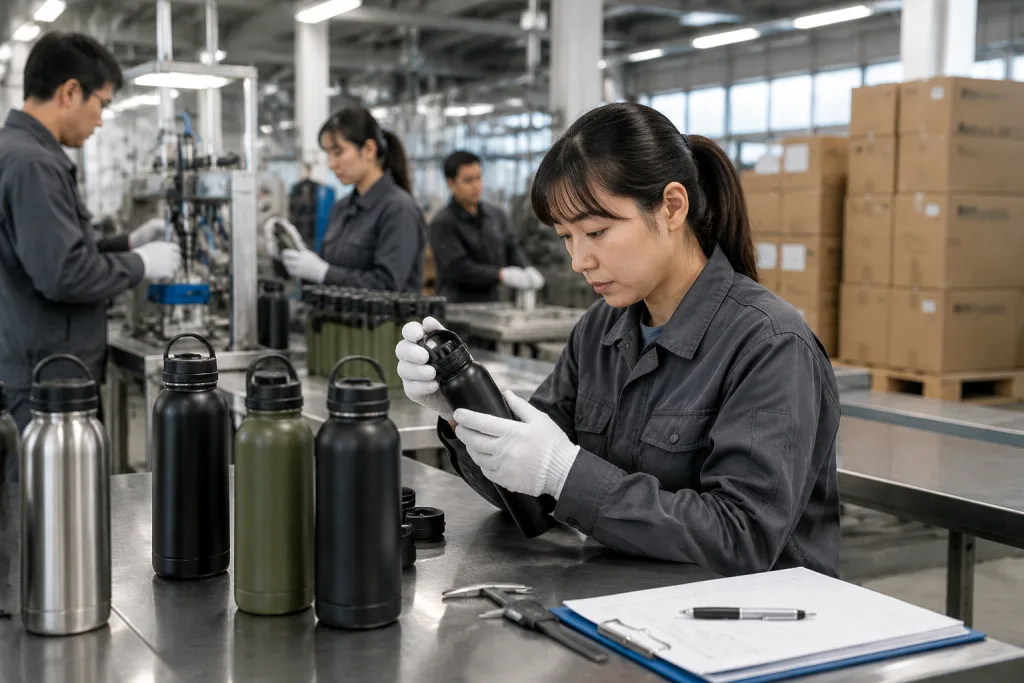
A gym bottle looks simple until the first 5,000 units land and QC opens the cartons: powder coating rubs off after a 3M tape test, lids wobble by 0.6 mm, shaker balls rattle, or the outer cartons crush on one corner. These are not “small cosmetic issues” for a fitness brand or gym chain. They turn into refund tickets, member complaints, and launch budget burned before the first reorder.
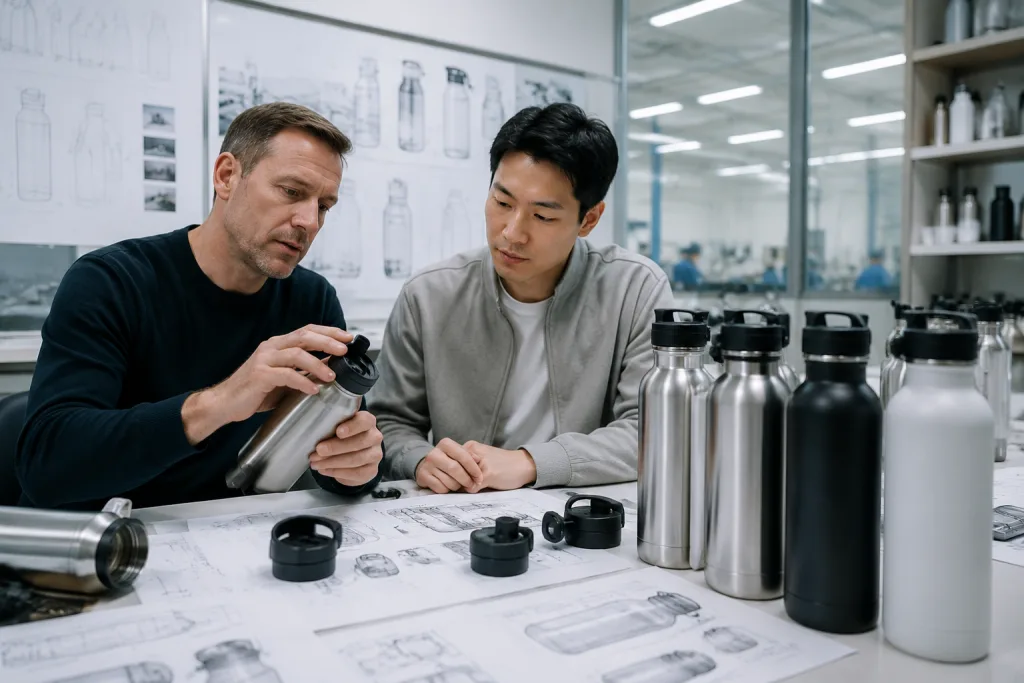
As a 304 stainless steel gym water bottle manufacturer in Zhejiang, China, we see the same mistake on the line: the buyer approves a clean rendering, but the PO only says “black bottle with logo.” Not enough. If you buy a bulk sports water bottle or custom gym water bottle, your quote needs to lock steel grade, wall thickness, lid structure, coating, packing method, AQL level, and lab testing before the deposit is paid. We’ve seen this go sideways; fixing a vague spec after mass production starts is slower than writing a proper one-page spec sheet at the beginning.
The steel grade mistake
The first failure mode looks boring on the line. It is a material swap that gets missed until bottles smell metallic, show rust at the rim, or fail the buyer’s lab test. If you are sourcing from a 304 stainless steel gym water bottle manufacturer, do not accept “stainless steel” as the material description. Too loose. Last March, QC pulled 32 random bodies with a handheld XRF gun and found 4 outer shells marked “304” on the carton but reading like 201.
For a custom sports water bottle, the inner wall should normally be food-contact 304 stainless steel, also written as SUS304 or 18/8. The outer wall can also be 304, though some buyers choose 201 outside to save cost. I do not recommend 201 for gym chains selling a premium customized sports water bottle. Sweat, wet lockers, and lazy dishwashing are rough on the exterior. We have seen this go sideways: one buyer flagged orange spots around the bottom seam after a 24-hour salt spray check, and the rework cost wiped out the saving.
Ask the factory to state the grade by component: inner body, outer body, lid contact parts, shaker ball, spring, straw, and screws if any. A custom logo shaker bottle can fail even when the bottle body is correct if the shaker ball is cheaper 201 stainless or chrome-plated iron. That is not food-contact safe. On our incoming table, the shaker ball goes through magnet checking first; if it grabs hard, QC pulls the sample before it reaches assembly.
For Europe and North America, common document requests include LFGB or FDA food-contact reports, REACH compliance for coatings and plastic parts, and sometimes CA Prop 65 review depending on your sales channel. In China, a serious Zhejiang factory should provide material certificates and third-party test reports from SGS, Intertek, TÜV, or similar labs. We produce about 450,000 stainless drinkware units per month in Zhejiang, and we still check incoming coil and tube batches because paper alone is not quality control. One recent coil tag had “SUS304” printed right, but the heat number on the mill certificate had 1 digit different from the warehouse label.
Spec around it: write “SUS304 inner and outer body, 304 stainless shaker ball, PP or Tritan lid as quoted, BPA-free, food-contact compliant” in the purchase order. If a lower-cost alternative is proposed, make the supplier show the exact saving per unit. In 7 RFQs we checked this quarter, the saving was usually USD 0.08-0.18 per bottle. The math does not work if one container gets held for retesting or your gym customer asks for replacement stock.
Thin walls and dent claims
The second failure mode is a bottle that looks fine on a showroom table but gets beaten up in a gym after one week. A bulk fitness water bottle is handled harder than a retail gift bottle. It sits in metal lockers, rolls off treadmills, drops onto rubber flooring, and gets jammed into cup holders beside keys. We’ve had a buyer flag 17 dent photos from one chain gym trial, all on the lower body near the base.
Wall thickness is where quotes hide cost. For single-wall stainless gym bottles, 0.50 mm is a sensible target for many 600-800 ml models. For vacuum sports bottles, 0.45-0.55 mm on the outer wall is common, with the final value tied to diameter, drawing depth, and target weight. Some suppliers quote 0.35-0.38 mm to win the job. Nice sample. Bad math. The sample feels light, the price looks nice, then the carton damage rate lands on your desk after the line has already packed 12,000 pcs.
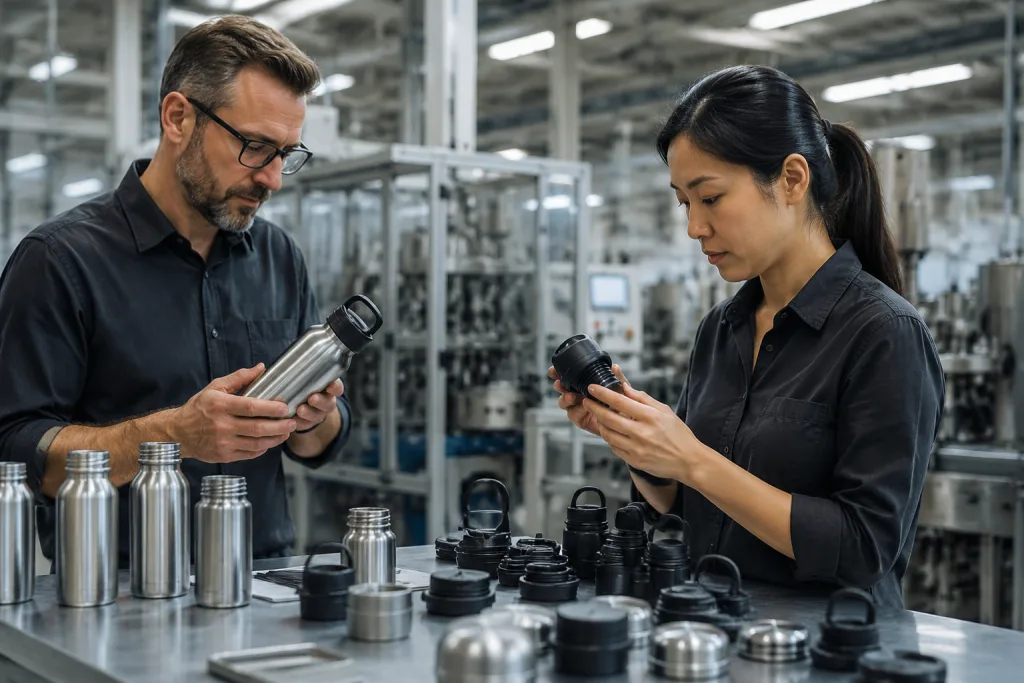
Denting also comes from poor forming control. If the shoulder radius is too sharp, stress marks appear after drawing; our QC team checks this area under a bench lamp before polishing approval. If the base is too flat and thin, it oil-cans when pressed with a thumb. If the neck thread is poorly formed, the lid feels tight on one bottle and loose on the next one. A distributor gym water bottle program with several colors must keep the same tooling and tolerance, not just the same drawing.
For a custom fitness water bottle, ask for weight tolerance and dimensional tolerance, not just capacity. A 750 ml bottle may be quoted at 185 g by one factory and 235 g by another. Those are not the same product. You can set finished bottle weight tolerance at ±5%, mouth diameter tolerance at ±0.30 mm, and height tolerance at ±1.0 mm for many models. Your exact numbers should match the design, but the purchase order needs numbers; we still see POs saying “normal tolerance,” and that line causes arguments during AQL 2.5 inspection.
Spec around it: require pre-production samples from mass-production tooling, not only hand samples. Add a basic drop test: filled bottle, closed lid, 1.0 m drop onto plywood or rubber-covered surface, three orientations. This test does not prove the bottle is indestructible, but it catches weak bases, cracked lids, and ugly welding problems before your bulk gym water bottle order ships. QC pulled the sample from a 300 pc pilot run for this test, not from the sales room shelf.
Lids leak before bottles fail
Most complaints we see are lid complaints, not stainless body complaints. On a customized gym water bottle, that gap gets worse. Users throw it into a duffel bag with wet clothes, protein powder, keys, and AirPods. A 1% leak rate on 10,000 units means 100 angry people, and each one blames your logo. Last season QC pulled 32 leak samples from one 5,000 pcs gym order; only 1 had a body weld issue, while 31 failed at the cap or gasket.
Leak failures usually start in the gasket groove or the closing parts. Gasket hardness matters, but so do thread depth, straw valve tolerance, and cap assembly pressure. Silicone gaskets should sit flat without twisting. If the groove is only 1.2 mm deep on a thick gasket, it can pop out after dishwashing. If the silicone is too hard, the lid needs excess torque. If it is too soft, it deforms after heat exposure. For most gym bottles we run, food-grade silicone around 50-60 Shore A is a sensible starting point, but the lid drawing and compression gap decide the final spec.
Flip lids and straw lids sell well, but they create more failure points. A customizable gym water bottle with a push-button lid has to control spring grade and button fit, then prove the locking tab will not crack after repeated opening. A straw lid needs a bite valve or vent structure that will not whistle, leak, or hold odor. We had one buyer flag a faint rubber smell after 24 hours with warm water at 45°C. Fair complaint. A custom shaker bottle lid has another problem: powder residue sits in threads and corners. If the lid has 6 narrow cavities around the mixing screen, cleaning complaints are not a surprise.
Every production line should run 100% leak testing. No shortcut here. For stainless bottles, our usual method is water fill, lid close, inversion, 10-second shake, then 30-second dwell on white inspection paper. For vacuum bottles, the line may also use air pressure or vacuum retention testing depending on the design. Final AQL inspection is not enough because AQL checks a sample, not every bottle. AQL 2.5 for major defects is normal for export orders, but lid leakage belongs in your internal critical defect list with zero tolerance. The math does not work if you catch leaks only at final inspection.
Spec around it: define the lid type, gasket material, leak test method, and pass criteria on the PO, not only in chat messages. If your product is a custom made shaker bottle for protein powder, test with water and check dry powder mixing residue after 3 shake cycles. A bottle can be watertight and still fail as a shaker if the internal corners trap clumps. We have seen this go sideways when a PO typo said “straw lid” but the approved sample was a flip lid.
Coating defects that ruin branding
Fitness brands care about color. A matte black bottle with a sharp white logo sells; a scratched bottle with patchy gloss gets called “cheap” in the buyer’s first email. Surface finish is the failure customers see before they ever test insulation. On our line, QC usually pulls 12 pcs from a 500 pcs carton run and checks the shoulder and bottom ring first, because those two areas take the most handling during packing.
Powder coating is popular because it gives better grip than bare stainless and holds up to normal gym use. We run dry film thickness around 60-80 μm, checked with a digital coating thickness gauge before logo printing. Too thin, and 304 stainless shows through on rolled edges. Too thick, and you start fighting lid fit, cup-holder fit, or logo sharpness. Paint adhesion should be checked by cross-hatch tape testing. For tougher programs, add an alcohol rub test and a 3M tape pull test after logo printing; we have seen a logo pass visual inspection at 10 a.m. and lift during tape pull after lunch.
Color control matters on reorder. If your gym chain has 120 locations, the second 8,000 pcs order must match the first, or store managers will flag it as a different SKU. Use Pantone references, but powder coating on stainless will not match ink on coated paper 1:1. Approve a physical color plaque or golden sample under D65 lighting. Keep one golden sample at your office and one at the China factory. Photos are the wrong approval tool here; one buyer once approved “black” from a phone photo, then rejected bulk because the actual finish was 8 gloss points higher than the first shipment.
Logo method changes the risk. Silk screen printing works well for one or two colors, with a common setup charge of USD 35-80 per color. Laser engraving lasts longer, but it shows the stainless base color, not a printed color. UV printing can handle complex artwork, but it still needs adhesion testing on the exact coating. A custom logo shaker bottle with measurement marks needs tighter checking, because 50 ml lines must stay readable after cleaning. QC pulled one sample last season where the 600 ml mark was 4 mm lower than the artwork file, and the buyer flagged it before shipment.
Spec around it: define coating type, Pantone target, gloss level if needed, film thickness, logo process, logo position tolerance, and abrasion standard. For a bulk sports water bottle order, we normally suggest keeping logo position tolerance within ±1.5 mm and rejecting obvious tilted logos at final inspection. Cosmetic standards are subjective until you make them measurable. Put it on the PO too; we once received a PO with “mat black” instead of “matte black,” and that typo cost 2 days of confirmation before the line could start.
Shaker features add hidden risk
A water bottle and a protein shaker are different jobs. We still get this request weekly: one customizable shaker bottle for gym retail, staff gifts, and membership bundles. It can work. The risk sits in the extra parts. On our line, QC pulls 12 samples per new shaker lid before tooling sign-off because the flip cap, gasket seat, and mixer insert all add leak points.
The mixing ball is the low-risk choice. Specify 304 stainless steel, no sharp wire ends, and no black residue after a 60°C wash cycle in a white PP test cup. Plastic mixer grids are quieter, but brittle PP can crack at the hinge ribs; we have seen a buyer flag 3 cracked grids out of 20 pre-production samples. Internal agitator cones look clean in renderings, but they need enough draft angle for molding and a brush-friendly gap for cleaning. If powder sits under the cone, the bottle smells bad after two weeks of real gym use.
Capacity claims cause trouble. A “700 ml shaker” often means full-to-rim capacity, not usable shaking capacity. For protein powder, the math needs headspace. If full capacity is 700 ml, practical mixing volume is usually closer to 550-600 ml after one scoop and foam. Put both numbers in your product brief. For a distributor shaker bottle sold to gyms and supplement retailers, wrong capacity claims create returns we could have stopped at the sample table with a graduated cylinder.
Measurement marks need a tolerance, not just artwork. On stainless, internal volume marks are harder than on transparent plastic because the operator cannot simply check through the wall. External printing works, but it must be calibrated against fill volume; we run a water-fill check with a 500 ml lab cylinder before approving the screen. If you need 100 ml, 200 ml, 300 ml marks, ask how the factory verifies the positions. “By artwork” is the wrong answer.
Spec around it: send the intended use case. Water only, pre-workout with dye, whey protein with foam, meal replacement with thicker residue, dishwasher exposure at 70°C, and ice cubes all change the design. A custom shaker bottle for premium fitness clubs should be tested with 30 g powder plus 400 ml water, shaken for 20 seconds, then checked for leaks, clumps, trapped residue, lid staining, and odor after 24 hours. This test costs less than one courier box, and we have seen it catch problems a CAD drawing hides.
Packaging fails in real freight
Packaging is not decoration on a shipment from China to Europe or North America. It is part of the product. We have seen a 500 ml gym bottle pass final QC and still land with dented bases because the corner crush on the master carton gave up in a container stack, or the inner tray rubbed the powder coat for 35 days on the water.
For export orders, the usual pack is one bottle in a polybag or tissue wrap, then a white box or kraft box, then master carton. Gift boxes sell better on a gym counter, but the paperboard needs more muscle; 300 gsm that works for domestic shipping can fail in warehouse picking. If the buyer uses Amazon or another fulfillment channel, the pack needs FNSKU labels, drop-test-ready individual packing, suffocation warnings on polybags, and carton marks for SKU, quantity, net weight, gross weight, and country of origin.
Carton strength has to match bottle weight. A 1,000 ml stainless bottle is not light. At 24 pcs per carton, gross weight often lands around 10-14 kg, depending on the model and insert. A weak 5-ply carton with poor edge crush strength will fold when the pallets go 6 high. For heavier vacuum bottles, we usually push 12 or 24 pcs per master carton, not 36; the math does not work once the warehouse starts hand-carrying them.
ISTA-style drop testing pays for itself even if you do not buy a formal ISTA report. We run the packed carton from 76 cm, one corner, three edges, and six faces, then open it and check coating rub, lid cracks, bottle dents, and gift box deformation. QC pulled one sample last month with a tiny crease on the lid ring after a 3-edge drop, and that was enough to stop the line. A fitness bottle program should not learn about weak packaging from the first container unload.
Spec around it: approve the dieline, carton layout, barcode rules, and drop test before production starts. If the buyer plans to ship from a central warehouse to club locations, run a second handling test with the outer carton and pallet wrap. Export freight from Zhejiang, China to Hamburg, Rotterdam, Los Angeles, or Vancouver is only the first leg; if the PO has a label typo or the carton mark is missing, the buyer will flag it fast.
Inspection plans that actually protect you
The trap is thinking the factory’s house QC equals your brand standard. It does not. A solid 304 stainless steel gym water bottle manufacturer runs incoming checks, in-line checks, leak tests, coating checks, and final inspection, but your order still needs a written QC plan because your logo, color, lid, packaging, and claim copy are the things the buyer will flag. On our line, QC can reject a 0.3 mm burr that would never show in a white sample, and that is the point.
Use AQL, but use it the right way. For most B2B drinkware orders, AQL 0.0 for critical defects, 2.5 for major defects, and 4.0 for minor defects is a good starting point. Critical defects cover sharp edges, contamination, serious leakage, broken lid parts, unsafe packaging, or wrong material. Major defects cover visible dents, poor logo, color mismatch, lid failure, and wrong carton labeling. Minor defects are small cosmetic marks inside the agreed limit. We ran a batch last month where the buyer wanted 1,200 pcs checked against the wrong sampling table, and the math did not work.
Timing matters. Approve the pre-production sample before bulk materials are bought. Do a production inspection at 20-30% if the order is large or the run has several colors. Final random inspection should happen when 80-100% of goods are packed. If you wait until the container is on the truck for tomorrow morning, you have no leverage and no time for rework. We have seen that go sideways more than once, usually after the torque wrench has already been packed away.
Commercial terms change the risk profile. FOB Ningbo or FOB Shanghai is standard for Zhejiang drinkware factories. Lead time for a customized fitness water bottle is usually 25-35 days after deposit and artwork approval for repeat tooling, and 40-55 days if new tooling or complex packaging is involved. MOQ is normally 1,000-3,000 pcs per color, though a simple logo on an existing model can sometimes start lower. On a recent PO, the buyer typed the carton mark one line off, and the shipping team caught it at pallet wrap before it turned into a port delay.
Spec around it: put the QC checklist into the purchase order: material, capacity, wall thickness, color, logo, lid leakage, coating adhesion, packaging, labeling, AQL level, and accepted golden samples. This is how distributors gym water bottle programs avoid surprises. You are not being difficult; you are buying a controlled product instead of hoping a nice sample represents 20,000 pcs. We run this with calipers, a leak rack, and a drop-test table because that is what protects margin.
Send your gym bottle spec for review
We will check material, lid, coating, MOQ, packaging, and lead time before you commit to a bulk order.
Frequently asked questions
What MOQ should a gym chain expect for custom stainless sports bottles?
For an existing 304 stainless bottle model, a practical MOQ is usually 1,000-3,000 pcs per color with one logo. If you need a new mold, private lid, custom powder color, or retail gift box, the MOQ often moves to 3,000-5,000 pcs. For a pilot gym rollout, you can reduce risk by using an existing bottle body and customizing logo, color, and packaging first. New tooling is better after you know the size, lid style, and price point your members actually buy.
How much does a custom stainless gym bottle cost from China?
As a rough FOB China range, a single-wall 304 stainless gym bottle may land around USD 2.20-4.20 depending on capacity, wall thickness, lid, coating, and logo. A vacuum insulated sports bottle often runs USD 4.50-8.50. A custom shaker bottle with stainless body, mixing ball, powder coating, and printed logo can sit between those ranges. The cheapest quote usually removes material thickness, coating quality, or packaging strength. Ask suppliers to quote the same spec sheet, not just the same photo.
Is 304 stainless steel necessary for a bulk fitness water bottle?
For food-contact drinkware, 304 stainless steel is the safe default. It resists corrosion better than cheaper stainless grades and is widely accepted for Europe and North America. If the bottle will be used with water, electrolytes, pre-workout, or protein shakes, 304 for the inner wall is strongly recommended. Some factories offer 201 stainless for cost reduction, especially on the outer wall, but the saving can be small, often under USD 0.20 per piece. For a fitness brand, the complaint risk is usually not worth it.
Which logo method is best for a custom gym water bottle?
Laser engraving is the most durable because it removes or marks the surface rather than adding ink. It is good for premium stainless bottles but gives a metal-tone logo. Silk screen printing is cost-effective for one or two colors and works well on powder coating if adhesion is tested. UV printing is better for full-color artwork but needs rub and tape testing. For orders above 2,000 pcs, always approve a physical pre-production sample with the final coating and logo process, not a digital mockup.
How long does production take for customized sports water bottles?
For existing tooling, normal production lead time is about 25-35 days after deposit, artwork confirmation, and color approval. If you need new tooling, a new lid, custom shaker insert, or complex retail packaging, plan for 40-55 days before shipment. Add 7-10 days for physical sample approval and third-party lab testing if required. Ocean freight from China to Europe or North America can add 25-45 days depending on port and season, so gym launch orders should be planned at least 10-12 weeks ahead.