Key Takeaways
- 304 stainless steel is not enough by itself; request material certs, 0.40-0.50 mm wall thickness, and a salt-spray or corrosion check before bulk release.
- For a bulk sports water bottle, leak rates should be tested at 100% on assembly and sampled under AQL 2.5 for appearance and 1.0 for function.
- A real factory plan for a custom shaker bottle starts around MOQ 3,000 pcs and 25-35 days lead time, not fantasy dates.
- Most return losses come from lids, gaskets, coating adhesion, and logo wear, so spec those details before you approve a customized fitness water bottle program.
You do not lose money on a 304 stainless steel gym water bottle factory because the quote is $0.20 too high. You lose money when the steel grade tests as 201 on the XRF gun, the lid leaks after 300 opens, or a glossy powder coat peels during the first retail return wave. That is the real cost of bulk fitness water bottle sourcing: production failure, not design failure.
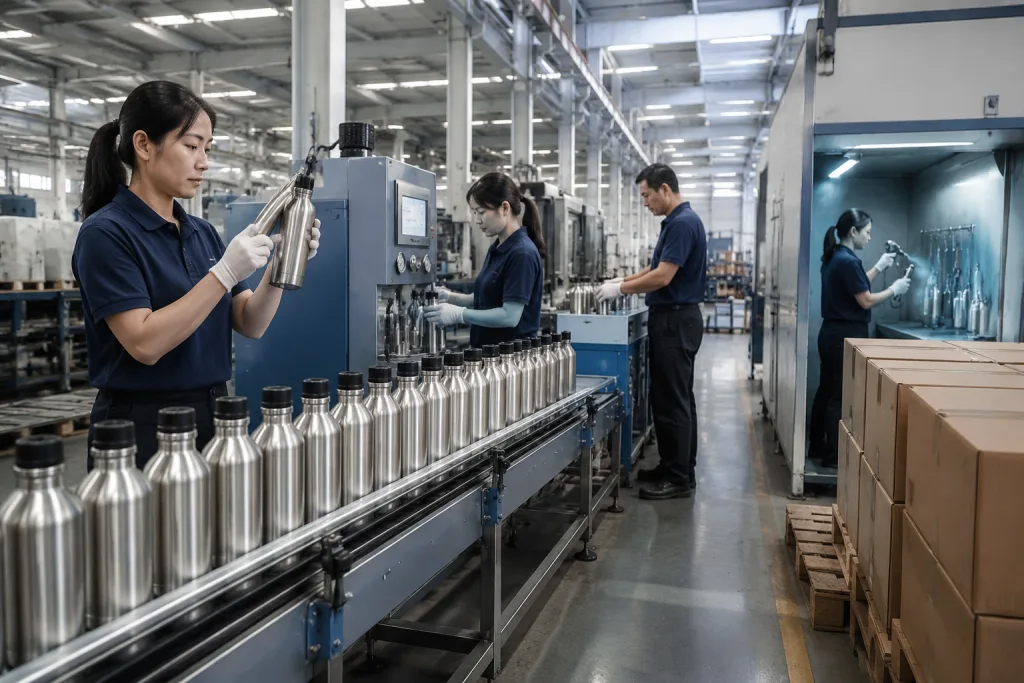
From Zhejiang, China, we see this on 6 to 8 custom gym water bottle orders every month. A factory can run 180,000 units/month, but if the buyer does not lock tube thickness, weld standard, gasket material, and AQL acceptance before the deposit, the line just makes bad bottles faster. We run this check before artwork approval; QC pulled one 0.45 mm body sample last quarter against a PO that clearly said 0.50 mm. Spec the failure points first.
Where 304 fails first
The first failure is usually quiet. A clean sample can hide the wrong coil. A real 304 stainless steel gym water bottle factory should hand over mill certs, heat numbers, and an internal purchasing trace for every lot of coil or sheet. We check the heat number against the coil label before slitting; if the supplier cannot show that paper trail, you are not buying a custom sports water bottle program. You are buying a promise.
For gym chains and fitness brands, specify 304 on both the inner and outer shells, then lock thickness by capacity. In our line, 0.40 mm is the low end for a light bulk fitness water bottle, while 0.45-0.50 mm gives better dent resistance for distributor fitness water bottle programs. The buyer often asks, “Can we save 8 cents with thinner steel?” The math doesn’t work after the first dent complaint. Thin wall parts feel cheaper, ring more on the table, dent faster, and warp more easily during neck spinning or vacuum forming. QC pulled one 750 ml sample last month with rust spots near the longitudinal weld after the 24-hour salt check; visually, it had passed.
- Require raw material certificates, not a verbal 304 claim.
- Specify wall thickness by model, with separate specs for 500 ml, 750 ml, and 1 L SKUs.
- Ask for passivation or equivalent cleaning control after forming, then check the rinse tank record.
If your order is a customizable gym water bottle line for retail, sample 1 bottle from the first carton and 1 from the last carton, then cut them open with a pipe cutter. Same finish. Same seam behavior. No dark residue inside the shell. We have seen this go sideways when the pre-production sample used clean 304, but the bulk run switched coil after carton 120.
Welds and vacuum loss
Second failure: the bottle passes in the sample room, then loses vacuum after 3 to 5 weeks in cartons, repacking, and buyer handling. We usually trace it to seam weld penetration under 0.35 mm, necks sitting 0.4 mm off-center in the fixture, or laser power drifting during the afternoon shift. A bulk gym water bottle program cannot depend on visual inspection. The shell can look clean under the LED bench lamp and still hide a pin leak that shows up later as outer-wall condensation or a 6°C temperature drop in the thermal test.
For double-wall vacuum products, ask the factory to write down the leak test method, pressure hold time, and thermal retention target on the PI or quality agreement. A practical spec is 24-hour leak-free verification at full inversion, plus thermal performance measured at room temperature conditions, with QC logging the starting water temperature and the reading after 6 hours. If the bottle is a custom made shaker bottle with a mixing ball or insert, check the cap-thread interface and the base weld after vibration. We have seen this go sideways: one distributor shaker bottle claim came back because nobody tested the bottle after dropping it 20 times from 1 meter, loaded with water, and QC pulled 7 leaking pieces from a 200-piece pilot run.
Do not approve a production run just because the sample looked good on a table. Ask what happens after 500 cap cycles, one drop test, and a hot-cold abuse test.
For fitness brands, this is where a Zhejiang factory can save days, not slogans. A line with fixed welding jigs, daily laser calibration, and in-house vacuum leak detection will beat a random exporter that farms out welding to a workshop 40 km away; the math does not work when a buyer flags vacuum loss after goods have already reached the Amazon warehouse.
Lids, gaskets, and cap wear
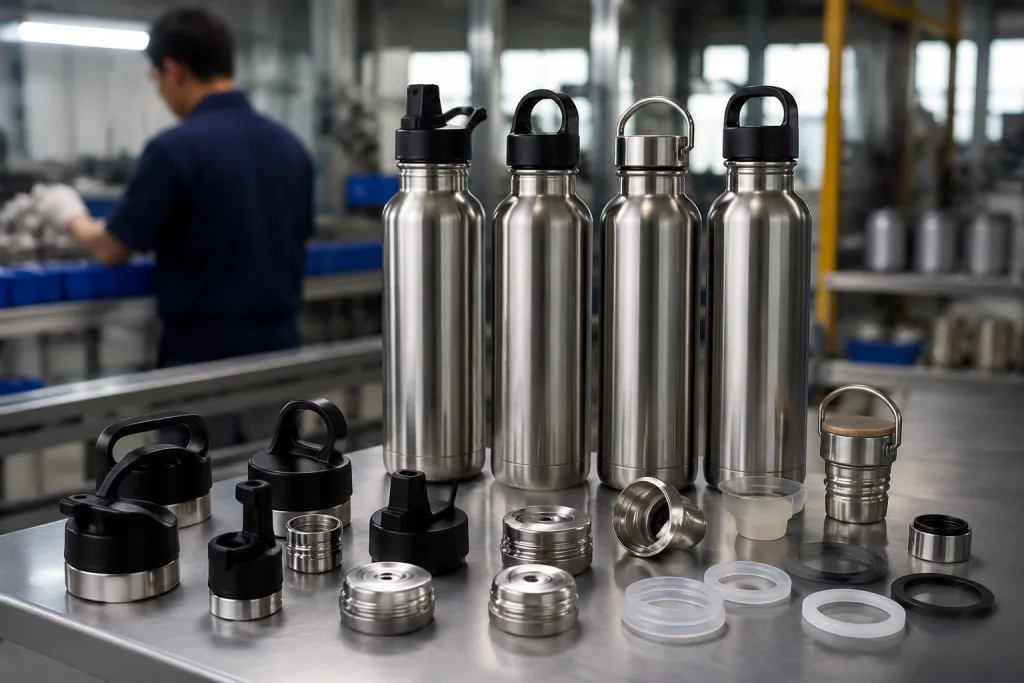
Third failure mode: the lid. In our last 9 leak complaints on gym bottle orders, 7 started at the cap system, not the 304 stainless body. Buyers spend two weeks arguing over powder coating gloss, then leave the thread and gasket as “standard” on the PO. Bad move. A custom shaker bottle that leaks at the thread, whistles under pressure, or backs off after 200 open-close cycles will get returned even if the bottle body looks clean. Ask for the cap spec. Not just the bottle spec.
Ask what gasket material is used. “Food-grade silicone” is not enough; we hear that answer from every mold room in Yongkang. You need the gasket ID/OD in mm, durometer, and how it seats in the lid groove. For a customizable shaker bottle or customizable sports water bottle, the gasket should stay in place during washing and should not swell after 95°C hot-water soaking for 30 minutes. QC pulled one sample last month where the gasket lifted 1.2 mm after the soak test, and the buyer flagged it before we shipped. If the lid has a flip-top, straw, or carry loop, require a cycle test of at least 3,000 openings. A weak hinge is a predictable failure, not bad luck.
- Confirm thread tolerance on the bottle neck and lid with a go/no-go gauge, not by hand feel.
- Specify gasket material, durometer, and target gasket size in mm.
- Test closure force before hot-water exposure and after it; record the torque, don’t just write “OK.”
For bulk gym water bottle orders sold through distributors, cap damage is expensive because the customer blames the brand, not the factory. We’ve seen this go sideways on a 5,000 pcs order where the cap looked fine in photos, but the first tooling shot had a shallow thread start and QC found 6 leaks in a 32 pcs check. Demand a sample cap from the first tooling shot. Waiting until mass production is the wrong place to save 3 days.
Coatings that peel or stain
Surface finish failures show up more often than steel failures. We see it on the line: 304 stainless passes the salt spray check, then QC pulls a coated bottle with scuffs after 500 rubs using a sweat-soaked cloth. Powder coat, spray paint, UV print, and rubberized coatings can look clean on day one, then break down under gym sweat, alcohol sanitizer, and zipper abrasion inside a training bag. A custom fitness water bottle for gym chains needs a finish built for lockers and backpacks, not a sample-room photo.
If you want a matte bulk sports water bottle, ask the factory how they control coating thickness and oven curing temperature. Ask for numbers. We run matte powder around 60-80 μm on most gym bottles; 35 μm scratches during carton vibration, while 110 μm can chip around the base ring or mouth. For high-touch programs, request a cross-hatch adhesion test and a rub test after curing. QC should cut the grid with a 1 mm cross-hatch cutter, tape it, then record the result before packing. If the finish is soft-touch or silicone feel, be honest about the trade-off: it feels premium, but it picks up carton dust and black marks faster during warehouse handling. We have seen this go sideways when a buyer approved a silky sample, then flagged 7 cartons for dirty-looking bottles after sea freight. A Zhejiang factory with stable pretreatment, filtered spray booths, and dust checks will beat a shop that sprays first and argues later.
If the bottle will be sold as a customized fitness water bottle or customized sports water bottle, ask for standard color references and batch tolerance before you place the PO. Pantone on the artwork is not enough. We keep a signed color plate at the coating line and compare every batch under a D65 light box; one PO once had “mat black” typed instead of “matte black,” and production stopped for 3 hours until the buyer confirmed. A 2-3% shade shift between lots is acceptable in many programs; anything bigger can ruin a chain rollout when 120 stores receive bottles from two production batches.
Logo methods that survive use
Logo failure is easier to prevent than most buyers expect. On our Hangzhou line, QC usually sees logo trouble from the wrong match between surface finish and decoration, not from the artwork file itself. A custom logo shaker bottle for gyms should not carry ink that cracks after 20 dishwasher cycles or a week inside a sweaty gym bag. Laser engraving lasts, but it gives a metal-cut look that some brands don’t want. Silk-screen printing stays sharp and cost-friendly if the ink is cured at the right oven temperature. UV print handles gradients and multi-color marks, but QC should pull the sample for tape adhesion and abrasion checks before mass production.
For bulk fitness water bottle programs, lock the logo size in mm, the exact Pantone count, and the wear target before approval. If the bottle is a distributor sports water bottle sold in packs of 50 or 100, the mark still has to read after carton rubbing on the truck, hand washing with detergent, and daily carry against keys or resistance bands. Ask the factory for a rub test: 50, 100, and 200 passes depending on the finish, with the load written on the test sheet. We run this on coated samples before packing because the buyer always flags logo fade first. For a custom gym water bottle in a chain rollout, the brand mark should not fade before the bottle body does. Obvious? Yes. Still, this is where cheap sourcing goes sideways and the math doesn’t work.
- Match the decoration method to the coating, washing method, and expected rubbing level.
- Approve artwork on the real print area with the correct curve, not a flat PDF mockup.
- Require a decorated preproduction sample after curing, then let QC pull the sample for adhesion testing.
If you need different products across channels, split the brief. A customizable fitness water bottle for retail can use a cleaner logo method with tighter color control, while a distributor fitness water bottle for promo use may need a faster option that keeps the MOQ and lead time under control.
Specs that stop repeat mistakes
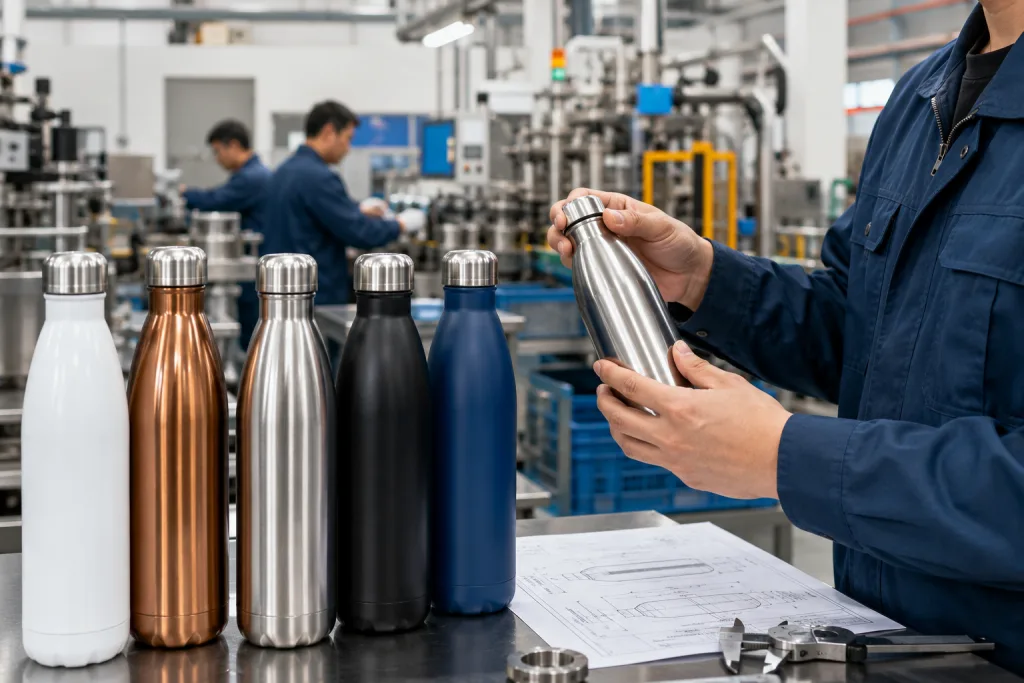
The fastest way to cut failures is a tighter spec sheet. Do not write 304 stainless steel gym water bottle factory on an RFQ and expect the supplier to guess the rest. Put steel grade, inner and outer wall thickness in mm, capacity tolerance, lid type, gasket material, finish, logo method, test standard, and carton pack-out on one page. We run calipers on the first sample; a 0.1 mm wall-thickness gap is already enough for the buyer to flag “soft body feel.” Skip those points and one sample revision becomes 7-10 lost days, then the mass order carries the same risk into packing.
A practical buying structure for fitness brands is this: MOQ 3,000 pcs for a single custom shaker bottle mold or existing body shape, 25-35 days lead time after sample approval, and production sampling at AQL 2.5 for appearance with tighter checks for leakage and closure torque. For a bulk gym water bottle or distributor gym water bottle program, ask for carton drop testing and barcode labeling that matches your warehouse or Amazon FNSKU file. Simple, but often missed. Last month QC pulled 32 cartons because the PO had one digit wrong in the FNSKU, and the buyer’s 3PL would not receive mixed pallets for North America.
We see better outcomes when the buyer treats the factory like an engineering partner, not a catalog seller. In Zhejiang, China, stronger plants will close the gaps between sampling, tooling, and mass production before the line starts. Weak ones say yes to every lid, coating, and logo request, then leave QC to catch leaks at the water-pressure table. We have seen this go sideways: 5,000 bottles packed, then the buyer flagged gasket odor after the final inspection. The math does not work at that stage.
Spec your next bottle like a pro
Send your brief, target price, and artwork. We will map the weak points before production starts.
Frequently asked questions
What is the right MOQ for a custom sports water bottle order?
For most factory programs, MOQ starts at 3,000 pcs for a customized sports water bottle using existing tooling and standard lid parts. If you need new tooling, unusual color matching, or a new cap system, MOQ often moves to 5,000 pcs or more. That is normal. A lower number usually means the factory is blending your order into stock, which increases color drift and mix-up risk. For a custom gym water bottle or custom shaker bottle, ask whether the MOQ is per SKU, per color, or per print method. Those details matter more than the headline number.
How do I verify that the bottle is really 304 stainless steel?
Ask for the mill certificate, heat number, and incoming material record for each coil or sheet batch. Then request a simple verification step during preproduction, such as PMI testing or third-party material confirmation. A true 304 stainless steel gym water bottle factory should not hesitate. If the supplier cannot link the raw material to your order, the 304 claim is weak. You should also check internal surface cleaning and passivation control, because good steel can still rust if the finish process is poor. For export, keep the paperwork ready for REACH and buyer audits.
What tests matter most before bulk production?
Leak testing, cap-cycle testing, drop testing, coating adhesion, and logo abrasion are the five that save the most money. For a bulk sports water bottle, demand 100% leak testing during assembly and sampled checks under AQL 2.5 for visual issues. For the lid, a 3,000-cycle opening test is a realistic minimum if the bottle will be used daily in gyms. If the bottle is vacuum insulated, also ask for thermal retention data at room temperature conditions. A good factory in Zhejiang, China, will already have a test station and can show you the records.
Which decoration method is best for a gym bottle logo?
It depends on the finish and the use case. Laser engraving is the most durable for a custom logo shaker bottle, especially if the product will be washed often. Silk-screen can work well for simple branding and lower unit cost, but it needs proper curing. UV print is useful when you need more color, while powder coat overprint gives a premium retail look. For a customized gym water bottle sold to fitness chains, choose the method that survives rubbing, sanitizer, and dishwasher exposure. Always approve the exact print position on the final production sample.
How long does production usually take in China?
For a standard customized fitness water bottle order, lead time is usually 25-35 days after sample approval and deposit, assuming the body shape and lid components are already available. New tooling, special colors, or extra packaging can push that to 40-50 days. If a supplier promises 10-15 days for a fully custom program, be careful. That usually means stock goods with minor branding. Good factories in China will be direct about the schedule and show you where each day goes: tooling, sampling, coating, printing, packing, and export carton checks.