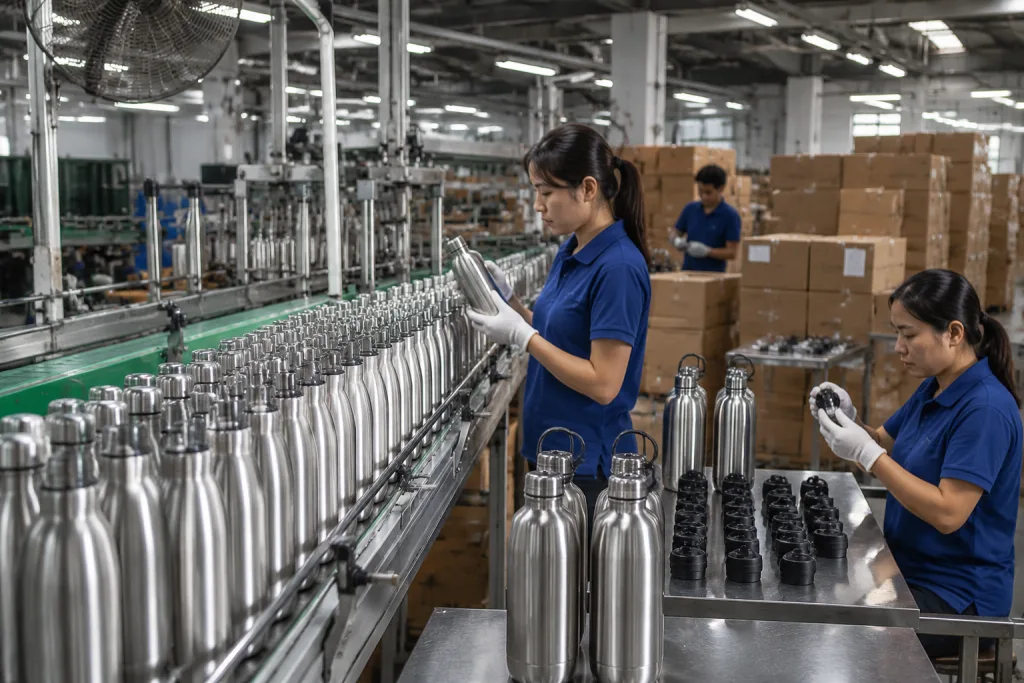
Key Takeaways
- A realistic MOQ for a 304 stainless custom gym water bottle is usually 1,000-3,000 pcs per color
- Confirm 304 steel, wall thickness, lid material, coating, and logo method before asking for final FOB pricing
- A proper pre-production sample usually takes 7-12 days after artwork and deposit approval
- Use AQL inspection, carton drop testing, and leak testing before shipping bulk gym water bottle orders
A 304 stainless steel gym water bottle custom project looks simple until the RFQ comes back with five prices, three lid styles, vague steel grades, and no clear testing plan. For a gym chain or fitness brand, the bottle is not just merchandise; it sits in lockers, hot cars, spin studios, and Amazon reviews. We’ve seen this go sideways. Last month QC pulled a 750 ml sample from the line, filled it to 95%, and found the flip lid leaking after 3 drops from 1.2 m. If the lid leaks or the logo scratches after two weeks, your buyer hears about it.
From our factory base in Zhejiang, China, we see the same sourcing mistakes about 6 times a month: wall thickness written as “normal,” artwork sent as a low-res JPG, sample timing requested in 3 days when tooling needs 7, and purchase orders missing carton marks or polybag requirements. Small gaps cost time. A practical sourcing process fixes most of this before bulk production starts, especially when the PO states 304 stainless, capacity tolerance, logo method, packing, and AQL 2.5 inspection terms before we run the first pre-production sample.
Start With The Real Bottle Spec
Your RFQ should not say only “304 stainless steel gym water bottle custom, 750 ml, logo printed.” Too thin. A factory cannot price that cleanly because it leaves open cheaper lids, thinner steel, weak powder coating, and export cartons that crush at the bottom of a 40HQ. Last month QC pulled a sample with 0.38 mm body steel against a buyer’s “standard quality” request; the buyer flagged it only after the first pre-production photos. If you want a custom fitness water bottle built for daily gym use, start with a technical spec sheet.
For a single-wall stainless sports bottle, we normally run SUS304 inside and outside, with 0.45-0.55 mm wall thickness checked by micrometer at the shoulder, body, and base. For vacuum insulated styles, buyers ordering mid-range retail lines often choose SUS304 inner wall, SUS201 or SUS304 outer wall, 0.4-0.5 mm thickness, and copper coating between walls to hit the heat-retention claim. State capacity in milliliters and US ounces. Also say whether 750 ml means brim-full or usable fill line, because one PO typo on “25 oz / 750 ml” turned into a label reprint on our side.
Put the lid into the same level of detail. PP is the cost option, Tritan is used when the buyer wants a clear flip lid, and stainless cap fits gift or outdoor channels. Is the gasket food-grade silicone? Do you need a carry loop, chug spout, straw lid, or shaker ball? A custom shaker bottle needs different internal geometry than a standard customized sports water bottle when protein powder is involved; otherwise powder sits under the shoulder radius after shaking. List the stainless ball, plastic mixer grid, or removable agitator as a separate component, and ask for spare gasket MOQ if your after-sales team sells replacement parts.
RFQ line items to include:
- Model type: single-wall gym bottle, double-wall vacuum bottle, or custom made shaker bottle with mixer structure defined
- Capacity: 600 ml, 750 ml, 1,000 ml, or other exact size, with brim-full or usable volume stated
- Steel grade: SUS304 inner, SUS304 or SUS201 outer, with test report requirement if needed
- Wall thickness: 0.45 mm target, with tolerance if required and measuring point agreed
- Lid material, gasket material, handle, straw, ball, and spare parts, listed as separate BOM items
- Compliance target: LFGB, FDA, REACH, Prop 65, or ASTM where applicable, matched to the sales market
Factories in Zhejiang and other China production clusters quote fast when the spec is tight. Loose specs create fake price gaps. We have seen this go sideways: one supplier prices a 0.40 mm SUS201 outer body with a basic PP lid, another prices 0.50 mm SUS304 outer with a locking Tritan lid, and the buyer thinks the second factory is expensive. That is the wrong comparison.
Price The RFQ Without Guesswork
After the spec sheet is fixed, ask for pricing in a table you can compare line by line. We run most bulk sports water bottle quotes as FOB Ningbo or FOB Shanghai; both ports are practical for Zhejiang factories, and our truck to Ningbo normally books as one 9.6 m vehicle when the CBM is ready. EXW looks cheaper on the first email, then inland trucking, export declaration, and port handling show up on your forwarder’s bill. For a new fitness brand, FOB is the cleaner quote.
Price moves with steel weight, lid structure, surface finish, logo process, packing method, and order quantity. We check body weight on a 0.1 g scale before quoting, because a “750 ml bottle” can have a 20-35 g steel difference from one drawing to another. As a working range, a 750 ml single-wall 304 stainless customizable gym water bottle may sit around USD 2.20-3.80 FOB at 3,000 pcs, depending on finish. A double-wall vacuum 750 ml customized gym water bottle may be USD 4.20-7.50 FOB. A bulk shaker bottle with stainless body, PP drinking lid, and mixing ball usually lands between those ranges when the lid tooling is standard.
MOQ is where gym chains get caught. A factory may accept 500 pcs for a stock body with laser logo, but color coating normally needs 1,000 pcs per color, because the spray line loses material during cleaning and color change. For powder coating with Pantone matching, 2,000-3,000 pcs per color is more realistic. At BottleForge Industrial in Hangzhou, Zhejiang, our monthly stainless bottle capacity is about 450,000 units, but a clean production slot still needs forecast planning, especially before March-April and September-October export peaks in China. We have seen a buyer ask for 6 colors at 600 pcs each; the math does not work.
RFQ price table should request:
- FOB port and Incoterms year, such as FOB Ningbo Incoterms 2020
- Unit price at 1,000, 3,000, 5,000, and 10,000 pcs
- Logo cost separated from bottle cost
- Sample cost and refund rule
- Tooling or mold charge for new lid, new body, or custom shaker bottle insert
- Carton quantity, carton size, gross weight, and CBM
If a supplier sends one low number without these lines, you do not have a quote yet. You have a starting point. Last month QC pulled a sample where the PO said “matte black,” but the artwork file named “gloss black”; that kind of mismatch changes cost, lead time, and the argument after shipment.
Choose Logo And Surface Finish
A custom gym water bottle has to carry your brand through sweat, chalk dust, wrong dishwasher cycles, and retail carton rubbing. Logo choice is not just decoration; it changes unit cost, scratch claims, lead time, and rework rate. For fitness chains, we run laser engraving, silk screen printing, heat transfer, UV printing, and powder coating with logo on 304 stainless bodies, then QC checks the first 20 pcs under a 5500K light box before the line continues.
Laser engraving is the safest choice for durability. On a powder-coated 304 stainless bottle, the laser removes the coating and shows the metal underneath. It will not peel. That matters on a distributor sports water bottle order where the end user throws the bottle into a gym bag with keys and lifting straps. The tradeoff is color. If your buyer needs a full-color gym mascot or campaign graphic, silk screen or heat transfer is the better route. Last month QC pulled a black 750 ml sample after engraving because the logo sat 3 mm too close to the base curve.
Silk screen works well for one- or two-color logos on round bottles, but the artwork must be adjusted for curvature. Fine text under 6 pt is risky. We have seen this go sideways on QR codes; the buyer flagged it after scanning failed on 7 of 30 pre-production samples. Heat transfer handles more color and gradient, but adhesion depends on coating quality and curing. UV printing suits smaller runs and complex graphics, though we avoid it on heavy abrasion zones such as the lower grip area.
Surface finish matters as much as the logo. Powder coating gives a better grip and hides fingerprints, but low-grade coating can chip at the base rim after drop testing. Spray painting is cheaper but weaker. Brushed stainless is stable and clean, though some gym brands call it too plain for paid merch. For a customizable sports water bottle sold at reception or bundled with a membership, we usually advise powder coating plus laser logo or high-quality silk screen; the math does not work if the decoration saves USD 0.08 but creates 3% logo complaints. On the line, we check base-rim coating with a cross-cut blade and 3M tape before packing.
PO line items for decoration:
- Pantone code for bottle body and lid parts; write Pantone 186 C, not “red,” because one PO typo caused 2,000 lids to be molded in the wrong shade
- Logo file format: AI, PDF vector, or high-resolution print file, with fonts outlined before our prepress team opens it
- Logo size in mm and exact position from base or top rim, such as 45 mm wide and 82 mm from the bottom edge
- Decoration method and number of colors, with separate notes for body, lid, and sleeve if the bottle has more than one part
- Adhesion test requirement, such as 3M tape test after 24 hours curing, plus pass/fail wording your inspector will accept
- Approval sample photo and physical sample requirement, including whether the buyer signs off by DHL sample, video call, or sealed golden sample
Do not approve a custom logo shaker bottle based only on a mockup. Mockups sell the idea; samples prove the process. Ask for one real sample from the same coating batch, because we have seen a perfect rendering hide a 1.5 mm logo shift on the actual curved body.
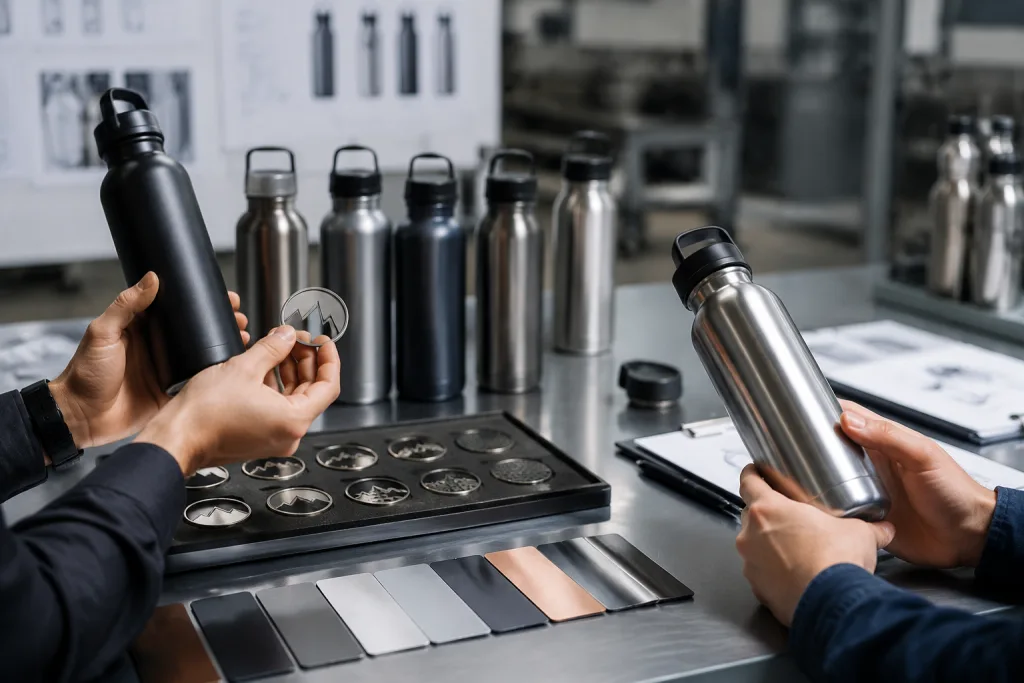
Approve Samples Before Committing Bulk
Sampling is where you catch problems while they still cost USD 35 in courier fees, not USD 3,500 in rework. For a customized shaker bottle or custom sports water bottle, we run two sample checks: first a stock blank to judge hand feel, mouth opening, grip, and lid movement; then a pre-production sample with your logo, Pantone color, lid, insert card, and carton mark. You can skip the blank if your team already bought this exact model before. Skipping the pre-production sample is the wrong question to ask. Last month QC pulled a 304 stainless bottle sample with the logo 3 mm too low, and the buyer flagged it before we started the line.
Typical timing is 2-4 days for a stock blank sample if the model is available, plus international courier time. A decorated sample normally takes 7-12 days after artwork confirmation. If a new lid mold is required, add 25-40 days for tooling and first trial. A new vacuum bottle body mold can take longer and may require USD 1,500-5,000 depending on complexity. For timing, count real days: a Monday artwork approval often means the sample leaves Hangzhou the next Tuesday, not Friday, because pad printing, baking, and leak testing each need their slot on the line.
For a gym chain with multiple locations, send samples to the people who will actually use or sell them. The retail manager will check shelf look, barcode position, and whether the matte black scratches after 20 hand rubs. Trainers should test grip with wet hands and lid speed between sets. Procurement needs to check labeling, carton logic, and whether the PO says “silver logo” while the artwork file says white, a typo we see too often. One franchise operator is enough. They will usually tell you if the bottle feels cheap before head office admits it. Do this before you place a bulk fitness water bottle order of 5,000 or 20,000 pcs.
Sample PO should state:
- Quantity: usually 2-5 pcs per color or logo version, with one extra if your team needs a retail counter test
- Sample type: blank, decorated, pre-production, or tooling trial, so the factory does not ship a plain bottle when you expected logo approval
- Courier account or prepaid freight, including recipient phone number for DHL or FedEx booking
- Approval criteria: color tolerance, logo size, leakage, lid fit, packaging, with measurable points such as Pantone code and logo width in mm
- Whether approved sample becomes the golden sample for bulk production, sealed and labeled with date, PO number, and buyer signature
Keep one approved sample with your team and one sealed at the factory. Simple rule. During production and inspection, both sides need the same reference on the table, next to the caliper, color card, and AQL 2.5 checklist. It cuts arguments about whether the bulk customizable fitness water bottle matches the agreed version. We have seen this go sideways when the buyer approved photos only, then rejected 5,000 pcs because the lid felt “softer” than expected.
Lock Packaging And Compliance Early
Packaging gets pushed to the end of the PO too often, and we’ve seen this go sideways. For distributor gym water bottle programs, it changes landed cost, retail damage rate, warehouse pick speed, and compliance checks. A bottle sold at a gym front desk can run in a plain white box with a scannable barcode. An Amazon FBA order needs FNSKU labels in the right corner, carton weight under the buyer’s limit, and polybag warnings when the bag opening is large enough. Last month QC pulled the sample because the PO said “matte black,” while the carton mark file said “black matt.” Small typo. Big delay.
Standard export packing for a stainless gym bottle is one bottle in a polybag or tissue wrap, then a white box or color box, then the master carton. We run 24 pcs or 36 pcs per carton, depending on bottle diameter and box size. For a 750 ml vacuum bottle, 24 pcs per carton is more realistic; 36 pcs often pushes the carton past safe handling weight. Use at least five-layer corrugated for export, especially if the goods pass through 3 warehouses before reaching clubs. We check carton burst strength and drop-test the packed carton from 76 cm when the buyer asks for stricter handling simulation.
Compliance depends on the market, and this is the wrong place to guess. For the EU, ask for food-contact testing aligned with LFGB or relevant EU food contact regulations, plus REACH for restricted substances in coatings and plastics. For the US, buyers often request FDA food-contact compliance and Prop 65 review for California exposure. If the bottle is marketed to children, rules become stricter, including CPSIA considerations. For normal adult gym use, we focus on food-contact safety, coating safety, and labeling accuracy; one buyer flagged a lid insert because the material claim said PP, while the supplier spec sheet listed Tritan.
Bulk PO packaging and compliance lines:
- Retail box artwork version and barcode number, with the PDF file name locked before mass printing
- FNSKU, UPC, EAN, or internal SKU label placement, including label size in mm and which panel gets the sticker
- Carton mark format: item number, color, quantity, PO number, country of origin
- Test reports required before shipment, with lab name and report date shown on the document list
- Instruction leaflet language and material claims, checked against the lid, gasket, straw, and bottle body specs
- Spare gasket or straw packing if included, either inside the box or in a separate PE bag counted by QC
Be careful with sustainability claims. “Eco-friendly” is weak and risky. “304 stainless steel body, reusable, BPA-free PP lid” is cleaner, and your legal team has something concrete to approve. The math doesn’t work if a 2-cent wording shortcut creates a label relabeling job across 8,000 pcs at the warehouse.
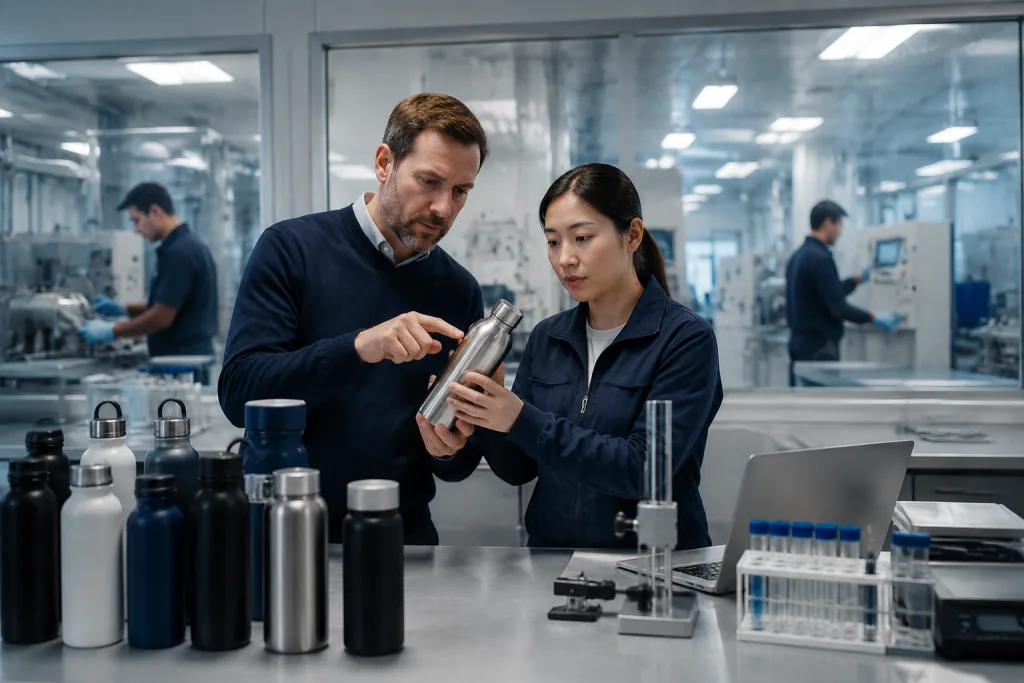
Control Bulk Production And Inspection
After sample approval, the bulk PO has to lock every open point. For a distributor fitness water bottle or customized sports water bottle order, the purchase order should repeat the product spec, not point back to an email thread. Email gets lost. On our floor, the merchandiser prints a work order for the line leader, and that sheet needs clear line items: body material, lid type, logo position in mm, carton packing, and approved color code.
A normal production lead time is 25-35 days after deposit and sample approval for standard models at 1,000-10,000 pcs. More colors, retail packaging, or a custom made shaker bottle lid can push this to 40-55 days, especially when the powder coating line has 3 color changes in one day. We hear buyers ask for “20 days including inspection” on first orders. The math doesn't work. Payment terms for new buyers are commonly 30% deposit and 70% balance before shipment, though repeat buyers with 3-5 clean orders usually get better discussion room.
Inspection should be planned before the factory finishes packing. For consumer drinkware, about 8 out of 10 retail buyers we work with use ANSI/ASQ Z1.4 AQL sampling. A practical setup is AQL 2.5 for major defects and 4.0 for minor defects, with critical defects not accepted. Critical defects include leakage, sharp metal edges, wrong material, strong odor, missing food-contact components, or incorrect logo that makes the product unsellable. QC pulled one sample last season with a 0.3 mm burr inside the rim; small on paper, unacceptable in hand.
Testing during inspection should include leak testing, lid torque or fit check, visual coating check, logo rub test, capacity check, carton drop test, and barcode scanning if retail or FBA is involved. For vacuum bottles, insulation testing is also reasonable. One simple method is filling with hot water and measuring temperature drop over 6 hours, but your standard should be written before production starts. We run the torque check with a handheld torque meter, and the buyer should state the pass range before mass production, not after the inspector arrives.
Final PO and QC line items:
- Approved golden sample reference number and approval date, matching the sealed sample in the QC room
- Production quantity by SKU, each color code, and each logo version
- Allowed over/under shipment, often 0-3%
- AQL level and third-party inspection rights before final carton sealing
- Required test reports and inspection photos, including leak test and logo close-up shots
- Shipping marks, pallet requirement, and latest shipment date shown exactly as the forwarder needs it
For gym chains, the cost of late delivery is not only freight. It can mean missing a membership campaign, store opening, or January fitness promotion. Build the calendar backward from your launch date, then add at least 10-14 days of buffer for China export handling, vessel changes, or customs questions. We ship from Ningbo or Shanghai most weeks, and one wrong digit in the PO shipping mark has delayed carton relabeling by 1 full day.
Send Your Gym Bottle RFQ For Factory Review
Share capacity, logo, color, MOQ, packaging, and target market. We will check manufacturability and quote with realistic lead time.
Frequently asked questions
What MOQ should I expect for a 304 stainless steel gym water bottle custom order?
For a stock 304 stainless bottle body with one laser logo, 500 pcs may be possible, but 1,000 pcs is a more normal factory MOQ. If you need Pantone powder coating, expect 1,000-3,000 pcs per color because coating lines lose efficiency on very small batches. For a custom shaker bottle with a new lid, mixing insert, or exclusive mold, MOQ can rise to 3,000-5,000 pcs. A distributor gym water bottle program with several colors should plan around total order quantity and per-color MOQ separately.
Is 304 stainless steel necessary for a custom gym water bottle?
For the inner surface that touches water, yes, 304 stainless steel is the practical standard for quality gym drinkware. It has better corrosion resistance than 201 steel, especially when users add electrolytes, lemon, or protein drinks. Some vacuum bottles use 304 inner wall and 201 outer wall to control cost, but this should be clearly stated. If your product page says 304 stainless steel, your PO should define whether it means inner only or both inner and outer. For a premium custom fitness water bottle, full 304 construction is easier to defend.
How long does sampling and bulk production usually take?
A blank stock sample usually takes 2-4 working days before courier pickup. A decorated pre-production sample with logo and color normally takes 7-12 days after artwork approval. Bulk production for standard 304 stainless custom sports water bottle orders is usually 25-35 days after deposit and sample approval. Add 10-20 days if you need multiple Pantone colors, special retail boxes, or complex inspection requirements. New tooling for a customizable shaker bottle lid can add 25-40 days before mass production even starts.
Which logo method is best for gym chains?
For durability, laser engraving on powder coating is the safest choice because it will not peel like weak ink. It is good for a custom gym water bottle used daily by members and trainers. For full-color graphics, silk screen or heat transfer is better, but you should request adhesion testing and approve a physical sample. If your bottle will be sold as merchandise at USD 15-30 retail, do not choose the cheapest print method blindly. The logo is the first thing users judge when the bottle gets scratched or washed.
What should be written on the purchase order for bulk bottles?
Your PO should include item number, capacity, steel grade, wall thickness, lid material, gasket material, finish, Pantone color, logo method, logo size, packaging, barcode, carton mark, compliance reports, inspection standard, Incoterm, FOB port, payment terms, and shipment deadline. For example, list 750 ml, SUS304 inner and outer, 0.5 mm body, powder coating, laser logo 45 x 28 mm, 24 pcs per export carton, AQL 2.5/4.0. A vague PO for a bulk gym water bottle order creates avoidable disputes.