Key Takeaways
- A practical MOQ for custom 304 stainless bottles is usually 1,000-3,000 units per color
- Double-wall vacuum gym bottles should use 0.4-0.5 mm inner 304 stainless steel for stable quality
- Laser logo is safer for sweaty gym use, while powder coating adds about USD 0.35-0.80 per unit
- Plan 30-45 days production after sample approval, plus 25-38 days sea freight to Europe or North America
Your gym chain needs a bottle that feels solid in the hand, holds ice through a 90-minute class, prints your logo without fuzzy edges, and does not trigger rust complaints after 3 months. Sounds easy. Then the quotations arrive for a 304 stainless steel gym water bottle bulk order, and one supplier lists “double wall,” another writes “vacuum flask,” and a third forgets the inner steel grade on the PI.
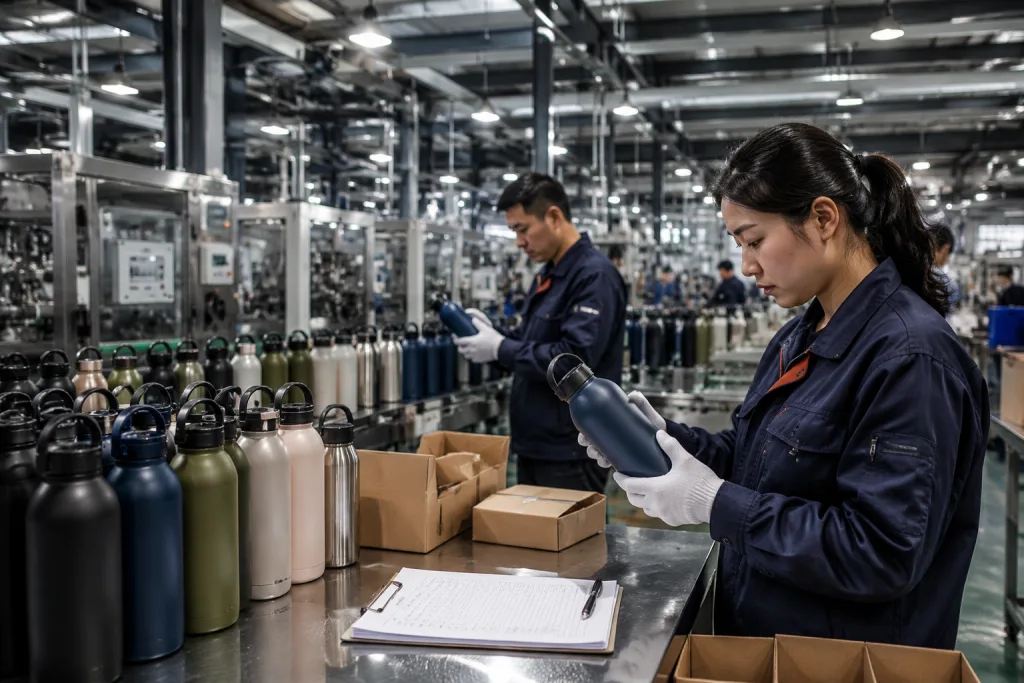
At our Zhejiang factory, we run this buyer case 6 or 7 times a month: a fitness brand wants 3,000 to 10,000 units for retail counters, member welcome kits, and distributor channels. Finding a bulk sports water bottle is the easy part. The work is locking the specification, logo method, AQL 2.5 inspection points, and 5-layer carton packing before the deposit lands, because we’ve seen this go sideways when QC pulled the sample and the buyer flagged a 2 mm logo shift after production had already started.
Start With The Gym Use Case
Picture a 40-location gym chain launching a paid membership bundle. The buyer wants a custom gym water bottle that feels retail-grade, not like the 12 RMB giveaway bottle sitting at reception, but finance still pushes back once the landed cost crosses USD 4.20. Color and logo come later. The real first question is simple: where does the member use it, and how often does it get dropped on rubber flooring?
For gym floor use, we usually run 600 ml, 750 ml, or 1,000 ml. A 600 ml bottle fits most treadmill cup holders; our gauge check is 72 mm body diameter before we approve the drawing. A 750 ml bottle gives personal trainers a better hand feel and more perceived value. A 1,000 ml bottle sells well for strength training, but the carton CBM jumps fast, and one EU buyer flagged freight after the loading plan moved from 18 cartons per stack to 14. If you are building a distributor sports water bottle line, carry two capacities. Five SKUs look good on a catalog page, then inventory gets ugly.
For 304 stainless steel, ask for food-contact 304 on the inner wall and 201 or 304 on the outer wall depending on budget. For a higher-grade customized gym water bottle, use 304 inside and outside. Wall thickness should normally be 0.4 mm to 0.5 mm for the inner tank and 0.5 mm to 0.6 mm for the outer shell. The math does not work if the factory saves 0.08 mm and you get dent claims later; QC pulled a 0.36 mm inner tank last month with a digital thickness gauge, and the sample dented after one gym-bag drop test.
If you need a bulk fitness water bottle for protein use, do not automatically choose stainless vacuum construction. This is the wrong question to ask. Powder residue sits in threads and lid corners, and we have seen this go sideways when a buyer approved a narrow flip lid for whey powder. A bulk shaker bottle or custom shaker bottle needs a wide-mouth single-wall body, mixing ball, removable strainer, or internal measurement scale. A vacuum bottle works better for water, electrolyte drinks, and cold brew; a custom made shaker bottle is the safer pick when the core use is powder mixing.
Build The Spec Sheet First
A serious RFQ for a 304 stainless steel gym water bottle bulk order should fit on one page. If your inquiry says only “send price for stainless sports bottle with logo,” the prices will be useless for buying work. We see this 6 or 7 times a month. One factory quotes 500 ml single-wall with a 58 mm body. Another quotes 750 ml vacuum with powder coating and a 72 mm body. The buyer flagged the gap only after the PI arrived, and by then the target price looked broken for the wrong reason.
For a custom sports water bottle, specify capacity, body diameter, lid type, material grade, finish, logo method, packaging, test standard, and target port. A working spec from our Hangzhou, Zhejiang team might read: 750 ml double-wall vacuum bottle, inner 304 stainless steel, outer 304 stainless steel, 0.5 mm outer wall, screw lid with PP food-grade insert, silicone seal, powder-coated body, laser engraved logo, individual white box, FOB Ningbo. Add the MOQ too. If the line is set for 3,000 pcs per color and your PO says 1,200 pcs in four colors, the math does not work.
For fitness brands, the lid deserves more attention than buyers give it. Straw lids are convenient, but they add 3–5 parts and leakage risk at the silicone plug. Flip lids sell well for a customizable sports water bottle, but the hinge needs cycle testing; we run 3,000 open-close cycles on a simple jig before we trust it. Screw lids are more reliable for distributors gym water bottle programs because they survive rough warehouse handling. If you want a carabiner lid, check the pin thickness in mm and ask whether the handle is rated for an empty bottle or a filled 750 ml bottle. We have seen this go sideways.
Ask your supplier to declare applicable compliance before sampling. For Europe, you may need LFGB, REACH, and food-contact migration documentation. For the United States, ask about FDA food-contact compliance and, when relevant, California Proposition 65 risk review. For children’s or school promotions, ASTM and CPSIA questions may enter the discussion, but for adult gym retail bottles the focus is usually stainless steel grade, coatings, plastic lid materials, and silicone seals. QC pulled one sample last quarter where the PO said “silicon seal,” the drawing said silicone, and the lid vendor sent the wrong gasket hardness at 45 Shore A.
Price The Order Like A Factory
Most price fights in bulk gym water bottle sourcing start with a USD 0.60 to USD 2.00 gap per unit. Margin explains part of it. Spec explains more. At our Hangzhou line, a plain 750 ml double-wall 304 stainless bottle usually prices around USD 3.20 to USD 5.80 FOB, depending on 0.4 mm vs 0.5 mm steel, powder coat type, lid parts, order quantity, and packaging. QC pulled two samples last month that looked identical in photos, but one lid had a 19 g PP insert and the other used a 31 g Tritan flip cap. Same buyer brief. Different cost sheet. A custom logo shaker bottle with extra plastic parts can land below or above that range once mold, gasket fitting, and hand assembly time are counted.
MOQ matters because coating ovens, logo screens, and carton printing runs all need enough volume to make the math work. For standard shapes, MOQ is often 1,000 units per color. For a custom mold or private lid, MOQ can move to 5,000 or 10,000 units. BottleForge Industrial can produce about 450,000 stainless drinkware units per month in Zhejiang, but this is the wrong question to ask if the PO has six tiny color splits. A 3,000-unit order split into six colors means six powder changes, six first-piece checks with the colorimeter, and more line stoppage. Two colors run faster and quote cleaner.
Separate one-time costs from unit costs. Laser engraving normally has a low setup cost and a stable result, especially on black powder coating where the contrast is clear after the 3M tape test. Silk screen works for one-color logos, but we run adhesion testing before approving mass production because some matte coatings reject ink at the curved shoulder. Full-wrap heat transfer or UV print gives stronger shelf impact, but the reject rate climbs when artwork has 1 mm registration lines around the bottle seam. If your customized sports water bottle needs Pantone-matched coating, expect a lab dip and usually 5-7 extra days before mass production starts. We have seen this go sideways when a PO says “navy” and the artwork file says Pantone 2965 C.
Freight is not a footnote. A 750 ml stainless bottle in an individual box may pack 24 units per master carton, around 14-17 kg gross weight, with carton size often near 48 x 32 x 28 cm after the insert tray is added. For 5,000 units, sea freight usually makes sense. Air freight can rescue a launch date, but we have quoted cases where DHL cost more than the bottle itself. Ask for FOB Ningbo or FOB Shanghai first. Compare DDP only after the product price, carton CBM, and shipment weight are clear.
Approve Samples Without Being Polite
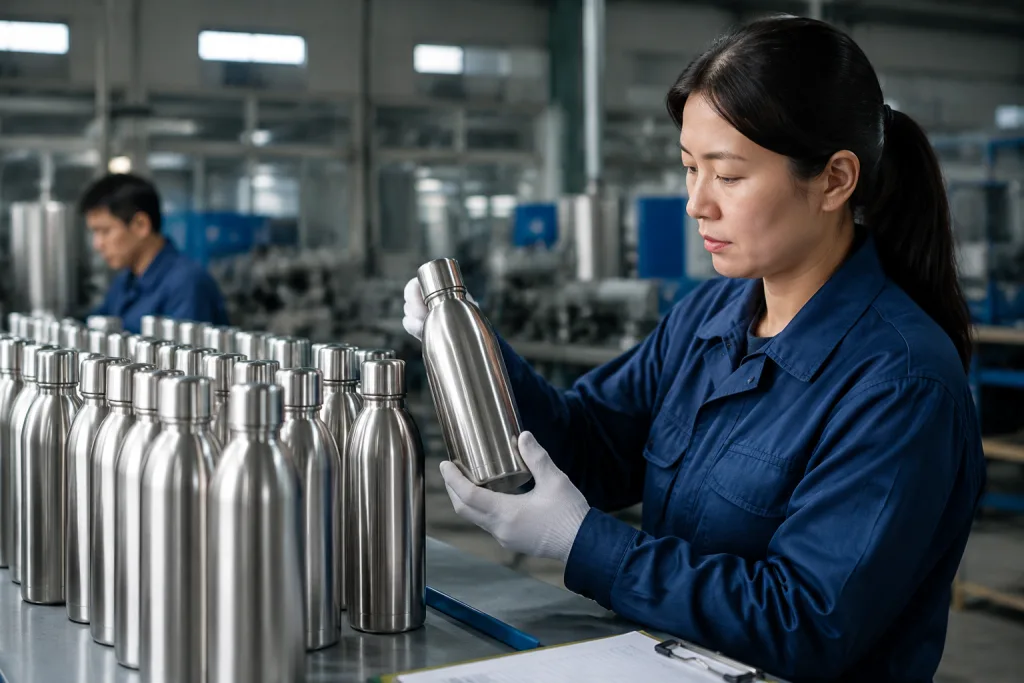
The approval sample is the place to be blunt. If the logo is 2 mm off center, the lid feels loose on the thread gauge, the powder coat has orange peel, or QC pulled a sharp thread edge with a cotton swab, do not hope the bulk order will fix itself. We can tighten a recorded issue on the line. We cannot fix a problem that never made it onto the sample approval sheet.
For a custom fitness water bottle, ask for at least two pre-production samples: one kept clean for visual sign-off, one abused like a gym user will abuse it. Fill the bottle with 95°C water for 30 minutes to check exterior heat transfer and lid deformation. Fill with cold water and ice for 12 hours if insulation is a selling point. Turn it upside down for 30 minutes on absorbent paper. Put it in a backpack with a towel and shake it for 60 seconds. Simple checks. Last season, a buyer flagged 3 leaking lids out of 20 samples this way before we released the mold for bulk production.
Logo approval should show size in millimeters, position from the base or centerline, Pantone or laser effect reference, and tolerance such as ±1 mm. For a laser logo, confirm whether the engraving shows silver stainless, dark gray, or coated contrast based on the body finish. For a customizable gym water bottle with silk screen, run a tape test and alcohol rub test. We usually recommend 3M tape pull after 24 hours and 50 alcohol rub cycles for printed logos on coated surfaces, because one pretty sample photo does not prove the ink will survive a sweaty hand and a protein shaker bag.
If you are ordering a customized shaker bottle, check the mixing insert fit and cleaning access. Narrow internal corners collect powder residue, and a 0.8 mm corner gap can turn into a bad review after one week of whey powder use. If the bottle is dishwasher-safe, write it in the specification and test for it. About 6 of 10 powder-coated stainless bottles we ship are not sold as dishwasher-safe because heat and detergent shorten coating life. Printing “hand wash recommended” is not being cautious; it is cheaper than sending replacement cartons after the buyer’s customer complains.
Control Production Before Packing
After the deposit lands, communication should get boring: approval sheet, production schedule, photo proof. Good. For a 3,000-unit to 10,000-unit 304 stainless steel gym water bottle bulk order, we usually run 30-45 days after sample and artwork approval. Custom molds, special coatings, or retail display packaging usually move the line to 50-60 days; last month a soft-touch powder order needed 7 extra days because the buyer changed the Pantone after the first spray panel.
Ask for three checkpoints, but make each one specific. Raw material confirmation should show stainless coil or tube grade, lid resin, silicone ring color, and coating powder label; we usually photograph the 304 tube bundle tag before cutting. Inline photos or a short video should come after forming and welding, before coating, so you can still catch a crooked seam or rough mouth rim. Packed carton photos need shipping marks before final inspection, including carton size, gross weight, and the PO number. Daily updates are noise. Stage evidence is what protects the order.
For QC, use AQL inspection instead of “please check carefully.” A common standard is AQL 2.5 for major defects and AQL 4.0 for minor defects, with critical defects set to zero. Major defects include leakage, wrong logo, serious dents, exposed rust, failed vacuum insulation, or wrong capacity. Minor defects include small coating specks, light scratches inside the agreed limit, or retail box printing shifted by 2-3 mm. We have seen this go sideways when the PO only said “good quality”; QC pulled the sample, found 11 logo scratches, and the buyer had no written limit to point to.
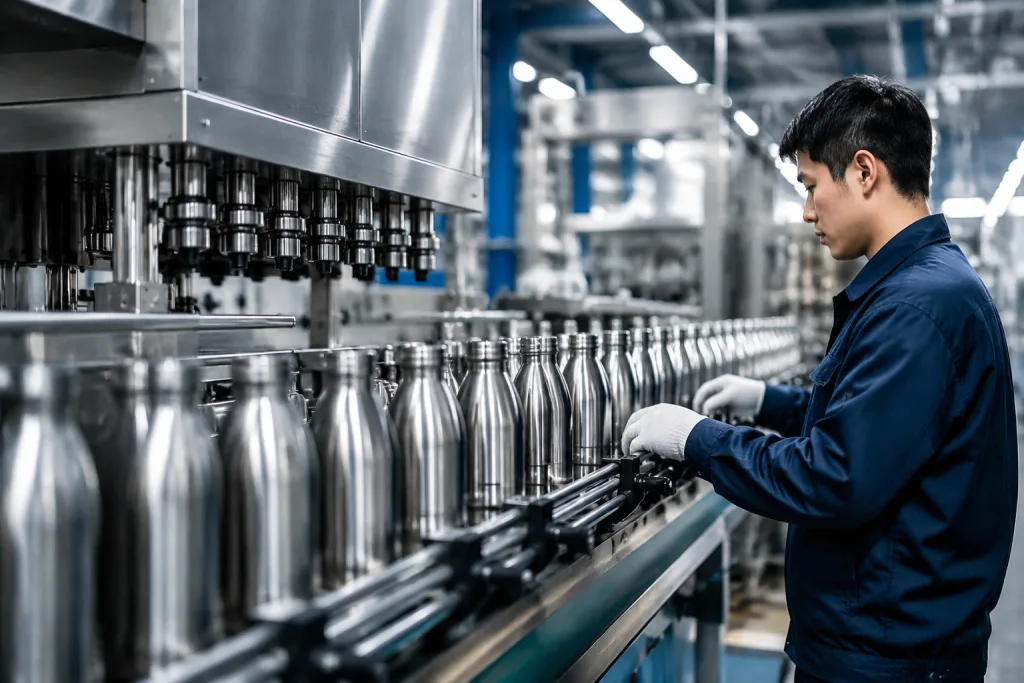
Vacuum testing belongs inside the factory process for double-wall bottles. One practical method is hot water temperature retention plus an exterior temperature check after filling; on our line, QC checks the shell with an infrared thermometer after the bottle sits on the bench. Another method is vacuum detection equipment before coating. For a distributor gym water bottle program, ask whether the factory tests 100% of vacuum bodies or only samples by batch. We prefer 100% vacuum screening before coating because a failed vacuum bottle looks perfect in the carton and only gets exposed after a gym customer fills it with ice water.
China factories vary a lot in inspection discipline. Write the inspection standard into the purchase order, including AQL level, defect photos, carton drop requirement if needed, and who pays rework cost. Zhejiang has a strong stainless drinkware supply chain, and we ship from this cluster every week, but location does not save a loose PO. Clear defect definitions do. One buyer once sent “black bottle” on the PO while the approved sample was matte charcoal; that 1-word gap stopped packing for 2 days.
Pack For Retail And Distribution
Pack choice starts with the next stop after Ningbo or Shanghai port. A gym chain selling at reception usually wants a white individual box, EAN-13 barcode, and a front panel clean enough for shelf display. An online fitness brand will ask for FNSKU labels, 5 cm suffocation-warning text on polybags, and cartons that survive a courier drop. For distributor fitness water bottle programs, we run neutral K=K master cartons with loose sticker labels, so one 3,000 pcs inventory pool can feed 6 accounts without repacking. Simple wins.
For Amazon-style or 3PL fulfillment, lock carton dimensions before mass production. The math doesn't work if a carton jumps into oversized handling for the sake of fitting 2 more bottles. A 24-piece master carton is common for 600-750 ml bottles, while 1,000 ml bottles may pack 12 or 18 pieces. Last April, QC pulled a 1,000 ml carton at 19.6 kg gross weight, and the buyer flagged it because their warehouse limit was 18 kg. If you ship mixed colors, mark color and quantity on two sides of each carton with a 40 mm label. Warehouse staff should not cut open 26 cartons just to count black and sage green stock.
Retail packaging should not promise what the product cannot prove. If you print “24 hours cold,” the bottle needs a test method and a result. We usually measure with 4°C water at 20°C ambient temperature after 24 hours, then record the final temperature on the test sheet. If you say “leakproof,” define it for still water with the lid fully closed and a 30-minute inverted test. Carbonated drinks, hot liquids, and protein shakes create pressure or residue; they are different use cases. We've seen this go sideways when a PO said “no leakage for soda,” but the approved lid was a standard flip straw lid.
For a customizable fitness water bottle or customizable shaker bottle line, packaging artwork should leave a 55 x 35 mm blank area for importer details, recycling marks, material icons, and compliance labels. In the EU, packaging waste rules are tightening, and 4 out of 10 new buyers now ask us for plastic-free packaging on first quotation. A kraft box with molded pulp tray can work, but it costs more and still must protect the powder coating during a 1.2 m carton drop test. Check the tray fit with calipers; a loose 2 mm gap at the shoulder is enough to rub the coating during sea freight.
Reorder Data Beats Guesswork
Your first order should tell you what to buy again. Track sell-through by capacity and channel first, then split complaints by leak, paint chip, dented carton, and lid fit. On one 750 ml gym chain run, the buyer flagged that matte black outsold neon green 3.4:1 after 42 days; QC also found 18 scratched lids from one PE bag packing method. Influencer programs can carry louder colors. Distributor shaker bottle buyers usually ask us for repeat SKUs they can reorder without another meeting.
If the first 5,000 units sell well, do not change five things on the reorder. Keep the body and lid stable, then change one item, such as the color ratio or the inner box. Reorders save real factory time: no new mold, no second logo test, 3 sampling days instead of 9, and fewer surprises during AQL inspection. We run repeat customized fitness water bottle orders in 25-35 days when 304 stainless coil, PP lids, and silicone rings are already in stock; during the May peak line, that same job can slip to 38 days.
Keep two files after shipment: the approved specification sheet and the final inspection report. Add carton marks, artwork files, Pantone codes, barcode files, plus spare parts notes for lids, straws, and silicone gaskets. Small detail, big headache. We once saw a reorder PO with “Panton 426C” typed without the “e,” and the line stopped half a day while the sales team checked the old drawdown card under the D65 light box. If you later ask for a distributor fitness water bottle version, a custom sports water bottle gift set, or a simplified bulk sports water bottle for promotions, the factory quotes from records, not someone’s memory.
The best sourcing relationship is not dramatic. You send a 90-day forecast, we reserve line capacity, the pre-production sample matches mass production, and your customers do not send leak videos. This is the practical target for 304 stainless steel gym water bottle bulk sourcing from Zhejiang, China. Chasing the lowest unit price every reorder is the wrong question to ask; if a 6 mm thinner carton adds 2% dent claims at destination, the math does not work.
Send Your Gym Bottle Spec For Factory Review
Share capacity, quantity, logo method, target market, and launch date. We will check feasibility, MOQ, pricing, and QC risks before sampling.
Frequently asked questions
What MOQ should we expect for a custom 304 stainless gym bottle?
For an existing bottle shape, expect 1,000-3,000 units per color for a custom gym water bottle with laser logo or one-color print. If you need Pantone powder coating, many factories prefer at least 3,000 units per color because coating lines and powder purchasing have minimums. For a custom made shaker bottle with a new lid, new mold, or special internal mixer, MOQ can rise to 5,000-10,000 units. If your first order is smaller, keep the body shape standard, choose one or two colors, and spend your customization budget on logo and packaging rather than tooling.
Is 304 stainless steel enough for gym water bottles?
Yes, 304 stainless steel is the normal commercial choice for a bulk fitness water bottle used with water, ice, electrolyte drinks, and cold brew. It has good corrosion resistance and is widely accepted for food-contact drinkware. For salty liquids, acidic drinks, or long storage of sports supplements, cleaning habits matter as much as steel grade. Ask for 304 stainless steel on the inner wall at minimum. For a premium customized gym water bottle, use 304 inside and outside. Also check lid materials, silicone seals, and coating compliance because those parts touch the user experience every day.
Which logo method works best for gym chains?
Laser engraving is usually the safest choice for gym chains because sweat, hand oil, and repeated washing do not remove it. It works especially well on powder-coated stainless bottles and gives a clean retail look. Silk screen is cheaper for simple one-color logos but needs tape and rub testing. UV print or heat transfer is better for complex artwork, gradients, or full-wrap branding, but reject rates can be higher. For a custom logo shaker bottle or custom sports water bottle sold at reception, we usually recommend laser for the main logo and printed packaging for richer brand storytelling.
How long does a bulk sports bottle order take from China?
A normal 304 stainless steel gym water bottle bulk order takes about 7-10 days for sampling, then 30-45 days for mass production after approval and deposit. Special powder colors, new molds, or complex retail packaging can add 1-3 weeks. Sea freight from Ningbo or Shanghai to major European or North American ports often takes 25-38 days, not including customs and inland delivery. If your launch date is fixed, work backward at least 90 days. Rush production is possible sometimes, but rushing inspection or carton packing is where expensive mistakes happen.
Can one supplier handle bottles for retail, gyms, and distributors?
Yes, but the specification should separate channel needs. Retail may need color boxes, barcodes, and stronger shelf appearance. A gym chain may want member-kit packing and fast carton picking by location. Distributors gym water bottle and distributors shaker bottle programs often need neutral cartons, stable repeat SKUs, and spare lids. One factory can produce all three if the base bottle is shared and packaging changes by channel. Keep the same body, lid, and QC standard, then vary logo, carton marks, and inserts. This keeps unit cost down and makes reorders easier.