Key Takeaways
- For custom glass bottles, use AQL 2.5 for major defects and AQL 4.0 for minor defects at final inspection
- A practical MOQ is 1,000-3,000 pcs per color or logo for borosilicate glass bottle custom orders
- Specify 304 stainless steel by grade, thickness, finish, and food-contact test requirement, not only by product photo
- Allow 25-35 days for mass production after approved pre-production sample and packaging artwork
A custom glass water bottle looks simple until the first shipment lands with leaking lids, scratched logos, loose silicone rings, and cartons crushed after courier sorting. We have seen 6,000 pcs held in a buyer’s warehouse because QC pulled the sample and found water seepage after a 30-minute inverted test. For wellness brands and sustainable retailers, one bad batch is not just a product issue. It turns into refunds, stock-out pressure, and customer reviews you cannot delete.
As a 304 stainless steel glass water bottle supplier in Zhejiang, China, we see the same failures repeat when buyers approve only a clean sample photo. Wrong question. Borosilicate glass thickness, 304 stainless steel cap grade, silicone seal hardness, logo printing position, and gift box paper weight each need a separate spec on the PO; one buyer once typed “matte black” while the approved sample was glossy, and the line stopped for 2 days. Our Hangzhou line can produce about 180,000 glass bottles per month, but stable quality starts before production, not during inspection.
The glass fails before the lid
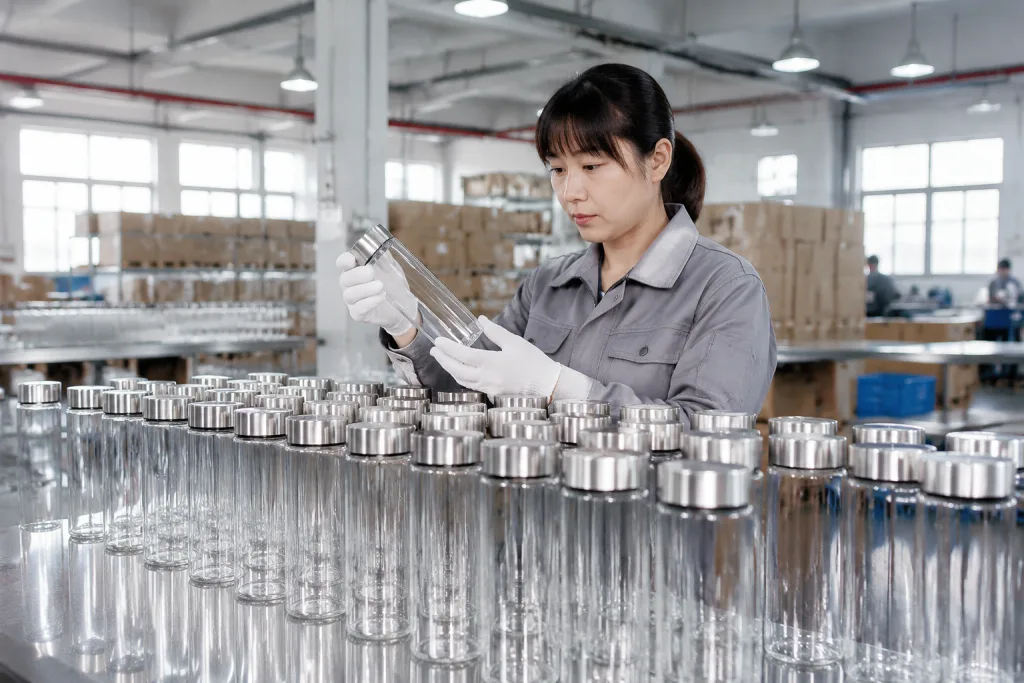
Most buyers start with the 304 stainless steel lid. Fair question. On the line, though, the glass body is usually the first part to fail. A borosilicate glass bottle manufacturer should give you the glass type, tube wall thickness, annealing curve, and thermal shock test method, not just the words “high borosilicate.” Last month QC pulled 32 samples from a 3,000 pcs pre-shipment lot; the lids passed torque check, while 5 glass bodies showed stress marks under the polariscope. If the supplier sends only a lifestyle photo, you do not have enough data to place a bulk borosilicate glass bottle order.
For a 500-750 ml bottle, we normally recommend 2.0-2.5 mm wall thickness, depending on shape. Thinner glass looks elegant and cuts carton weight, but the math does not work if your breakage rate moves from 1.5% to 4% after parcel delivery. We’ve seen this go sideways. A straight cylindrical bottle is easier to control than a narrow-waist bottle or one with a sharp shoulder because the forming pressure and cooling speed stay more stable. If your brand sells through e-commerce, choose durability over the thinnest silhouette; a buyer once flagged a 1.8 mm sample as “premium-looking,” then rejected the pilot run after drop-test cracks appeared near the shoulder.
The common failure modes are small bubbles, black dots, uneven mouth diameter, internal stress, and wobbling base. Small bubbles under 1 mm may pass if they are not clustered near the lip or logo area. The base is less forgiving. A 0.8 mm tilt on the granite inspection table makes the bottle feel cheap at retail, even when the lid and sleeve look fine. Ask your borosilicate glass bottle supplier for a written defect standard with photos before production starts, including bubble size, black dot limit, mouth ovality, and the distance allowed from the printed logo.
For QC, specify annealing inspection, mouth diameter tolerance, and a thermal shock test such as 80°C hot water followed by room-temperature water. We run the mouth check with a go/no-go gauge, and QC records the worst reading, not the average. Do not promise consumers boiling-water performance unless the full assembled bottle, including lid and silicone seal, has been tested. China factories can make strong glass bottles, but strength cannot sit in the buyer’s head. Put it on the PO, check it at AQL 2.5 if that is your standard, and make sure the sample room and mass-production line are working from the same drawing.
304 steel is not a slogan
“304 stainless steel” gets thrown around too loosely in drinkware sourcing. On a glass bottle, 304 stainless steel can sit in the outer cap shell, inner cap plate, tea infuser, carry ring, or bottom sleeve. Each part needs its own material line on the BOM. If your purchase order only says “304 stainless lid,” the math doesn't work: a cheaper supplier can run 201 stainless on the outer decorative shell and reserve 304 only for the inner contact plate. We have seen QC pull a cap with a magnet at the packing table because the PO had one lazy line, not part-by-part callouts.
A serious 304 stainless steel glass water bottle supplier should provide a material declaration and, when requested, third-party food-contact testing. For Europe, buyers usually ask for LFGB or EU food-contact compliance, plus REACH for coatings or colored components. For North America, FDA food-contact expectations and, for children’s products, ASTM-related checks can matter. If the lid is powder coated or painted, the coating also needs adhesion and heavy metal review. We run cross-cut adhesion testing on coated lids; one German buyer once flagged a 2 mm paint chip near the thread after only 6 sample openings.
Thickness matters. A 0.4 mm stainless cap shell dents faster than a 0.5-0.6 mm shell, especially after carton compression and courier sample abuse. Brushed steel hides small handling marks better than mirror polish. If you want a premium wellness look, specify brushed, bead-blasted, or electro-polished on the artwork sheet, not “silver.” Too vague. For a promotional borosilicate glass bottle, mirror polish looks clean in photos but shows fingerprints and carton rub marks faster; our line has rejected 37 mirror caps in one morning for rub marks from a loose PE bag.
The failure mode we dislike most is rust staining around the threaded area. True 304 stainless can still show tea stains or surface contamination if polishing residue is not cleaned properly, but it should not rust like low-grade steel. Ask for a 24-hour salt spray reference when appropriate, and require pre-shipment visual checks on 100% of metal caps. This is the wrong place to save 0.03 USD. It is cheaper to reject a cap batch in Zhejiang, with QC under a 6000K inspection lamp, than to replace leaking bottles after retail launch in Germany or Canada.
Seals leak for boring reasons
Leaking bottles fail for small, boring reasons: silicone hardness, gasket squeeze, thread tolerance, cap torque. We see it on the line with a torque meter set at 0.7-0.9 N·m: the cap feels fine by hand, then QC pulls the sample and finds a wet ring under the lid. A custom borosilicate glass bottle project needs engineering work here. A nice cap can still leak if the gasket is 0.3 mm too thin or sits loose inside the lid.
For most glass water bottles, food-grade silicone at 50-60 Shore A works well. Softer silicone seals fast, then deforms after 30-50 dishwasher cycles. Harder silicone survives more washing, but the thread fit must be cleaner. Your spec should name gasket material, color, hardness, and whether it is removable for cleaning. Wellness buyers often ask for removable silicone for hygiene; the buyer flagged it twice last year after consumers lost loose rings in the sink. That becomes an after-sales problem, not a design feature.
Thread matching is another weak point. Glass mouth finish tolerance is less forgiving than molded plastic. If the mouth is 0.2 mm oval or the cap thread is too shallow, leaking becomes random: 20 bottles pass, then 3 fail after a courier toss test. We run an inverted leak test for 30 minutes on sampled units, plus a shake test on filled bottles at room temperature. For higher-risk wholesale orders, we increase the sample size beyond standard AQL. The math does not work if you only test the golden sample.
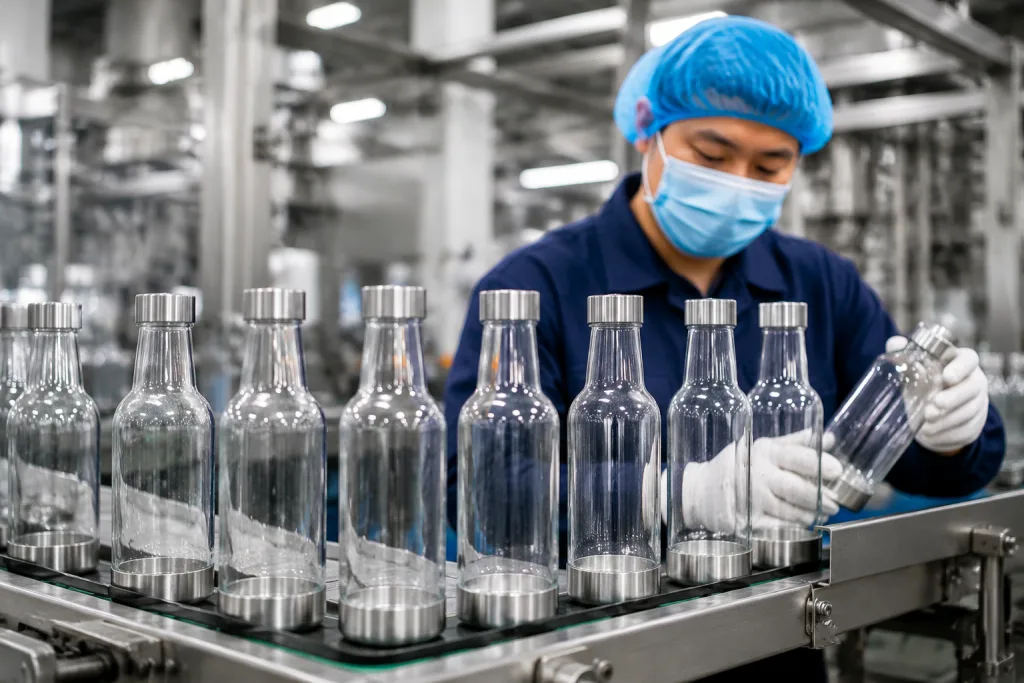
If you are comparing borosilicate glass bottle vendors, ask how they control cap and bottle matching. Some vendors buy glass from one workshop and caps from another, then do assembly trials after 8,000 pieces are already packed. We have seen this go sideways. As a borosilicate glass bottle factory partner in China, we prefer pre-production assembly using mass-production tooling, actual silicone rings, and the same cap insert mold that will run bulk production.
Decoration hides many traps
Branding is where we see sustainable retailers lose money: they approve one sample, then assume it protects the next 8 batches. A borosilicate glass bottle custom order can use screen printing on a curved jig, decal transfer for full artwork, heat transfer film, laser marking on stainless steel, or color coating before print. Each process has limits on round glass, especially when the operator is lining up a logo against a 62 mm bottle body at 9 p.m. on the line.
For a custom glass water bottle with a one-color logo, screen printing is still the safest price choice. Typical logo MOQ is 1,000 pcs, with a plate cost of about USD 35-60 per color. Fine lines below 0.25 mm may break, and large solid ink areas can show pinholes; QC pulled 17 samples last month for exactly that issue on a dark green print. If you want a 360-degree wrap, expect more rejects and slower output, maybe 1,200 pcs per shift instead of 1,800 pcs. For a customized glass water bottle with gradient artwork, decal or heat transfer is the better call, but adhesion testing matters more than the mockup. The math doesn’t work if the artwork looks perfect and fails after 20 rubs.
On stainless steel caps, laser engraving gives a durable result with no ink migration. It looks clean for premium wellness brands, but the color is limited, so buyers expecting a bright Pantone logo often flag it after seeing the counter sample. If you need a colored logo on the cap, pad printing or UV printing can work, but we test the surface for abrasion before we run bulk. We normally use a 3M tape test, alcohol rub test, and cross-hatch adhesion check when the finish is coated; last inspection, the black coated cap passed tape but failed after 50 alcohol rubs.
The failure modes are predictable: logo color drift, crooked placement, weak adhesion, scratches, or artwork scaled differently from the approved PDF. Your purchase order should include Pantone color, logo size in millimeters, placement tolerance such as ±1.5 mm, and approved artwork version; one buyer once sent “logo 45 mn” on the PO, and production read it as 45 mm until pre-production QC stopped it. For a borosilicate glass bottle customized for retail shelves, do not rely on “same as sample.” Samples are made slowly. Mass production is made under time pressure.
Packaging decides your real defect rate
A bottle can pass final QC with zero scratches and still arrive as scrap if the carton spec is treated like decoration. Glass gives no second chance. For a bulk glass water bottle shipment, set the packaging by sales channel, not just FOB price. This is the wrong place to save USD 0.05. A distributor glass water bottle order going palletized to a warehouse can use a different packout from an e-commerce order thrown through parcel hubs one unit at a time. Last season QC pulled the sample after a corner drop, and the bottle was fine; the gift box corner was crushed 11 mm.
For standard export cartons, we run individual white boxes or kraft boxes, dividers when the bottle shoulder needs spacing, and 5-layer corrugated master cartons. Check carton burst strength and edge crush if the carton is heavy. A 24 pcs carton looks efficient on the quote sheet, but for 750 ml glass bottles it often reaches 15-18 kg after caps, sleeves, and inserts. Warehouse staff do not handle that gently. We ship safer with 12 pcs or 16 pcs master cartons for this size, even when carton cost rises by USD 0.08-0.18 per bottle. The math still works if it cuts breakage from 3 cartons per 100 to 1 carton per 100.
Drop testing should be practical, not theater. Use a carton drop test from 60-80 cm on edges, corners, and faces, matched to carton weight. We use a simple marked test area on the packing line, then open the carton and check glass, lid thread, silicone ring, and retail box corners. If your goods go to Amazon FBA or a similar fulfillment network, include barcode placement, FNSKU labeling, polybag suffocation warnings where required, and carton weight limits in the PO. One buyer flagged a 6 mm barcode shift because the scanner missed it after pallet wrap. A borosilicate glass bottle wholesale shipment that survives pallet transport can still fail parcel distribution.
Retail packaging has its own problem: scuffed gift boxes. Matte black boxes look premium in a showroom, then show rub marks after one truck ride from Hangzhou to Ningbo. Uncoated kraft boxes hide handling marks better and fit a sustainable position without trying too hard. If you source as a borosilicate glass bottle distributor, ask for a packaging pre-production sample using the exact paper, insert, barcode, and carton layout. No mockup paper. We have seen this go sideways when the approved sample used 350 gsm paper, but the PO typo said 300 gsm. Zhejiang factories can adjust packaging fast, but only before paper, inserts, and printed cartons are purchased.
Supplier fit beats low quote
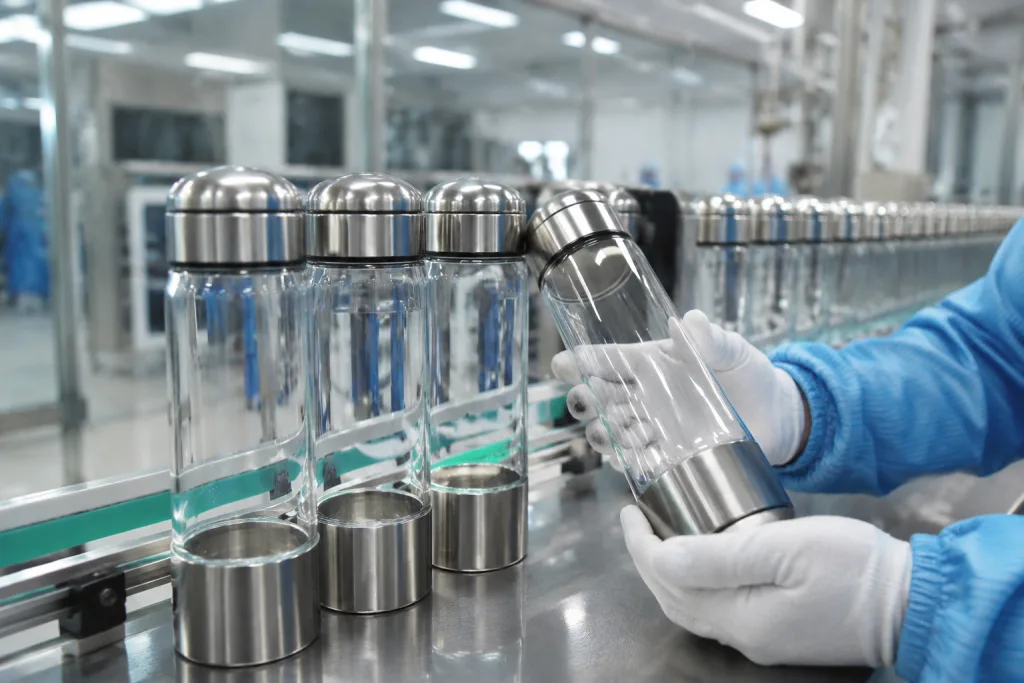
Price matters. The lowest quote is the wrong question to ask for a wellness launch if the supplier cannot hold the spec. First check who is quoting: a trading vendor, an assembly factory, or a borosilicate glass bottle manufacturer that controls glass tube cutting, 304 stainless lid sourcing, silicone ring fit, final assembly, and QC. We have seen this go sideways when a buyer saved USD 0.18/pc, then QC pulled the sample and found 9 leaking caps in a 200 pcs carton test.
For a first order, a realistic MOQ is 1,000-3,000 pcs for a customizable glass water bottle with logo. If you need custom mold glass, expect higher cost, usually USD 800-3,000 for tooling depending on shape, with sampling around 12-18 days instead of the normal 7-12 days for a logo sample. Mass production is usually 25-35 days after sample approval. FOB Ningbo or Shanghai is common for Zhejiang, China suppliers. On our line, a 500 ml bottle with sleeve and 304 stainless cap usually needs a checked tolerance of about ±1.0 mm at the mouth, or the leak test becomes ugly.
Ask your borosilicate glass bottle vendors for BSCI, ISO 9001, or recent audit documents if your retailer requires social compliance. Ask for AQL inspection terms before paying the deposit. We run AQL 2.5 for major defects and 4.0 for minor defects, with 100% functional leak checks on selected high-risk SKUs. For a borosilicate glass bottle customizable with multiple lid colors, approve each color under a D65 light box; last month a buyer flagged “cream white” because the PO said C01 but the artwork file said C10.
A good supplier will push back when your spec is risky. If you ask for ultra-thin glass, a dark matte coating, a complex logo, and courier-safe packaging at the lowest wholesale price, the math does not work. Say the real targets first: retail price, sales channel, compliance market, logo method, carton drop requirement, acceptable defect level. We ship better when those details are clear. That is how a borosilicate glass bottle manufacturer turns a product idea into a repeatable shipment instead of a one-time gamble.
Send your glass bottle spec for factory review
Share target size, lid style, logo method, market, and MOQ. We will flag production risks before quoting the cheapest wrong option.
Frequently asked questions
What MOQ should I expect for a custom borosilicate glass bottle?
For a standard shape with your logo, 1,000 pcs is often possible, but 2,000-3,000 pcs gives better unit cost and steadier production scheduling. If you need a custom glass mold, special cap tooling, or several silicone colors, expect a higher MOQ, usually 3,000-5,000 pcs. For borosilicate glass bottle bulk orders, color coating and multi-color printing also affect MOQ because ink, fixtures, and line setup create fixed costs. A practical first order is one bottle size, one lid style, and one or two logo colors. That keeps sampling simple and reduces the chance of mixed defects across too many variants.
How do I verify the lid is really 304 stainless steel?
Ask the supplier to define which parts are 304 stainless steel: outer cap shell, inner contact plate, infuser, handle, or sleeve. Then request a material declaration and, for larger orders, third-party testing such as LFGB or FDA food-contact review for the assembled lid. A handheld material test can help, but written control is better. You should also inspect for rust-like staining after washing, especially around threads and welded areas. For premium retail orders, specify 0.5-0.6 mm stainless shell thickness and surface finish. Do not accept “stainless steel” without grade, because 201 and 304 can look similar in photos.
What is the normal lead time from a China glass bottle supplier?
For an existing bottle shape, logo sampling normally takes 7-12 days after artwork confirmation. Mass production usually takes 25-35 days after the pre-production sample is approved and deposit is received. Add 5-10 days if you need custom retail packaging, color coating, or third-party testing. Sea freight to Europe or North America often adds 25-40 days depending on port and season. During peak months before summer promotions or Q4 retail, book capacity earlier. A Zhejiang, China factory can move quickly, but glass, stainless caps, printing, and packaging still need sequence control.
Which branding method is best for a sustainable wellness bottle?
For glass bodies, one-color screen printing is the most balanced option for cost and durability, especially at 1,000-5,000 pcs. Decal printing works better for detailed artwork or larger wraps, but you should test adhesion and dishwasher exposure if you plan to make that claim. For 304 stainless steel caps, laser engraving is the cleanest and most durable method. It avoids ink and fits a sustainable positioning, but it gives a tone-on-metal look rather than bright color. Always define Pantone color, logo size, placement tolerance, and test method before production. Decoration failures are easier to prevent than repair.
Can glass bottles be safe for e-commerce shipping?
Yes, but packaging must be designed for parcel handling, not just pallet export. Use an individual box with enough clearance, an insert or sleeve to stop movement, and a 5-layer master carton. Test the packed carton with 60-80 cm drops on corners, edges, and faces. For single-unit shipping, consider molded pulp, paper wrap, or reinforced inserts, but check that the bottle cannot touch the box wall directly. Keep master cartons under a practical handling weight, often below 15-18 kg. If you need FNSKU labels or retail barcodes, confirm label position before carton printing.