Key Takeaways
- Start RFQs with glass wall thickness, cap grade, MOQ 1,000 pcs, and packaging line items
- 304 stainless steel parts usually mean cap shell, infuser basket, tea strainer, or base sleeve
- Sample approval should cover 3 units per color plus logo, leak, and carton drop checks
- Bulk POs should state AQL 2.5/4.0, REACH/LFGB needs, FOB port, and spare cap percentage
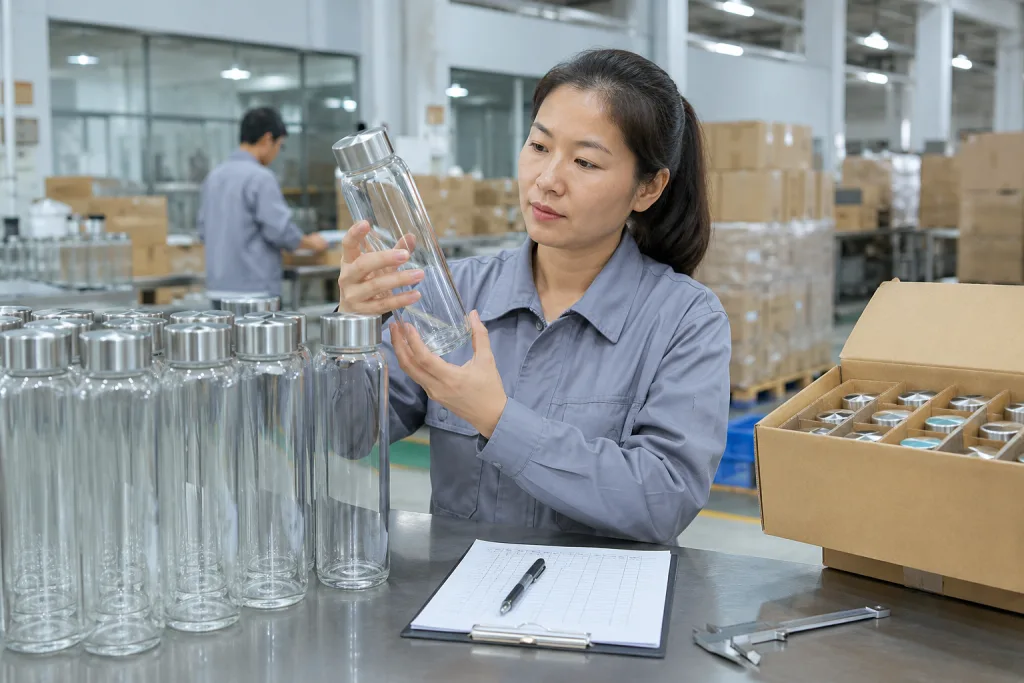
A 304 stainless steel glass water bottle private label project looks easy until the first RFQ comes back with 1.8 mm, 2.0 mm, and 2.2 mm glass options, two cap grades, a loose “color box included” note, and zero answer on breakage allowance. We see the margin get squeezed right there. Last month QC pulled a 500 ml sample from the line and found the silicone ring sitting 0.6 mm proud, enough for one buyer to flag leakage before we even discussed logo printing.
From our Hangzhou, Zhejiang export desk, we see this mistake about 7 times in 10 new inquiries: the buyer asks for a custom glass water bottle, but the cap spec, sleeve material, logo method, carton drop target, and sales market are still blank. This is the wrong question to ask first. China can run this item cleanly, but your PO needs line-item detail a factory can quote, sample, inspect, and ship against; “same as photo” does not survive a 12 kg master carton drop test.
Define the product before RFQ
Do not send a factory one vague line, we need a borosilicate glass bottle custom quote, and expect a price you can compare. This is the wrong question to ask. Start with a product definition sheet for the 304 stainless steel glass water bottle private label project. The bottle body should be called out as high borosilicate glass; 304 stainless steel normally means the cap shell, tea infuser, strainer, bottom sleeve, or trim ring. If those parts are mixed together, one supplier quotes a plastic inner cap with a steel skin while another quotes a full 304 insert, and the USD 0.38 gap looks like magic. QC pulled a sample last month and the “stainless cap” was only 0.22 mm on the digital caliper, not the 0.35 mm the buyer thought they approved.
For a wellness brand, we run the baseline at 550 ml or 750 ml borosilicate glass, 1.8-2.2 mm wall thickness, food-contact silicone seal, and 304 stainless steel cap component at 0.35-0.45 mm thickness. Retailers often choose 750 ml because the shelf price feels better, but the math changes once the carton hits the pallet. A 750 ml bulk glass water bottle may add USD 0.12-0.20 per unit in ocean freight versus 550 ml, depending on carton size and destination. We have seen this go sideways when the buyer approved the bottle but not the 5-ply export carton; after a 76 cm drop test, 11 bottles broke in a 100 pcs trial carton.
Your first PO-style RFQ line should look closer to this: 750 ml borosilicate glass bottle; clear body; 2.0 mm wall; 304 stainless steel screw cap with silicone seal; leakproof; single-color logo; kraft gift box; MOQ 1,000 pcs; FOB Ningbo. That gives a borosilicate glass bottle manufacturer in Zhejiang enough data to quote the glass tube, cap construction, logo process, gift box, and master carton loading without guessing. At BottleForge Industrial in China, our usual MOQ for a borosilicate glass bottle bulk order is 1,000 pcs per SKU, with sample lead time of 7-10 days and bulk production around 25-35 days after approval. Small thing, but check the PO: we once had “FOB Ningbo” typed as “FOB Qingdao,” and the line had already packed 62 cartons before the buyer flagged it.
Send RFQs that compare cleanly
Once the spec is clear, send the same RFQ to each borosilicate glass bottle supplier or vendor. You are checking price and checking whether the factory reads line items. A serious borosilicate glass bottle factory will split the quotation into bottle body, 304 stainless steel components, logo, packaging, testing, and inland handling. A weak quote hides it in one number, then adds USD 0.18 for the insert card after sample approval. We see this go sideways. Last month QC pulled a 750 ml sample where the cap was quoted as 304 stainless steel, but the magnet test flagged a 201 stainless inner piece.
Ask for quotes in a table, not casual email text. Your RFQ should request: unit price at 1,000 / 3,000 / 5,000 pcs, mold or setup fee, sample fee, logo fee, box fee, master carton dimensions, gross weight, payment terms, FOB port, and production lead time. For a standard customizable glass water bottle, realistic FOB China pricing often sits around USD 2.20-4.80 depending on capacity, cap structure, sleeve, logo, and packaging. A heavy double-wall design or full stainless sleeve can move above USD 6.00. Put carton size in the same sheet; our packing line checks it with a tape measure before we book space, because a 2 cm carton change can push the CBM over the buyer’s freight estimate.
Your RFQ line items should include:
- Product: customized glass water bottle, 550 ml or 750 ml, borosilicate glass, with target height and mouth diameter in mm.
- Metal: 304 stainless steel cap shell or infuser, confirm no 201 stainless substitution, and ask for the grade shown on the material declaration.
- Logo: screen print, decal, laser on cap, or paper insert in gift box, with artwork size and Pantone code if the buyer has one.
- Packaging: white box, kraft box, color box, insert card, barcode label, FNSKU if needed, plus drop-test requirement for the master carton.
- Compliance: LFGB, REACH, Prop 65 statement, FDA food-contact declaration as applicable, with test report owner and report date shown.
If you are a borosilicate glass bottle distributor or distributor glass water bottle buyer, ask the supplier to quote spare parts separately. Replacement caps at USD 0.35-0.90 and silicone rings at USD 0.03-0.06 save you from customer service claims later. The math is simple. We usually pack 2% spare silicone rings in a PE bag, and the buyer flagged it once because the PO typo said “silicon ring” instead of “silicone ring.”
Control samples like a buyer
Sampling is where private label glass projects get settled or start drifting. Do not approve from one nice photo. For a borosilicate glass bottle customizable program, request physical samples built to the bulk spec: the same glass thickness in mm, the same cap structure, the same logo method, and the same retail box with the same carton protection. Last month QC pulled a sample with a 1.8 mm wall while the PO said 2.2 mm; the buyer flagged it before we opened the mould order. If the factory sends a stock sample with a different cap, treat it as a shape reference only, not approval.
A sensible sample PO has line items. Example: 3 pcs clear 750 ml bottle with 304 stainless cap, 3 pcs amber 550 ml bottle with 304 stainless infuser, one-color logo on glass, laser logo on cap, printed kraft box, DHL freight prepaid. Pay for samples if needed. USD 80-180 for sample development is normal when logo and packaging are included. Free samples often mean generic stock, and the math does not work if you expect the line to match your final construction from a free shelf item. We run the sample sheet with cap gasket material, carton size, and even barcode position, because one buyer once had “matte black” typed as “matt black” on the PO and the box artwork followed the typo.
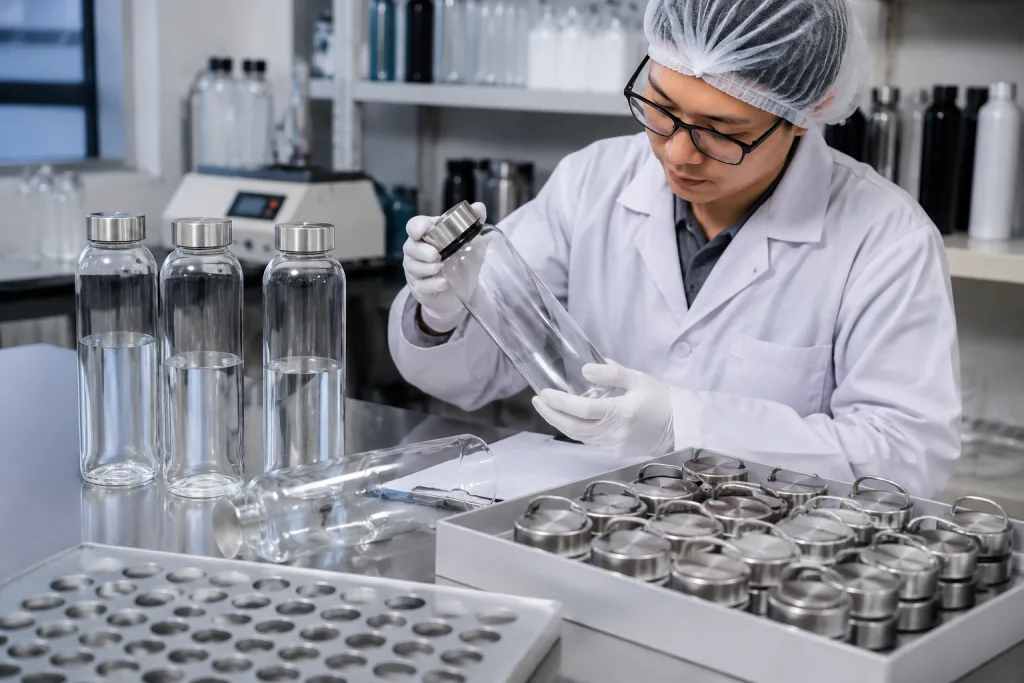
Check the sample the way a customer will abuse it. Fill the bottle with water, invert it for 2 hours, shake it 30 times, and leave it overnight on white A4 paper to spot cap leakage. Simple test. Measure capacity with a kitchen scale: 750 ml should not quietly become 690 ml. Inspect the glass rim for chips under a desk lamp, close the thread 10 times to feel any grinding, and check the 304 stainless steel part for burrs or discoloration with your fingertip. If there is a silicone sleeve, pull it off and reinstall it twice to see if it deforms. We have seen this go sideways when a sleeve looked fine in photos but stretched 3 mm after the second install.
For promotional or wellness kit projects, logo durability matters. Screen print on glass can look clean, but it needs adhesion testing. A simple tape test is not enough for retail; ask the borosilicate glass bottle manufacturers to run dishwasher or warm-water rub checks if the bottle will claim washable use. On our side, QC records the rub result on the pre-production sample tag before mass production starts, because a logo that passes one dry wipe can still smear after 20 minutes in warm water. Do not approve the customized borosilicate glass bottle until you have written corrections back into the pre-production sample record.
Write the PO around risks
The bulk PO is not a quantity-and-price sheet. It is your risk-control document. A proper 304 stainless steel glass water bottle private label PO should repeat the signed sample details and lock inspection, packaging, spare parts, and shipping terms. We once had QC pull a pre-shipment sample with the correct bottle but a 31 mm cap instead of the approved 32 mm cap because the PO only said “stainless cap.” If it is not written in the PO, the line will follow the factory’s default, not your retail team’s memory.
Use line items that remove guesswork. Example: Item 01: 750 ml clear borosilicate glass bottle, 2.0 mm wall, 304 stainless steel cap shell, silicone sealing ring, laser logo on cap, one-color print on body, kraft box, 24 pcs master carton, FOB Ningbo, 3,000 pcs. Then add Item 02: spare silicone rings, 2% of order quantity and Item 03: spare caps, 1% of order quantity. Small parts matter. For a distributor borosilicate glass bottle order, spare parts are cheap insurance; the math works better than air-freighting 60 loose silicone rings later because a warehouse picker found 2 cartons short.
Inspection terms should be written before the deposit is paid. AQL 2.5 for major defects and AQL 4.0 for minor defects is common for drinkware. Critical defects should be zero tolerance: broken glass, sharp edges, leaking cap, wrong material, strong odor, wrong barcode, or mold contamination. We run a simple water-leak check with bottles inverted for 4 hours, and QC pulled the sample last month after 3 caps showed thread burrs under a 10x loupe. If your product enters the EU, ask for REACH and LFGB-related documentation. For the US, request FDA food-contact material statements and Prop 65 review if relevant. ASTM drop testing may apply if the bottle is marketed for children, though glass kids products need extra caution.
Payment terms also belong in the PO. For a new borosilicate glass bottle vendor, 30% deposit and 70% balance after passed inspection but before shipment is normal. If a supplier asks for 100% before production on a bulk borosilicate glass bottle order, slow down. We have seen this go sideways: a buyer approved payment after seeing production photos, then the final cartons failed because the PO had a typo, “24 pcs master carton” became “12 pcs,” and the freight cost per bottle jumped.
Lock packaging before production
Glass bottle sourcing is packaging engineering as much as bottle making. A custom borosilicate glass bottle can pass the leak test on our vacuum tester and still fail commercially if 4% arrives broken. Lock the packaging before mass production. Do not wait until the line has 8,000 finished bottles sitting in trays. For retail, we run individual box, inner protection that grips the shoulder and base, then a master carton sized for export stacking. For e-commerce or FBA, use stronger inserts and a shipper that has passed drop testing, because courier handling is not the same as palletized sea freight.
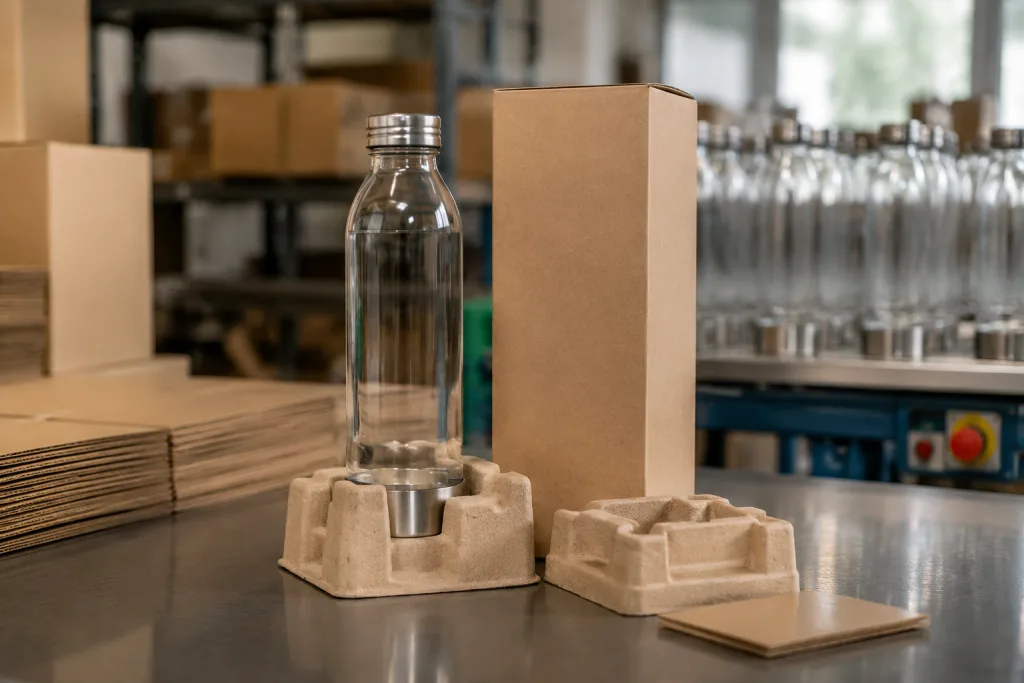
Ask for packaging line items in writing: box paper weight in gsm, insert material with thickness or mold type, carton ply and burst strength, carton size, units per carton, gross weight, plus pallet plan. A common setup is 350 gsm kraft box, molded pulp or EPE insert, 5-ply export carton, 24 pcs per master carton, with carton weight under 18 kg. If the bottle is 750 ml with a stainless infuser, 12 pcs per carton may be safer. Our warehouse QC in Zhejiang uses a carton scale and corner-compression check; cartons over 20 kg get rougher handling and show crushed corners after trucking to Ningbo or Shanghai.
For a borosilicate glass bottle promotional order, packaging is where buyers often cut the wrong cost. The math doesn't work. Saving USD 0.08 on inserts can turn into USD 0.40 in replacement cost after breakage, and we have seen this go sideways on a 5,000 pc promo run. Sustainable retailers usually prefer pulp inserts over foam, which is reasonable, but the insert still needs to lock the shoulder and base. QC pulled one sample last year where the paper wrap looked neat, then the bottle moved 6 mm inside the box during a table drop. Loose paper wrap is not enough for glass.
Barcode and label control needs its own PO line. If you sell through marketplaces, specify the FNSKU label size, exact placement in mm, scan grade, and whether labels go on the retail box or master carton. A customized glass water bottle with the wrong barcode becomes warehouse rework, not a factory problem, unless your PO made it one. We once had a buyer flag a PO typo where “master carton label” was written as “box label”; 36 cartons had to be reopened before shipment.
Approve bulk with evidence
Before shipment, ask for evidence, not reassurance. A solid borosilicate glass bottle supplier should send production photos, packing photos, carton marks, and inspection data before you release balance payment. At BottleForge Industrial in Hangzhou, Zhejiang, we run about 300,000 units per month across glass bottles, 304 stainless tumblers, and plastic sport bottles, but glass still gets treated as a higher-risk packing item than stainless. The line knows this. One missed inner divider can turn a clean order into 26 cracked bottles in the first carton we open. Capacity does not replace inspection.
Your pre-shipment inspection checklist should match the PO. Pull samples across finished cartons, not just from the top layer of one pallet. Check dimensions with a digital caliper, logo position against the approved artwork, color consistency under the same light box, cap fit, leakage, odor, glass bubbles, barcode scan, box print, carton drop result, and quantity count. For 3,000 pcs, a third-party inspection under ANSI/ASQ Z1.4 general level II usually checks around 125 pcs, depending on lot size and inspection plan. If you cannot inspect in China, require the factory to submit an internal QC report with photos and videos sorted by defect category. We have seen this go sideways when a buyer approved “packing looks okay” photos and later found the barcode was 2 mm too low for their warehouse scanner.
Shipping terms matter for glass. FOB Ningbo or FOB Shanghai is clean if your forwarder already handles drinkware. DDP works for smaller retailers, but compare duty, insurance, and who pays when 3 cartons fail the drop check at arrival. For borosilicate glass bottle wholesale programs, ocean freight is usually the only sane option above 1,000 pcs. Air freight can make a USD 3.20 bottle cost more than your retail margin allows. The math does not work. We ship glass with tighter carton fill, corner protectors, and a pallet label the warehouse can read without cutting the stretch film.
When the goods arrive, keep one sealed carton as a reference. If you reorder, your next PO should cite the approved order number, sample date, artwork version, and every correction. Small details save time: we once had a PO with “matte black lid” typed as “mate black lid,” and QC pulled the sample before production because the old reference carton was still sealed. That is how a borosilicate glass bottle customized program becomes repeatable instead of turning into a fresh argument every season.
Send your glass bottle RFQ for a line-item quote
Share capacity, cap structure, logo, packaging, MOQ, and destination market. We will return a practical China sourcing quote with sample timing.
Frequently asked questions
What does 304 stainless steel mean on a glass water bottle?
It usually means the cap shell, infuser basket, tea strainer, base cover, or decorative sleeve is made from 304 stainless steel. The bottle body is normally borosilicate glass. You should state the exact 304 stainless part in the RFQ because some suppliers may quote 201 stainless or plated steel to reduce cost. For food-contact areas, we recommend 304 stainless steel at 0.35-0.45 mm thickness, paired with food-grade silicone seals. Ask for material confirmation on the PO and keep one approved sample. If the metal part touches beverages, request LFGB or FDA food-contact documentation depending on your sales market.
What MOQ should I expect for private label borosilicate glass bottles?
For a standard borosilicate glass bottle custom order with logo and retail box, 1,000 pcs per SKU is a realistic MOQ in China. If you need a special glass mold, exclusive cap shape, or custom silicone sleeve color, MOQ can move to 3,000-5,000 pcs because the factory must set up glass forming, accessories, and packaging lines. Mixed colors are possible, but expect minimums such as 500 pcs per color. For first orders, we usually suggest one capacity and two colors at most. Too many SKUs make inspection and inventory harder before your sales data is proven.
How much does a custom glass water bottle cost wholesale?
A practical FOB China range is USD 2.20-4.80 for a 550-750 ml customizable borosilicate glass bottle with 304 stainless steel cap component, logo, and individual box. A basic clear bottle with simple cap and one-color logo sits near the low end. A bottle with infuser, silicone sleeve, laser cap logo, pulp insert, and color box moves higher. Tooling, sample, testing, and freight are separate unless quoted clearly. For a 3,000 pcs order, packaging can represent USD 0.25-0.70 per unit, so do not compare unit prices unless box and carton specs match.
Can I use glass bottles for Amazon FBA or e-commerce?
Yes, but packaging must be designed for parcel handling, not only pallet shipment. For FBA, specify FNSKU labeling, scannable barcode placement, individual retail box, and carton markings. A glass bottle should pass a practical carton drop check from 76 cm on faces, edges, and corners, though the exact protocol depends on your channel. We often recommend molded pulp or EPE inserts, 5-ply master cartons, and 12-24 pcs per carton depending on bottle size. Ask your borosilicate glass bottle suppliers to quote e-commerce packaging separately because it may add USD 0.15-0.45 per unit.
Which tests should sustainable retailers request before bulk shipment?
At minimum, request leak testing, visual glass inspection, cap fit check, odor check, logo adhesion check, barcode scan test, and carton drop review. For EU retail, ask about REACH and LFGB food-contact compliance. For US retail, request FDA food-contact statements and review Prop 65 exposure risks. If the bottle includes paint, coating, silicone, or printed decoration, test those materials too, not only the glass. Use AQL 2.5 for major defects and AQL 4.0 for minor defects on pre-shipment inspection. Critical defects such as broken glass, sharp rim, leakage, and wrong material should have zero acceptance.