Key Takeaways
- For hot-fill or tea use, specify borosilicate 3.3 and a wall thickness tolerance of ±0.2 mm.
- A normal MOQ for a custom glass water bottle is 3,000 pcs, with 7-10 days for samples and 25-35 days for production.
- A 304 lid still fails if the gasket, torque, or passivation is weak; ask for 0.8-1.2 N·m and 48-hour leak and salt-spray checks.
- Packaging can cut transit breakage below 1 percent if you use 5-ply cartons, pulp or 3 mm EPE dividers, and palletized export loading.
A wellness brand asking for a custom glass water bottle is usually not stuck on the silhouette. The pain shows up later: a shoulder crack after drop testing from 1.2 m, a cap that shows rust after 20 dishwasher cycles, or an export carton landing with 4 percent breakage. We see this on the line. QC pulled one sample last season where the silicone ring sat 0.6 mm proud, enough to make the lid feel “loose” in the buyer’s hand. A 304 stainless steel glass water bottle factory in Zhejiang should catch those problems before you pay for tooling.
In China, a decent supplier can make a clean sample. A serious manufacturer can repeat it across 3,000 or 30,000 pcs. The difference sits in the control plan: borosilicate material checks by batch, seal compression measured with a caliper, print cure checked after tape testing, export packing tested with a 15 kg carton drop. If you are buying borosilicate glass bottle bulk for retail or a borosilicate glass bottle promotional run, the wrong question is “Can you copy this sample?” Ask what tolerance they run, what AQL level they inspect to, and what happens when the buyer flags breakage in the first container.
Breakage Starts in the Glass
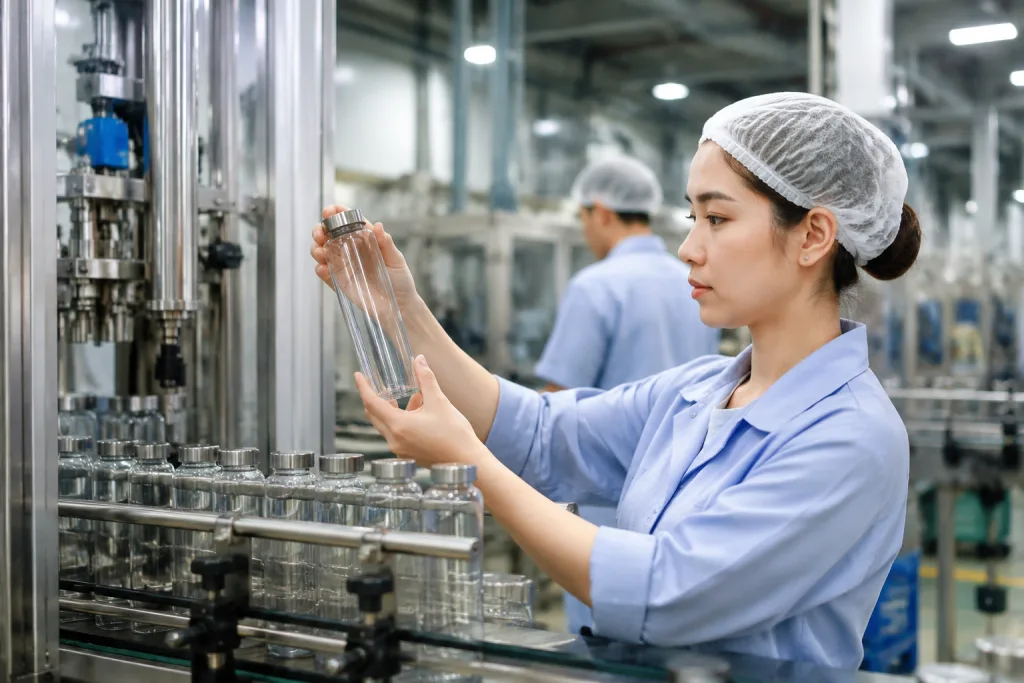
The first failure is not the logo. It is the glass body. We have seen bulk glass water bottle orders pass artwork approval, then lose 37 pieces in carton drop because the wall thickness ran from 1.8 mm to 2.6 mm. The bottle feels wrong in hand, and after 6 hot-cold cycles the crack usually starts near the shoulder or mouth. For hot-fill or tea use, specify borosilicate 3.3, not generic soda-lime. On a proper Zhejiang line, we run a digital thickness gauge around the body and keep wall thickness within ±0.2 mm. The neck matters too. Anneal it properly, or QC will pull the sample for microfractures around the mouth finish.
Do not sign off on a sample until the test method is written down. Ask for at least 5 pieces from 3 cavities, a 1 m drop test on the carton, and a thermal shock report showing the delta your bottle can survive. For a custom borosilicate glass bottle sold through wellness retail, 120°C thermal shock is a realistic target for borosilicate; soda-lime needs a softer spec, and the math does not work if the buyer wants tea use plus cheap glass. We had one PO where “borosilicate” was typed as “glass bottle” only, and the buyer flagged it after pre-shipment inspection. Too late. If the factory cannot explain why cavity 2 chips more than cavity 5, you are not buying from a glass bottle factory; you are buying luck.
304 Steel Is the Weak Link
304 steel looks straightforward until QC pulls 32 caps from the line and 5 come back with red spots around the thread. On a 304 stainless steel glass water bottle factory line, the trouble usually sits in the thread, the liner, or the plated logo ring. True 304 handles normal moisture, but weak passivation still rusts, and a shiny coating can hold rinse water under the edge. Ask for an XRF material check, a salt-spray result, and a torque window written on the spec sheet. For most screw caps, 0.8 to 1.2 N·m is enough; too loose leaks, too tight strips the liner.
The seal matters more than the steel. Food-grade platinum-cured silicone at 50 to 70 Shore A is the safe middle ground, and we check it with a Shore durometer before the gasket goes into mass assembly. If the bottle is for cold brew, juice, or tea, ask the factory to run inverted leakage for 8 hours and 50 dishwasher cycles. A lid can pass a 3-minute bench test, then fail after heat, soap, and repeated opening. We have seen this go sideways when the buyer approved the cap drawing but left the bottle mouth tolerance open. A borosilicate glass bottle custom project should specify the cap, the gasket, and the bottle mouth tolerance as one matched set, not three separate parts.
Decoration That Survives Washing
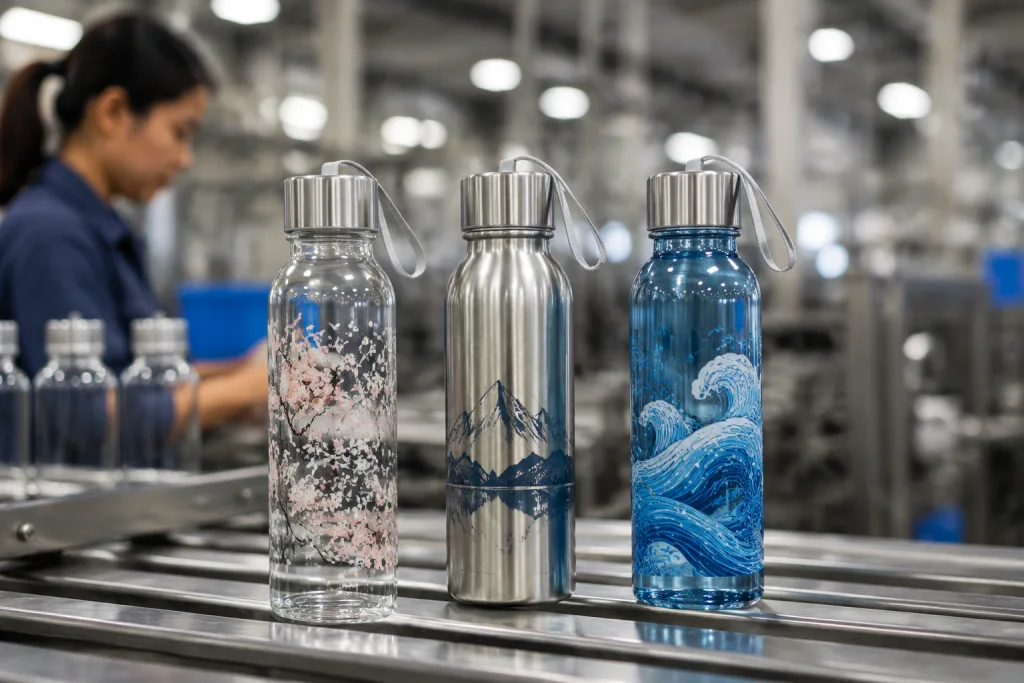
Decoration is where a lot of borosilicate glass bottle custom jobs go off the rails. We’ve seen the render look fine, then the wrap turns fuzzy on curved glass or starts lifting after one dishwasher cycle. On the line, QC will pull the first-off sample with a 10x loupe and check the edge before we approve anything. For retail work, start with 1 or 2 Pantone colors and one print panel. Ceramic ink on borosilicate needs the right firing curve; if the bake is too cold, the logo scratches, and if it runs too hot, the glass can warp at the print zone.
For a customized glass water bottle, ask for a daylight sample and a 4000K LED check. Buyers sometimes push back and call it overkill, but we’ve seen that shortcut go sideways when the white ink goes muddy or the wrap lands 1.5 mm off. Laser engraving on the 304 lid usually holds up better than chrome-style printing, but the stroke still needs to stay above 0.25 mm. For a borosilicate glass bottle promotional run, I’d take a clean two-color print and a recyclable paper belly band over a full-wrap layout that nobody can read after 3 washes.
Packaging Beats Pretty Photos
Glass usually breaks in the carton, not on the line. We see it at the base ring and shoulder after the outer carton is stacked 7 layers high, especially when a bulk borosilicate glass bottle sits in a soft inner tray. The fix is not sexy: a 5-ply export carton, molded pulp tray or 3 mm EPE divider, and orientation marks printed large enough for a warehouse guy to see from 2 meters away. For a 500 ml bottle, 12 or 24 pcs per carton is common; we run the choice by gross weight, carton bursting strength, and whether the cap is 304 stainless or plastic. Ask for the palletized load plan before mass packing, plus a drop test covering a 610 mm corner drop, a long-edge hit, and a bottom-face hit. QC pulled the sample after one test last month; the divider left a 1.5 mm rub mark on the coating.
If you sell online, reserve a flat label area for FNSKU or barcode before the artwork is approved. Do it early. We had one PO where the buyer approved the sleeve art first, then flagged “no scannable side” after 3,000 gift boxes were printed. That small blank panel saves repacking later. A serious borosilicate glass bottle wholesale program from China should keep transit breakage below 1 percent after sample shipments, and a stable supplier will tell you which cartons fail the compression tester before your warehouse sends photos from destination. Skipping packaging specs is the wrong place to save money; the math goes sideways fast when chargebacks, replacements, and second freight cost more than the bottle itself.
Factory Controls You Can Audit
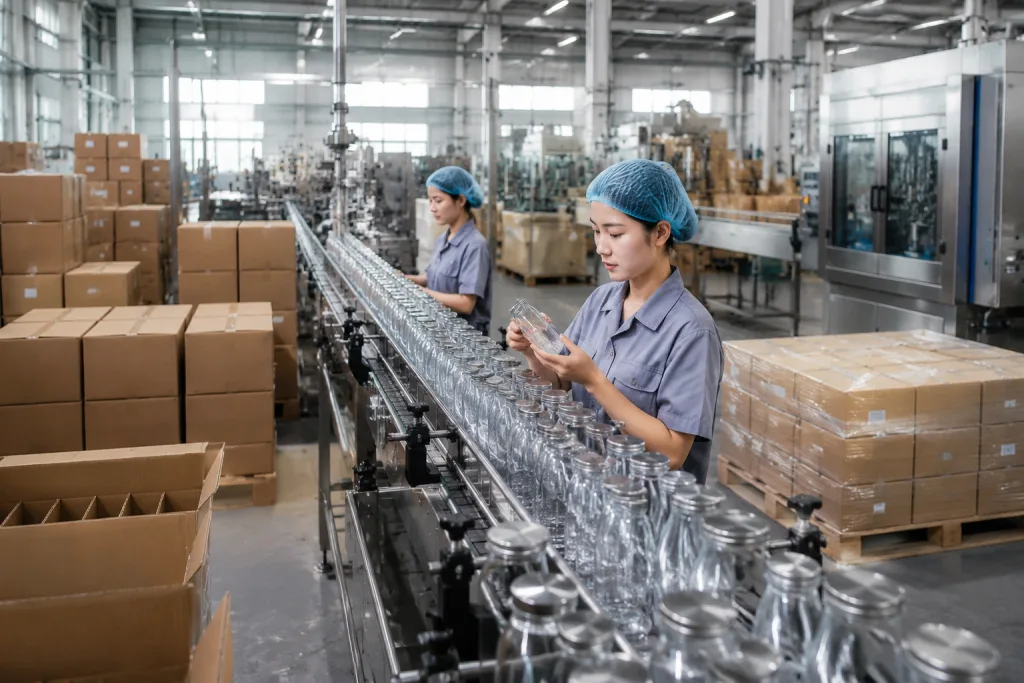
Do not judge the factory by the showroom. Judge it by the checkpoints they record every shift. A borosilicate glass bottle factory in Zhejiang should be able to show incoming glass tube inspection, forming checks at the IS machine or lampworking station, annealing oven charts, decal or screen-print inspection, and final packing AQL sheets. For export work, AQL 2.5 for major defects and 4.0 for minor defects is a normal starting point. Ask who signs off on cavity numbers, neck concentricity within 0.3 mm, and lid fit with the 304 stainless cap after torque testing. If one supervisor says he handles all of it, the process is too loose for a wellness brand placing repeat orders. We have seen this go sideways when QC pulled the sample and found 11 tilted necks in one 200-piece check lot.
What a solid factory should be able to state on day one:
- Monthly capacity: 300,000 units for standard shapes, based on 2 running lines and a 26-day production month
- MOQ: 3,000 pcs per SKU, 5,000 pcs if tooling changes, with the mold drawing locked before deposit
- Lead time: 7 to 10 days for samples, 25 to 35 days for mass production after artwork and lid color approval
- Compliance: REACH, LFGB, food-contact paperwork, and a social audit such as BSCI, with test reports matching the bottle, lid, gasket, and sleeve materials
If the supplier cannot quote those numbers without calling 3 departments, you are probably dealing with a trading layer, not a borosilicate glass bottle manufacturer in China. Small clue: last April a buyer flagged a PO where the factory name was typed one way on the proforma invoice and another way on the carton mark file. That is the wrong risk to take before you wire a 30% deposit.
Commercial Terms That Protect Margin
The commercial trap is chasing the lowest FOB line. Wrong question. A Zhejiang quote for a plain 500 ml custom glass water bottle with a 304 lid might sit around USD 1.10 to 1.80 FOB at 3,000 pcs, while a printed or customized glass water bottle can add USD 0.08 to 0.25 per color and a tooling charge of USD 500 to 1,500 for a new cap or carton insert. That is normal. What is not normal is a one-line quote that hides the parts cost. Last month our costing sheet showed the 304 lid at USD 0.32, the silicone ring at USD 0.035, and the buyer still asked why the quote was not USD 0.98 like a soda-lime bottle offer from Yiwu. The math does not work. If the borosilicate glass bottle supplier will not break out print, packaging, or overrun rules, somebody is protecting margin where you cannot see it.
Ask for separate lines for bottle body, 304 parts, silicone gasket, decoration, packaging, and freight terms. FOB Ningbo or FOB Shanghai gives the cleanest comparison when you are buying from China; we ship both, but Ningbo is 2 days faster for our Hangzhou line in a normal week. Whether you buy from a borosilicate glass bottle supplier, vendor, or distributor, ask for factory test data from the last production run, not a nice sample from the sales shelf. QC pulled one 500 ml bottle sample in March with a 1.6 mm glass wall at the shoulder when the PO said 2.0 mm minimum. That becomes a claim fight if the contract is loose. A real commercial agreement names the claim window, spare breakage percentage, and replacement rule for the first shipment, so the retail program keeps moving without renegotiating every order.
Spec your next bottle run with fewer surprises
Send your size, lid style, print area, and target MOQ. We can quote a China-built sample plan that matches retail, wholesale, or FBA needs.
Frequently asked questions
What MOQ should I expect for a custom glass water bottle?
A typical MOQ for a custom glass water bottle from a Zhejiang factory is 3,000 pcs per SKU for a standard body with one-color print. If you change the cap mold, expect 5,000 pcs or more. For a full customized glass water bottle with new packaging, the first run can sit at 5,000 to 10,000 pcs because the line needs setup time. Samples usually take 7 to 10 days, and mass production 25 to 35 days after approval. If a borosilicate glass bottle supplier offers 500 pcs with custom tooling, the quote usually hides cost in freight or decoration. Ask for a split between bottle, lid, print, and carton.
Is borosilicate worth the extra cost for retail bottles?
Yes if you expect hot and cold swings or repeated washing. Borosilicate 3.3 has much better thermal shock performance than soda-lime. On a wellness shelf, the premium is often USD 0.18 to 0.40 per bottle depending on volume and cap style. If you sell cold water only and want the lowest landed cost, soda-lime may be acceptable, but you must tighten packaging and breakage allowance. For tea, infused water, and premium retail, the lower break rate usually pays back the extra cost on the first container. Ask the factory for a heat-shock test and compare breakage, not just unit price.
Will 304 stainless steel rust on a glass bottle lid?
304 stainless steel can rust if plating, passivation, or moisture retention is poor. The metal itself is fine for most bottle caps, but the finish needs cleaning and passivation. Ask for material certs and a salt-spray result of at least 48 hours for decorative parts. If your bottle sees dishwasher heat, acidic drinks, or coastal distribution, 316 on the cap may be smarter than 304, though it costs more. The gasket and thread design matter just as much. A leaking lid often comes from a bad liner, not the steel grade. Request an inverted leak test and a torque spec before you approve production.
What compliance documents do I need for Europe and North America?
For Europe, ask for REACH and LFGB food-contact compliance for the bottle system, plus documentation for inks, silicone, and any metal parts. For North America, keep FDA food-contact paperwork on file and make sure any material claims are supported. BSCI or another social audit helps if you need retailer compliance, but it does not replace product testing. If you sell through Amazon or wholesale chains, your compliance pack should also include carton dimensions, net and gross weights, HS code guidance, and a clear declaration of materials. One missing document can delay a container by a week.
How do I keep transit breakage under 1 percent?
Start with the carton, not the bottle. Use molded pulp or 3 mm EPE, a 5-ply master carton, and pallet wrap that locks corners. Keep the bottle from touching bottle. For a 500 ml SKU, many buyers target under 1 percent breakage in sea freight if the pack-out is disciplined. Ask the factory for a drop test, carton compression test, and a written spare breakage allowance of 0.5 to 1.0 percent in the purchase order. If you are shipping FNSKU-labeled units, test the label placement before mass print. The cheapest bottle becomes expensive once you repack 10,000 pieces.