Key Takeaways
- Typical MOQ is 1,000-3,000 pcs per SKU for a custom borosilicate glass bottle with 304 stainless steel lid
- A serious RFQ should define glass capacity, wall thickness, lid grade, logo method, packaging, and AQL level
- Pre-production samples usually take 7-12 days after artwork and deposit approval
- For retail programs, reserve 35-50 days for bulk production plus 25-40 days ocean freight to Europe or North America
A 304 stainless steel glass water bottle custom project looks simple until the RFQ hits the sales desk. You are not buying only a bottle. You are locking down 1.8 mm or 2.0 mm borosilicate glass, 304 lid tooling, silicone ring compression, logo adhesion after 3M tape testing, carton drop survival, and a ship date tied to your retail launch.
For wellness brands and sustainable retailers, choosing glass is not the problem. The wrong move is sending a loose quote request to 3 factories in China, then comparing prices that do not cover the same lid, sleeve, carton, logo process, or AQL 2.5 inspection level. We see this go sideways. Last month, a buyer flagged a $0.32 gap that disappeared once QC pulled the sample and found one offer used a thinner sleeve and no inner tray. Here is the practical sourcing path we run in Zhejiang, from RFQ to sample to bulk PO.
Start With A Real RFQ
Your RFQ decides whether you get usable pricing or a messy spreadsheet full of guesses. For a 304 stainless steel glass water bottle custom order, don’t write “500 ml glass bottle with logo” and expect a firm quote. This is the wrong question to ask. A borosilicate glass bottle manufacturer prices from capacity, glass tube diameter, wall thickness, lid structure, silicone parts, sleeve material, logo process, carton strength, and compliance documents; our caliper check on a recent 500 ml sample showed 2.1 mm glass at the shoulder and 2.4 mm at the base, which changed the carton drop-test result.
A clean RFQ should include these PO-style line items from day one. Short beats clever.
- Product: custom glass water bottle, high borosilicate glass body, 500 ml or 750 ml, with target finished weight if your freight budget is tight.
- Glass: borosilicate, 2.0-2.5 mm wall thickness, clear or tinted, plus the outside diameter in mm if it must fit a car cup holder.
- Lid: 304 stainless steel outer cap, food-grade PP inner insert, LFGB silicone gasket, with thread type confirmed by sample or drawing.
- Decoration: 1-color screen print, laser marking on lid, or decal print, with artwork in AI or PDF and Pantone code, not a low-res JPG pasted into a PO.
- Packaging: kraft retail box, instruction card, 5-ply export carton, barcode label, and carton drop-test requirement if Amazon or club retail is involved.
- Compliance: LFGB, REACH, FDA food contact, Prop 65 if selling into California, with the exact market named so we quote the right test package.
- Inspection: AQL 2.5 for major defects, AQL 4.0 for minor defects, including leak test, lid scratch check, print adhesion tape test, and carton barcode scan.
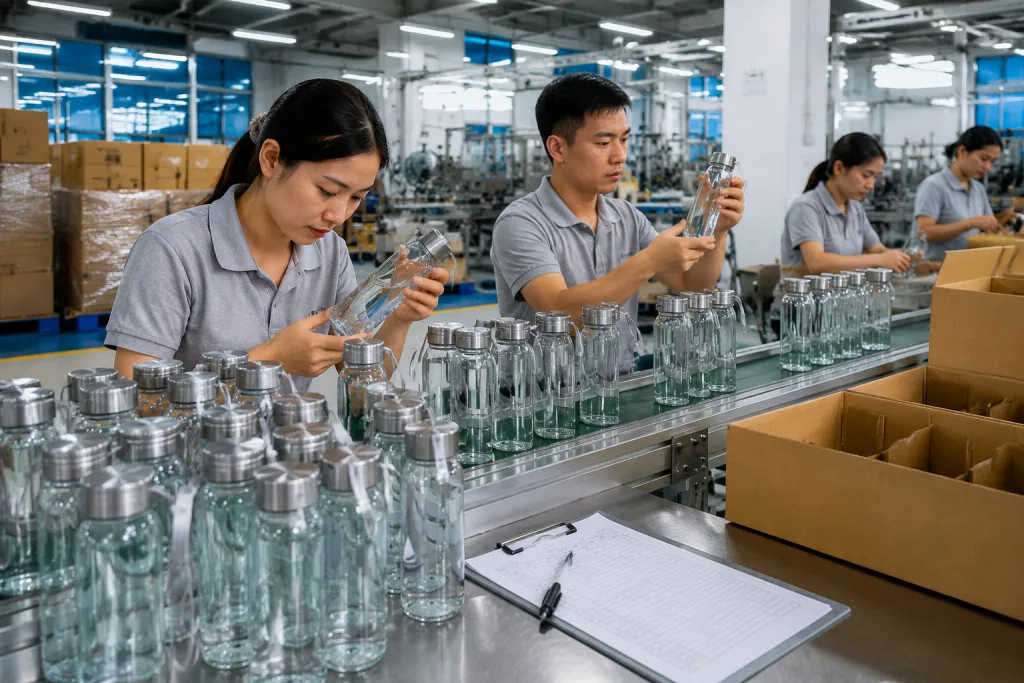
At BottleForge Industrial in Hangzhou, Zhejiang, our glass bottle line handles about 180,000 units/month across standard and custom items. For borosilicate glass bottle bulk programs, we usually quote FOB Ningbo or Shanghai, with MOQ from 1,000 pcs for existing molds and 3,000-5,000 pcs if you need a new diameter, unique lid shape, or exclusive sleeve color. We’ve seen this go sideways: one buyer sent a PO with “mat black” instead of “matte black,” QC pulled the sample before mass packing, and that typo still cost 6 days on approval.
Choose The Bottle Architecture
About 7 out of 10 RFQs we see get stuck on the phrase “stainless steel glass bottle.” The drinking chamber is glass; the 304 stainless steel normally sits on the lid shell, tea infuser, base cover, carry loop, or protective sleeve parts. If a vendor claims the whole bottle is stainless and glass at the same time, ask for a cross-section drawing with wall thickness marked in mm. We had one PO last year with “304 glass body” typed in the spec line, and QC pulled the sample before mass production because the buyer and supplier were talking about two different structures.
For wellness retail, borosilicate is usually the right glass because it handles temperature shock better than soda-lime glass. It is still glass. Not magic. A 2.0 mm wall is lighter and cheaper, while 2.5 mm feels more premium and survives carton drops better on the line. A 500 ml bottle with 2.0 mm borosilicate glass and a 304 lid might land around USD 2.10-2.80 FOB China before premium packaging. A thicker 750 ml customized glass water bottle with silicone sleeve, infuser, and gift box may move into the USD 3.20-4.80 range. In our Hangzhou workshop, the caliper check on incoming glass tubes often decides whether the batch runs smoothly or gives us chipped mouths at assembly.
Define the architecture before requesting samples. This is the wrong question to ask: “What is your cheapest stainless steel glass bottle?” Ask which part is glass, which part is 304 stainless steel, where the gasket sits, and what MOQ applies for sleeve color. For most custom projects we run, 1,000 pcs works for stock glass with logo printing, while a new silicone sleeve color often needs 3,000 pcs because the color masterbatch and mold setup have their own cost.
- Body: straight cylinder is cheaper and faster to inspect; curved shoulders need tighter forming control, and we usually allow higher scrap after the annealing oven check.
- Mouth: 38-45 mm is common for drinking; 55-60 mm works better for fruit and ice, but the buyer should approve the cap feel with a real hand sample.
- Lid: 304 stainless steel shell with PP inner core is more stable than all-metal contact designs, because the thread fit stays cleaner after hot water testing.
- Seal: removable silicone gasket should pass odor testing after hot water exposure; QC normally opens the lid after 2 hours and smells the gasket, not the carton.
- Protection: silicone sleeve reduces breakage but adds tooling cost and color tolerance work, especially when a Pantone number looks different under warehouse LED lights.
A good borosilicate glass bottle supplier should explain the trade-offs, not push the lowest unit price. We’ve seen this go sideways: the buyer saved USD 0.18 per piece on thinner glass, then lost more on replacement claims after retail shelf drops.
Lock Decoration Before Sampling
A customizable borosilicate glass bottle can take screen print, decal, laser, or pad print, but glass and 304 stainless react differently on the line. Approving only a photo mockup is the wrong question to ask; we need the process locked before sampling. Last month QC pulled the sample under a D65 light box: the logo looked black in the office, then showed a green cast after the first 3M tape test.
Screen printing is still the workhorse for a custom borosilicate glass bottle. It is cost-effective at 1-2 colors and fits clean wellness branding, especially logos under 60 mm wide. Expect a setup charge of USD 45-90 per color and a logo MOQ near 1,000 pcs. Decal printing handles gradients and wraparound art better, but it costs more and needs firing or curing control; we run a temperature chart on the oven because a 10°C drift can change adhesion. Laser engraving on a 304 stainless steel lid is clean and durable, often USD 0.08-0.18 per piece depending on area. Pad printing works on curved lids, though the buyer may flag it as less premium.
Your sample PO should name the exact decoration. Be precise. We have seen this go sideways when a PO said “dark green logo” and the artwork file used Pantone 5535 C while the email screenshot looked closer to 5605 C.
- Item: borosilicate glass bottle customized with 1-color screen print, Pantone 5535 C.
- Logo size: 45 mm wide on front center, 70 mm from base.
- Lid marking: laser engraved logo on top, 22 mm wide.
- Artwork file: AI or PDF vector, outlines converted, 1:1 scale.
- Test request: 3M tape test, 24-hour water soak, 50-cycle hand wash check.
If you are a borosilicate glass bottle distributor serving 3 retail accounts or more, keep artwork zones consistent across sizes. It cuts sample repeats and avoids a separate MOQ for every SKU. On our side, the jig plate is easier to hold at the same front-center position, and that saves arguments when the buyer checks a 2 mm logo shift with a ruler.
Sample Like You Mean It
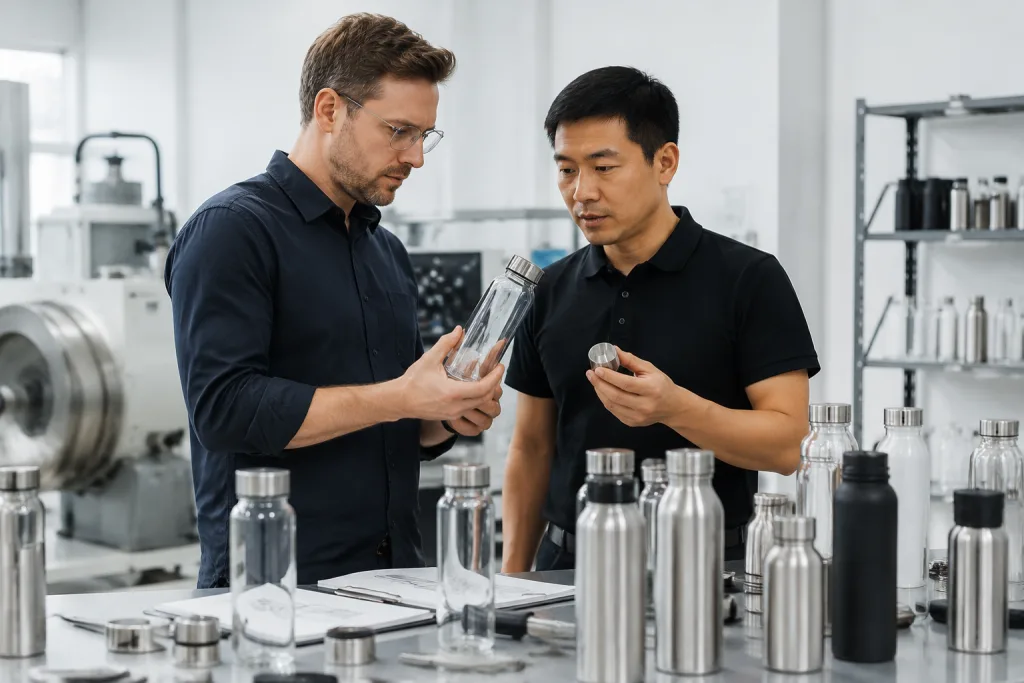
Sampling is not photo approval. It is where you catch the defects that cost money after the bulk glass is blown, printed, and packed into export cartons. For a borosilicate glass bottle custom project, request at least 3-5 physical samples: one for your office, one for drop and leak checks, one for the retailer or buyer, and one retained by the factory as the golden sample. QC pulled one sample last month with the silk-screen logo sitting 1.5 mm off center; the PDF looked fine, the bottle did not.
A normal sample timeline in Zhejiang is 7-12 days for existing molds with custom logo and 18-25 days if a new lid insert, sleeve tooling, or packaging structure is needed. Sample cost usually ranges from USD 80-250 for decorated existing products and USD 500-1,500 when silicone sleeve tooling or special cap components are involved. Around 6 of 10 borosilicate glass bottle vendors will refund part of the sample charge after a bulk PO above 3,000 pcs, but write that into the proforma invoice. We run into trouble when the buyer assumes “sample refund” means full refund; the math does not work once CNC sleeve tooling and 304 stainless steel cap trials are booked.
Your sample PO line items should include:
- Quantity: 5 pcs finished samples, same as proposed mass production, packed from the line, not hand-picked from a display shelf.
- Materials: borosilicate glass, 304 stainless steel lid shell, food-grade PP, LFGB silicone, with gasket hardness checked by durometer if the lid design is new.
- Packaging: final retail box, insert card, carton label mockup, including barcode size and one printed carton mark for the buyer to scan.
- Checks: leak test inverted for 4 hours, lid torque check, odor check after 80°C water, plus thread fit checked with the same cap used for bulk production.
- Approval rule: no bulk production before signed sample approval and color confirmation, with the signed bottle photo attached to the PO file.
Do not approve bulk production from a render. Short sentence, serious rule. For a bulk glass water bottle launch, the physical sample is your contract reference when arguments happen later. We have seen this go sideways when a buyer flagged the sleeve color after 12,000 pcs were packed, while the only “approval” on file was a glossy 3D image.
Build The Bulk Purchase Order
The bulk PO is where 6 out of 10 sustainable retailers get too loose. A factory quote is not a production instruction. Your PO needs to turn the approved sample into measurable items: bottle height in mm, sleeve Pantone, lid material, carton spec, barcode position. This protects you and the borosilicate glass bottle factory because the line will follow the paper, not the buyer’s memory. We have seen this go sideways from one typo on a PO: “304 lid” approved, but the attachment said “201 lid.” QC pulled the sample before packing, luckily.
For a 5,000 pc custom glass water bottle order, we run a PO structure like this:
- SKU: 500 ml borosilicate glass bottle wholesale, clear body, sage silicone sleeve, 304 stainless steel lid. Add the approved sample photo and sleeve color code, not just the color name.
- Unit price: USD 3.05/pc FOB Ningbo, including retail box and export carton. State whether the price includes the barcode sticker and silica gel bag.
- Quantity tolerance: +/-3% accepted due to glass production yield. Glass blowing and annealing loss is real; asking for exact 5,000 pcs is the wrong question to ask.
- Payment: 30% deposit, 70% after passed final inspection before shipment. We release the booking only after the balance lands or the payment slip is confirmed.
- Production lead time: 40 days after deposit, artwork, and golden sample approval. If artwork approval takes 6 days, the clock starts 6 days later.
- Carton: 24 pcs/carton, 5-ply K=A export carton, gross weight below 16 kg. Our packing team checks this on the digital scale before sealing the first master carton.
- Inspection: third-party PSI allowed at buyer cost, AQL 2.5/4.0. Put the inspection window on the PO so the line does not pack everything before the inspector arrives.
If you sell through borosilicate glass bottle distributors or private label accounts, add FNSKU, EAN, or retailer label placement to the PO. For Amazon-style prep, cartons need one SKU per carton, suffocation warnings for polybags, and scannable outer labels. Small line items. Big delay risk. We had one buyer flag an outer label printed 8 mm too low; repacking took 12 hours and pushed the Ningbo cutoff from Friday to Monday.
Be careful with rock-bottom prices from borosilicate glass bottle suppliers. The math often comes from thinner glass, 201 stainless instead of 304, weak retail boxes, or no final inspection. On the factory floor, that usually shows up as a 0.8 mm lighter wall, loose lid threading, or a retail box that crushes under a 16 kg carton stack. Cheap is fine. Hidden cheap is not.

Control Quality Before Shipment
Glass bottle QC is not the same job as checking stainless tumblers. On the line, QC looks for cracks, bubbles, stress marks, rim deformation, sharp edges, poor annealing, lid leakage, silicone odor, print scratches, and box crush strength. We use a polarizing stress viewer for annealing marks and a 0.2 mm feeler gauge on rough rims. Small seed bubbles happen in borosilicate glass production. Large bubbles within 15 mm of the rim or sitting in the base are retail rejects, and buyers usually flag those first in shelf photos.
Run a pre-shipment inspection when production is 100% finished and at least 80% packed. For a distributor glass water bottle order, pull samples under ANSI/ASQ Z1.4 or ISO 2859-1 sampling, then check capacity verification, unit weight, mouth diameter, lid fit, inverted leak test, logo position, barcode scan, carton drop, and metal material confirmation. If the lid is claimed as 304 stainless steel, ask for a supplier material declaration and consider an XRF spot test for large orders above 10,000 pcs. We had one PO typo last season: “304” on the artwork file, “201” on the lid spec sheet. QC pulled the sample before packing, which saved a full rework.
Set defect rules clearly before mass packing starts. The wrong question is “Does it look okay?” The right question is whether the defect blocks sale, causes a claim, or only affects appearance under close inspection.
- Critical: cracked glass, sharp rim, contamination inside bottle, wrong material contact parts.
- Major: leakage, badly tilted logo over 2 mm, wrong Pantone beyond tolerance, crushed retail box.
- Minor: small cosmetic bubble away from drinking area, slight sleeve flash under 1 mm, tiny print dot.
Our China export team normally schedules inspection 3-5 days before vessel cutoff. That gives the factory 1 day to replace cartons, 1 day to rework labels, and 1 day to sort obvious defects before the truck booking. Tight timing goes sideways. If your launch date is fixed, do not put inspection on the same day the container must leave the factory; we ship cleaner when QC has breathing room.
Plan Freight And Reorders
Glass is heavy, breakable, and cartons cannot be guessed. A 500 ml borosilicate bottle with 304 lid and box may weigh 420-550 g per unit before master carton, so a 24 pcs master carton can pass 12 kg after dividers and outer box. We run 5-layer export cartons and ask QC to pull one carton for a 48 cm drop check when the buyer changes the gift box paper. Air freight works for urgent samples or 200-500 pcs pilot lots. For a full borosilicate glass bottle wholesale order, the math does not work. Ocean freight is the normal route for Europe and North America.
For planning, allow 25-35 days port-to-port from Ningbo or Shanghai to major North American ports, and 30-40 days to European ports such as Rotterdam and Hamburg, depending on routing. Add 7-14 days for trucking, customs, warehouse receiving, and retailer booking. That last step gets missed. We had one buyer lose 6 days because the carton label said “glass botttle” on the PO artwork and the retailer asked for a relabel before delivery. If your order is going to a sustainable retail chain, build in time for packaging compliance review and carton label approval before mass packing.
Reorders should be easier than the first order, but only if the technical file stays alive. Save the approved artwork; Pantone codes with coating method; lid drawing with gasket size in mm; sleeve material and thickness; carton dieline; inspection report; golden sample photos from the light box. QC pulled the sample for one repeat order last year and found the bamboo-grain lid print had shifted 2 mm from the approved batch. If you are working as a borosilicate glass bottle vendor or distributor borosilicate glass bottle program manager, create a reorder PO that references the previous batch number and any corrective actions.
For stable SKUs, we suggest 60-90 days of inventory cover. Glass production slots in China get tight before Chinese New Year, usually from late December through February, and the line will not stop a 30,000 pcs run to squeeze in a late 3,000 pcs sleeve reorder. We have seen this go sideways. Place replenishment POs early if you cannot accept an 8-10 week gap on shelf.
Send Us Your Glass Bottle RFQ
Share capacity, lid design, logo method, MOQ, and destination. We will return a practical FOB quote with sampling and production timing.
Frequently asked questions
What MOQ should I expect for a 304 stainless steel glass water bottle custom order?
For an existing borosilicate glass body with a 304 stainless steel lid, expect 1,000-3,000 pcs per SKU as a realistic MOQ. If you need a custom silicone sleeve color, special retail box, or new cap color, 3,000 pcs is more common. New glass molds or exclusive lid tooling usually start at 5,000 pcs and may include tooling fees from USD 800 to USD 3,500. If a supplier offers 200 pcs with full customization, check whether they are using stock bottles, digital stickers, or manual repacking rather than true mass-production decoration.
Is borosilicate glass better than regular glass for retail bottles?
For reusable drinkware, borosilicate glass is usually better because it tolerates temperature changes more reliably than standard soda-lime glass. It is suitable for hot tea, infused water, and wellness use cases where consumers may pour warm liquid into the bottle. That does not mean it is unbreakable. We normally recommend 2.0-2.5 mm wall thickness for retail bottles, with silicone sleeves for travel-oriented SKUs. Ask your borosilicate glass bottle manufacturer for thermal shock test conditions, not just the word “heat-resistant” in a catalog.
Can I use 304 stainless steel for every metal part?
Yes, but specify it clearly. Many bottles use 304 stainless steel for the outer lid shell, tea infuser basket, or base trim, while the inner lid structure may be PP because it seals better and reduces metallic taste. Your PO should say “304 stainless steel for all metal food-contact parts” if that is required. For larger orders, request a material declaration and consider XRF testing. Avoid vague terms like “stainless lid” because some factories may use 201 stainless for decorative outer parts to reduce cost by a few cents.
What certifications do glass water bottle buyers usually need?
For Europe, buyers often ask for LFGB food-contact testing, REACH declarations for restricted substances, and packaging compliance. For the United States, FDA food-contact compliance and Prop 65 review are common, especially if selling in California. If the product is for children, discuss CPSIA and ASTM requirements early, although most glass bottles are not ideal for young kids. Factory audits such as BSCI or Sedex may be required by retailers. Testing costs vary, but a practical budget is USD 300-900 per material set and colorway.
How long does a custom glass water bottle project take from RFQ to shipment?
A normal project takes 8-12 weeks before ocean transit. RFQ and quote alignment may take 3-5 working days. Decorated samples usually need 7-12 days for existing molds, or 18-25 days with new sleeve or cap components. Bulk production is typically 35-50 days after deposit and sample approval. Pre-shipment inspection and booking add 3-7 days. Then ocean freight from China to Europe or North America commonly takes 25-40 days port-to-port, plus customs and local trucking.