Key Takeaways
- Use 2.0-2.5 mm borosilicate glass for most retail bottles; thinner glass saves about USD 0.12 but raises breakage risk
- 304 stainless steel should be specified for lid contact surfaces, not just described as a metal cap
- A practical MOQ for custom glass water bottle projects is 3,000 pieces per size, with 30-45 day production after sample approval
- Ask for AQL 2.5/4.0 inspection, REACH/LFGB support, and carton drop testing before paying the balance
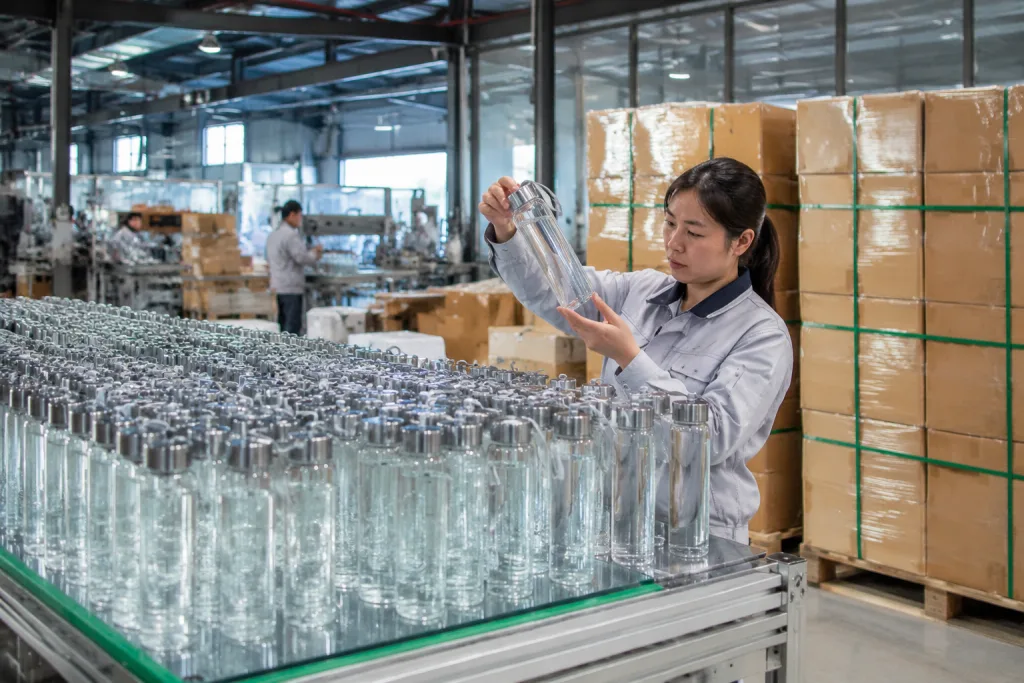
A glass bottle looks simple until you buy 5,000 pieces and QC pulls 37 leaking samples from the first sealed carton. Then the small stuff gets expensive: lid thread tolerance, silicone sleeve odor, inner gasket hardness, and whether the master carton survives a 76 cm drop test. For wellness brands and sustainable retailers, the wrong question is “glass or steel?” The real check is glass grade, 304 stainless steel cap structure, decoration yield, and whether the supplier can run the same result again on the next PO.
At our Zhejiang drinkware factory in China, we see buyers get stuck on four choices before deposit: borosilicate thickness in mm, cap material, logo process, and packing standard. Last month a buyer flagged a typo on the PO—“304 stainles”—but missed the sleeve smell limit, so QC had to hold 1,200 sets after the line packed them. If you are sourcing 304 stainless steel glass water bottle bulk orders, treat these choices as risk controls with cost, lead time, and claim exposure attached.
Start With Four Sourcing Decisions
Before you ask a borosilicate glass bottle supplier for a quote, pin down what the bottle has to do on the shelf. A yoga studio retail bottle, a wellness subscription gift, and a grocery chain reusable bottle need different specs, cartons, and price targets. We’ve seen this go sideways: one buyer sent a PO with “glass bottle, stainless lid” and no sleeve thickness, then rejected the sample because the 72 mm body felt too fat for their retail display tray. If you quote everything as one generic bulk glass water bottle, you usually get the cheapest middle-ground product, and nobody is happy.
Start with capacity. For North America, 500 ml and 750 ml move well because they fit most cup holders and gym bags; our caliper check usually keeps the bottle body under 74 mm for that reason. In Europe, 550 ml and 650 ml are common for sustainable retail sets, especially with kraft box packaging. Then set the glass wall thickness. Most borosilicate glass bottle bulk projects we run use 2.0-2.5 mm wall thickness. A 1.8 mm wall can cut unit cost by roughly USD 0.08-0.15, but the math doesn’t work if your e-commerce carton sees 1.2 m drop tests and the breakage claim lands back on you.
Next is the lid. A 304 stainless steel lid sounds premium, but define the exact 304 stainless part: inner contact plate, outer shell, or full cap assembly. QC pulled the sample on one order because the magnet stuck hard to the outer cap; the buyer had approved “304 lid” but the factory used 201 stainless outside with a plastic inner liner. That may pass for a low-cost promotional order. It will not fit a wellness brand selling a clean-material story, especially if the product page says 304 stainless and glass only.
Last, lock the branding method. A borosilicate glass bottle custom order can use screen printing, decal, laser engraving on the steel cap, silicone sleeve debossing, or paper band packaging, but each route changes MOQ, lead time, and defect rate. On the line, screen print registration is checked with a simple jig, and a 0.5 mm logo shift already looks bad on clear glass. Laser caps are cleaner for small logos; sleeve debossing works better when the MOQ reaches 3,000 pcs per color. Fix these four decisions first, then compare factory quotes line by line.
Choose Glass Grade And Thickness
For a reusable drink bottle, high borosilicate glass is the practical choice. It handles temperature change better than soda-lime glass and gives a clearer, lighter feel. A decent borosilicate glass bottle manufacturer in China should spell out the composition range, annealing curve, and thermal shock test method. If the answer is only “high quality glass,” that is the wrong question to ask. On our side, QC checks the lot with a thickness gauge before we release it.
Most borosilicate bottles are built for cold and warm drinks, not boiling-water abuse. We normally specify thermal shock testing around 80°C temperature difference for standard models. If your brand wants tea, lemon water, or infuser use, ask for a real sample test instead of taking catalogue claims at face value. For one infuser run, the buyer flagged a loose cap gasket, and we had to retest the glass tube, filter, and seal together on the line.
Wall thickness is where buyers over-optimize. A 2.0 mm bottle feels light and keeps freight cost lower. A 2.5 mm bottle feels more solid and usually survives retail handling better. For Amazon-style parcel shipping, we often recommend 2.3-2.5 mm plus an individual kraft box with molded pulp or EPE protection. The math does not work if you chase a thinner bottle and then pay for breakage on a 10,000 pcs shipment. For palletized distributor glass water bottle programs going to stores, 2.0-2.2 mm may be acceptable if the inner tray and master carton are strong.
Capacity tolerance also matters. A 500 ml bottle may measure 500 ml to overflow, or it may hold 500 ml at a usable fill line. Ask your borosilicate glass bottle factory to define this on the spec sheet. We once saw a PO typo that listed “500ml usable” in one column and “500ml overflow” in another, and that kind of mess turns into claim disputes later. For regulated retail claims, sloppy capacity wording brings returns and relabeling costs fast.
Specify The 304 Steel Cap
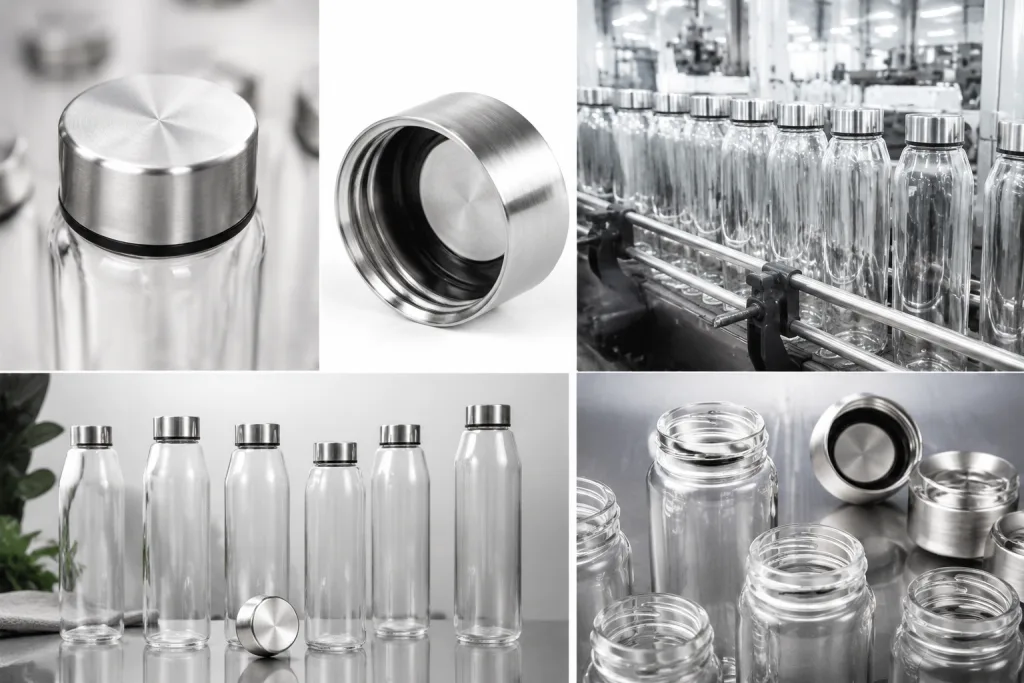
The phrase 304 stainless steel glass water bottle bulk should mean a real part spec, not “glass bottle with a silver lid.” On the purchase order, list 304 stainless steel for the liquid-contact or vapor-contact part, then name the plastic insert separately if there is one. If the cap uses a PP or Tritan inner plug, ask for food-grade grade and the migration test report. If it uses a stainless inner plate, confirm whether it is SUS304 and ask for LFGB, FDA, or EU food contact documents before you lock the order. We check this at the sample room with a caliper, because a 0.2 mm mismatch on the insert is enough to cause a bad fit later.
There are three cap builds we see every week. A full stainless cap is heavier, costs more, and gives a premium feel. A stainless outer shell with PP inner thread is usually the safer tradeoff; the molded thread stays consistent, and the seal is easier to control on the line. A bamboo-and-stainless cap works for sustainability branding, but bamboo moves with moisture, so the sealing stack needs more care and dry storage at the warehouse. One buyer once pushed for bamboo because “it looks cleaner”; that is the wrong question to ask if the goods will sit in transit for 45 days.
Gaskets do more work than most buyers think. Food-grade silicone is standard, usually 50-60 Shore A hardness. Too soft, and the cap can over-twist past the seal. Too hard, and small glass-thread variation starts to leak. We run leak testing with filled bottles inverted and shaken on a 1.2 m bench, and for export orders the test method should be written into the spec sheet, not left as “no leak” in a chat message.
For a customized glass water bottle with a carry loop, check pull strength before you approve the artwork. A small stainless ring may look fine in product photos, then fail after a few weeks of daily use. We have seen the buyer flag a broken loop on a USD 14.99 bottle faster than any other complaint. If the loop is part of the sales point, ask for a pull test standard and sample approval on the actual hook, not a loose ring from another model.
Decide Branding Before Quotation
Decoration is not a finishing touch. It changes the route on the line. A custom borosilicate glass bottle with one-color screen print is a clean job and usually works from 3,000 pieces per design; we run the mesh screen, check logo height with a 0.5 mm tolerance, then send it through curing. Multi-color printing needs tighter registration, and 5,000 pieces is usually the point where the setup math starts to work. Full wrap decals sell well for lifestyle bottles, but they add firing or curing, plus extra checks for bubbles, edge lift, and color shift.
Laser engraving belongs on the 304 stainless steel cap, not the glass body. The mark stays permanent and looks premium, with a setup charge around USD 45-80 per logo in most cases. QC pulled the sample last month because a buyer’s logo was 1.8 mm off-center on a brushed cap, so we now confirm cap artwork with a flat layout before tooling. Screen printing on glass may cost about USD 0.06-0.18 per color depending on logo size and order quantity. If you add a silicone sleeve for grip and impact protection, sleeve printing or debossing is also practical.
If you need a borosilicate glass bottle promotional order, keep it simple: stock bottle shape, one-color logo, standard kraft box, 30-35 day production. That is the safe lane. For one 10,000-piece promo order, the buyer flagged a PO typo on the Pantone code after the sample was approved, and changing sleeve color at that point cost 6 extra days. If you need a borosilicate glass bottle customized for retail shelves, plan for color-matched lids, custom paper insert, barcode label, and transit packaging. That is normally a 40-50 day project after approved pre-production sample.
For a customizable glass water bottle range, do not create too many SKUs at launch. Two capacities and three sleeve colors already create six inventory lines. Add two lid finishes and you have twelve. Distributors like choice, but the math does not work if each SKU only moves 300 pieces per replenishment and the MOQ is 1,000. We have seen this go sideways when warehouse labels, carton marks, and sleeve colors all look close under LED inspection lights. A good borosilicate glass bottle vendor should push back and help rationalize the range, not simply quote every idea.
Compare Factories Beyond Unit Price
A low quote from borosilicate glass bottle vendors is not a sourcing strategy. Wrong question to ask. First confirm who is holding the process: trading office, decorating workshop, or a borosilicate glass bottle factory that controls assembly and QC. A trader is fine if they says so on day one, but repeat retail supply needs traceability. Last April, QC pulled the sample from a “factory” quote and found the silicone gasket packed loose in a 12 kg master carton with no incoming batch label.
At BottleForge Industrial in Hangzhou, Zhejiang, our drinkware production network supports about 450,000 units per month across stainless steel, glass, and hybrid bottle lines. For custom glass bottle orders, a realistic MOQ is 3,000 pieces per size and color. We run logo samples in 7-12 days, depending on decal, silk screen, or laser mark on the 304 stainless cap. Mass production is 30-45 days after deposit and sample approval. On the line, the operator checks cap fit with a torque meter before the leak test, because a nice-looking bottle that seeps at 0.3 bar still fails the order.
When comparing borosilicate glass bottle manufacturers, ask every supplier for the same quote sheet: FOB Ningbo or Shanghai, glass thickness, cap structure, gasket material, logo process, inner box, master carton, and testing standard. Spell it out. We have seen this go sideways when one supplier quoted 2.0 mm glass with a PP-lined cap and another quoted 2.5 mm glass with a full 304 plate. The buyer flagged the 18% price gap, but the math did not match because the products were not the same.
For European buyers, REACH and LFGB awareness matters. For North American buyers, FDA food contact and California Proposition 65 screening depends on channel. For children’s or family positioning, ASTM-related checks may be needed for packaging or accessories. Ask early. Retesting after production burns time and money; one PO typo changing “LFGB report before shipment” to “LFGB report after shipment” cost 12 days at the lab and held 96 cartons in our warehouse.

Set Quality Gates And Packing
Glass bottle quality is controlled at gates, not rescued by a final check at 6 p.m. The first gate is the golden sample: approved bottle, cap, gasket, logo, sleeve, box, and carton mark, all signed on one sample board with date and PO number. The second gate is incoming glass inspection before decoration; we run calipers on mouth OD and thread height, and QC pulls 20 pieces per lot for chips around the rim. The third gate is assembly inspection. The fourth gate is final AQL inspection before shipment.
For most wholesale glass bottle programs, AQL 2.5 for major defects and 4.0 for minor defects is practical. Critical defects are zero tolerance. Major defects include leaking after a 3-minute inverted test, cracked glass, sharp edges found by cotton-wipe check, wrong logo position over 2 mm, heavy print peeling after tape test, or cap thread failure. Minor defects include small bubbles under the approved limit, light print dust, or sleeve color variation within the signed Pantone range. Put this in writing, especially if you are a borosilicate glass bottle distributor selling to retailers with chargeback rules; we have seen buyers lose USD 1.20 per unit because “tiny bubble” was never defined on the PO.
Packing needs a real test. A single bottle in a thin white box might pass pallet freight and still break in parcel shipping. For e-commerce, ask for 80-100 cm carton drop testing based on gross weight and channel rules; QC should record the drop faces and corners, not just write “passed” on the report. For retail distribution, a 5-ply export carton with dividers is often enough. If the order is FBA, we also need FNSKU labeling, suffocation warnings for polybags if used, carton weight limits, and scannable outer labels. The buyer flagged this once because one outer label had “botle” instead of “bottle.” Small typo, big delay.
A practical carton for 500 ml bottles might pack 24 pieces, with gross weight around 12-15 kg depending on glass thickness and box style. Pushing to 36 pieces per carton saves maybe USD 0.03 per bottle on paper, but the math does not work if breakage moves from 0.3% to 2%. Warehouse teams hate it too; one 18 kg carton with glass inside gets dropped more often than a 13 kg carton. In China export packing, the cheapest carton often becomes the most expensive decision.
Build A Reorder-Friendly Program
The best custom glass water bottle project is not the first shipment. It is the reorder landing with the same spray color, the same 304 stainless cap fit, and the same 48.5 × 48.5 × 32 cm inner-carton plan. We tell buyers to treat SKU setup like a replenishment program from day one, not a one-time promo run. Keep one locked spec sheet with 2D drawings, Pantone colors, logo size in mm, carton dimensions, net weight, gross weight, HS code, and approved sample photos. QC pulled a sample last month where the PO said “matte sage,” but the artwork file said Pantone 5635C; that small typo delayed approval by 3 days.
If you work with borosilicate glass bottle suppliers in China, confirm mold ownership and mold availability before you send the deposit. Stock molds cost less and we can usually run sampling in 7-10 days, but the same shape may already be sitting on another buyer’s shelf in Germany or Canada. Private molds give you a cleaner position, though the tooling bill can be USD 1,200-4,500 depending on body shape, cap thread, and undercut difficulty. For most new brands, the math does not work on a private mold at 3,000 pieces; a stock glass body with a custom 304 stainless steel cap, silicone sleeve, and printed gift box is the better first move. On the line, our mold tech checks the thread with a go/no-go gauge before we release cap samples.
Forecasting changes the price more than negotiation does. A first order of 3,000 pieces may be FOB USD 2.20-3.80 depending on capacity and packaging. At 10,000 pieces, the same customized borosilicate glass bottle may drop by 6-12% because printing setup, carton purchasing, and line changeover are spread across more units. Do not expect miracle discounts at 1,000 pieces; this is the wrong question to ask when each bottle still needs glass handling, cap torque checking, logo inspection, and safe packing. We run the packing table with 5-layer export cartons and a 1.2 m drop-test check when the buyer’s carton mark looks risky.
For a borosilicate glass bottle wholesale or distributor borosilicate glass bottle program, ask the manufacturer to hold critical components for repeat orders: matching gaskets, cap inserts, sleeve colors, and spare gift-box paper. These small parts create the reorder headaches. We have seen this go sideways when a buyer reordered 5,000 pieces after 9 months and the new silicone gasket was 0.4 mm softer, so the cap felt loose even though the bottle body passed inspection. A serious borosilicate glass bottle manufacturer records the gasket supplier, cap insert thickness, sleeve Pantone, and batch photos in the order file, not in someone’s WeChat memory.
Send your glass bottle spec for a factory quote
Share capacity, logo, cap style, packaging, and target market. We will return MOQ, FOB pricing, sample timing, and practical risk notes.
Frequently asked questions
What is a realistic MOQ for 304 stainless steel glass water bottle bulk orders?
For a custom logo order using an existing bottle mold, 3,000 pieces per size is a realistic MOQ. If you need custom sleeve color, custom box, and cap laser engraving, 3,000-5,000 pieces is more workable. Below 1,000 pieces, the unit price becomes high because printing setup, sampling, inspection, and export packing do not scale down well. For private mold development, expect higher commitment, usually 10,000 pieces or more across the first production runs. At our Zhejiang facility in China, sample lead time is typically 7-12 days and mass production runs 30-45 days after approval.
Is borosilicate glass better than regular glass for retail bottles?
Yes, for most reusable bottle programs, borosilicate glass is the safer commercial choice. It has better thermal shock resistance, lower expansion, and a clearer premium look than standard soda-lime glass. That does not mean it is unbreakable. A 2.0-2.5 mm borosilicate wall is still glass and needs proper packaging. If your channel includes parcel shipping, specify individual boxes with molded pulp, EPE, or strong paper inserts. For store-only pallet distribution, you may use lighter packing, but you should still run carton drop testing before approving mass production.
Can I customize the bottle shape, cap, sleeve, and packaging?
Yes, but each customization has a different cost and timeline. Logo printing on glass or laser engraving on a 304 stainless steel cap is the simplest, often possible from 3,000 pieces. Custom silicone sleeve colors are also common, but Pantone matching needs a signed sample. Custom bottle shape requires a private mold, usually USD 1,200-4,500 and 20-30 days for mold and trial samples. Custom retail packaging is practical from 3,000 pieces, but complex inserts or gift sets may need 5,000 pieces to keep the price sensible.
Which tests should I request before shipment?
For a glass bottle with 304 stainless steel cap, request leak testing, thermal shock testing, visual inspection, cap torque or fit check, logo adhesion testing, and carton drop testing. For Europe, ask about LFGB and REACH support. For the United States, FDA food contact documentation and Proposition 65 risk screening may be relevant. Final inspection should use AQL, commonly 2.5 for major defects and 4.0 for minor defects, with zero tolerance for critical defects such as broken glass, sharp edges, contamination, or leaking bottles.
What price range should I expect for wholesale custom glass bottles?
For a 500-750 ml borosilicate glass bottle with 304 stainless steel cap, custom logo, and export-safe individual box, FOB China pricing often falls around USD 2.20-3.80 at 3,000-10,000 pieces. The final price depends on glass thickness, cap structure, sleeve, decoration, and packaging. A full stainless cap, silicone sleeve, and printed retail box can add USD 0.40-0.90 compared with a plain bottle. Always compare quotes using the same specs; otherwise a low quote may hide thinner glass, cheaper cap materials, or weak cartons.