Key Takeaways
- Set AQL at 2.5 for major defects and 4.0 for minor defects on wholesale drinkware lots above 3,000 pcs
- Confirm 304 stainless steel by material certificate and random XRF testing before mass assembly
- For glass bottles, specify carton drop test height at 76 cm for export packaging
- BottleForge Zhejiang output is 450,000 units/month with typical MOQ from 1,000 pcs per SKU
Buying 304 stainless steel glass bottle wholesale looks simple until carton 37 gets opened and QC finds leaking caps, cloudy glass, scratched logos, or a 5-ply carton crushed after one courier drop test at 76 cm. The unit price may look fine on a spreadsheet. The loss shows up after the balance is paid, the vessel is booked, and the buyer flags 312 bottles with wet inner bags.
We manufacture in Hangzhou, Zhejiang, and we run into the same sourcing mistakes from Europe and North America: loose drawings, vague steel claims, missing AQL plan, and packaging made for a warehouse pallet instead of parcel handling. This is the wrong question to ask if the first email only says “best price for 5000 pcs.” For a bulk drinkware program in China, specify the failure modes before production starts: cap torque, glass thickness in mm, logo abrasion standard, inner box strength, and who signs off when QC pulled the sample from the line.
The metal grade gets blurred
The first failure is quiet. A quotation lands in your inbox saying “stainless steel” but not the grade, the exact part, or the test method. For 304 stainless steel glass bottle wholesale, the 304 part is usually the cap shell, tea infuser, inner lid plate, handle, or decorative sleeve. The bottle body might be borosilicate glass, soda-lime glass, or double-wall glass. If the supplier writes only “304 glass bottle,” you still do not have a specification. Last month QC pulled 12 samples from the line and found the cap shell was marked 304 in the PI, while the inner lid plate had no material callout at all.
For food-contact export to Europe and North America, ask for SUS304 or 18/8 stainless steel on every part that touches liquid. In China production, we run it this way: collect the mill certificate for incoming coil or sheet, then do random XRF inspection during IQC. XRF is not a substitute for full chemical lab testing, but it catches 201 or 430 material mixed into a 304 order before assembly starts. Our handheld Niton XRF gun takes about 8 seconds per point, so checking 5 caps from a 3,000 pcs lot is cheap insurance.
Do not accept “304 outside, 201 inside” wording for drink-contact parts. That is the wrong question to ask; the buyer drinks from the inside, not the outside. 201 can be used on non-contact decorative components if you approve it, but it should not touch water, tea, beer, or acidic drinks. If you are sourcing a wholesale canteen, beer growler bulk order, or alcohol flask bulk project, chloride and acid exposure matter more than on a dry promotional item. We have seen this go sideways when a buyer flagged rust spots after 18 days in a salt-spray-style storage test, while the supplier kept pointing to a “stainless” line on the quotation.
Put this in the purchase order: all liquid-contact stainless components must be SUS304, thickness 0.4–0.6 mm unless otherwise approved, with incoming material certificate and random XRF verification. Simple sentence. It saves arguments later. One PO we received even had “SUS304” typed on page 1 and “SS201” buried in the packing note, so our merchandiser circled it before deposit payment.
Glass fails before the customer does
Glass drinkware looks premium, but it punishes weak cartons and loose thermal specs. We see the same failures on the line: chipped rims, hairline cracks near the shoulder, cloudy walls after poor annealing, and base breakage after courier sorting. QC pulled 32 pcs from a 3,200 pcs pilot run last April and found 11 rim chips before packing. For drinkware bulk orders, a 1% breakage rate sounds harmless until you ship 20,000 pcs and create 200 complaints.
Separate glass type from sales copy. Borosilicate glass usually handles thermal shock better than ordinary soda-lime glass. If the bottle is for hot tea, cold brew, infuser bottles, or a bulk canteen with stainless tea strainer, specify borosilicate glass on the PO and write the temperature range clearly. A practical buyer spec is thermal shock resistance from 0°C to 80°C, with no cracking after controlled testing. We run this with a water bath and timer, not by guessing at the sample table. If your channel only sells it for cold water, print that on the color box and instruction sheet.
Rim finishing gets missed too often. A bottle mouth that looks smooth at 1 meter can still catch the lip when someone drinks straight from it. Ask for flame-polished or machine-polished rims, then add a hand-feel check in final QC with AQL 2.5. Visual inspection alone is the wrong question to ask. Last season, the buyer flagged “smooth rim” on the artwork, but the PO forgot the polishing method, and the first 500 pcs felt sharp.
Packaging has to match the channel. Pallet shipment to a distributor is easier than parcel delivery to individual consumers. For Amazon-style or DTC handling, request a 76 cm carton drop test on one corner, three edges, and six faces. Inner trays, honeycomb paper, or molded pulp often add USD 0.08–0.25 per unit, but the math still works when one broken glass replacement costs USD 6–12 after reshipment. We ship to Germany, France, Canada, and the United States, and we’ve seen this go sideways when a buyer saves USD 0.10 on inserts and loses 147 pcs in courier handling.
Caps leak because tolerance was ignored
Most leak complaints start with tolerance, not a careless worker on the line. The cap ID, silicone compression, thread pitch, and glass mouth OD have to match within a small window; we check these with a digital caliper and a thread gauge before trial assembly. If one plant blows the glass and another supplier stamps the stainless cap, the finished bottle needs assembly testing. Component inspection alone is the wrong question to ask.
For canteen wholesale and growler wholesale programs, spell out the sealing structure on the spec sheet. We usually see two workable setups: a silicone O-ring seated inside a threaded PP insert, or a flat silicone gasket under a stainless outer shell. Food-contact silicone should meet LFGB or FDA requirements depending on your market. The hardness is usually 50–60 Shore A for bottle gaskets; at 45 Shore A QC pulled samples that squeezed out of position, and at 70 Shore A we saw caps pass visual inspection but drip after inversion.
A basic leak test is simple: fill the bottle to 90–95% capacity, tighten the cap to the agreed torque with a torque wrench, invert for 30 minutes, then shake horizontally for 30 seconds. Simple test. For a beer growler wholesale bulk project or wholesale growler with carbonated-use claims, pressure needs to be discussed before artwork is approved. About 6 of 10 glass bottle structures we review are not built for active fermentation or high internal pressure. Do not let marketing call it a beer growler unless the structure and warning label support that use; we have seen this go sideways after the buyer flagged one missing warning line on the PO.
Thread tolerance should be locked before mass production. We recommend approving 10–20 pre-production samples assembled from mass-production tooling, not hand-picked prototype parts from the sample room. Your PO should say the supplier cannot change gasket material, thread insert, or cap supplier without written approval. Strict? Yes. But that is how we avoid a second batch leaking while the first batch was fine; once, a cap vendor changed a 0.8 mm gasket to 0.6 mm to save cost, and the line failed 14 cartons during final AQL 2.5 inspection.

Decoration looks cheap after transit
Logo defects are where brand owners get angry. The bottle may hold water perfectly, but if the print scratches off after 2 cartons of drop testing or the laser mark sits 1.5 mm off-center, the product looks like cheap promo stock. We see this most on 304 stainless steel glass bottle wholesale orders because the decoration can land on glass, stainless steel, plastic lid parts, silicone sleeves, or carton packaging. Each surface needs its own process, ink, fixture, and QC limit. One buyer flagged a 0.8 mm logo tilt last April. Fair complaint.
Silkscreen printing on glass works for one or two colors, usually adding about USD 0.06–0.18 per position depending on size and quantity. Heat transfer handles richer artwork, but the line still needs adhesion testing before we open 10,000 pcs of film. Laser engraving works well on stainless caps or sleeves, but it will not give you a colored logo unless you add printing or color fill. For a best wholesale drink bottle program, sample photos are the wrong question to ask; ask how the logo survives packing, sea freight, and shelf handling. We run the first pieces through a 3M 600 tape pull before QC signs the decoration sheet.
Ask for three checks before mass decoration: 3M tape test, alcohol rub test, and a real abrasion check with a 500 g load or agreed hand-rub standard. A practical alcohol rub test is 50 cycles with 75% alcohol on a white cloth, with no obvious color transfer. For printed glass, check dishwasher claims in writing. We have seen “dishwasher safe” typed on a PO when the supplier only tested warm water for 10 minutes, and that math does not work. If you need 50 dishwasher cycles, write 50 cycles.
Color matching needs numbers. Use Pantone codes for printed logos and Delta E tolerance for coated parts if color is critical. Bulk growler, beer tumbler wholesale, and alcohol flask wholesale buyers often sell sets, so a cap that is Delta E 3.0 away from the sleeve can make the whole set look patched together. Approve a signed golden sample and keep one at your office and one at the Zhejiang factory. QC pulled the sample from our light box last week because the carton logo was right, but the silicone sleeve was two shades too blue.
Cartons pass freight, not ecommerce
Export cartons pass sea freight because they sit on pallets with stretch film, not because they are ready for courier abuse. The breakage starts after that, when the distributor cuts the pallet, repacks mixed SKUs, or ships one bottle by DHL. We have seen this go sideways: QC pulled 3 cracked samples from a courier drop test after the sea shipment arrived clean. For drinkware wholesale, packaging belongs on the product spec sheet.
Start with carton strength. For glass bottle orders, we run 5-ply K=A or B=C corrugated export cartons, based on unit weight and packing layout. A 500 ml glass bottle with stainless cap may weigh 300–450 g before packaging. Pack 24 pcs per master carton and the gross weight can reach 10–14 kg. Too big, it crushes. Too heavy, handlers drop it. On the line, we check carton size with a tape measure before mass packing, because a 20 mm height mistake changes the stacking pressure.
Inner protection should match how the buyer sells the goods. A canteen bulk order for retail shelves may need color boxes with cross dividers, while a corporate gifting drinkware bulk order usually needs kraft mailer boxes that survive one-piece dispatch. Beer tumbler in bulk and beer growler in bulk projects need stronger corner protection because the base carries more weight. For alcohol flask in bulk, surface scratching causes more claims than breakage, so polybags or tissue sleeves matter. The buyer flagged hairline scuffs on 200 pcs last year, and the math did not work after local rework.
If you sell through Amazon FBA or another marketplace warehouse, add barcode and carton rules before we print cartons. FNSKU labels, suffocation warnings, carton weight limits, and “sold as set” labels must be locked before packing starts. Re-labeling 8,000 units after production can cost more than the original artwork setup. We once had a PO typo on the FNSKU suffix, and two workers spent 12 hours replacing labels by hand.
Inspection happens too late
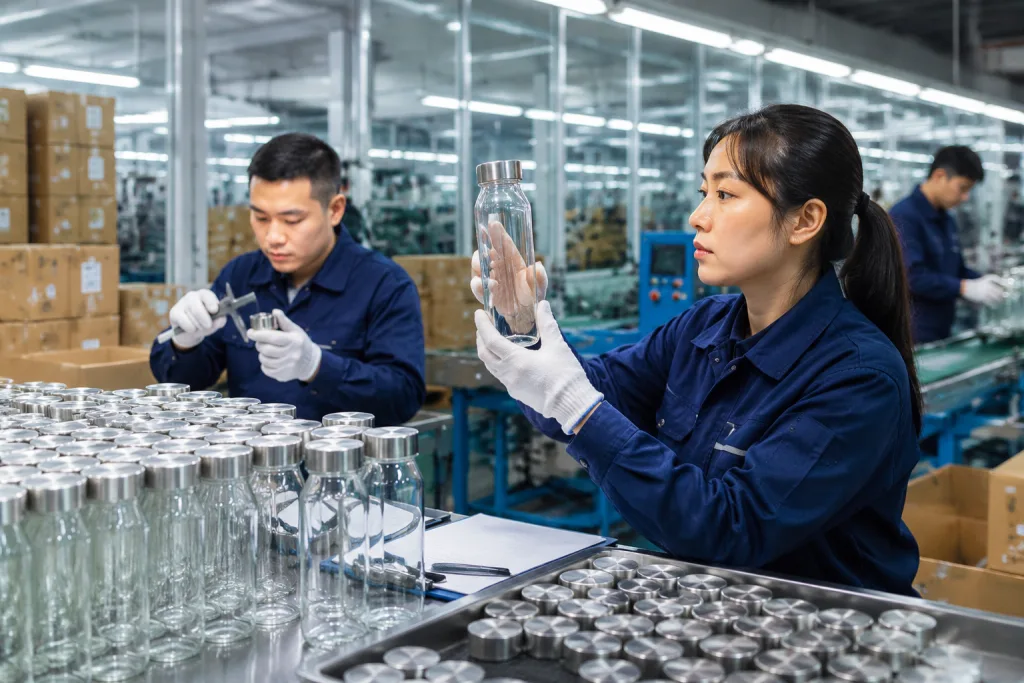
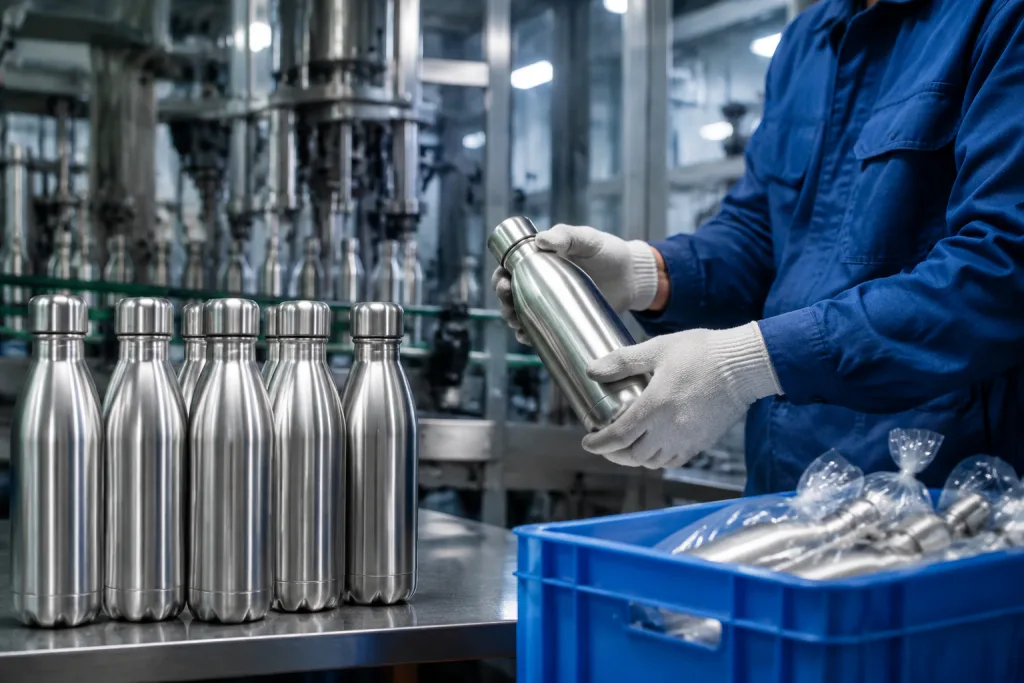
The costliest inspection is the one booked after the container is sealed. Once the 40HQ door is closed and the seal number is on the packing list, you are arguing over a credit note, not stopping defects. For 304 stainless steel glass bottle wholesale, we run QC in three hard stops: incoming material checks for glass thickness, 304 stainless grade, silicone gasket odor, and cap fit; during-production checks at the line for logo position, leakage, and assembly; final random inspection before balance payment, with cartons still openable.
At BottleForge Industrial in Hangzhou, Zhejiang, our standard MOQ starts at 1,000 pcs per SKU for stainless and glass hybrid bottles, and our normal lead time is 25–35 days after artwork and sample approval. For new tooling or custom molds, add 15–25 days. Those dates work only when QC checkpoints are booked before the line is full. Last month a buyer asked us to “just check at the end” on a matte black bottle with laser logo; the math doesn’t work once 18 pallets are already wrapped.
Use AQL, not vague “good quality” wording on the PO. For export wholesale drinkware, 9 out of 10 buyers we ship to set critical defects at 0, major defects at AQL 2.5, and minor defects at AQL 4.0. Critical means broken glass, sharp edges, unsafe contamination, or the wrong food-contact material. Major means leakage on the vacuum tester, wrong logo, deep scratches over the agreed sample limit, loose cap fit, or barcode failure on the handheld scanner. Minor means small cosmetic marks inside the signed limit sample.
During production, inspect the first 5–10% of finished goods. QC pulled the sample at 1,200 pcs on one order and caught a gasket seated 1 mm high; that is easy to fix before 20,000 pcs are packed. This check also catches logo position errors, wrong accessory bags, and carton layout problems before the line keeps repeating them. For wholesale canteen, growler bulk, beer tumbler bulk, and alcohol flask wholesale bulk orders, one small assembly variation spreads fast. Good QC is not about distrusting the factory. It is about finding defects while the line can still correct them.
Your quote hides real cost
A low FOB Ningbo or FOB Shanghai price can still be a bad buy. We have seen buyers compare unit price only, then get hit with safer packaging, SGS lab testing, barcode labels, spare gaskets, color boxes, palletization, or inspection rework. On one canteen bulk order, QC pulled the sample after the 1.2 m carton drop test because the glass shoulder cracked. The buyer saved USD 0.08 on the quote and paid USD 0.19 later for stronger dividers. For wholesale drinkware programs, landed cost is the number that matters.
A realistic 500–750 ml 304 stainless steel and glass bottle wholesale project may fall around USD 2.20–5.80 FOB China depending on glass type, cap structure, sleeve, logo process, packaging, and quantity. A simple glass bottle with 304 infuser may sit near the lower end. A double-wall glass bottle with stainless cap, silicone sleeve, retail box, and molded pulp insert will price higher because the line runs slower, often 900 pcs per shift instead of 1,400 pcs. Beer growler wholesale bulk and beer tumbler wholesale bulk items swing more because capacity, wall thickness, and pressure-related claims change the structure. The math doesn't work if the cheap quote skips the part that keeps the bottle alive in transit.
Ask suppliers to split the quotation into bottle, decoration, packaging, testing, and accessories. Keep it practical. You do not need a 20-line cost sheet, but you do need to know what moves the price. If you remove the gift box, how much do you save? If you upgrade from soda-lime to borosilicate, what is the delta? If you add one spare gasket per unit, is it USD 0.03 or USD 0.12? We once had a PO with “silicon ring” typed instead of “silicone ring”; the buyer flagged it, and we corrected the gasket spec before mass production.
For payment, most China factories we deal with use 30% deposit and 70% before shipment. Tie the balance to passed final inspection where possible, using AQL 2.5 if that is your normal standard. When you compare canteen wholesale, growler wholesale, beer tumbler wholesale, or alcohol flask wholesale offers, make every supplier quote the same spec sheet: capacity in ml, glass type, 304 stainless parts, logo method, carton size, and MOQ. Otherwise you are not comparing factories; you are comparing assumptions.
Send your bottle spec before you request price
We will check material, leakage, packaging, MOQ, and FOB cost risks before you commit to a wholesale drinkware order.
Frequently asked questions
What MOQ should I expect for 304 stainless steel glass bottle wholesale?
For a standard bottle with existing mold, a practical MOQ is usually 1,000–3,000 pcs per SKU. At BottleForge in Zhejiang, many models start from 1,000 pcs, while custom colors, custom caps, or private retail boxes often move the MOQ to 3,000 pcs. Fully custom glass shape or new stainless tooling can require 5,000–10,000 pcs because mold cost and line setup must be amortized. If you need several colors, ask whether MOQ is per color or total order. A supplier quoting 500 pcs may be fine for sampling, but the unit price and decoration options will usually be worse.
How do I verify the stainless steel is really 304?
Ask for the incoming material certificate, then require random XRF testing on mass-production parts. The certificate should identify SUS304, 18/8, or equivalent chemistry, and it should match the batch used for your order. XRF testing can quickly detect if 201 or 430 stainless has been substituted. For stricter programs, add third-party lab testing for food-contact migration under LFGB, FDA, or EU 1935/2004 requirements. Make sure the requirement applies to liquid-contact parts, not only the outer decorative shell. For caps, infusers, and flask interiors, 304 should be stated directly on the approved specification sheet and purchase order.
Can I sell these as beer growlers or alcohol flasks?
You can, but only if the structure supports the claim. A beer growler bulk order needs careful review of glass thickness, cap seal, pressure expectations, and warning labels. Many attractive glass bottles are suitable for serving or short-term storage, but not for fermentation or high-pressure carbonation. Alcohol flask wholesale orders also need attention to gasket material, corrosion resistance, and local labeling rules. Before using terms like beer growler wholesale, alcohol flask wholesale bulk, or beer tumbler wholesale bulk, ask the factory to confirm intended use in writing. If pressure testing is needed, define the test value and pass/fail standard before production.
What lead time is realistic for custom logo drinkware wholesale?
For existing molds, expect 7–10 days for pre-production samples after artwork confirmation and 25–35 days for mass production after sample approval and deposit. Add 5–7 days if you need third-party inspection and lab testing before shipment. New glass molds, custom stainless caps, or special silicone sleeves can add 15–25 days before the production clock starts. Peak season in China, especially before Chinese New Year, can stretch lead times by 10–20 days. If you have a retailer launch date, confirm artwork, packaging dielines, barcode rules, and inspection booking at the purchase order stage, not after production is finished.
Which inspection standard should I use for drinkware bulk orders?
Use ANSI/ASQ Z1.4 or ISO 2859-1 sampling with written AQL levels. A common setting for drinkware bulk and wholesale canteen orders is critical defects 0, major defects AQL 2.5, and minor defects AQL 4.0. Critical defects include broken glass, sharp edges, unsafe contamination, and wrong food-contact material. Major defects include leakage, incorrect logo, failed barcode, missing accessories, and severe scratches. Minor defects include small cosmetic marks within the approved limit. Also add functional tests: leak test, cap fit, logo adhesion, carton drop test, and barcode scan. Without defined AQL, “acceptable quality” becomes an argument.