Key Takeaways
- 304 stainless steel is usually 0.4-0.6 mm thick for single-wall bottles and 0.5-0.7 mm for vacuum shells
- A practical custom drinkware MOQ starts at 1,000-3,000 pcs depending on mold, color, and logo method
- Glass bottles fit clean taste and retail shelf appeal, while 304 steel fits durability, insulation, and outdoor use
- Standard production lead time from Zhejiang, China is 25-45 days after artwork and pre-production sample approval
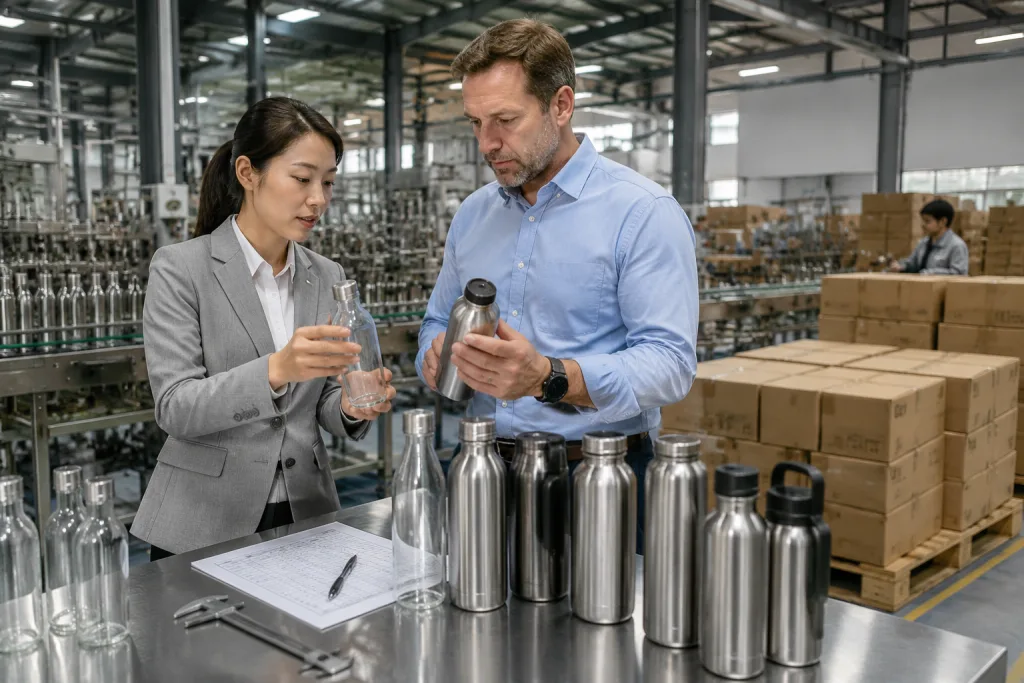
If you search for a 304 stainless steel glass bottle supplier, you are not sourcing one “bottle.” You are sorting through 500 ml insulated steel bottles, 750 ml glass infuser bottles, hybrid gift sets, custom canteen programs, and distributor drinkware that has to survive retail shelves, e-commerce drops, or corporate gifting. QC pulled a sample last month with a 0.4 mm logo offset; the buyer flagged it before we even discussed carton drop testing.
Finding a canteen manufacturer in China is the easy part. The hard part is matching material, decoration, MOQ, compliance, and carton packing to the channel that pays you. BottleForge Industrial in Hangzhou, Zhejiang runs stainless steel, glass, and mixed-material drinkware projects with a simple factory view: if the cap leaks at 45° during line testing, the math does not work, no matter how nice the render looks. The best bottle passes inspection, ships on time, and leaves your margin intact.
Steel versus glass at a glance
A buyer searching for 304 stainless steel glass bottle supplier is usually mixing two product lines in one RFQ. We see this on POs every month; last week one brief even wrote “304 borosilicate” in the item name, and QC pulled the sample before artwork approval. 304 stainless steel bottles and borosilicate glass bottles do different jobs. Treat them as the same SKU family and you get dead stock, weak reviews, or a channel test that fails after 30 days.
This is the comparison we run with procurement before we quote a custom canteen or customizable drinkware program. Simple table. It saves rework.
| Spec | 304 stainless steel | Borosilicate glass |
|---|---|---|
| Best use | Travel, sports, corporate gifting, outdoor canteen promotional campaigns where buyers ask for drop resistance | Office desks, retail wellness shelves, tea infusers, premium gift sets where the clear body sells the product |
| Typical capacity | 350 ml to 1,900 ml, including custom growler formats; 750 ml is the line’s common outdoor size | 300 ml to 1,000 ml; 500 ml moves fastest for retail display cartons |
| Weight | Light to medium, based on wall gauge; 0.5 mm and 0.6 mm feel different in hand | Heavier and easier to crack, especially after loose packing in a 12 kg master carton |
| Temperature | Works for hot and cold drinks; vacuum models hold 6-24 hours when the weld and stopper pass leak test | Works for hot tea if borosilicate; no real insulation unless you add a sleeve |
| Decoration | Powder coating, laser engraving, silkscreen, heat transfer; laser is safer for small logos under 25 mm | Silkscreen, decal, sleeve, cap engraving; large decals need scratch testing before bulk |
| Risk | Dents, weak welds, vacuum leakage; we reject samples when the base rocks over 1 mm on the bench | Breakage, cap sealing, thermal shock; the buyer flagged cracked rims once after a 60°C rinse test |
If your buyer brief says “durable custom canteen for field staff,” start with 304 stainless steel. If it says “clean taste, transparent body, tea or fruit infuser,” glass is the better fit. For distributor canteen ranges, we often ship both: a 500 ml glass bottle for lifestyle retail and a 750 ml stainless model for outdoor or workwear channels. Asking which material is “better” is the wrong question; ask where the bottle will be sold, who drops it, and whether the MOQ can support two molds or one shared cap system.
When 304 stainless steel wins
304 stainless steel is the safer commercial choice when the bottle will be dropped, packed in school bags, left in vehicles, stacked in warehouses, and washed every day. It contains about 18% chromium and 8% nickel, so corrosion resistance stays stable for normal beverage use. We run 304 as the default for most North American and European programs unless the buyer gives us a marine, high-salt, or specialty chemical use case. QC still checks the material with an XRF gun on incoming coils; one rejected batch last year read 7.1% nickel on the report, not the 8% the mill sheet claimed.
For a canteen factory, the key details are not just “304 inside.” Ask for the internal liner grade, outer shell grade, wall thickness, welding method, and whether the cap components are food-contact compliant. Some cost-down bottles use 201 stainless steel on the outer shell and 304 only on the inner wall; we see this on around 4 out of 10 price-driven RFQs under 10,000 pcs. That can work for a lower price point, but it must be declared on the quote. If the buyer finds it later during third-party inspection, the math doesn't work.
For a customized canteen, common specifications are:
- Inner wall: SUS304, 0.4-0.5 mm
- Outer wall: SUS304 or SUS201, 0.5-0.7 mm
- Vacuum performance: 95°C water still above 55-65°C after 6 hours, depending on capacity
- Surface: powder coating, spray paint, or stainless polish
- Leakage test: 100% inline water or air pressure check
A stainless canteen manufacturer should also be clear about passivation, odor control, and cap sealing. The bottle body may pass AQL 2.5, but a cheap silicone ring or loose threaded lid creates the complaint your customer remembers. We have seen 1,200-1,900 ml distributor growler and customizable growler orders go sideways because the lid fit looked fine dry, then leaked after a 0.6 MPa air-pressure test. QC pulled the sample. The buyer flagged it immediately.
Where glass bottles still fit
Glass is not the weak option; it is the specific option. Pick it when the buyer cares more about clear contents, neutral taste, and a sharp shelf look than dent resistance. We see borosilicate glass bottles with stainless steel caps, silicone sleeves, or bamboo-look lids work best in wellness, tea, office, and premium gift programs. QC pulled one 500 ml sample last month because the sleeve sat 2 mm off-center; on glass, small alignment problems show fast.
For a canteen supplier handling both steel and glass, start the glass discussion with wall thickness and thermal shock. Cheap soda-lime glass is fine for cold water runs, but borosilicate is the safer call for hot tea or fruit infusion. A typical borosilicate wall thickness is 1.8-2.5 mm. Thicker glass feels better in the hand, but the math does not work if you keep the same inner tray and export carton. We tested a 2.5 mm wall bottle in a 24 pcs carton, and the gross weight jumped by 3.6 kg compared with the lighter version.
Use glass when your channel needs:
- Visible contents, such as fruit slices, tea leaves, botanicals, or a printed branding insert that the buyer wants seen through the bottle
- Low odor retention for office desks and home kitchens, especially after coffee, lemon water, or herbal tea
- Retail shelf presence where clarity matters; buyers often reject smoky or green-tint glass after checking samples under LED shelf lights
- Lower tooling cost than some shaped stainless models, since a straight glass body usually avoids a new steel mold charge
Use caution when selling glass through parcel-heavy channels. If you ship direct-to-consumer, Amazon FBA, or subscription boxes, carton engineering decides your complaint rate. We usually recommend individual corrugated boxes, molded pulp or EPE protection, and a 60-80 cm drop-test protocol before mass production. Do the drop test first. For canteen distributors in Europe, breakage under 1.5% after warehouse handling is a realistic target; above that, your landed cost starts to move. We have seen this go sideways when a buyer pushed for a thinner mailer box to save USD 0.18 per unit, then flagged 37 broken bottles in the first inbound report.

Customization changes the real price
About 7 out of 10 buyers ask for the bottle price first. Fair question. It is also the wrong first question if the item is custom drinkware, because decoration method, surface finish, packing spec, and AQL 2.5 inspection time can move the cost as much as 304 stainless steel itself. A plain 750 ml stainless bottle may quote at USD 3.20-4.80 FOB Ningbo or Shanghai depending on gauge, cap, and surface. Add powder coating, laser logo, individual color box, and a printed manual, and the same canteen customized project may move to USD 4.10-6.20. Last month QC pulled a 750 ml sample with a 0.42 mm body wall and the buyer flagged the powder coat shade under a D65 light box; that one detail changed the quote and the lead time.
For a canteen customizable range, we usually quote from these decoration choices:
- Laser engraving: durable and clean on stainless surfaces; common for corporate logos, usually USD 0.08-0.25 per position, with logo size checked by caliper before mass run
- Silkscreen: works for 1-2 color logos; needs a flat panel or a controlled curved area, otherwise the line gets pinholes near the bottle shoulder
- Heat transfer: better for multi-color artwork, but we run adhesion testing because weak film edges show up fast after tape pull
- Powder coating: strong retail finish; Pantone matching is possible but not exact on every textured surface, and buyers should approve a sprayed metal chip, not just a PDF
- Decal on glass: gives good visual detail, but abrasion and dishwasher testing should be written on the PO before order
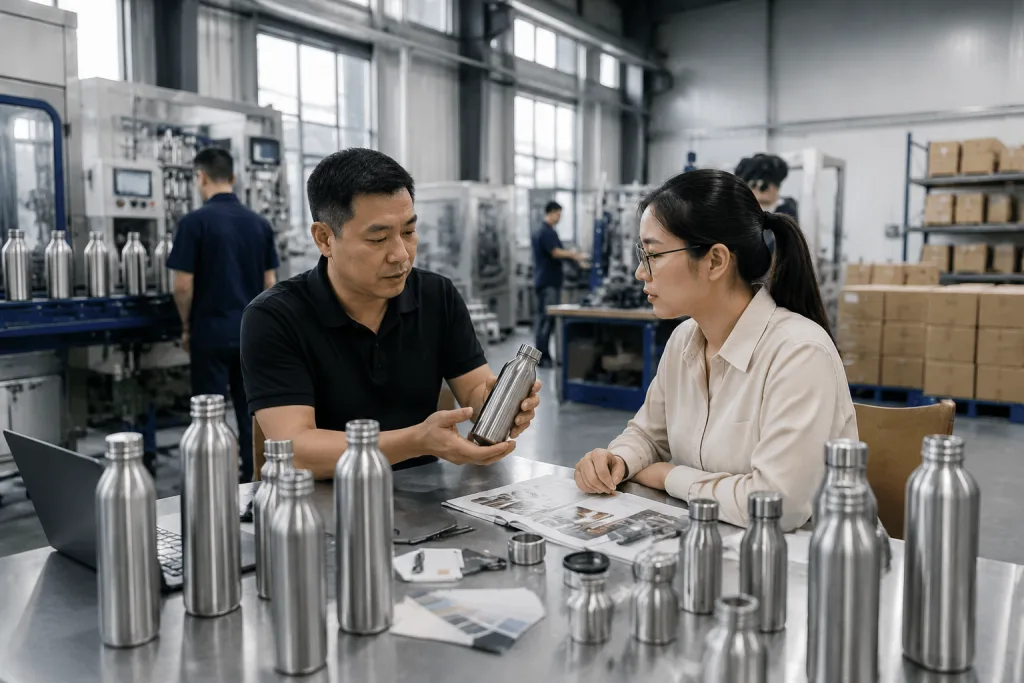
If you are a canteen vendor or distributor drinkware buyer, do not approve production from a digital mockup only. Get one pre-production sample with final color, logo size, cap, packaging, barcode, and carton marks. For 5,000 pcs and up, we run 2-3 approval samples: one for the buyer, one for the factory line, and one retained by QC. It adds 5-7 days. Still cheaper than a repack. We have seen this go sideways when a PO typed “matte black” but the artwork file said “gloss black,” and the container was already packed in Zhejiang.
MOQ and capacity planning
A serious canteen manufacturer should break MOQ down by process, not hide behind one flat number. At BottleForge Industrial in Hangzhou, Zhejiang, we usually run 1,000 pcs for existing stainless shapes with one logo, 2,000-3,000 pcs for custom colors, and 5,000 pcs or more for new molded lids or special glass shapes. On the line, the laser room can switch a logo file in 8 minutes, but a powder coating color change means cleaning the gun, checking the Pantone panel, and wasting the first 30-50 pcs until the finish is stable. Our monthly drinkware output is about 600,000 units across stainless steel bottles, tumblers, glass bottles, and related custom canteen orders.
Lead time depends on how many decisions are still open. Simple rule. For an existing 304 stainless steel bottle with laser logo, 25-30 days after sample approval is normal. Powder coating and retail packaging usually push that to 35-45 days because the color chip, barcode sticker, inner box dieline, and master carton mark all need buyer sign-off. QC pulled a sample last month because the PO said matte black, but the approved artwork called it soft-touch black; that one typo cost 4 days. New mold work can add 20-35 days before bulk production even starts. If you need delivery into a European promotion date or a North American retail reset, count backward from the required warehouse date, not the vessel departure date.
Procurement buyers should compare carton quantity and CBM early, not after the price sheet is signed. A 500 ml glass bottle may look cheaper per piece than a vacuum steel bottle, but EPE sleeve, divider thickness, and drop-test protection can increase carton volume by 15-25%. We’ve seen this go sideways: the buyer saved USD 0.18 per bottle, then lost it on ocean freight because the 40HQ loaded 18% fewer glass units than the same-capacity stainless order. That affects freight and storage, and it can break distributor canteen pricing.
Price per bottle is not landed cost. Landed cost is bottle, decoration, packaging, inspection, freight, duty, breakage, and the cost of being late.
Compliance and inspection basics
For Europe and North America, treat compliance as a line-item specification, not a certificate chase after the cartons are sealed. A 304 stainless steel glass bottle supplier should confirm the food-contact rules for each material in the bill of materials: 304 stainless body, borosilicate glass, silicone ring, PP lid, coating, ink, and adhesive. We ask for the BOM before sampling; last month QC pulled one lid gasket at 2.1 mm instead of the approved 2.4 mm, and that small change meant the old test report no longer matched the product.
Common checks include LFGB or EU food-contact testing for Europe; FDA food-contact expectations for the United States; REACH screening for coatings and restricted substances; California Proposition 65 review when the selling channel requires it. Kids-related bottles need a separate look at ASTM or CPSIA-related requirements, mainly around coatings, small parts, and straws. Retail buyers also ask for BSCI reports, Sedex SAQ records, or ISO 9001 documentation with the factory scope page. We have seen this go sideways when a buyer accepts a “similar item” report, then the retailer flags the printed sleeve during onboarding.
For inspection, set AQL levels before deposit. Not after packing. A common setup is AQL 2.5 for major defects and AQL 4.0 for minor defects, with critical defects at zero tolerance. Major defects include leakage, sharp edges, severe coating peel, wrong logo, wrong capacity, and failed barcode scan. Minor defects include dust marks under 0.5 mm, color drift inside the signed Pantone limit, or small carton rub marks that do not affect shelf display. The wrong question is “Can we inspect faster?” The right question is whether the inspector has the approved sample, barcode file, torque range, and packing method on the table before opening carton 1.
Do not skip functional tests. For stainless vacuum bottles, run vacuum retention, leakage, coating adhesion, and odor checks; we normally log hot-water retention at 6 hours and 12 hours on the line. For glass bottles, run thermal shock, cap torque, leakage, and drop testing in final packaging. A good canteen supplier in China will accept a written QC checklist because it cuts subjective arguments during final inspection. One buyer once pushed back on 1.2 m carton drop testing to save 18 samples, but the math did not work after we found 7 cracked inner glass bottles in a 200-piece pilot run.
Choosing your supplier match
The right supplier match starts with the sales channel, not the bottle photo. A promotional agency usually needs 24-hour artwork checking, ΔE color control under 1.5, and no surprises after the client signs the PDF proof. A retail brand needs packaging drawings, FDA or LFGB files, barcode placement, and repeat batches that do not drift after the first 3,000 pcs. A distributor buying growlers cares about line capacity, 5-layer carton strength, and reorder pricing that still works after freight changes. A canteen vendor with mixed SKUs needs one team to run stainless, glass, lids, sleeves, and spare parts together; forcing each item through a different workshop is where we’ve seen this go sideways.
Ask these questions before you place a deposit. QC pulled one sample last month because the PO said “matte black,” while the approved sample was sandblasted gunmetal; that one typo cost 6 days.
- Is the quoted steel 304 for inner wall only, or inner and outer wall?
- What is the wall thickness in mm, and what is the finished bottle weight in grams?
- Which food-contact parts are tested: bottle body, cap, silicone ring, coating, and printed ink? Ask for the actual report name, not just “passed.”
- What is the real MOQ for each color and each logo version? Some lines run 500 pcs for laser logo but need 1,000 pcs for powder coating.
- Can you send FOB pricing, carton CBM, gross weight, and HS code before sampling, so the landed-cost math is not guessed later?
- What inspection standard will be used, and who pays if rework is needed? We normally see AQL 2.5 for major defects on drinkware orders.
If you are building a canteen promotional program, do not over-engineer the product. Use an existing mold, one body color, one logo method, and a standard white or kraft box. Simple wins here. If you are building a long-term customized drinkware retail line, spend money on better caps, tighter color control, and packaging that survives two warehouse touches without crushed corners; our drop test usually starts at 76 cm on the packed carton. China can make budget and premium drinkware, but the factory has to know which one you are buying before the line starts.
BottleForge Industrial works best with buyers who share the sales channel, target landed cost, testing requirement, and launch date early. Give us those 4 points, and we can say plainly whether stainless steel, glass, or a hybrid custom canteen set makes better commercial sense. The wrong question is “which one is cheapest?” The better question is which one ships on time, passes inspection, and still leaves margin after duty and freight.
Send your bottle spec for a practical quote
Share capacity, material, logo, packaging, MOQ, and delivery market. We will recommend the cleaner stainless or glass route.
Frequently asked questions
Is 304 stainless steel always better than glass for custom drinkware?
No. 304 stainless steel is better for durability, insulation, outdoor use, and high-volume canteen promotional orders. Glass is better when the buyer wants clean taste, transparent appearance, tea infusion, or a premium office gift feel. For example, a 750 ml vacuum 304 bottle may hold hot water for 6-12 hours and survive daily commuting. A 550 ml borosilicate glass bottle will not insulate, but it shows fruit or tea clearly and avoids metallic taste concerns. If your return risk is from breakage, choose steel. If your selling point is purity and shelf appearance, glass may be the stronger SKU.
What MOQ should I expect from a 304 stainless steel glass bottle supplier?
For existing molds, expect 1,000 pcs as a realistic starting MOQ for one logo on many stainless steel bottles. Custom colors usually require 2,000-3,000 pcs per color because powder coating lines need setup time and material control. Glass bottles can sometimes start around 1,000-2,000 pcs if the shape and cap are standard. New molds, special lids, private bottle shapes, or customized growler projects often require 5,000 pcs or more. If a quote offers 100 pcs at mass-production pricing, check whether it is trading stock, not factory production.
How long does production take after I approve the sample?
For a standard 304 stainless steel bottle with laser engraving, plan 25-30 days after pre-production sample approval and deposit. If you add powder coating, Pantone matching, silkscreen, retail color box, or barcode labeling, 35-45 days is more realistic. Glass bottles with standard caps are often similar, but upgraded protective packaging can add a few days. Sea freight from Ningbo or Shanghai to Europe or North America is separate and can add 25-45 days depending on port and season. Always lock artwork, carton marks, and testing requirements before the lead time starts.
Which tests should I require before shipping?
At minimum, require leakage testing, visual inspection under agreed AQL, capacity check, logo adhesion check, carton drop test, and barcode scan if retail or FBA is involved. For vacuum stainless bottles, add heat retention testing and 100% vacuum leakage screening during production. For glass bottles, add thermal shock and final packaging drop tests from 60-80 cm. For Europe, discuss LFGB, REACH, and relevant food-contact tests. For the United States, confirm FDA food-contact suitability and Proposition 65 if your channel requires it. Put these tests in the purchase order, not only in emails.
Can one supplier handle stainless steel, glass, and custom packaging?
Yes, but you should check whether the supplier is actually controlling the project or only passing messages between unrelated workshops. A capable canteen supplier should provide material specs, artwork proofs, pre-production samples, carton drawings, inspection plans, and consolidated shipping documents. For mixed stainless and glass gift sets, ask for one final packed sample before mass production. That sample should include the bottle, cap, sleeve, insert, manual, barcode, and export carton marks. Managing everything through one experienced China supplier can save 7-14 days of coordination, but only if the QC process is clearly documented.