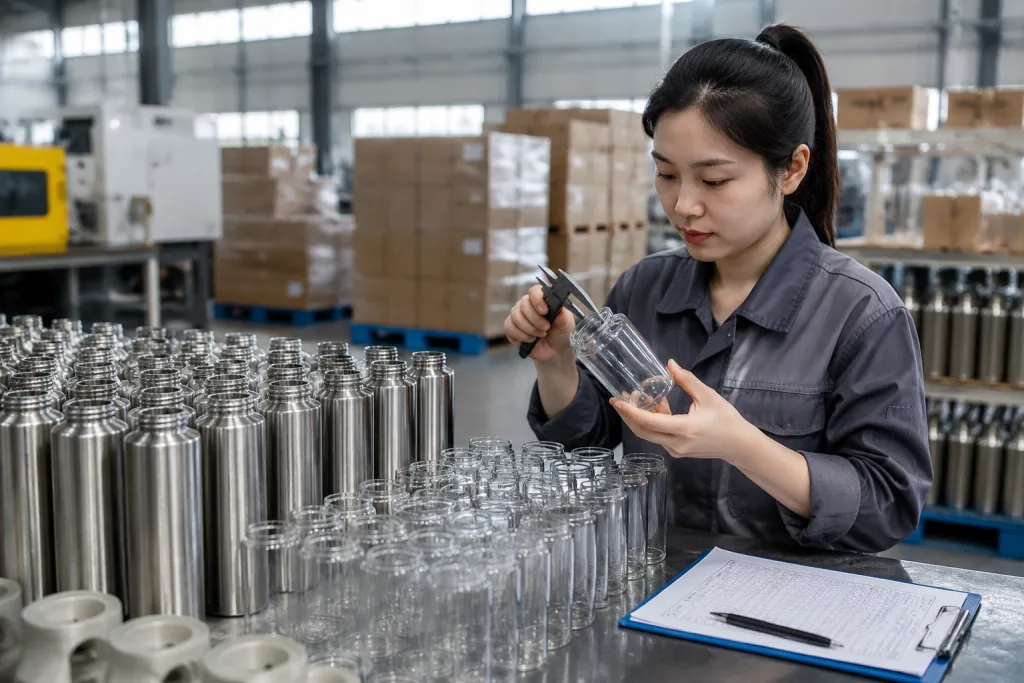
Key Takeaways
- A serious RFQ should state capacity, 304 grade, wall thickness, MOQ, logo method, packaging, and target FOB price
- For private label orders, 2-3 rounds of samples are normal before a bulk PO
- Our Zhejiang line can produce about 450,000 stainless drinkware units/month with 30-45 day bulk lead time
- Use AQL 2.5/4.0 inspection and locked golden samples before approving shipment
A 304 stainless steel glass bottle private label project looks simple until your buyer sends one email asking for capacity tolerance, lid material, logo abrasion test, 1.2 m carton drop result, and REACH paperwork. If the RFQ says only “500 ml bottle with logo,” we have seen 6 suppliers quote 6 different bottles, from 0.45 mm thin-wall bodies to heavier 304 stainless inner shells. That quote is not comparable. QC pulled a sample last month where the buyer expected 500 ml to the rim, but the factory drawing showed 500 ml usable capacity at 10 mm below the mouth.
We manufacture custom drinkware in Zhejiang, and the smooth projects are not the cheapest on the first quote. The math doesn’t work if the structure, artwork, packaging, AQL 2.5 inspection level, and FOB or EXW terms change after the sample invoice is paid. We run the line faster when the buyer locks the bottle drawing, confirms the Pantone code, and approves the carton layout before tooling starts; one PO typo, “304 outside” instead of “304 inside,” has delayed a sample by 4 days. This is the sourcing flow we use with canteen distributors and private label buyers.
Start with the bottle definition
Before you ask for a price, pin down the bottle construction. A 304 stainless steel glass bottle private label project can mean two different things: a stainless steel outer shell with a glass inner liner, or a glass bottle fitted with a 304 stainless cap, infuser, sleeve, or base. These do not quote the same. The first one runs through forming, TIG welding, polishing, and vacuum or fit checks. The second one starts at glass blowing or borosilicate tube forming, then moves to stainless accessory assembly. We had one PO last March that said “steel glass bottle” only; QC pulled the sample at 2.3 mm glass wall, while the buyer expected a double-wall stainless body. Start here. Saves 12 days of back-and-forth.
Your RFQ should remove guessing. For a 500 ml canteen custom project, we would expect these line items on the spec sheet, not buried in WeChat messages:
- Capacity: 350 ml, 500 ml, 750 ml, 1,000 ml; tolerance normally +/-5%.
- Stainless steel: SUS304 for food-contact parts; SUS201 only if clearly approved for non-food exterior parts, such as an outer trim ring.
- Glass: high borosilicate preferred for thermal shock; soda-lime glass is cheaper but breaks faster when the buyer tests hot water after cold rinse.
- Wall thickness: 0.4-0.6 mm stainless body is typical; borosilicate glass often 1.8-2.5 mm depending on shape.
- Lid: 304 stainless outer, PP or silicone seal, leakproof target 0 leakage after 30 minutes inverted.
- Compliance: LFGB or EU 1935/2004 for Europe, FDA food-contact expectation for the US, REACH for surface coatings.
If you are a canteen distributor selling to outdoor buyers, corporate gift accounts, or retail chains with shelf packaging, do not let the factory fill in these details silently. This is the wrong place to “see what they recommend.” A canteen factory may quote the cheapest workable version unless you tell us the channel, target retail price, and test standard. We ship distributor drinkware every month, and the math does not work if a USD 0.18 cheaper lid creates 3% returns. The buyer flagged it once on a 6,000 pcs order because the PO said silicone, but the approved counter sample had a TPE seal. Unit price looked fine. The claim did not.
Build an RFQ factories can price
A solid RFQ lets a canteen manufacturer quote within 24-48 hours without five clarification emails. Last month we checked 37 RFQs from Europe and North America; 22 had nice mood boards, but no carton requirement, logo size, or shipment term. The line cannot price artwork from a lifestyle photo. That slows the project, and the buyer ends up comparing one quote with kraft box against another quote with color box.
Use PO-style lines even at RFQ stage. For example: “Item 1: 500 ml 304 stainless steel glass bottle private label, matte powder coating, one-color silk screen logo, individual kraft box, 3,000 pcs, FOB Ningbo, target shipment 40 days after deposit and sample approval.” That one sentence gives the canteen supplier enough to calculate material, labor, printing, packaging, and export handling. We run this through a costing sheet with coating loss, silk screen film charge, inner box GSM, and master carton CBM; if the logo is 38 mm wide instead of “small logo,” the print room can answer.
For a normal private label run from Zhejiang, realistic MOQ is 1,000-3,000 pcs per color for existing molds. New mold work may start at 5,000 pcs and add USD 600-2,500 tooling depending on shape and lid complexity. Indicative FOB China pricing for a 500 ml stainless-and-glass structure may sit around USD 3.20-6.80 at 3,000 pcs, depending on glass grade, coating, cap design, and packaging. A custom growler or customizable growler at 1.9 L with thicker stainless components can easily move into USD 8.50-14.00. We have seen this go sideways when a buyer asks for a USD 3.00 target on a 1.9 L growler with bamboo cap and gift box; the math does not work after 0.8 mm stainless, silicone ring, and carton drop-test allowance.
Add these RFQ line items:
- Expected annual volume, not only first PO quantity; 3,000 pcs once and 3,000 pcs per quarter are priced differently on the coating line.
- Logo method: laser engraving, silk screen, heat transfer, UV print, or debossed metal badge, with logo size in mm and Pantone code if color matching matters.
- Packing: white box, color box, gift box, master carton, palletization if needed; tell us if the carton must pass 1.2 m drop testing.
- Barcode: EAN, UPC, or FNSKU for marketplace inventory, and send the barcode file instead of a screenshot from the PO.
- Inspection requirement: AQL General II, critical 0, major 2.5, minor 4.0 is a practical starting point; QC pulled the sample faster when the defect list named coating scratches, lid leakage, and logo position.
A canteen vendor who refuses to quote with basic specifications may still be fine for commodity stock. For serious customized drinkware, pass. We ship private label orders every week, and vague RFQs are where wrong caps, wrong box marks, and last-minute “why is the lead time 18 days longer?” arguments usually start.
Check supplier capability before sampling
Do not pay for samples until you know the canteen supplier can support your order. This is where buyers get burned. A trading company is not a problem by itself, but you need to know whether you are talking to a canteen factory, a canteen vendor, or an export middle office that cannot touch the line. The wrong question is “Can you make it?” Ask who signs off production, QC, and corrective action when QC pulled the sample and found a 0.4 mm mouth-ring mismatch.
Ask for factory facts, not pretty words. At BottleForge Industrial in Hangzhou, Zhejiang, our stainless drinkware capacity is about 450,000 units per month across standard bottles, tumblers, travel mugs, and selected glass-lined SKUs. For existing private label items, we usually quote 30-45 days after deposit and approved pre-production sample. Peak season before Q4 can stretch to 50-60 days, mainly when the powder coating booth is full and the gift-box line is waiting on printed inserts. Last October, one PO had the Pantone code typed as 186U instead of 186C; we stopped the sample room before coating 200 pcs the wrong red.
Your supplier qualification checklist should include:
- Audit status: BSCI, Sedex, ISO 9001, or customer audit reports with the factory name and address matching the PI.
- Food-contact test history: LFGB, FDA, REACH, BPA-free declarations, plus silicone ring reports for the exact lid material.
- Process control: incoming stainless coil checks with calipers, glass thermal shock test, leak test at the cap, and coating adhesion test by cross-cut tape.
- Export experience: FOB Ningbo or Shanghai, carton marks that match the shipping plan, HS code support, and clean document handling.
- Private label control: artwork confidentiality, mold ownership terms, and logo plate storage in a locked cabinet instead of a shared sample shelf.
If you are a distributor growler buyer or a canteen promotional buyer, ask for carton drop test photos and real packing dimensions. We ship air-filled products. Freight can change your landed cost by 8-18% on bulky drinkware. A low FOB price from China means little if the master carton wastes container space; we have seen a 12 pcs carton at 54×42×31 cm lose a container plan against an 18 pcs carton with tighter dividers.
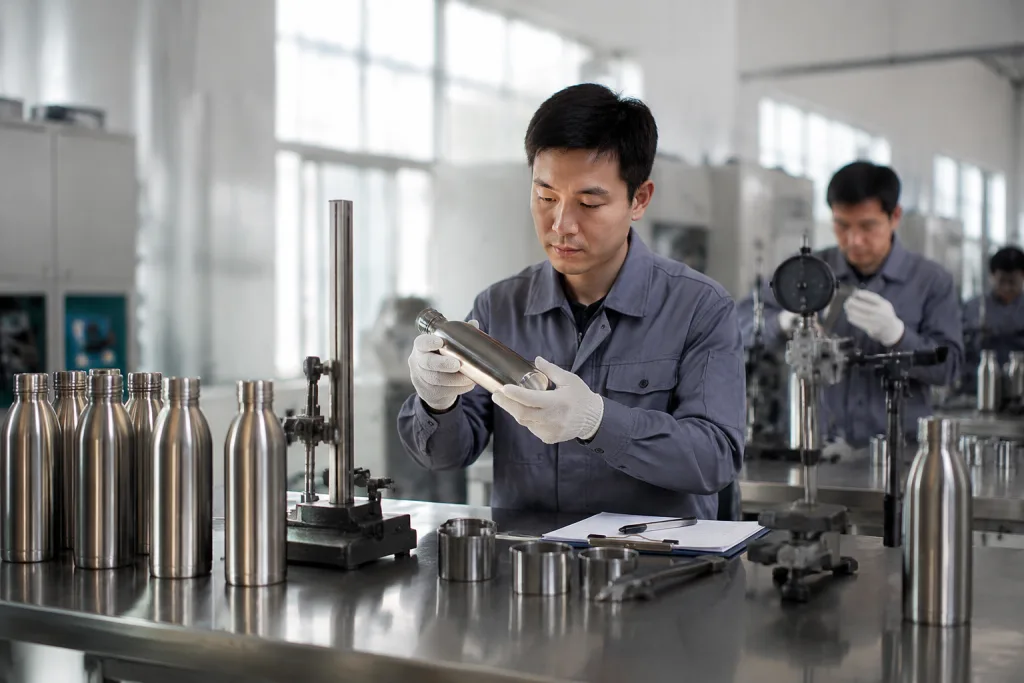
Approve samples like a PO
Sample approval is where roughly 6 out of 10 private label projects start to drift. The buyer signs off on “the look,” not the measurable parts. Then bulk goods land with a 1.2 mm different lid gasket, a logo sitting 4 mm lower, or coating that feels thin in the hand. We’ve seen this go sideways. Run the sample order like a small PO, with line items, tolerances, and a clear sign-off name.
For a 304 stainless steel glass bottle private label sample, your sample PO should spell out sample quantity, exact body color with Pantone or powder code, logo artwork size in mm, packaging mockup version, sample cost, courier cost, and target dispatch date. Typical custom sample cost is USD 80-250 per design when printing or laser setup is needed. Existing blank samples may be free or USD 10-30 each, but DHL/FedEx freight is usually charged. Sample lead time is normally 7-12 days for laser or silk screen, 12-18 days for powder coating, and 20-30 days if a new lid insert or mold adjustment is involved. One buyer once sent a PO with “matte black” in the item line and “gloss black” in the remarks; the line stopped until we got the corrected PDF.
Check the sample with a simple table. Use a 0.1 g scale, caliper, Pantone book, and 3M tape on the desk, not just phone photos.
- Capacity measured with water to practical fill line, recorded in ml after the bottle sits level for 60 seconds.
- Weight compared against quoted target, for example 310 g +/-20 g, using the same lid and gasket set.
- Logo size, Pantone color, position from the base in mm, and scratch resistance after a fingernail rub and tape pull.
- Leak test after shaking and inversion for 30 minutes, with tissue paper under the cap to catch small seepage.
- Coating adhesion by 3M tape pull or cross-cut test if coated, checked before the sample leaves the workshop.
- Glass fit, rattle, thermal shock behavior, and visible bubbles or scratches, with QC pulling the sample under a white inspection lamp.
Once approved, call it the golden sample. Take dated photos of all sides and packaging, including the carton mark and barcode sticker if used. A good canteen manufacturer will keep one signed sample in the QC room and use it during incoming inspection, production patrol, and final inspection. If you are managing several canteen vendors, this discipline protects you from the classic argument: “This is normal production tolerance.” Some tolerance is normal. Undocumented change is not. The wrong question is “Does it look close?” Ask, “Does it match the signed sample on the QC table?”
Write the bulk PO clearly
The bulk purchase order is not just a payment trigger. It is the work sheet the line follows: production checks capacity, purchasing books caps and cartons, printing sets the logo film, QC pulls the sealed golden sample, and shipping books space. We have seen a PO arrive with only “customizable drinkware, 3,000 pcs” and the buyer later flagged the carton mark because nobody wrote “Amazon FNSKU on short side.” Too loose. For private label drinkware, your PO should look boring, precise, and easy for a merchandiser to copy into the factory ERP without guessing.
Recommended PO line items:
- Item code and description: 500 ml 304 stainless steel glass bottle, private label, matte black, glass inner liner, 304 stainless cap.
- Quantity: 3,000 pcs, with over/under shipment tolerance stated, usually 0% for retail cartons or +/-3% for promotional bulk.
- Unit price: FOB Ningbo, USD amount, packing included or excluded.
- Artwork: file name, version date, logo method, Pantone, print area. Put the real file name here; “latest logo” is how the wrong AI file gets printed.
- Packaging: individual box dimensions, master carton quantity, carton mark, barcode/FNSKU location.
- Quality standard: approved golden sample, AQL General II, critical 0, major 2.5, minor 4.0.
- Payment: common terms are 30% deposit, 70% balance before shipment after passed inspection.
- Lead time: 35 days after deposit and final artwork approval, not after verbal confirmation.
For a customized growler, custom canteen, or canteen customizable retail set, add replacement parts to the PO if you need them: spare lids, silicone seals, straws, brushes, hang tags, display trays. These small accessories cost little while we run the order, then become painful after shipment when they need air freight. We ship spare lids for 1-2% of bulk quantity on about 6 out of 10 canteen distributor POs, because lids create more service tickets than the stainless bodies. QC pulled one 500 ml sample last season with a good bottle body and a slightly loose silicone seal; the math does not work if you discover that after 3,000 pcs are already in retail cartons.
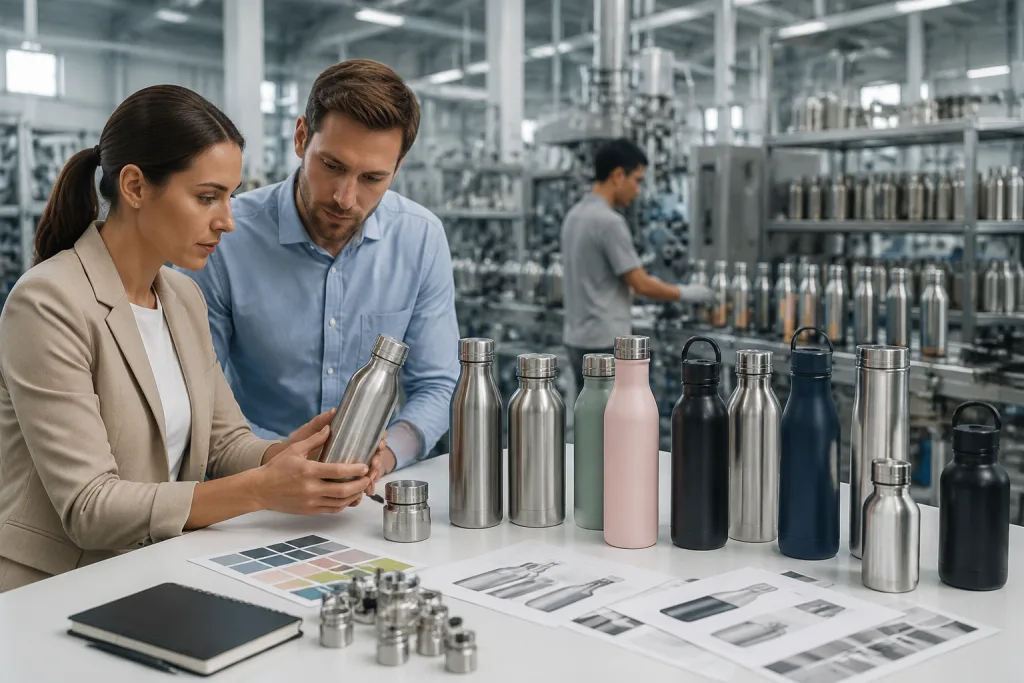
Control production and inspection
After deposit, the good buyers stay close to the order, but they do not stand on the line all day. Ask your China supplier for 3 checkpoints with evidence: material preparation with coil or tube photos, a pre-production sample checked against the approved artwork, and mid-line production photos showing cartons, caps, and inner bags. For powder coating, ask for a color panel or the first coated unit before full spraying; we run this against the Pantone card under a D65 light box, not under a yellow office bulb. For glass-lined or glass-accessory bottles, check glass fit and silicone contact early with a caliper. A 0.3 mm mismatch at the mouth looks small. After full assembly, it becomes a slow rework problem.
Production control needs checks at each dirty point, not just a clean final photo. Incoming material should be checked before cutting, the first piece should be signed off before the line runs, leak testing should happen during assembly, logo position should be checked with a simple jig, and packing should be opened again before sealing master cartons. For stainless components, ask whether the supplier uses XRF spot checks to confirm 304 material on food-contact parts; our QC usually pulls 5 pieces from the first 500 pcs and records the reading. For glass, ask about thermal shock testing. A normal test for this type of bottle is moving it from 20°C water to 80°C water, if the design claim supports it, but do not print that performance claim unless the exact method is written down.
Final inspection earns its fee. For a 3,000 pc distributor canteen order, a third-party inspection in Zhejiang or nearby provinces usually costs USD 250-350. The math does not work if you skip that and later find 300 scratched bottles in a warehouse in Germany or Ontario. Use AQL General Inspection Level II. Define defects before the inspector arrives: leakage is critical, wrong logo is major, light carton rub is minor. We have seen buyers argue for 40 minutes over a 1 mm logo shift because the PO said “centered” but gave no tolerance. If you sell canteen promotional orders into events, late delivery hurts more than a few light cosmetic marks, so set the inspection date against the vessel cut-off, not against a hopeful factory promise.
Do not approve shipment from factory photos alone unless the reorder is low risk and the supplier has passed several shipments. Photos hide too much. For new customized drinkware or distributor growler programs, inspect before balance payment; once the container leaves Ningbo, your options get expensive.
Ship with landed cost visible
FOB China is only the first number on the quote sheet. Landed cost also includes ocean or air freight, duty, customs brokerage, inland delivery, insurance, inspection, and sometimes storage or relabeling. Drinkware eats space. Before you sign off packaging, ask for carton size, gross weight, net weight, and pieces per carton; our packing engineer checks the master carton with a tape measure and drop-test corner before we release the dieline. A 500 ml bottle packed 24 pcs per carton is easier for warehouse staff to lift, but 30 pcs per carton can improve container loading if the gift box uses strong enough E-flute and the gross weight stays under about 18 kg.
For North America and Europe, we see about 8 out of 10 B2B buyers choose FOB Ningbo or FOB Shanghai from Zhejiang factories. If you ask for DDP, slow down. This is the wrong place to chase the lowest headline price. DDP is convenient for a first order, but you still need clear importer responsibilities, tax treatment, and compliance documents in your file. For Amazon or marketplace stock, define FNSKU labeling, carton label placement, and pallet requirements before production; we once had QC pull 60 cartons because the buyer flagged a 5 mm shift on the FNSKU label position. For wholesale distributor drinkware, carton marks and mixed-SKU packing lists matter more than marketplace labels, especially when one PO has 6 colors and 3 lid types.
After delivery, close the loop with a simple claim window. We normally ask buyers to inspect within 7-14 days after warehouse arrival and send photos, carton numbers, and defect counts. No vague claims. If the issue is factory-responsible, replacement parts, credit, or replenishment can be handled against the next PO. We had one PO where the carton mark showed “sliver” instead of “silver,” and that small typo still slowed receiving at the distributor warehouse by 2 days. A serious canteen supplier wants that data because it improves the next production run. The best private label programs from China are controlled reorders, not one-off shipments with a surprise waiting at the warehouse door.
Send your bottle RFQ for a practical quote
Share capacity, material, logo, packaging, quantity, and target market. We will reply with MOQ, FOB pricing, sample plan, and lead time.
Frequently asked questions
What MOQ should I expect for 304 stainless steel glass bottle private label?
For an existing mold, a practical MOQ is usually 1,000-3,000 pcs per color and logo. If you need a new body shape, new lid, or special glass insert, expect 5,000 pcs or more plus tooling. Tooling can range from USD 600 for simple logo or accessory work to USD 2,500+ for a more complex lid or body change. For promotional canteen orders, some factories accept 500 pcs, but the unit price and setup charge will be higher.
How long does sampling and bulk production take?
Blank samples can ship in 3-5 days if stock exists. Custom logo samples usually need 7-12 days. Powder-coated or special color samples often need 12-18 days. Once you approve the golden sample and pay the deposit, bulk production from a Zhejiang canteen manufacturer is commonly 30-45 days for 1,000-5,000 pcs. Add 7-15 days in peak season or if the order uses custom gift boxes, molded inserts, or multiple SKU packing.
Is 304 stainless steel always required for the whole bottle?
Not always, but food-contact stainless parts should be 304 unless you have a documented reason to use another grade. A lid outer shell, decorative sleeve, or base trim may sometimes use 201 stainless to reduce cost, but the drinking surface, tea infuser, or inner metal contact area should be 304. Ask for a material declaration and, for larger orders, request XRF verification during inspection. For Europe, combine this with LFGB or EU food-contact testing where applicable.
Which logo method is best for private label drinkware?
Laser engraving is durable and clean on bare stainless steel, but it gives a metal-tone mark rather than full color. Silk screen is cost-effective for one or two colors and works well on smooth coated surfaces. Heat transfer or UV printing supports more complex artwork, but you should test adhesion and abrasion. For 3,000 pcs, setup charges are usually modest, often USD 30-80 per color or position, but failed logo durability costs much more than the setup fee.
What should be included in an inspection for a customized canteen order?
Use AQL General II with critical 0, major 2.5, and minor 4.0 unless your customer requires another plan. Critical defects include leakage, unsafe sharp edges, broken glass, wrong food-contact material, or serious contamination. Major defects include wrong logo, wrong color, bad coating adhesion, incorrect barcode, or missing accessories. Minor defects may include small cosmetic marks within an agreed limit. For a 3,000 pc order, a final inspection normally checks around 125 pcs under common AQL tables.