Key Takeaways
- Start with 3,000 pcs MOQ per model and 25-35 days mass production after approval
- Confirm SUS304 contact parts, 0.45-0.55 mm wall thickness, and LFGB or FDA test scope before quoting
- Use AQL 2.5 for major defects and 4.0 for minor defects on distributor drinkware orders
- Lock logo method, carton drop test, barcode rules, and FOB port before paying the deposit
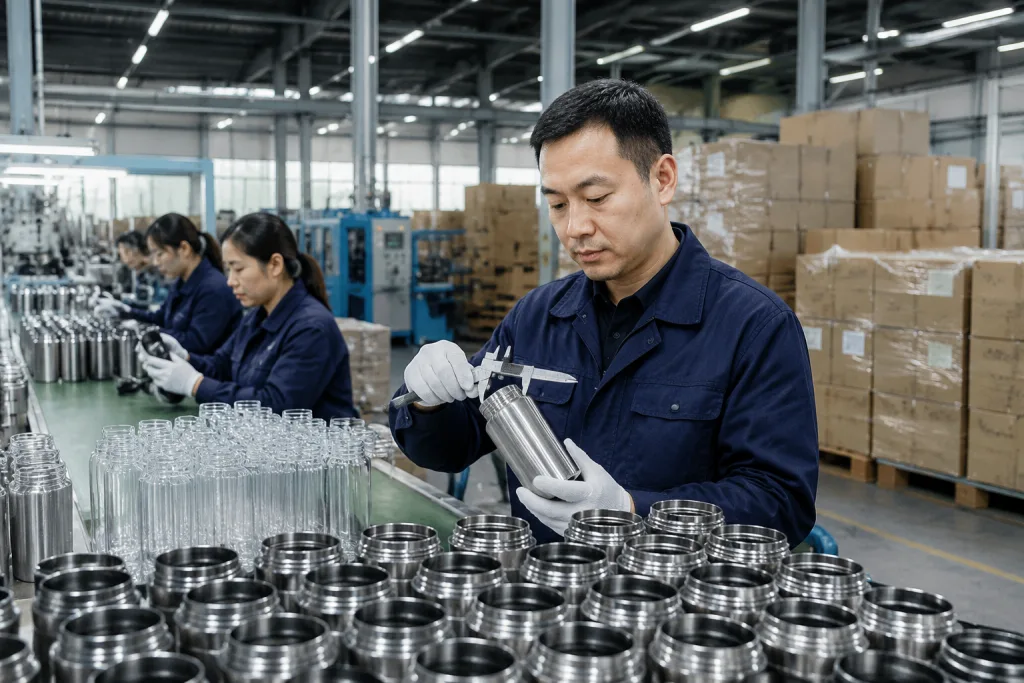
You are not buying a bottle. You are buying a repeatable supply chain: 304 stainless claim, logo position within 1.5 mm, carton drop-test strength, paperwork, and the ship date your sales team already put on a customer PO. If a 304 stainless steel glass bottle manufacturer cannot explain wall thickness, AQL inspection, and FOB timing without checking three departments, the math does not work. QC pulled one sample last month where the laser logo sat 4 mm high; small miss, big argument.
Here is one real B2B order flow: 5,000 pieces of customized drinkware for a distributor program in Europe and North America. BottleForge Industrial is based in Hangzhou, Zhejiang, China, and we run planning on plain factory numbers: 3,000 pcs MOQ per model, 25-35 days production after sample approval, and 600,000 units/month drinkware capacity. The buyer flagged a PO typo once, “matte black” on page 1 and “gloss black” on page 3, so we froze the line until the Pantone sheet and carton mark file matched.
The Buyer Scenario We Are Pricing
Assume you are a canteen distributor launching a custom drinkware line for outdoor retailers, corporate gift buyers, and your own online store, with each channel needing a slightly different carton label or barcode rule. Your first order is 5,000 pcs of a 600 ml bottle with a transparent outer body look, a 304 stainless steel inner structure, leak-proof cap, powder-coated lid trim, and one-color logo. We would price this as one warehouse carton for pallet handling, normally 24 pcs per master carton, and a second Amazon FBA packing version later with GS1 barcode placement checked against the FBA carton template. The carton spec matters. Last month QC pulled a sample because the buyer’s FBA label covered the “Made in China” mark by 6 mm.
This is where 7 out of 10 new buyers send a short email: “Please quote best price for customized canteen.” That gets a weak quote. Wrong question. A serious canteen manufacturer needs the commercial target and the technical target in the same brief. Tell the canteen supplier the sales channel, target retail price, compliance region, logo artwork file, packaging style, and annual forecast. A factory in Zhejiang, China can quote tighter when it knows whether the order is a one-time canteen promotional campaign or a rolling distributor canteen program. We also ask for the PO name early, because “matt black” and “matte black” have both appeared on the same buyer PO and the line stopped for 42 minutes while sales confirmed the finish.
For this scenario, a workable brief looks like this: 5,000 pcs initial order, 20,000 pcs annual forecast, FOB Ningbo, 600 ml capacity, SUS304 food-contact metal, BPA-free PP cap, silicone sealing ring, one-color silkscreen logo, individual kraft box, 24 pcs master carton, GS1 barcode sticker, and inspection before shipment. If you are comparing canteen manufacturers or canteen vendors, send this same brief to every factory, then ask each one to mark excluded items in writing. The cheapest number can simply leave out testing, carton strength, or logo setup. We have seen this go sideways when a buyer saved USD 0.08 per pc, then failed a 76 cm carton drop test because the supplier used 5-layer weak flute instead of the agreed stronger carton.
For BottleForge, a typical price range for this specification is USD 3.20-4.60 FOB Ningbo depending on finish, cap design, outer body material, order quantity, and packaging. Below 3,000 pcs, tooling setup, line changeover, and logo preparation make the unit price jump fast. MOQ is not a factory trick; the math does not work when the silkscreen fixture, color-matching plate, and first-article QC check are spread across only 1,000 pcs. We run the line better at 5,000 pcs because the operator can hold color and logo position within about 1.5 mm after the first 30 pcs are adjusted.
Material Claims Need Proof
“304 stainless steel” means little unless the drawing shows where the 304 stainless sits and the lab report matches that part. For drinkware, the food-contact metal should be SUS304 or equivalent 18/8 stainless steel. If the body is transparent, pin it down: borosilicate glass, Tritan-type copolyester, or another named material with thickness and supplier code. We’ve seen this go sideways when a buyer’s PO said “stainless glass bottle” and the factory packed a 201 outer sleeve with no BOM callout. Wrong question to ask: “Is it 304?” Ask which part is 304.
For a B2B order, we write the structure into the quotation and the pre-production sample sheet before the line opens. Example: inner drinking-contact wall SUS304, wall thickness 0.45-0.55 mm checked by micrometer; outer decorative sleeve borosilicate glass or transparent plastic depending on confirmed design; cap PP or stainless steel shell; sealing ring food-grade silicone. If vacuum insulation is involved, the outer wall is usually SUS304 or SUS201 depending on budget, but the mouth and liquid-contact surface should remain SUS304. QC pulled one sample last quarter where the mouth was fine, but the cap insert had no resin code, so we held 3 cartons until the supplier sent the PP declaration.
Ask for test reports that match your selling market, not a thick file nobody will read. For Europe, REACH and LFGB are common requests. For North America, FDA food-contact requirements and California Proposition 65 screening may be relevant. For kids or school programs, ASTM or CPSIA-related packaging and material checks can enter the discussion. A canteen customized for a 500 pcs promotional event may not need every test, but a distributor growler or custom growler going into retail chains usually does. The buyer flagged this exact gap on a 2024 order because the silicone ring color on the sample was black, while the mass order switched to Pantone 186C red.
Here is the practical rule: test the exact material and sealing parts you will ship, with the same color and coating. A generic old report from another bottle is not enough. In Zhejiang, we run pre-shipment compliance through third-party labs in China, but the standard should be locked before sample approval and written on the PI, not added after cartons are sealed. Changing the test scope after mass production can delay shipment by 7-12 days and may force rework if a coating or silicone color fails. The math does not work when the vessel is already booked and the lab asks for 3 working days just to confirm sample receipt.
Sampling Before You Trust The Quote
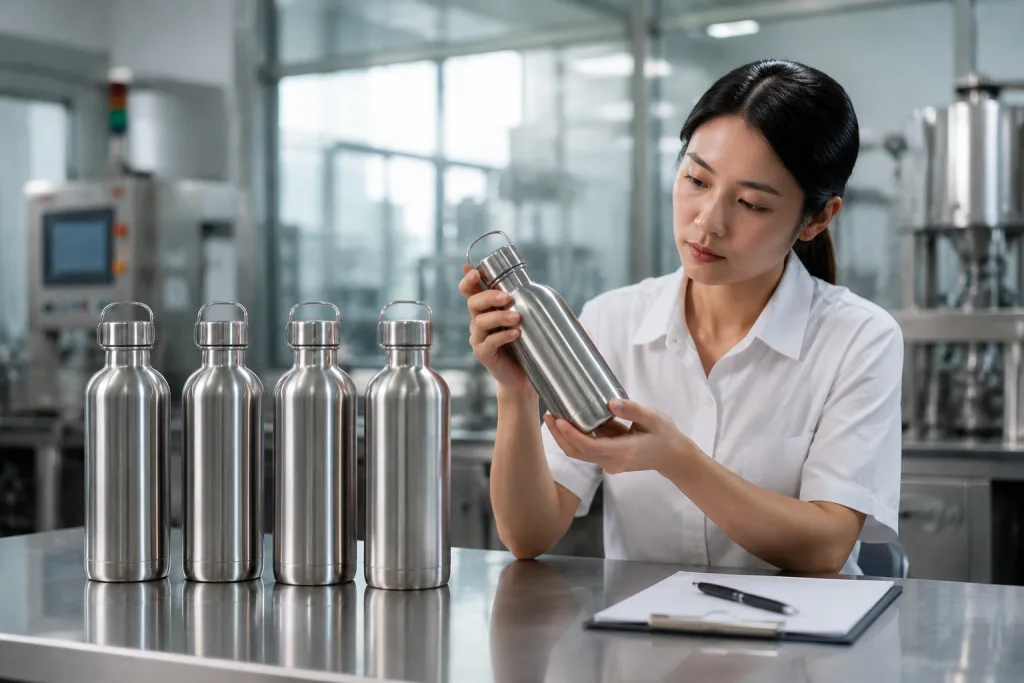
A sample is not a souvenir. It is the buyer’s first QC document. For this 5,000 pcs customized canteen order, ask for two rounds: one blank reference sample and one pre-production sample with logo, finish, cap, packing, and barcode position locked. The blank sample checks hand feel and construction. The pre-production sample sets the red line for mass production; if QC pulled the sample from the line later and the thread depth is 1.2 mm off, this is the piece we compare against.
Typical sample timing is 5-7 days for existing molds without logo and 10-14 days for logo or color matching. If the order needs a new lid, special sleeve, or customized growler handle, allow 20-30 days for prototype tooling. Sample cost may be USD 50-150 for standard custom canteen work, while new tooling can range from USD 500 to several thousand dollars. We’ve seen this go sideways: a buyer once asked why a “free” handle change added USD 0.42 per unit, and the math didn’t work after 5,000 pcs. A canteen vendor who says every change is free is usually hiding that cost in the unit price or skipping proper tooling control.
When you receive the sample, measure it. Use water. Check capacity with a digital scale, not just the catalog claim. We usually allow capacity tolerance around ±5% unless the buyer specifies a stricter line. Check mouth diameter with a caliper, total height, lid thread engagement, gasket fit, coating adhesion, and whether the bottle stands flat on a glass inspection plate. For logo, ask for Pantone reference, printable area, and tolerance. A silkscreen logo can usually hold clean lines above 0.25 mm; laser engraving lasts better, but surface finish and contrast decide whether the mark looks premium or washed out.
For distributor drinkware, packing samples matter. Drop a packed carton from 76 cm on corners, edges, and faces if you expect courier handling. If the individual gift box crushes during sampling, it will not magically survive a container. We run carton checks before production because one crushed corner can turn into 300 buyer photos after delivery. A good canteen supplier will adjust flute strength, inserts, or carton size before production, not after complaints arrive.
Logo, Finish, And Real Unit Cost
Custom work is where quotes stop lining up. One canteen factory may show only the bottle price, while another has already folded in pad print setup, color box, and export carton changeover. We always split the base bottle from each add-on on the PI, because a buyer will flag a 0.12 USD logo charge fast once the deposit is in.
For this case, one-color silkscreen on the body usually adds USD 0.08-0.18 per piece, depending on print area and oven time. Laser engraving runs USD 0.15-0.35 per piece and fits better on premium distributor programs. Full-wrap heat transfer or UV print can add USD 0.35-0.90 per piece. Powder coating adds USD 0.45-0.80 over a polished surface, and a custom Pantone coat usually needs 3,000-5,000 pcs per color before the setup math works. The 8 mm logo zone on the sample cup is the kind of detail QC pulls first.
If you are buying canteen promotional products for a 90-day campaign, the cheapest logo is often fine. If you are building a reusable custom drinkware line, that is the wrong question to ask. Ask for adhesion testing instead. We run 3M tape pull after curing, then abrasion checks on the print area. For powder coat, cross-hatch adhesion and dishwasher simulation tell you more than a sales promise. Do not call it “dishwasher safe” unless the test matches the cycle you actually need.
Customizable canteen does not mean you can change everything at one MOQ. Four bottle colors with five logos each is 20 production lots, not one order. That splits the line, adds carton-label work, and raises scrap risk. A clean first order is two colors, one logo per color, 2,500 pcs each. We have seen this go sideways when the PO typo changed one color code by one digit, so if the forecast is shaky, keep the bottle fixed and customize the sleeve or hangtag instead.
QC Plan From Line To Carton
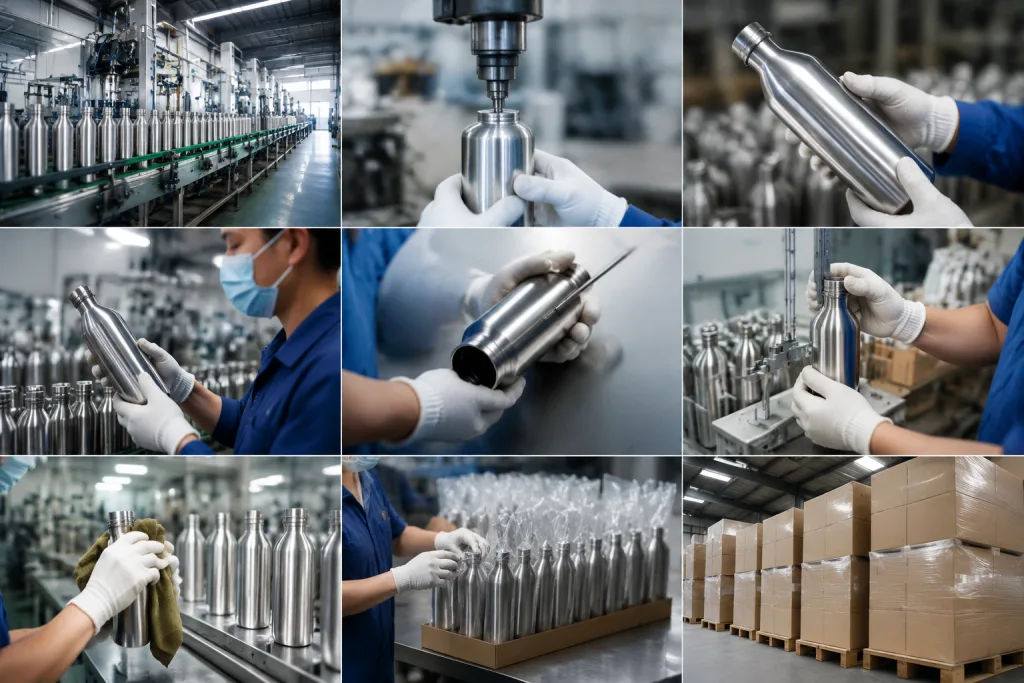
For a 5,000 pcs order, final inspection alone is a gamble. We run QC in steps: incoming material check, first-piece sign-off, in-process check, leak test, cosmetic sort, packing audit, then final AQL. On our line, QC pulled the sample at the 1,000 pcs mark last month and caught a gasket issue before it turned into a pallet problem. It is cheaper to stop a bad part at 300 pcs than to find 1,200 leaking bottles in sealed cartons.
For this buyer case, the checklist should match the BOM line by line: 304 stainless steel grade, wall finish, mouth edge sharpness, lid thread smoothness, silicone ring fit, odor, capacity, logo position, logo adhesion, leak test, carton mark, barcode scan, and gross weight. Leak testing is simple: fill with water, close the lid, flip it upside down, shake it, or leave it on its side for a set time. On vacuum insulated bottles, we also run a heat-retention check with 95°C water and a temperature read at 6 or 12 hours. The buyer flagged it once on a PO typo, and that saved us from shipping the wrong lid type.
Put the AQL terms into the purchase order, not in a later email. General Inspection Level II, AQL 0 for critical defects, 2.5 for major defects, and 4.0 for minor defects is a common setup for drinkware. Critical defects mean unsafe sharp metal, contamination, wrong material, or heavy leakage. Major defects cover cracked bodies, caps that do not work, wrong logo, bad coating peel, or wrong packing. Minor defects are small cosmetic marks inside the approved limit sample. This is the wrong question to ask: “Can you inspect everything?” The math does not work on a 5,000 pcs lot. We use a go/no-go thread gauge and a 0.5 mm feeler check where needed.
If you are a canteen distributor, keep one signed golden sample and one defect board on file. Photos help, but a physical sample settles the argument faster when a carton claim comes in. For programs above 20,000 pcs, third-party inspection in China before balance payment is smart money. It usually runs a few hundred dollars, while re-sorting stock in your warehouse can burn a full day and a truck fee. We have seen that go sideways more than once.
Shipping Terms And Distributor Details
Most B2B buyers start with FOB because it keeps the bottle cost separate from freight swings. For our Hangzhou line, we usually quote FOB Ningbo or FOB Shanghai, and the buyer’s forwarder decides the lane. If you are new to China sourcing, ask your canteen suppliers for FOB pricing plus carton size in mm and gross weight in kg. Real numbers matter. For 5,000 pcs of 600 ml bottles, we normally see 8-14 CBM, depending on gift box, divider, and outer carton spec. LCL can work, but this is the wrong question to ask if the carton fails a drop test. Last month QC pulled a 5-layer K=A carton after the corner crushed at 18 kg stacking weight, and the buyer flagged it before booking.
Payment terms for a first custom drinkware order are usually 30% deposit and 70% balance before shipment after inspection. Established distributor drinkware accounts sometimes move to better terms after 3-5 clean orders, but most factories will not finance custom color, logo, and carton inventory for a new buyer. The math does not work. If the order includes custom tooling, tooling payment is normally upfront because the mold shop asks us for cash before cutting steel. On the factory floor, we do not release the CNC drawing or 304 stainless trial mold until the tooling receipt matches the PI.
Distributor details need confirmation before carton printing. If you need FNSKU labels, suffocation warnings for polybags, country-of-origin marking, bilingual instructions, recycling marks, or retailer-specific carton labels, send final artwork before production starts. Adding stickers after packing usually costs USD 0.03-0.10 per unit plus 2-4 days, and we have seen this go sideways when a PO had “Made in PRC” but the carton file said “Made in China.” For a distributor growler or customizable growler going into retail, individual box EAN/UPC scanning should be checked during packing audit with a handheld scanner, not at the destination warehouse.
Lead time should be written as a production calendar, not a WeChat promise. For this order: sample approval day 0, material preparation days 1-7, forming and assembly days 8-20, coating and logo days 15-25, packing days 24-30, final inspection days 31-32, vessel booking and customs documents days 33-35. Tight, but workable. Chinese holidays, especially Lunar New Year in China, can add 12-20 days because polishing workers and coating subcontractors leave early. Place spring orders early or accept that every canteen factory in Zhejiang will be congested; we run 2 shifts before CNY, and even then the powder coating line becomes the bottleneck.
When To Approve The Order
Approve the purchase order only when three documents match line by line: commercial sheet, technical sheet, QC sheet. The commercial sheet needs model number, quantity, unit price, currency, Incoterm, payment terms, delivery port, packaging, lead time. The technical sheet needs capacity in ml, material grade, wall thickness in mm, surface finish, logo method, artwork file name, Pantone or RAL color codes, test requirements. The QC sheet needs AQL level, defect definitions, inspection timing, and reinspection cost owner if the order fails. We once caught a PO typo where “matte black” became “mate black”; QC pulled the sample under the light booth before the line printed 6,000 wrong cartons.
This is strict. Good. A brand-launch canteen usually carries 20 to 35 small decisions before mass production starts: lid color, silicone ring color, barcode position, inner box flute, hang tag hole, master carton mark. If those details sit only in WeChat screenshots and email chains, the math does not work. We have seen this go sideways when a buyer approved a photo sample but never confirmed the 78 mm barcode placement, then the warehouse flagged scanning failures on arrival. A clear PO does not offend a serious canteen vendor. It keeps the line moving.
For BottleForge Industrial in Hangzhou, Zhejiang, the best projects are not the orders with the biggest forecast on slide 4 of a buyer deck. They are the ones where the buyer knows the shelf price, signs the pre-production sample within 48 hours, and sends clean AI artwork plus packing instructions before deposit. Call it custom canteen, canteen customizable, customized growler, or general custom drinkware; we run the same factory sequence: define the product, verify the materials, freeze the sample, inspect against AQL, then ship with carton labels and documents your warehouse can read. Last month the buyer flagged one missing “Made in China” mark before mass packing, which saved a relabeling job on 312 cartons.
If a 304 stainless steel glass bottle manufacturer cannot answer these points before deposit, slow down. This is the wrong stage to chase only price. A USD 0.20 saving vanishes fast when 5% of cartons arrive crushed, EAN-13 barcodes fail at receiving, or the cap leaks in the retailer’s first customer review. On our floor, a 0.6 mm dent on the shoulder is enough for QC to separate the piece, because one bad unboxing photo can cost more than the discount.
Send Your Bottle Spec For Factory Review
Share quantity, market, logo file, and packing needs. We will return a practical FOB quote, MOQ, lead time, and QC notes.
Frequently asked questions
What MOQ should I expect from a 304 stainless steel glass bottle manufacturer?
For an existing mold with one logo and one color, 3,000 pcs per model is a practical MOQ in China. Some canteen suppliers accept 1,000-2,000 pcs, but the unit price may rise by USD 0.30-0.80 because setup, inspection, and packing labor do not shrink much. For custom Pantone coating, new caps, or special gift boxes, expect 3,000-5,000 pcs per color. If you need four colors, treat each color as a separate lot. A first distributor canteen order is often best structured as 5,000 pcs split into two colors, not five small variants.
How long does a customized drinkware order take from sample to shipment?
For existing bottle molds, allow 5-7 days for a blank sample and 10-14 days for a logo sample. After sample approval and deposit, mass production is usually 25-35 days for 3,000-10,000 pcs. Add 2-4 days for final inspection and export documents. If you require LFGB, REACH, FDA, or Prop 65 testing on the exact production materials, add 7-12 days depending on lab workload. New tooling for a custom growler lid or unusual bottle body can add 20-30 days before normal production even starts.
Which logo method is best for canteen promotional orders?
For short-term canteen promotional projects, one-color silkscreen is usually the best cost option at about USD 0.08-0.18 per piece. It works well for simple logos and larger quantities. Laser engraving costs more, often USD 0.15-0.35 per piece, but it is more durable and suitable for premium custom canteen or distributor drinkware programs. UV print and heat transfer handle multi-color artwork but may add USD 0.35-0.90 per piece. Ask for a printed pre-production sample and run tape adhesion checks before approving mass production.
What should I include in my RFQ to canteen manufacturers?
Send capacity, target material, quantity, annual forecast, logo file, color requirement, packaging style, selling market, compliance needs, and preferred Incoterm. A strong RFQ might say: 5,000 pcs, 600 ml, SUS304 food-contact parts, one-color logo, kraft box, 24 pcs/carton, FOB Ningbo, Europe market, LFGB and REACH required. Include whether you are a canteen distributor, retail brand, or promotional buyer, because the packing and inspection standard may change. If you only ask for “best price,” canteen vendors will quote different assumptions and you cannot compare fairly.
Can one supplier handle bottles, growlers, and canteens together?
Yes, if the canteen manufacturer has the right production lines and sourcing control. BottleForge Industrial handles stainless thermos bottles, sports bottles, travel tumblers, custom growler projects, and related customized canteen orders from Zhejiang, China. The practical issue is MOQ by model. A 3,000 pcs MOQ usually applies per shape or color, not across a mixed catalog. For a distributor growler plus bottle launch, combine shared finishes, shared cartons, and one inspection standard to reduce risk. Do not mix too many lids, coatings, and packing formats in your first order.