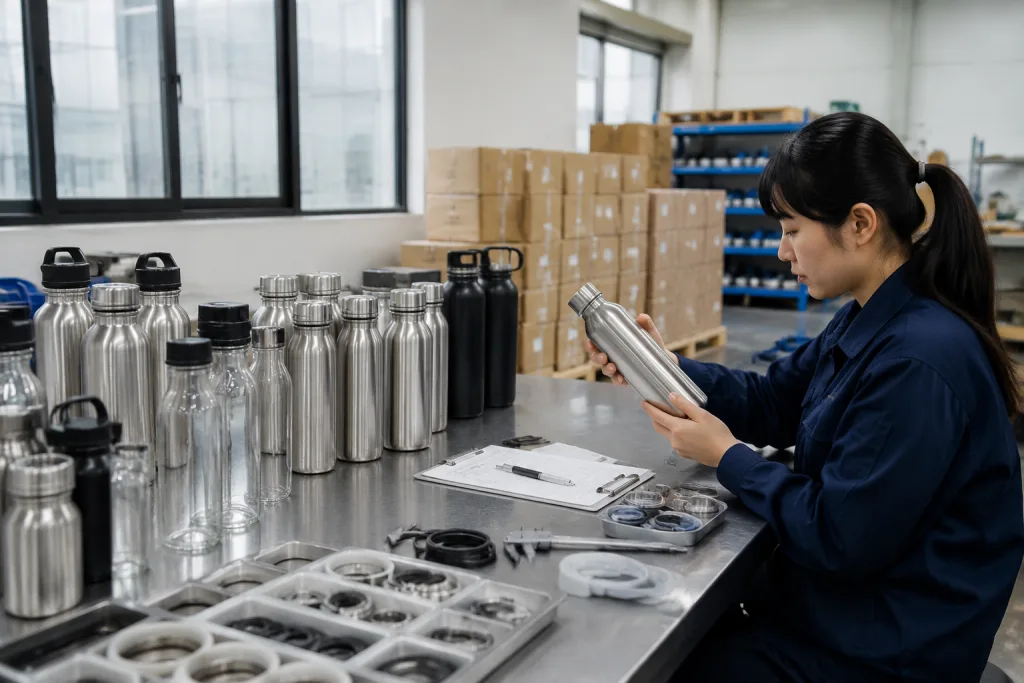
Key Takeaways
- For mixed 304 stainless and glass bottle projects, start with 3,000 pcs MOQ per shape and 35-45 days lead time after sample approval
- Specify 18/8 304 stainless steel with food-contact test reports, not vague “food grade steel” wording
- Control leak claims with 100% lid air-pressure testing plus AQL 2.5/4.0 final inspection
- Logo, coating, and packaging failures usually come from weak artwork files, poor curing time, or carton specs below 5-ply export grade
A good sample can lie. We have seen one 304 stainless steel glass bottle factory make a clean pre-production sample, then ship 3,000 pcs with leaking lids, weak welds, cloudy glass, or logos that rub off after three dishwasher cycles. QC pulled the sample on a 1.2 m drop test, and the lid looked fine. The bulk did not. If you buy custom drinkware for retail shelves, corporate gift sets with printed sleeves, or distributor canteen orders with mixed carton marks, the expensive part is not the unit price. It is the claim after the container lands.
BottleForge Industrial works from Hangzhou, Zhejiang, close to stainless forming, glass processing, coating, and packaging suppliers in eastern China. We run this with a simple view: most failures are preventable if the risk is written into the RFQ before pricing starts. Ask earlier. A canteen manufacturer should talk about 0.5 mm wall thickness, gasket material, AQL level, and drop tests, not only Pantone color and logo size. The buyer flagged a PO once because “matte black” was typed as “mate black”; small typo, 18 days of rework risk. This is the wrong question to ask if the first question is only “How cheap can you make it?”
The material spec gets diluted first
The first failure mode is boring and expensive: the buyer asks for “stainless steel bottle,” the supplier quotes a sharp price, and the alloy stays blank. For a 304 stainless steel glass bottle factory, our baseline is SUS304, also called 18/8 stainless steel, for any part touching drinking water. Say it part by part. Lid liner, infuser, tea strainer, inner sleeve. Last March, QC pulled the sample on a 5,000 pcs canteen order and found the “stainless” tea strainer was 201 by PMI gun, not 304.
Do not accept “food grade” as the only material line on a proforma invoice. It means almost nothing. Food grade can mean 304, 316, PP, silicone, borosilicate glass, or a sales phrase typed to close the order. Your purchase order should state the grade, the test standard, and the component it applies to. For Europe, ask for LFGB or EU 1935/2004 food-contact testing where relevant. For North America, FDA food-contact compliance is commonly requested. If the item is for kids, the discussion may extend to CPSIA and ASTM depending on the market. We once had a PO with “304 steal” on line 7; the typo was funny, but the missing component list was the real problem.
Glass also needs a proper name. Soda-lime glass is cheap and acceptable for some promotional drinkware, but borosilicate glass handles thermal shock better. If you are buying a custom canteen with a stainless outer guard and glass inner bottle, the glass thickness matters. A 1.8 mm wall is not the same risk profile as 2.5 mm. The math doesn’t work if the buyer wants boiling-water use, a thin glass insert, and a gift-box drop test from 80 cm. For a customizable growler or customized growler, neck finish tolerance is critical because the cap seal depends on it; on the line we check that neck with a go/no-go gauge before approving the cap mold.
At our Zhejiang partner lines, incoming material checks include steel grade verification by supplier certificate and random PMI testing when the project value justifies it. That beats arguing after 300 cartons show rust spots in a warehouse in Germany or Canada. A serious canteen supplier will put the material spec into the quotation, sample invoice, and mass-production QC checklist. If they only promise by chat message, you do not have a spec. We’ve seen this go sideways: the buyer flagged rust after 18 days at port storage, and nobody could prove which batch of lids used 304.
Leaks start with lazy lid drawings
Leaks are not a mystery. We see them start in 3 places: a gasket spec left blank, thread tolerance opened up by 0.15 mm, or a lid copied from a different bottle body. “Same as sample” is not a drawing. Last quarter QC pulled the sample from a 5,000 pcs run and found the silicone ring was 0.2 mm thinner than the approval sample; the cartons were dry in the workshop, then wet after truck vibration.
For canteen customized projects, define the seal on the lid drawing. Food-grade silicone should normally be specified at 50-60 Shore A for 304 stainless bottle lids, though the right hardness still depends on the cap structure and compression height. Threads should be checked with go/no-go gauges, and we run caliper checks during IPQC at the mouth and lid thread. If the product is a sports bottle, travel tumbler, custom growler, or distributor canteen with a carry handle, include a torque check in N·m. A lid that seals only when tightened by our strongest technician will fail with retail customers.
Leak testing is not decoration. For most stainless/glass drinkware, we recommend 100% lid assembly inspection and leak testing on mass production. The basic method is simple: fill to the set level, close the cap, invert for 5 minutes, then add side placement or random vibration checks. We ship test pieces on a small vibration table before packing when the buyer plans Amazon or supermarket delivery. For vacuum stainless items, add air-pressure or vacuum retention testing. For glass inner bottles, do not chase pressure numbers that crack the liner during the test itself; the math does not work.
Put the requirement in writing: “100% leak test before packing; final inspection AQL 2.5 major, 4.0 minor; critical defects not allowed.” Critical defects include glass cracks, sharp edges, broken lids, and leakage. We have seen one PO say “leek test” instead of “leak test,” and the buyer still flagged wet cartons after shipment. A canteen factory that refuses 100% leak testing on a drink container is protecting the unit price at the expense of your returns rate.
Surface finish hides weak process control
About 7 out of 10 buyer complaints we see on custom bottles start as cosmetic, but the debit note is not cosmetic. Powder coating chips at the base. Spray paint gets scratched inside the export carton. Electro-polished 304 stainless shows cloudy bands under the light box. Laser engraving turns tea-brown instead of clean silver. Silkscreen peels because the bottle body skipped alcohol wiping, or the ink oven ran 120°C for 12 minutes when the work instruction called for 150°C for 18 minutes. QC pulled the sample, and the fingernail test already told the story.
For customized drinkware, write the finish stack like an engineering spec, not a mood board. If you need matte powder coating, state the Pantone reference, target gloss range, coating thickness in μm, and adhesion level. A cross-hatch tape test catches weak coating fast. We run the blade, apply 3M 600 tape, pull at 180°, then record the grid loss before packing. For painted stainless parts, a 3M tape pull after curing is the minimum I would accept. Dishwasher-safe claims need tighter wording. The math doesn't work if the finish only survives hand washing while the retail box says 50 dishwasher cycles at high heat.
Logo method changes the failure mode. Laser engraving on stainless lasts and suits premium custom drinkware, but it cannot reproduce soft gradients like a catalog photo. Silkscreen is economical for one-color canteen promotional orders from 1,000-3,000 pcs, though registration can move 1-2 mm on curved bodies if the jig is loose. Heat transfer carries richer artwork, but edge lifting shows up when the bottle radius is too tight; we saw this go sideways on a tapered 600 ml body where the buyer flagged white edges after the first rub test. For a canteen customizable program with several regional distributor logos, lock artwork as vector files and approve a printed logo sample, not only a PDF proof.
Our Hangzhou, Zhejiang team asks for AI, EPS, or high-resolution PDF artwork and confirms printable area in millimeters before the line opens. For example, a 750 ml stainless sleeve with a glass bottle inside may allow a 55 mm by 80 mm logo on the front, while a narrow canteen body may only accept 35 mm height without distortion. Small detail, big headache. Last month a PO listed “front logo 85 mm,” but the approved dieline said 58 mm; catching that typo before film output saved 12 days versus remaking 18 cartons after shipment. A reliable canteen vendor will explain that limit before production, not after you reject 20 cartons.
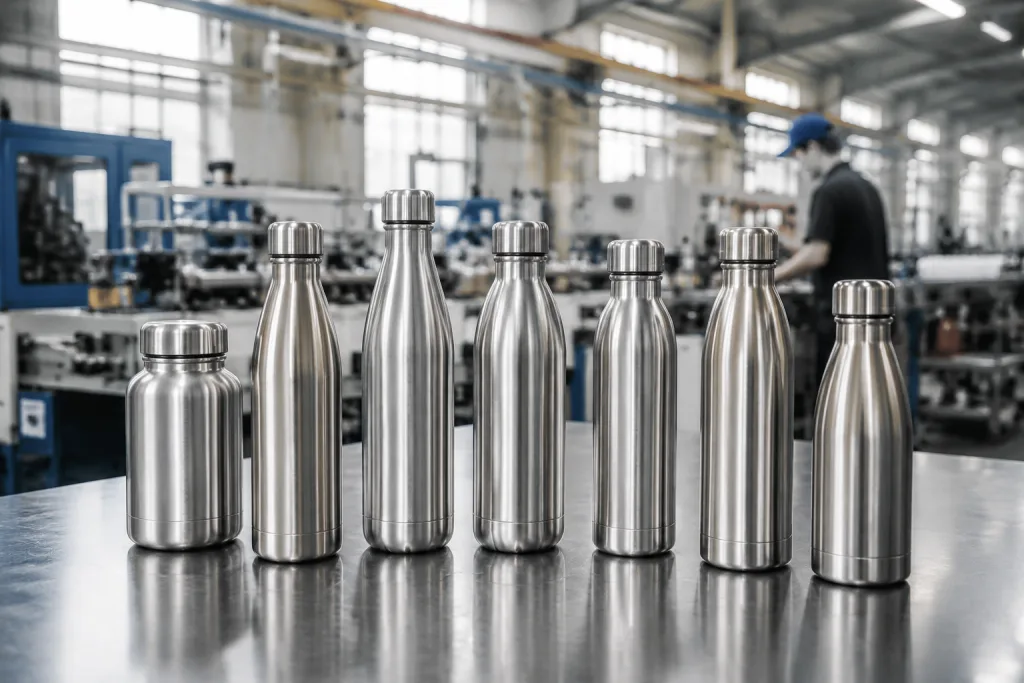
Glass damage happens before shipping
Buyers often blame ocean freight when glass breaks, but we see 6 out of 10 crack complaints start before the carton is taped. Small chips at the mouth, uneven annealing, impact during assembly, or a metal sleeve pressed too tight around the glass can create failures that appear after vibration on the truck. On our line, QC pulled a sample last month with a 0.4 mm mouth chip that looked harmless under normal light but caught on a cotton swab. If you are sourcing from a 304 stainless steel glass bottle factory, you are pairing two materials that behave differently. Stainless can flex. Glass cannot.
Specify the glass inspection points in the PO, not after the first shipment. The mouth needs a chip check and sharp-edge check; the base should sit flat on a glass plate without rocking; wall thickness should stay within the agreed tolerance, such as ±0.3 mm if that is what the drawing says. If the bottle uses a stainless bottom cup or protective cage, assembly clearance must prevent point pressure. We run a feeler gauge check at the sleeve joint because a tight spot of 0.2 mm can turn into a crack after cap assembly. For a customized canteen with a glass liner, the gasket or sleeve design should absorb movement instead of locking the glass like a clamp. The math does not work if the glass is used as the stress point.
Thermal shock gets misunderstood. Borosilicate glass performs better than soda-lime glass, but it is not magic. If your marketing copy says the bottle handles boiling water, ask for a thermal shock test before artwork approval. A common practical test is moving glass between temperature ranges, such as 20°C to 80°C, but the exact protocol should match the product design and market claim. We have seen this go sideways when a buyer printed “boiling water safe” on a gift box while the lab report only covered a 60°C difference. Do not print stronger claims than the test supports.
Packaging must be designed around glass, not copied from a plain stainless bottle. For ecommerce or Amazon FBA drinkware, inner boxes, dividers, and drop-test results matter. A 5-ply export carton, EPE or molded pulp protection, and ISTA-style carton drop testing can reduce breakage. For distributor drinkware shipped to 3 warehouses, carton labeling should include SKU, color, capacity, barcode, and handling marks; one buyer flagged a PO typo where 500 ml cartons were labeled 550 ml, and the warehouse rejected the pallet. China factories can make strong packaging, but only if you allow the cost. Saving USD 0.08 on inner protection can become a 3% breakage problem.
Capacity and fit are often misquoted
Capacity gets messy once the label claim meets the mold drawing and the test bench. We have had buyers call a bottle “1 liter” because the graduated cylinder reads 1,000 ml at brim, while QC marks the safe fill line at 900 ml. That is a different product promise. A 64 oz customizable growler can pass the fluid-ounce check and still fail the buyer’s use case if it leaves only 12 mm headspace for carbonated drinks. Outdoor retail customers do not complain politely when the hangtag says 1L and the usable pour feels short.
Use three capacity terms on the specification sheet: nominal capacity, brimful capacity, and recommended fill capacity. Put the ml value beside each one, not in a footnote. On glass-inside and 304 stainless-outside designs, the outer shell can look like a 750 ml body while the liner gives only 620 ml usable volume; our caliper reading on the liner gap is often the first clue. This comes up on insulated and protected designs. For customized growler projects, specify mouth diameter, cap thread, gasket material, and the drink type the bottle is built for. Still water is one job. Carbonation is another. Selling every bottle as carbonation-safe is the wrong question to ask, because the pressure test math does not work on some lids.
Fit failures usually look small on the table and expensive at receiving. We have seen straws come in 3 mm too short after the supplier changed the lid insert, and QC pulled the sample only after the straw sat below the sip hole. Infusers rattle when the basket OD is 0.8 mm under the mouth ID. Silicone boots cover the barcode by 6 mm. Retail boxes feel fine until a hangtag adds 1.5 mm and the top flap starts bulging. FNSKU labels on a curved powder-coated wall scan poorly, then the buyer flags it as a warehouse issue. It is not dramatic. It still creates chargebacks.
Before mass production, request a golden sample packed with the real production set: lid, gasket, infuser, sleeve, straw, retail box, manual, warning label, barcode, and master carton marks. We also ask buyers to sign the carton mark layout because one PO typo, such as “matte balck,” can travel all the way to the printing plate. For distributor growler and distributor canteen programs, keep one signed sample at the factory and one in your office. BottleForge usually supports 3,000 pcs MOQ per custom color for stainless/glass hybrid projects, with 35-45 days mass-production lead time after sample approval. For plain logo-only orders on existing molds, timing is shorter, usually 25-35 days depending on coating and packing.

Audits and inspections must match the risk
A factory audit does not guarantee a clean shipment. It tells you whether the supplier runs a production system or just a sales desk with nice PDFs. If you are buying from canteen manufacturers in China, ask who forms the 304 stainless parts on the hydraulic press, who supplies the borosilicate glass, who handles assembly, and who packs the master cartons. We often see 3-5 workshops behind one quoted order in Zhejiang and across China. That is normal. The PO still needs one responsible party, with names on the process sheet and carton label approval.
For brand owners, BSCI, Sedex, ISO 9001, or a customer social audit is often required before a purchase order is released. For promotional buyers, we run a shorter supplier questionnaire and tie it to production inspection instead. The wrong move is using one generic audit standard for every order. A simple laser-logo custom canteen, checked with a 0.15 mm logo gauge and one approved gold sample, does not need the same control plan as a new mold glass/stainless construction for retail launch.
Use staged inspection when the order value or launch date matters. Pre-production inspection checks 304 stainless material, glass fit, artwork files, and packaging dielines before the line starts. During-production inspection at 20-30% completion catches coating color shift and logo position drift; QC pulled one sample last April with the logo 4 mm off center, and that would have been 18,000 bad bottles if we waited. Final random inspection uses AQL before balance payment. For a high-risk first order, loading supervision is cheap insurance. You need the cartons on the truck to match the approved shipping marks and quantities, not just the factory’s packing list.
A professional canteen supplier should accept third-party inspection from SGS, Intertek, BV, or your appointed QC team. They can charge for rework or extra testing if the spec changes after approval, but inspection itself should not become a debate. We have seen this go sideways when a buyer added a new barcode after carton printing, then blamed the line for a PO typo. BottleForge Industrial’s current export capacity for drinkware is about 450,000 units per month across stainless bottles, tumblers, and glass/stainless assemblies. We still prefer clear inspection criteria over trust, because trust does not define a major defect under AQL 2.5.
Price pressure creates predictable defects
Bad drinkware orders rarely come from evil factories. They come from missing specs and target prices that do not match the build. If you push a canteen vendor down by USD 0.30 without changing any requirement, that USD 0.30 usually gets taken from steel thickness, silicone grade, carton weight, inspection time, or the coating supplier. We see it on the line: a wall that was supposed to read 0.42 mm on the digital micrometer comes back at 0.38 mm, and nobody sees the problem until dents show up after drop testing. The defect is not printed in the quotation. It ships in the carton.
Ask for a line-item quotation. FOB Ningbo or FOB Shanghai pricing should show capacity, material, finish, logo method, packaging, MOQ, sample cost, tooling cost if any, and lead time. For a typical custom canteen or stainless/glass bottle project, sample lead time is often 7-12 days for existing molds with custom logo, and 20-35 days if new tooling or a new glass shape is involved. Mold cost can run USD 300-800 for a simple plastic lid change and USD 3,000-8,000 for new body tooling. We run the quote against a spec sheet, not a chat screenshot; last month one PO had “matte black” in the email and “gloss black” in the attachment, and the buyer flagged it only after the pre-production sample.
If you are a canteen distributor comparing 3 or 4 canteen suppliers, compare the same spec. One quote may include 304 stainless, borosilicate glass, 5-ply carton, LFGB testing, and AQL inspection support. Another may skip all of that. The second quote is not cheaper; it is incomplete. QC pulled the sample, opened the lid with a torque gauge, and found a low-cost gasket that smelled like rubber after hot water testing. This matters more for canteen promotional orders, where buyers often focus on logo and delivery date while compliance documents sit untouched in the folder.
The better negotiation is not “lowest price.” The right target is “lowest landed risk at the required retail quality.” Tell the factory your market, sales channel, target retail price, compliance needs, and return tolerance. A good canteen manufacturer will tell you where to save and where not to save. On a customized canteen, we would cut retail box complexity before touching gasket quality. On customizable drinkware for ecommerce, we may spend USD 0.12 more on inner packaging and cut a secondary decoration instead. The math doesn’t work if a 2% return rate wipes out the saving. We’ve seen this go sideways.
Send your bottle spec before you request quotes
We will review material, lid, logo, packing, MOQ, and inspection risks before you commit to a custom drinkware order.
Frequently asked questions
What MOQ should I expect from a 304 stainless steel glass bottle factory?
For an existing mold with your logo, a practical MOQ is usually 1,000-3,000 pcs per color or design. For a stainless/glass hybrid bottle with custom coating, custom lid color, or retail packaging, 3,000 pcs is a more realistic starting point. If you need a new glass shape or new stainless sleeve tooling, factories may ask for 5,000-10,000 pcs to spread setup cost. BottleForge in Zhejiang can sometimes combine color runs for distributor drinkware programs, but only when the same body, finish process, and packing line are used. Very low MOQs are possible for samples, not for stable export pricing.
How do I confirm the bottle really uses 304 stainless steel?
Start by writing SUS304 or 18/8 stainless steel into the quotation, purchase order, and approved specification sheet. Ask for material declarations and food-contact test reports for the exact product or similar material family. For larger orders, you can require random PMI testing or chemical composition testing through a third-party lab. Be specific about which parts are 304: body, lid insert, infuser, handle pins, or decorative sleeve. Some lids use PP, silicone, and stainless together. If the supplier only says “food grade,” that is not enough for a B2B buyer placing a retail or promotional order in Europe or North America.
What quality inspection level is normal for custom drinkware?
A common final inspection plan is AQL 2.5 for major defects and AQL 4.0 for minor defects, with critical defects not allowed. For drinkware, critical defects include leakage, broken glass, sharp edges, contamination, and serious safety issues. You should also require 100% leak testing before packing, because random inspection alone may miss intermittent seal problems. During-production inspection at 20-30% completion is useful for first orders, new coatings, or complex customized drinkware. If the order is going into Amazon FBA or major retail, add carton drop checks, barcode scan checks, and packaging verification before shipment from China.
Which logo method is safest for a customized canteen?
Laser engraving is usually the most durable on exposed stainless steel, especially for premium custom canteen or custom growler orders. Silkscreen printing is cost-effective for one or two colors, but curved surfaces can limit artwork size and registration accuracy. Heat transfer works for colorful artwork, though it needs good adhesion testing and careful curing. Powder-coated bottles can be laser engraved to reveal the metal underneath, which is attractive and durable. For dishwasher-safe marketing claims, test first; do not assume. A realistic approval process includes vector artwork, a printed or engraved logo sample, tape test, rub test, and signed golden sample.
How long does production and shipping take for a canteen customized order?
For existing molds, sample production normally takes 7-12 days after artwork confirmation. Mass production is commonly 25-35 days for simple logo orders and 35-45 days for stainless/glass designs with coating, assembly, and retail packaging. Add time for third-party testing if you need LFGB, FDA-related food-contact reports, or customer-specific compliance documents. Ocean freight from China to Europe or North America may add about 25-40 days port to port, depending on route and season. If your launch date is fixed, approve packaging, barcode placement, and inspection criteria before production starts, not during the final week.