Key Takeaways
- Confirm structure first: glass body, glass liner, or 304 stainless body changes tooling, testing, and MOQ
- Typical custom drinkware MOQ starts at 1,000-3,000 units per SKU for color and logo work
- For 304 stainless bodies, ask for 0.45-0.55 mm wall thickness and AQL 2.5/4.0 inspection terms
- Laser engraving is safer for long use; powder coating gives better shelf impact but needs abrasion testing
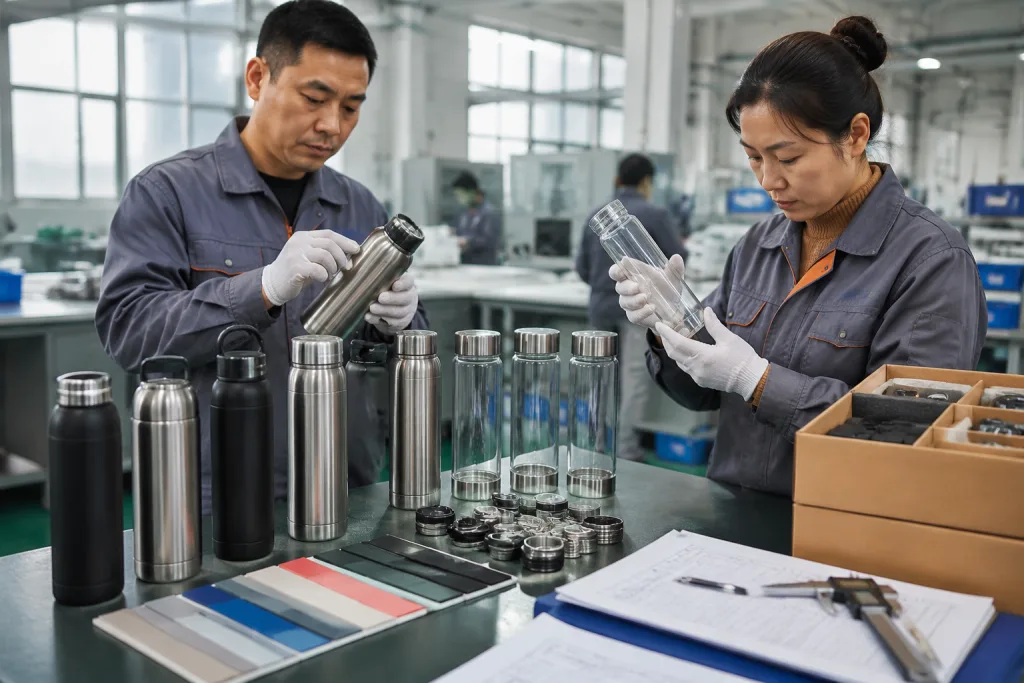
A 304 stainless steel glass bottle custom order looks simple until the first 3 samples hit the desk. One supplier quotes a glass-lined stainless bottle. Another quotes a glass body with a 304 stainless cap. A third quotes a vacuum stainless bottle with a glossy coating that only looks like glass. QC pulled a 500 ml sample last month and the caliper showed a 0.38 mm wall difference between the approved sample and the pilot-run piece. Define the construction first, or your quotation sheet is just noise.
You are not buying one bottle. You are buying repeatable production, packaging, documentation, and delivery risk. From our Hangzhou, Zhejiang team, a useful buyer brief starts with four decisions: body structure, food-contact material, decoration method, and retail channel requirements. We run these on different lines, with MOQs from 1,000 pcs for simple cap marking to 3,000 pcs for full-body coating, and the defect math changes fast. The buyer flagged this once after asking for “304 stainless steel glass bottle custom” on the PO; the line made stainless bodies, while their Amazon listing needed a glass body. We have seen this go sideways.
Decide What Bottle You Mean
The phrase 304 stainless steel glass bottle custom is loose wording, and it causes bad quotations. Lock the product definition before you ask for FOB pricing. We see 3 different meanings from buyers in Europe and North America; last month one PO even said “glass stainless vacuum bottle,” and our merchandiser had to stop the quote because the HS code, packing test, and logo process were all different.
The first meaning is a glass bottle fitted with 304 stainless steel parts, such as the cap and base, or sometimes an infuser and outer sleeve. Treat this as a glass-bottle job, not a canteen line job. Check the borosilicate grade, annealing result, silicone gasket spec, drop test target, and cap thread fit with a go/no-go gauge. Small detail, big claims. MOQ can be 2,000 units if the glass mold already exists, but a private mold may push the first order to 5,000-10,000 units.
The second meaning is a 304 stainless steel bottle with an inner glass liner. It gives cleaner taste, but the math does not work for every channel because breakage can show up during filling, sea transit, shelf handling, and consumer use. We have seen this go sideways for sports retail when the buyer expected gym-bottle durability. QC pulled the sample after a 1.2 m carton drop because 2 liners cracked at the shoulder. Packaging must be stronger, usually 5-ply export carton plus molded pulp or EPE protection.
The third meaning is a standard 304 stainless vacuum bottle with a glossy finish that looks like glass. For promotional orders and retail programs, this is the practical route. A canteen manufacturer in Zhejiang can run it cleanly with powder coating or spray painting, then add UV printing or laser logo depending on the artwork. On our line, a 500 ml bottle with a 68 mm body is much easier to control than a mixed-material glass liner build. Our Zhejiang production partners can handle about 450,000 stainless drinkware units per month across tumblers, bottles, and custom canteen programs, but capacity only helps when your specification is clear.
Choose 304 Grade With Proof
For customized drinkware, 304 stainless steel is the standard food-contact choice for the inner wall. It is not magic, and a cheap quote does not prove the coil is 304. Ask the canteen supplier for mill certificates showing 06Cr19Ni10, SUS304, or equivalent, then match the heat number against the coil label before cutting. On our line, QC checks incoming sheet with an XRF gun; last year we rejected 2 batches marked “304” because the nickel reading came back closer to 201.
For EU buyers, REACH and LFGB-style food-contact testing are common requests. For U.S. buyers, FDA food-contact compliance and California Proposition 65 screening depend on where the bottle will be sold. Kids items often need ASTM F963 or CPSIA-related checks if coatings, straws, bite valves, or small parts are included. Do not leave documents for final inspection. Testing takes 7-10 working days, and we have seen a soft-touch coating fail migration, then push shipment from 12 days to 38 days while the buyer changed artwork and re-sampled 20 pcs.
Wall thickness matters more than most new buyers expect. For a single-wall stainless canteen customized for events, 0.45 mm can be acceptable. For vacuum insulated bottles, inner and outer shell thickness often sits around 0.40-0.55 mm depending on shape, volume, and forming method. Too thin, and the body dents when the bottle hits the packing table. Too thick, and the math does not work: unit cost rises, vacuum performance may stay the same, and carton weight jumps past 16 kg for a 24 pcs master carton.
A practical buyer brief says: inner wall 304 stainless steel, outer wall 201 or 304 depending on budget, no recycled stainless unless approved, silicone gasket food grade, no BPA in plastic contact parts, and test report required before balance payment. That wording is fair. We run it on POs every month, and a serious canteen vendor will not object; if the supplier pushes back on “test report before balance,” QC pulled the sample for a reason, and you should slow the order down.
Match Decoration To Your Channel
Your logo method should follow the sales channel, not the designer’s mood board. This is the wrong question to ask at RFQ stage: “Which decoration looks best?” Ask where it sells. We run conference canteen orders that get handed out in 3 hours, and we run distributor drinkware programs that sit on retail shelves for 2 seasons. Same 304 stainless body, different risk. Last month a buyer flagged a PO typo, “slikscreen,” and the sample room still caught it before the film was made.
Laser engraving is the safe choice for 304 stainless steel surfaces. It will not peel, it holds up better in dishwasher checks than ink, and it fits corporate custom canteen orders where a clean mark is enough. The trade-off is color. You get exposed metal or a dark etched mark, not full-color artwork. On the line we check engraving depth with a 0.01 mm digital caliper, because a shallow mark looks grey after polishing.
Silkscreen printing works for 1-2 color logos on painted bottles when the budget is tight. Good for canteen promotional runs. Still, the math does not work if nobody tests adhesion on the chosen coating. For curved bodies, registration tolerance is usually around ±1 mm; if your brand guideline needs fine-line alignment on both sides, say it before sampling. QC pulled one sample last quarter where the white ink shifted 0.8 mm, acceptable by spec but not acceptable to the buyer’s retail team.
UV printing handles full-color artwork and gradients, so marketplace sellers often ask for it on customizable drinkware. It costs more and needs scratch testing, especially on matte powder coating. We use a coin rub and 3M tape pull before we call it stable. Heat transfer covers a larger area, but the edge can feel cheap if it sits proud by 0.2 mm. We have seen this go sideways on dark bottles under strong shelf lighting.
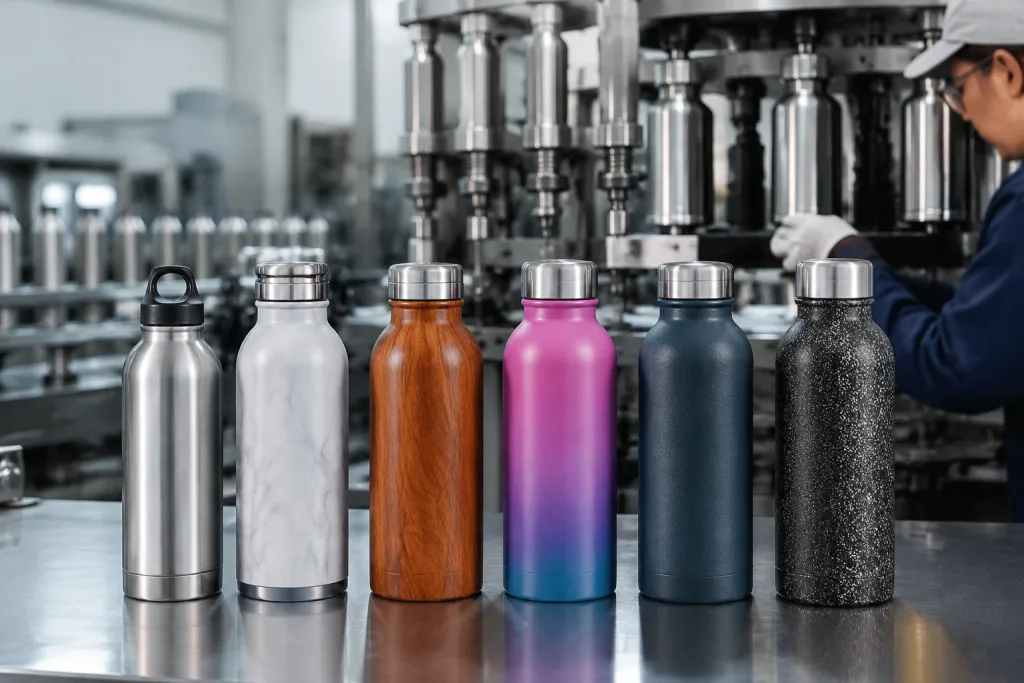
Powder coating is the finish we ship most for stainless custom drinkware because it gives grip and shelf appeal. Ask for coating thickness around 60-90 microns, cross-hatch adhesion test, and 3M tape pull after curing. A glossy glass-like spray finish can look premium, but it shows fingerprints and scratches faster. If you are a distributor canteen buyer, take one production sample and abuse it for 7 days before approving 20,000 units. Drop it in a tote, rub it against a key, wash it 10 times. The line will thank you later.
Set MOQ And Cost Expectations
Set the MOQ before you ask for price. If you need 300 units, we would send you to a stock decorator, not a China canteen manufacturer running custom production on the line. Our powder room does not even warm up the guns for 300 pcs. If you need 3,000-50,000 units, then factory-level pricing, packaging control, and a real production slot make sense.
For existing molds, we usually quote 1,000 units for laser logo on stock color, 2,000-3,000 units for custom powder color, and 3,000-5,000 units for full custom carton plus insert. Private mold work usually needs 8,000-20,000 units before the math works. Tooling can range from USD 800 for simple cap or sleeve changes to USD 6,000-15,000 for a new body shape, depending on structure. Last month QC pulled a cap sample with a 0.4 mm thread mismatch, and that small change still needed a trial mold before mass production.
FOB China pricing changes with capacity, lid type, coating process, carton strength, and inspection standard. As a rough factory-side range, a 500 ml single-wall stainless bottle sits around USD 2.10-3.40 FOB Ningbo or Shanghai. A 500 ml double-wall vacuum bottle with powder coating and laser logo sits around USD 4.20-6.80. A glass body with stainless cap ranges from USD 1.80-4.50 depending on borosilicate thickness and packaging. We ship most mixed 304 stainless and glass orders in 5-layer export cartons, and the buyer often flags carton weight after seeing a 13 kg master carton on the PI.
Be careful when a canteen supplier comes in 18-25% cheaper than the average quote. The saving usually comes from 0.4 mm steel instead of 0.5 mm, downgraded outer material, 125 g carton instead of 175 g, skipped testing, or subcontracted coating. Some canteen vendors run a lean shop, fine. They still need to show where the cost difference comes from. If they cannot, we’ve seen this go sideways during AQL 2.5 inspection when the coating tape test fails and nobody wants to pay for rework.
Build Packaging Around Loss Rate
Packaging is not an afterthought for a 304 stainless steel glass bottle custom project. It decides breakage rate, FBA acceptance, shelf look, container loading, and landed cost. For glass or glass-lined bodies, we lock the pack plan before final pricing, not after the PO. QC pulled one 750 ml sample last month after a 1.2 m corner drop cracked the inner glass liner; the bottle was fine, but the insert tray had 3 mm too much free play.
For e-commerce, we usually quote an individual white box or printed color box, barcode, suffocation warning on polybags where required, and drop-test packaging. For Amazon-style programs, FNSKU labeling, carton label position, and master carton weight limits need to be written into the artwork file and the packing instruction. Small things bite. We had a buyer flag a 17.8 kg carton because their warehouse cap was 15 kg, so the line repacked from 24 pcs to 18 pcs and the CBM math changed overnight. Buyers often ask for premium gift boxes, then find the carton cube jumps 20-35%, killing the product margin they thought they had.
For distributor growler or customizable growler programs, retail packaging can earn its cost because shelf presence sells. For corporate canteen customized orders, a plain kraft box with a printed logo is usually enough. This is the wrong question to ask: “What is the nicest box?” Ask where the bottle will travel. A giveaway item going from HR to staff desks does not need a rigid gift box; a glass bottle going through parcel delivery needs molded pulp, corner protection, and a box that survives the tape gun test on the packing table.
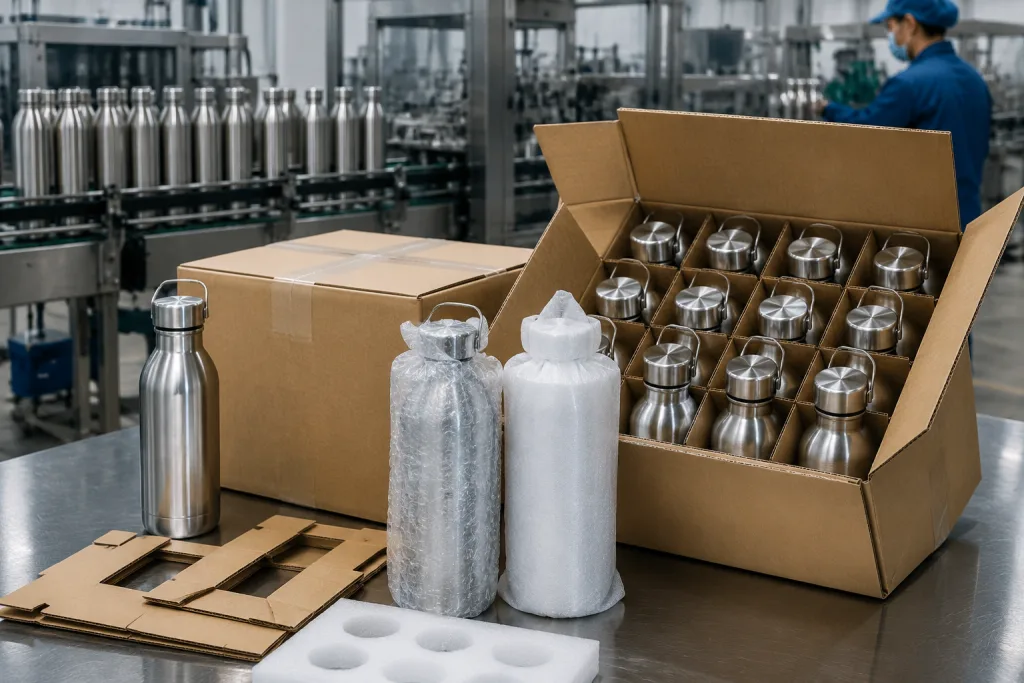
Export cartons should normally be 5-ply for drinkware, with burst strength or edge crush performance matched to the unit weight. For stainless bottles, 24 pieces per carton is common for 500-750 ml sizes. For glass bottles, 12 or 24 pieces depends on weight and protection. Ask your canteen factory for carton dimensions early so your freight forwarder can calculate CBM accurately. We run carton drawings in mm before mass production; one PO typo changed 48 × 36 × 28 cm to 48 × 36 × 38 cm, and the container load plan lost 312 cartons. A cheap bottle with poor carton loading is not cheap after ocean freight.
Control Quality Before Shipment
Put QC terms in the PO. We do. A buyer once sent us a PO with “sliver” typed instead of “silver,” and the line almost followed the artwork note until QC caught it against the Pantone chip. Verbal promises from canteen manufacturers do not hold up when coating color, vacuum performance, lid leakage, and food-contact parts are involved. Use AQL terms and list the checks by defect type.
A workable inspection plan is AQL 0 for critical defects, AQL 2.5 for major defects, and AQL 4.0 for minor defects. Critical defects include sharp edges, leakage, broken glass, unsafe contamination, wrong material, or severe odor. Major defects include logo misplacement over 1.5 mm, coating scratches over the agreed size, dented bodies, failed vacuum insulation, poor lid threading, or wrong barcode. Minor defects include small specks, slight color deviation within agreed tolerance, or carton scuffs. QC pulled 200 pcs on one 8,000 pc run last month and rejected the lot for 17 lids with rough thread starts.
For vacuum bottles, test heat retention on pre-production samples and random bulk samples. We run 95°C water filled to rated volume, then measure after 6 hours and 12 hours under room temperature with a probe thermometer. The exact result depends on capacity and lid structure, so compare against the approved golden sample, not a marketing claim. This is the wrong question to ask if the buyer only says “keep hot all day.”
For glass-body bottles, add thermal shock and leakage checks. Borosilicate glass handles temperature change better than soda-lime glass, but it still needs responsible packaging and consumer instructions. On the line, we check silicone ring seating with a 0.5 mm feeler gauge and do an upside-down leak test for 30 minutes. If your project is a custom growler or customized growler for beverage filling, confirm whether the product is intended for still drinks only or can handle carbonation pressure. We have seen 6 decorative drinkware bottle projects go sideways because the buyer wanted them sold like pressure-rated containers.
We prefer pre-shipment inspection after 80% of goods are packed and 100% of production is complete. At that stage, cartons are closed, barcodes are scannable, and the inspector can check real export packing instead of loose table samples. It costs less than arguing about defects after the container reaches Hamburg, Rotterdam, Los Angeles, or Toronto. The math does not work after sailing.
Select Suppliers By Fit
Not every canteen manufacturer fits your order. A line that runs 304 stainless vacuum bottles all day can still make a mess of glass sleeves, and we have seen it: QC pulled 3 samples with a 1.5 mm gap between the silicone boot and the bottle shoulder. A glass workshop can blow a clean bottle but lose control when the stainless coating needs 60-70 gloss units. A trading company makes sense when your PO has bottles, caps, straws, cotton bags, and POS displays from 4 separate canteen suppliers, but the math does not work if you expect factory-level answers on every part.
If you are a canteen distributor, ask whether the supplier can support repeat orders with stable color control and replacement parts. Simple question. Hard answer. For a distributor drinkware line, ask for production records, color cards, and the last 3 batch photos, not just a polished sample from the showroom shelf. If you are sourcing a distributor growler, ask about cap torque, 24-hour leak testing, and whether the growler is decorative, insulated, or cleared for beverage service; one buyer flagged this after finding a “food grade” typo on the PO but no test report in the file.
Factory audits matter. BSCI, ISO 9001, Sedex, or customer audit reports do not guarantee a clean shipment, but they show whether basic systems exist. For China sourcing, check export experience too: Incoterms, HS code use, carton marking, pallet loading, and document accuracy. We have had cartons rejected because the side mark missed 1 digit from the SKU. Zhejiang factories usually ship through Ningbo or Shanghai, both practical ports for Europe and North America, and we run container loading with a 20 kg carton limit when the buyer’s warehouse asks for manual handling.
Ask for a sample timeline and bulk timeline in writing. For existing molds, samples normally take 7-12 days after artwork confirmation. Bulk production usually takes 30-45 days after deposit and sample approval. Peak season can add 10-15 days, especially before Q4 promotional campaigns. Get dates, not promises. A reliable canteen supplier gives you a calendar with artwork freeze, pre-production sample, line start, inspection, and ETD; a weak one sends “no problem” on WeChat and then asks for 5 more days when the coating jig is still occupied.
The best fit is not always the lowest quote. This is the wrong question to ask if the lid changes on the second order. Choose the supplier who understands your sales channel, states trade-offs clearly, and can repeat the same product 6 months later without changing the lid, coating, carton, or steel gauge; we keep a sealed golden sample and measure wall thickness with a micrometer before the line starts again.
Send Your Bottle Spec Before You Quote
Share capacity, structure, logo, packaging, and target market. We will flag cost risks before you commit to tooling or bulk production.
Frequently asked questions
What MOQ should I expect for a 304 stainless steel glass bottle custom order?
For existing molds, plan around 1,000 units for a simple logo on a stock stainless bottle, 2,000-3,000 units for a custom color, and 3,000-5,000 units if you need retail packaging, inserts, barcode labels, and carton customization. If the project uses a new glass mold, custom sleeve, special cap, or private body shape, MOQ can rise to 8,000-20,000 units. A small canteen promotional order under 500 units is usually better handled through stock inventory and local decoration. Factory production in China becomes more efficient when color, coating, lid, and carton are standardized across the run.
Is 304 stainless steel always required for custom drinkware?
Use 304 stainless steel for the inner food-contact surface when the bottle touches water, tea, coffee, or acidic drinks. Some factories use 201 stainless steel for the outer shell of double-wall bottles to reduce cost; that can be acceptable if clearly disclosed and if the inner wall is 304. For single-wall bottles, we normally recommend full 304 if the buyer wants stronger corrosion resistance. Ask for a material certificate and, for EU programs, migration testing aligned with food-contact expectations. Do not accept vague wording like food grade stainless without grade, standard, or test report.
Which logo method is best for a customized canteen?
For long-term use, laser engraving is the safest because it will not peel and it works well on raw stainless or coated surfaces. For colorful promotional artwork, silkscreen printing is cheaper at scale, especially above 2,000 units, but it needs adhesion and abrasion checks. UV printing is better for full-color designs, gradients, or marketplace SKUs, but it costs more and may scratch faster on some matte coatings. If you are a canteen distributor selling repeat programs, approve one golden sample and keep Pantone, logo size, logo position, and curing requirements in the purchase order.
How long does production take after sample approval?
For an existing bottle mold with standard coating, bulk production usually takes 30-45 days after deposit and sample approval. A new coating color, custom lid, glass insert, or molded packaging can add 7-20 days. Testing can add another 7-10 working days if REACH, FDA, LFGB-style, or Proposition 65 documentation is required. Shipping is separate: ocean freight from Ningbo or Shanghai to Europe or North America often takes 25-45 days port to port, depending on routing. If you need Q4 delivery, place the order earlier than your marketing team thinks.
How do I compare quotations from canteen vendors fairly?
Make every canteen vendor quote the same specification: capacity, body structure, steel grade, wall thickness, coating, logo method, lid material, gasket material, packaging, test reports, AQL level, Incoterm, port, and lead time. A USD 0.40 difference can be real, but only if all those items match. Ask for carton size and gross weight because freight can change the landed cost by 5-12%. Also ask whether the quote comes from a canteen factory, trading company, or mixed supply chain. The right answer is not always factory-only; the right answer is transparent responsibility.