Key Takeaways
- Set RFQ specs around 304 stainless steel, 0.45-0.60 mm wall thickness, capacity tolerance, coating, and cap type
- Expect practical MOQ from 1,000 pcs per color for custom sports water bottle orders
- Use 7-10 days for logo samples and 30-40 days for bulk production after deposit and artwork approval
- Put AQL 2.5/4.0, FOB Ningbo or Shanghai, carton drop rules, and spare caps directly into the PO
A gym member drops a bottle on rubber flooring, throws it into a steel locker, then leaves it in a car for 4 hours. That is the real use case, not a polished studio photo. If you are buying 304 stainless steel fitness water bottle wholesale for a fitness brand or gym chain, price is the wrong first question. We’ve seen this go sideways: 0.8 mm dents on the shoulder, powder coating scratched after a 3H pencil test, cap seepage during an inverted leak test, logo wear after 50 rubs, 5-layer cartons crushed on the bottom pallet, and delivery slipping 12 days vs 18 days before a campaign launch.
From our Zhejiang, China factory, we see buyers lose 5 to 7 working days because the RFQ says “500 ml sports bottle with logo” and nothing else. Too thin. For a bulk fitness water bottle order, we need measurable specs before the line opens: body diameter in mm, 304 stainless wall thickness, cap material, logo method, carton drop-test requirement, MOQ, and AQL 2.5 inspection points. Last month QC pulled the sample because the PO listed “matte black” but the buyer’s artwork file named “black gloss.” A good sourcing process locks sample rules, PO line items, and inspection criteria before money is committed.
Start with the bottle job
Before you ask for price, decide what job the bottle must do inside your fitness business. A 304 stainless steel fitness water bottle wholesale order for a gym chain is not the same as a retail custom shaker bottle for supplement stores. Gym chains need bottles that survive locker drops, rinse clean under a tap, and show the member logo from 2 meters away at check-in. Fitness brands care more about carton presentation, Pantone matching, and shelf price. We saw one buyer reject a good 750 ml sample because the matte black coating hid the laser logo under gym lighting.
Put the use case inside your RFQ. Example: “750 ml single-wall 304 stainless steel bottle for gym membership welcome pack, matte black powder coating, leak-proof screw cap, one-color logo, packed in white box.” Good sentence. It gives our merchandiser capacity, material, finish, cap type, logo process, and packing before we open the caliper. Five reference photos with no diameter or height create rework; last month QC pulled a sample that was 72 mm wide, while the buyer’s treadmill cup holder allowed only 68 mm.
For a bulk gym water bottle, choose single-wall or vacuum insulated construction early. Single-wall is lighter and lower cost, often around USD 2.10-3.20 FOB for 750 ml depending on cap and finish. Double-wall vacuum bottles can run USD 4.20-6.80 FOB, but the hand feel is better and cold retention can be 12 hours versus about 4 hours for single-wall in our 20°C room test. The math does not work if you want vacuum insulation, gift-box packing, and a USD 3.00 FOB target. Shaker styles add more failure points: mixing ball, internal strainer, measurement scale accuracy, protein residue cleaning, and cap hinge strength after 3,000 open-close cycles on the jig.
Your first PO planning line items should already include these details. Check the PO twice; we once received “750 oz” instead of “750 ml,” and the line stopped for half a day before the buyer confirmed.
- Target buyer: gym members for welcome packs, retail consumers buying from shelf display, event attendees needing low-cost handouts, or a distributor sports water bottle channel with repeat cap requests.
- Capacity: 600 ml, 750 ml, 1,000 ml, or 32 oz. Do not mix ml and oz without confirming fill-line tolerance; we mark the fill line with a 0.3 mm laser setting when needed.
- Construction: single-wall 304 for light gym use, double-wall 304/201 for cold drinks, or stainless body with PP shaker lid when protein powder is part of the product plan.
- Finish: powder coating for grip, spray painting for lower-cost color runs, brushed steel for fewer visible scratches, or electro-polished interior when the buyer cares about easier cleaning.
- Sales channel: retail shelf with barcode and color box, online with drop-test packing, gym giveaway with simple white box, or distributor fitness water bottle program with spare lids kept in stock.
If you sell through distributors gym water bottle programs, avoid strange one-off parts. This is the wrong question to ask: “Can we make the lid unique?” Ask whether you can still buy 2,000 replacement caps six months later. A custom made shaker bottle with a special lid looks sharp in the first sample video, then goes sideways when a distributor needs after-sales parts and the mold insert is already changed. We ship fewer complaints when the lid thread, silicone ring, and PP flip cap are standard parts from the line.
Turn the RFQ into numbers
A serious RFQ is a technical document, not a “best price?” message. For 304 stainless steel fitness water bottle wholesale, write down the steel grade, thickness, capacity, cap material, surface finish, logo process, packaging, testing expectations, and delivery term. Short RFQs create bad quotes. Last week QC pulled a sample where the buyer’s email said “matte black,” but the PO file had “gloss black”; that one-word miss cost 2 days of confirmation before the line could start.
For material, request food-contact 304 stainless steel for the inner surface. If the bottle is double-wall, about 7 out of 10 cost-sensitive projects we see use 304 inside and 201 outside. That is acceptable only if you approve it in writing. Do not let it hide inside a cheap quote. For a single-wall customized sports water bottle, ask for a 304 body with 0.45-0.60 mm wall thickness. Below 0.40 mm, dent resistance drops fast in gym use; our QC team checks this with a digital caliper at the straight wall and shoulder before mass production.
For caps, state whether you need PP, Tritan, silicone gasket, stainless loop, carabiner, straw lid, or shaker lid. Name the parts. A customizable shaker bottle should list the mixing method, such as 304 stainless ball or PP strainer, because the buyer flagged rattling noise on one 2024 order after bulk packing had already started. If you are sourcing a custom logo shaker bottle for protein powder, ask for a wide mouth of at least 45 mm so users can clean under the thread properly.
Useful RFQ line items include. Put them in the email body and the PO, not only in a PDF attachment; we have seen artwork files renamed “final-final.ai” with two different logo sizes inside.
- Item name: 750 ml custom fitness water bottle, 304 stainless steel.
- Quantity: 3,000 pcs, split into 2 colors, 1,500 pcs each.
- Logo: laser engraving 45 x 28 mm, one position, AI artwork supplied.
- Color: Pantone Black 6C matte powder coating, delta E below 2.0 if confirmed by sample.
- Packing: 1 pc/polybag/white box, 24 pcs/export carton, carton under 15 kg.
- Terms: FOB Ningbo, 30% deposit, 70% before shipment after inspection.
In Zhejiang, around 35 drinkware factories in our circle can produce 80,000-150,000 stainless sports bottles per month depending on model mix, coating yield, and cap assembly speed. At BottleForge Industrial in Hangzhou, China, a normal MOQ is 1,000 pcs per color for stock molds and 3,000-5,000 pcs for a fully customized gym water bottle with private cap tooling. If a supplier offers 500 pcs with new tooling and a tight FOB Ningbo price, ask where the tooling cost is hidden. The math does not work.
Price the options before sampling
Sampling too early burns calendar days. Price it first. Before we open a sample request on the line, we compare the real cost drivers and cut features that do not move your sell-through. A bulk sports water bottle order changes price through steel weight in grams, lid structure, coating method, logo process, export packing, and testing. Buyers often stare at the bottle body price and miss the lid cost. We see this go sideways. On a custom shaker bottle, the lid can represent 25-35% of the total unit cost because it has 3-5 plastic parts, silicone seals, a flip spout, and 100% leak testing on a water-pressure jig.
For logo decoration, choose by use case, not by the prettiest mockup. Laser engraving holds up well on stainless or powder-coated bottles, but it cuts through to the metal color, so a black bottle gets a silver logo. Silk screen printing gives stronger color, but QC pulled one sample last month where the ink failed a 3M tape test because the coating cure time was shortened by 18 minutes. Heat transfer handles gradients and larger artwork, but it scuffs sooner in gym bags and cup holders. For a custom sports water bottle used in gyms, we usually recommend laser engraving for 12-month membership programs and screen printing for 30-60 day campaign giveaways.
Typical FOB reference ranges from China, assuming 1,000-5,000 pcs and standard packing, are based on our Hangzhou quotes with 304 stainless, normal carton packing, and no special retail insert card:
- 600-750 ml single-wall 304 stainless bottle: USD 2.10-3.40. Wall thickness and body height change the steel draw, so 0.45 mm and 0.50 mm are not the same quote.
- 750 ml double-wall vacuum sports bottle: USD 4.20-6.80. The higher end usually includes better vacuum yield control and a cleaner powder coat finish.
- 700-800 ml stainless custom shaker bottle with mixing ball: USD 3.60-5.50. Ask whether the ball is 201 or 304 stainless, because buyers flag rust complaints fast.
- Logo cost: laser USD 0.08-0.25 per position; silk screen USD 0.06-0.18 depending on colors. Two-color printing needs tighter registration, and the line rejects more pieces if the logo wraps over a curve.
- Individual color box: usually USD 0.18-0.45, depending on paperboard and print coverage. A 350 gsm box with full-coverage dark ink costs more and shows corner rub in carton drop tests.
Your pre-sample PO worksheet should separate base bottle, logo, packaging, spare parts, compliance testing, and inland freight if you use EXW. It makes negotiation cleaner. If a supplier quotes one blended price, ask for the breakdown in writing before paying sample fees. Good factories will not show every cost line, and we also protect exact material formulas and labor rates, but base bottle, lid, logo, box, and test cost should be visible. One buyer once sent us a PO with “LFGB test included” typed as “LFGG”; that typo delayed approval by 2 days because the lab paperwork had to be corrected.
For distributors shaker bottle orders, ask about reorder stability before chasing the lowest lid. A cheap lid from a temporary mold is a risk if your distributor wants the same SKU next season. Confirm mold ownership, mold life, and whether the supplier keeps spare gaskets. The math doesn't work if you save USD 0.12 now and then need a new lid sample after 6 months because the old mold was shared, worn, or moved to another subcontractor. We run spare gasket stock in sealed PE bags by color and size, usually 3,000-5,000 pcs per active SKU, because a missing 58 mm silicone ring can stop a full container booking.
Approve samples like production parts
A sample is not a souvenir. Treat it as the first production control document. For a customized fitness water bottle, approve the sample only after you check capacity, weight, coating, logo position, cap fit, odor, leakage, and packing. Photos are not enough. We have seen this go sideways when a buyer approved a glossy photo, then QC pulled the sample and found the logo sitting 4 mm lower than the approved dieline.
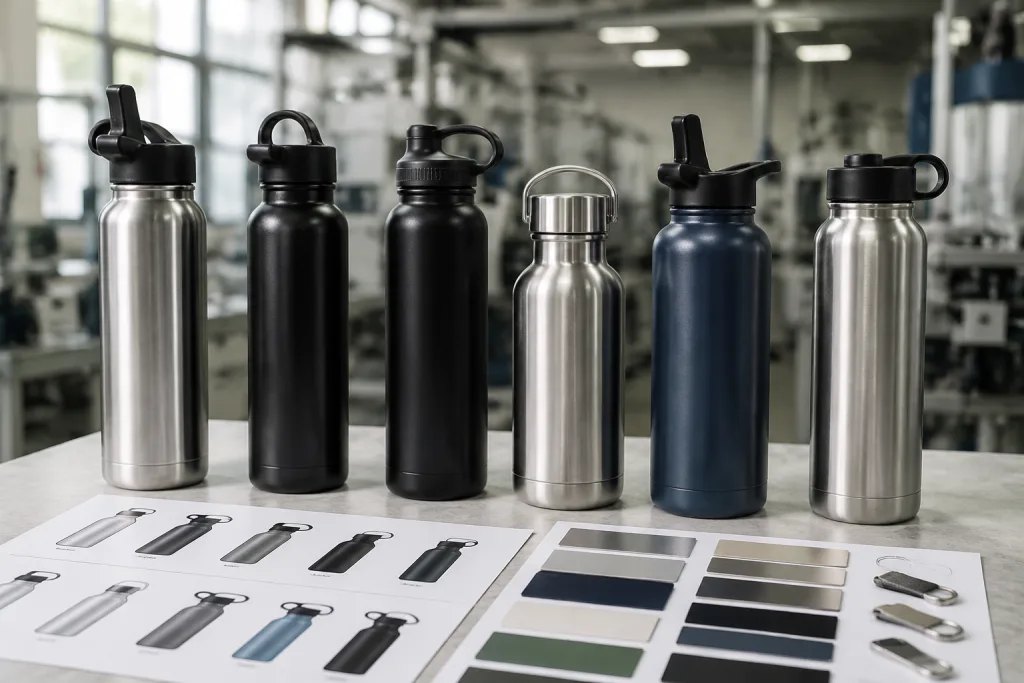
Most logo samples take 7-10 days after artwork confirmation. If a new cap mold or custom made shaker bottle structure is involved, first samples may take 20-30 days. For stock molds, ask for two sample types: a plain engineering sample to test fit and function, plus a logo/color sample to approve appearance. Keep one signed golden sample at the factory and one with your team. The PO should say bulk goods must match the approved golden sample within agreed tolerance. We stamp the factory sample bag with item code, color code, and date; one buyer once sent a PO with “matte black” typed as “mate black,” so the signed sample saved the order.
Check these sample points before you release deposit:
- Capacity: fill to practical brim and normal fill line; allow about ±3% unless you require tighter. We run this with a graduated cylinder, not by guessing from the bottle shape.
- Weight: compare against quoted gram weight; a 10% drop may mean thinner steel. Ask the line to check it on a 0.1 g scale after polishing and coating.
- Leakage: fill with water, invert for 30 minutes, shake 20 times, then inspect the cap thread and gasket. QC should also wipe the thread with white tissue to catch slow seepage.
- Coating adhesion: cross-hatch tape test according to ISO 2409 is useful for powder coating approval. If the tape lifts paint around the laser logo edge, fix it before deposit.
- Logo: measure size and position in mm, not “looks centered.” The buyer flagged this before on a 750 ml bottle because the print was 6 mm off the front seam.
- Odor: PP lids and silicone seals should not have strong chemical smell after normal washing. Open the carton after 24 hours closed; that is when bad silicone shows itself.
For a custom gym water bottle, test with real gym behavior. Drop it from 80-100 cm onto rubber flooring and tile if your buyers will use it outdoors. This is not always a formal certification test, but it shows whether the cap loop breaks too easily. For a bulk shaker bottle, mix 30 g protein powder with water, shake for 20 seconds, and clean it after two hours. If powder gets trapped in the lid seam, you will hear about it from customers. The wrong question is “does the sample look nice?” Ask whether a sweaty hand can open it after training, because that is where complaints start.
Write a PO that controls risk
A purchase order for 304 stainless steel fitness water bottle wholesale should be boring and tight. If the PO only says “as sample,” the line is working from memory, and memory fails after the third color change. Put the commercial and technical points into line items. This matters more when you buy through a trader, but we still see it go sideways with direct Zhejiang factory orders; last month QC pulled a golden sample where the PO missed the lid finish, and production ran glossy lids against a matte bottle.
Your PO should include item code, product description, quantity by color, unit price, total value, Incoterms, payment terms, artwork revision, packaging, barcode rules, inspection standard, shipment window, plus penalty or remedy language for serious defects. Break the color split clearly, such as 1,200 pcs black, 800 pcs white, 600 pcs navy, not “mixed colors.” If selling through North America retail or Amazon-style channels, include FNSKU or carton label requirements before mass packing. Relabeling 5,000 cartons after production is slow and expensive; we have seen a buyer flagged for one missing hyphen on a PO label code, and the math did not work after warehouse labor was added.
A practical PO block may read: “3,000 pcs 750 ml customized gym water bottle, 304 stainless single-wall, 0.50 mm nominal wall, matte black powder coating, laser logo 45 x 28 mm, silicone gasket, 1 pc white box, 24 pcs carton, FOB Ningbo, delivery 35 days after deposit and sample approval.” Good. It gives production, QC, and finance the same target. On the factory floor, our laser operator checks the 45 x 28 mm logo against the AI file with a steel ruler before the first 20 pcs are released to the line.
For quality terms, use AQL instead of soft words like “good quality.” Common inspection settings are AQL 2.5 for major defects and AQL 4.0 for minor defects, general inspection level II. Critical defects, such as leakage, sharp edges, wrong material, or unsafe odor, should be zero tolerance. If you need REACH, LFGB, FDA food-contact, or California Proposition 65 review, state the selling market and the component to be tested. This is the wrong question to ask: “Is the bottle tested?” A bottle body test does not automatically cover the PP cap, silicone gasket, paint, or printed ink; our lab request form has separate checkboxes for each material.
For customized shaker bottle programs, add spare parts. We recommend 1-2% spare silicone gaskets and 0.5-1% spare caps for gym-chain rollouts, especially when bottles are distributed through 20 or more locations. Cheap insurance. A distributor gym water bottle order with no spare parts creates small but annoying after-sales claims; one 8,000 pcs order had 37 gasket-loss complaints in the first month, and shipping replacement parts one by one cost more than packing the spares at the start.

Manage bulk production and inspection
After deposit, the job turns into production discipline. We run the order date, sample approval date, and artwork version on the line board because one wrong PDF name can cost 3 days. A normal stainless custom sports water bottle order takes 30-40 days after sample and artwork approval. Complex color matching, retail packaging, or a custom cap can push it to 45-60 days. Chinese New Year, usually January or February, can add another 2-4 weeks if you approve samples late.
Ask for three production updates with proof: raw material and component readiness with steel coil or tube photos, coating/logo trial with a close-up under shop lighting, and packing start with the first sealed carton on the scale. Photos help, but they are not enough for orders with real money on the table. For 5,000 pcs or more, pay for a pre-shipment inspection. Inspectors should check quantity, workmanship, function, dimensions, logo, barcode, carton markings, and packing strength. For vacuum bottles, add hot/cold retention testing from random samples; QC usually logs the starting water temperature with a probe thermometer. For single-wall bottles, focus more on leakage, dents, coating scratches, sharp edges, and cap torque.
Common major defects include leaking cap, wrong steel grade, wrong logo, serious dent, exposed sharp edge, paint peeling, and unstable base. Minor defects include small dust spots under coating, slight color variation within tolerance, tiny polishing marks, or carton scuffs that do not affect retail presentation. Your inspection checklist should match how you sell. A premium custom fitness water bottle in a retail box needs tighter cosmetic rules than a bulk gym water bottle used as a member gift. We have seen this go sideways when the buyer approved “normal scratches” by email, then rejected 312 pcs after QC pulled the sample under a brighter lamp.
Carton design is not glamorous, but it protects your margin. Use 5-ply export cartons for heavy stainless bottles, keep carton weight under 15-18 kg, and request edge protection if color boxes are thin. For ocean freight from China, moisture control matters. Desiccant packs are cheap insurance for long transit, especially with printed boxes. On the packing line, we check carton drop risk with a 1 m corner drop, because a weak master carton looks fine in Hangzhou and arrives crushed in Hamburg.
Do not pay the 70% balance just because production is “finished.” That is the wrong question to ask. Pay after inspection passes or after an agreed corrective action is documented, with photos of the reworked cartons or replacement parts. Good suppliers understand this. Serious buyers and serious factories both prefer written standards over arguments at loading time. We have had buyers flag a PO typo in the logo color code after packing started; written approval saved the order from a messy chargeback.
Plan reorders and distributor SKUs
The first order proves the bottle. The second order proves the supply chain. If you manage a fitness brand, gym franchise, or distributors fitness water bottle program, set reorder rules while the first bulk order is still on the line. Lock the item code, Pantone color, logo file version, carton size, barcode, and signed sample photo in one folder. We usually write the cap spec down to gasket color and straw length in mm. Small uncontrolled changes create mismatched inventory across locations, and QC pulled the sample more than once because a repeat PO used the old logo file.
For distributor sports water bottle sales, keep the SKU ladder tight: one 750 ml single-wall bottle for entry programs, one 1,000 ml customizable sports water bottle for training packs, and one stainless customizable shaker bottle for nutrition bundles with a separate mixing ball or strainer spec. Do not build 6-8 shapes before the channel has sales data. The math doesn't work. Split volume across too many molds and each SKU drops below MOQ, which means weaker pricing and slower replenishment. We run smoother when one color cap and one carton format cover several distributor orders.
Ask your supplier to keep production files for at least 24 months. That file should include artwork, color standard, cap component list, packaging die line, and inspection record, with the approved sample number written on the PO. At our Hangzhou, Zhejiang operation, we keep repeat-order technical files because it prevents the classic problem: a buyer says “same as last time,” but the previous salesperson, mold code, or carton label has changed. We have seen one carton label typo turn into 38 mixed pallets at warehouse check-in.
Reorder lead time is usually shorter than first-order lead time if components are standard. A repeat custom sports water bottle can often ship in 25-35 days after deposit, while a new customized shaker bottle may still need 40-50 days. Fixed gym launch dates need blanket POs with scheduled releases, not last-minute panic buying. For example, 12,000 pcs total with 3,000 pcs shipped every quarter lets the factory reserve 304 stainless steel sheet, caps, and export cartons ahead of cutting. We ship cleaner this way, and your unit cost stays closer to a larger-volume price.
The best wholesale program is not the cheapest first invoice. It is a bottle your members use, your locations can reorder, your distributors gym water bottle partners can sell without complaints, and your finance team can forecast without surprises. One buyer flagged a $0.03 higher cap cost, then accepted it after two leak-test failures on the cheaper cap. Cheap parts are expensive when returns start.
Send your bottle RFQ for a real quote
Share capacity, quantity, logo file, target market, and launch date. We will return specs, pricing, MOQ, and sampling timing.
Frequently asked questions
What MOQ should we expect for 304 stainless steel fitness water bottle wholesale?
For stock molds, a realistic MOQ is usually 1,000 pcs per color and 2,000-3,000 pcs per order. If you need a custom cap, unique body shape, or private mold, expect 3,000-5,000 pcs minimum because tooling setup, component purchasing, and coating line changeover must be justified. For a mixed bulk fitness water bottle order, many China factories will allow two colors at 1,000 pcs each if the same logo and packaging are used. Below 500 pcs, unit price rises sharply and decoration choices become limited. If you are testing a gym-chain rollout, start with a standard body and custom logo rather than a new mold.
Is 304 stainless steel necessary for a custom gym water bottle?
For the inner food-contact surface, yes, 304 stainless steel is the safer specification for a custom gym water bottle. It has better corrosion resistance than 201, especially with electrolyte drinks, flavored water, and repeated washing. For double-wall bottles, using 304 inside and 201 outside is common when cost control is important, but it should be stated clearly in the quote and PO. For single-wall bottles, we recommend full 304 construction with about 0.45-0.60 mm wall thickness. If your product will be sold in Europe or North America, also consider LFGB, FDA food-contact, REACH, or Proposition 65 testing depending on your market.
Which logo method lasts longest on a bulk gym water bottle?
Laser engraving is usually the most durable for a bulk gym water bottle because it does not add ink that can rub off. On powder-coated bottles, the laser removes the coating and shows the metal underneath, giving a clean permanent mark. Silk screen printing is better when you need exact brand colors, but adhesion depends on coating quality, ink, and curing. For gym use, ask for a cross-hatch adhesion check and abrasion review before bulk production. Heat transfer works for complex graphics, but it is less ideal for bottles that will be dropped, washed often, or carried in rough gym bags.
How long does a custom shaker bottle order take from RFQ to shipment?
For a standard customizable shaker bottle using an existing mold, plan around 45-60 days from RFQ to shipment. Quotation and technical confirmation may take 2-4 days, logo sample 7-10 days, and bulk production 30-40 days after deposit and approval. If you require a custom made shaker bottle with a new lid mold, add 20-35 days for design, tooling, and first samples. Packaging artwork can also delay the schedule if barcode, legal text, and color box dielines are not ready. Before Chinese New Year, add at least 2-4 weeks of buffer because factories and component suppliers in China fill capacity early.
What should gym chains put in the purchase order?
Your PO should include more than quantity and price. List capacity, steel grade, wall thickness, cap material, logo size and process, color standard, packaging, carton quantity, barcode or location labels, Incoterms, payment terms, delivery date, and inspection standard. For example: 5,000 pcs 750 ml customized sports water bottle, 304 stainless, matte powder coating, laser logo, 24 pcs/carton, FOB Ningbo, AQL 2.5 major and 4.0 minor. Add 1-2% spare silicone gaskets if bottles go to multiple gym locations. If you need compliance testing, state whether FDA, LFGB, REACH, ASTM, or other market rules apply to body, cap, coating, and ink.