Key Takeaways
- A realistic private label MOQ is 1,000 pieces per color for most 304 stainless steel fitness bottles
- 304 stainless steel is right for most gym bottles; 316 is usually over-spec unless you sell into marine or medical niches
- Plan 35-45 days for mass production after sample approval, plus 7-10 days for custom packaging proofing
- For gym chains, leak testing, coating adhesion, and AQL inspection matter more than fancy renders
You are not just buying a bottle. Your gym chain, supplement line, or fitness brand is going on a product people drink from at 6 a.m., toss into a locker, and leave in a car cup holder. If the 304 stainless body is swapped for a cheaper grade, the lid leaks at the silicone ring, or the logo rubs off after 30 dishwasher cycles, the buyer emails you first. Not the factory in China.
For a 304 stainless steel fitness water bottle private label project, this is the wrong question to ask: “What is your cheapest bottle?” We run the quote from MOQ, wall thickness in mm, lid tooling, logo process, carton drop test, and inspection level such as AQL 2.5. A custom logo shaker bottle that looks fine on a PDF can still go sideways on the line if the powder coating is 55 μm on one batch and 38 μm on the next. BottleForge Industrial works from Hangzhou, Zhejiang, and we ship these orders with both sides in mind: the brand plan from the buyer and the production limits that decide whether 3,000 pcs leave cleanly or QC pulls the sample before packing.
What Are You Really Sourcing?
A procurement manager might type 304 stainless steel fitness water bottle private label into Alibaba or Google, but that search term is too loose. We’ve seen buyers use it for a 500 ml gym welcome-kit bottle, a 750 ml retail bottle with color box, and a shaker for protein powder. Same keyword. Different job. On our sample table, QC pulled three “sports bottle” samples last month: one failed lid torque at 0.8 N·m, one had a gasket smell issue, and one box barcode was 2 mm too close to the edge.
Decide the use case before asking for a quote. For a gym chain, I would split the project like this:
- Daily hydration bottle: 500 ml, 650 ml, 750 ml, or 1,000 ml, usually vacuum insulated, screw lid or flip lid; we run these on existing molds when the buyer needs 18 days instead of 35 days.
- Training bottle: single-wall or double-wall 304 stainless steel, easier to carry, often with a silicone boot or handle; the buyer usually flags weight first, so we check body weight in grams before color matching.
- Shaker format: a custom shaker bottle or custom made shaker bottle with mixing ball, strainer, or powder compartment; check the strainer fit with a go/no-go gauge, because a 0.5 mm gap turns into complaints fast.
The steel body is only one part of the order. Lids and gaskets decide the return rate more often than the 304 stainless body. Coatings, straws, carry loops, and retail boxes matter too, but the lid is where we’ve seen this go sideways. A cheap lid can ruin a good 304 body. For a distributor sports water bottle program, I usually recommend testing two lid systems before locking the mold or color; last season one buyer changed lids after a 24-hour leak test left 6 wet cartons on the QC bench.
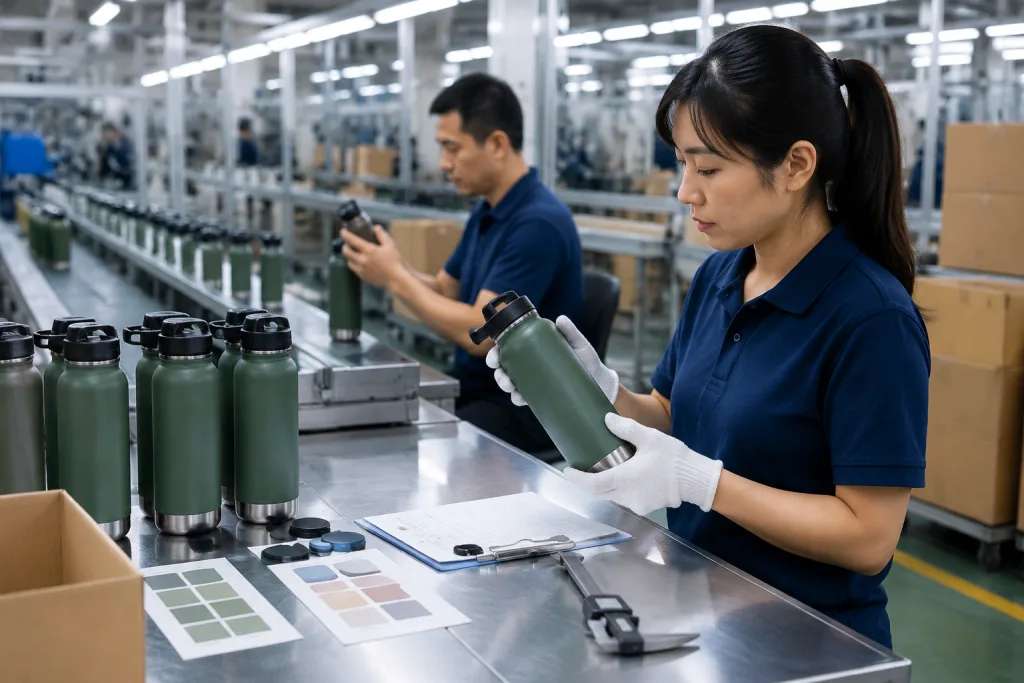
At BottleForge Industrial in Zhejiang, China, our sports bottle lines handle about 320,000 stainless steel bottles per month, with private label MOQ starting from 1,000 pieces per color on existing molds. New tooling is different: expect 25-35 days for mold work and sample adjustment before the normal production clock starts. This is where the math doesn’t work if the launch date is already fixed; a PO typo on “matte black” versus “gloss black” can cost 3 days before the line even starts.
Is 304 Steel Enough?
For most fitness brands, yes. Food-grade 304 stainless steel is our normal starting point for a custom fitness water bottle, especially for 500 ml, 750 ml, and 1 L gym bottles. It resists rust from daily washing, stays neutral after proper passivation, and passes most EU and North American drinkware programs without a fight. QC pulled a sample last month where the PO said “SS bottle” but the test request said 304 stainless; that mismatch stopped the line for 2 days. If a supplier will not write 304 on the quotation, test report, and production spec, slow down.
Typical material specs you should ask for:
- Inner wall: SUS304, commonly 0.4 mm to 0.5 mm thickness for vacuum bottles.
- Outer wall: SUS304 or SUS201 depending on price target; for premium private label, use 304 outside too.
- Lid contact parts: PP, Tritan, or food-grade silicone, with LFGB or FDA-grade documentation where required.
- Coating: powder coating, spray paint, or UV finish tested for adhesion and sweat resistance.
316 stainless steel sounds stronger in a sales deck, but the math often does not work. On a gym bottle used for water, electrolytes, or cold brew, 304 gives the same user experience at a better landed cost. We run 316 only when the buyer has a real reason, such as saltwater exposure, strong acidic drinks, or a tender document that names 316. One UK buyer pushed for 316 on a 3,000 pcs order, then switched back to 304 after the unit price moved by USD 0.42.
Do not accept wording like “premium stainless steel” or “food-safe metal.” Ask for a material declaration, and for larger orders, request an SGS, Intertek, or equivalent third-party test tied to the exact SKU. For Europe, REACH and LFGB are often requested. For the US, FDA food-contact expectations and California Proposition 65 screening depend on the sales channel. We have seen this go sideways when a buyer approved artwork before checking the steel grade; the carton mark said 304, but the supplier file only listed “stainless steel,” and the inspection finding took 5 working days to clear.
MOQ, Price, And Lead Time
About 8 out of 10 buyers ask for a fixed price before they lock the bottle drawing. This is the wrong question to ask. A bulk gym water bottle quote moves once we confirm capacity and insulation spec, lid tooling, powder coating thickness, logo method, inner tray or color box, and AQL 2.5 inspection level. On our line, QC pulled one 750 ml sample last month because the buyer changed from laser logo to 2-color silk print after the PI, and the unit cost moved by USD 0.18.
For an existing 304 stainless steel sports bottle mold, a realistic FOB China price is usually:
- 500 ml single-wall: about USD 2.20-3.40 at 3,000 pieces.
- 750 ml vacuum insulated: about USD 4.20-6.80 at 3,000 pieces.
- 1,000 ml gym bottle with handle lid: about USD 5.20-8.50 at 3,000 pieces.
- Stainless shaker with mixing insert: about USD 4.80-7.20 depending on lid complexity.
For private label work, we run 1,000 pieces per color as the practical MOQ for standard colors, and 2,000-3,000 pieces for custom Pantone powder coating. If you need a customizable gym water bottle in four colors, do not assume the MOQ stays at 1,000 total. It often becomes 1,000 per color because the coating booth, logo jig, and carton label roll all need stable batch quantities. We had one PO with “mat black” typed instead of “matte black”; the buyer flagged it only after 36 cartons were labeled.
Lead time is normally 7-12 days for a logo sample after artwork approval, then 35-45 days for mass production after sample sign-off and deposit. Custom retail packaging, FNSKU labeling, or Amazon-style carton rules add 5-10 days because we need dieline proofing, barcode scans, and packing table checks before we ship. China holidays matter. Orders placed close to Chinese New Year or National Day need extra buffer; 35 days can turn into 52 days if the powder coating line is already full.
Which Logo Method Works Best?
A custom logo shaker bottle carries the brand, so decoration is not a small line item on the PO. The wrong question is “which logo method looks best?” We ask what coating we run, how many pieces, how fine the artwork is, and whether the bottle sits in a yoga studio or gets thrown into a gym bag 5 days a week.
Laser engraving is our safest pick for a long-life custom gym water bottle. The fiber laser cuts through the powder coat and shows the 304 stainless surface below, usually with a logo depth around 0.03-0.06 mm. It will not peel, and it takes sweat, dishwasher abuse, and zipper scratches better than ink. One buyer flagged the “silver” logo as too low-key on a white bottle, so check contrast before approving the pre-production sample.
Silkscreen printing works when you need a sharp one-color logo at a lower cost. We use it often for distributor gym water bottle orders where the buyer is fighting for USD 0.08-0.15 per piece. The risk is abrasion if ink thickness, oven temperature, or curing time drifts on the line. Ask for a 3M tape test and a rubbing test; QC pulled the sample last month after 50 rubs because the blue ink was under-cured.
UV printing fits multi-color artwork, gradients, or short campaign bottles. It gives more design room, but I would not put it on every high-contact fitness bottle unless the supplier tests adhesion on the exact coating, not “similar black.” We have seen this go sideways when a buyer approved artwork on matte powder coat, then switched to glossy paint 2 days before mass production.
Embossing or custom molded lids looks premium, but tooling cost usually starts around USD 800-2,500 depending on complexity. The math does not work for a one-time 1,000-piece campaign. It does make sense for an ongoing customized sports water bottle program, especially if we can amortize the lid mold across 20,000-50,000 pieces and lock the logo position in the CAD drawing.
For most fitness brands, my blunt recommendation is simple: laser engraving for premium retail, silkscreen for event or member kits, and UV only when full-color branding is essential. If the logo file arrives as “final-final-2.ai” with 0.2 mm hairlines, send it back before sampling. Saves 3 days.
Checklist Before Paying Deposit
Run the checklist before you pay the 30% deposit. We have seen this go sideways: the buyer approved a clean 3D render, then QC pulled the PP sample and found a 53 mm mouth instead of 58 mm, coating rubbed through after 100 grid-tape cuts, and the flip lid leaked after 20 shakes in a test gym bag.
Product specification checklist:
- Confirm capacity two ways: brim-full volume and usable volume, for example 750 ml actual usable volume measured on a digital scale with water weight.
- Confirm inner and outer steel grade on the spec sheet, such as 304 stainless for liner and shell, not just “stainless steel.”
- Confirm wall thickness in mm, vacuum insulation target, and heat retention test, such as 95°C water checked after 6 hours in the lab room.
- Confirm lid material, gasket material, straw material, plus spare gasket policy; one missing silicone seal can stop a whole retail carton from shipping.
- Confirm powder coating color by Pantone or physical color chip, then ask the line to spray one real sample because screens lie.
Branding checklist:
- Send vector artwork in AI, EPS, or PDF format; JPG logos from WhatsApp usually fail when the laser file is opened.
- Confirm logo size in millimeters, not by visual estimate, such as 42 mm wide on a 76 mm bottle body.
- Approve logo placement on a dieline or real sample photo, and mark the distance from the bottom curve in mm.
- Confirm whether the same artwork applies to bottle, box, manual, and carton mark; we once caught a PO typo where the carton mark used “Fitnes” with one s.
Commercial checklist:
- Confirm Incoterm: FOB Ningbo or FOB Shanghai is common from Zhejiang, but pickup cost changes if the factory loads from Hangzhou instead of the port warehouse.
- Confirm payment terms, usually 30% deposit and 70% before shipment for first orders; the math does not work if tooling, coating, and cartons start before artwork is frozen.
- Confirm AQL level, inspection date, and who pays for reinspection if the batch fails; book the inspector 3 days before final packing, not after cartons are sealed.
- Confirm spare parts, especially lids and silicone seals, at 1%-2% of order quantity, packed in a separate carton with a clear PO line.
This is not paperwork for paperwork’s sake. It is how we keep a customizable sports water bottle project from turning into a deposit dispute after production, when 3,000 bottles are already coated and the buyer flags the wrong lid color.
Testing That Actually Matters
Some tests are worth the lab fee. Some are not. Skipping the basic ones is where the math breaks. We had one distributor push back on a shaker bottle claim rate near 3%; on a 10,000 pcs shipment, that means 300 leaking bottles, 300 complaints, and replacement freight that usually costs more than the original QC charge.
For 304 stainless steel fitness bottles, we run these checks first:
- Leak test: fill to the neck thread, tighten to the approved torque, invert for 30 minutes, then shake shaker formats 20 times on the line.
- Vacuum test: use 95°C hot water or a temperature drop check; QC pulled the sample if the outer wall warms too fast after 6 hours.
- Coating adhesion: cut a cross-hatch grid with a 1 mm blade spacing, then do the 3M tape pull test on powder-coated samples.
- Drop test: test the packed export carton and the bottle body from 80-100 cm, adjusted for 500 ml, 750 ml, or 1 L formats.
- Odor test: soak the silicone gasket, straw, and lid in warm water at 60°C; a plastic smell after 2 hours is a reject for most gym buyers.
- Food-contact testing: match the order market to LFGB, FDA-related migration, REACH, and Prop 65 where applicable; do not pay for every report if the buyer only sells in one country.
For final inspection, AQL 2.5 for major defects and 4.0 for minor defects is common. Critical defects, such as sharp edges, contamination, or serious leakage, should be zero tolerance. If you are buying a bulk sports water bottle for a national gym chain, third-party inspection is cheap insurance. One inspection day in Zhejiang usually costs less than 20 rejected cartons at retail DC level, and we have seen this go sideways when the buyer skipped it to save USD 280.
Ask the factory to keep golden samples: one with you, one with the production team, and one with QC. Label them with PO number, color code, logo position in mm, and approved lid version. When a dispute happens, the golden sample beats memory, email wording, and sales promises.
Packaging For Gym And Retail
Packaging has to follow the sales channel. For gym bulk orders, we often run a plain white box with a 60 × 35 mm carton mark, and nobody complains. For a retail customized shaker bottle, the buyer will flag weak shelf presentation, wrong barcode placement, or a lid rubbing mark after 3 days in transit testing.
Common packaging options we quote:
- Bulk polybag plus master carton: lowest cost, usually for staff issue, race packs, or 500-piece event distribution where shelf display does not matter.
- White box: clean choice for distributors sports water bottle programs; we print the SKU sticker on one short side to reduce picking mistakes.
- Custom color box: better for retail and gift programs, especially when the buyer needs barcode, capacity, 304 stainless callout, and care icons on the same panel.
- Kraft box: good for sustainable positioning, but the brown paper pulls Pantone colors down; our prepress team usually warns buyers before plate making.
- Mailer box: works for DTC brands, but carton space gets wasted; the math often fails when freight is charged by CBM.
If you sell through marketplaces or centralized gym procurement, label control is not a small admin job. Confirm EAN, UPC, FNSKU, SKU code, carton quantity, gross weight, carton dimensions, and country-of-origin wording before mass packing; we have seen a PO typo change “750 ml” to “700 ml” and QC pulled the sample before sealing cartons. For US shipments, “Made in China” marking must be handled correctly. For EU shipments, importer details and recycling marks may be required depending on packaging law in the destination country.
For a custom sports water bottle shipped by sea, I prefer 24 pieces per export carton for 750 ml bottles. Large 1,000 ml bottles are safer at 12 or 18 pieces per carton so gross weight stays under 15 kg. Heavy cartons get dropped more. We see it on the line when corner crush shows up after the 80 cm drop test.
Send Your Bottle Spec Before You Quote
Share capacity, logo method, order quantity, target market, and packaging needs. We will return a practical FOB China quote with lead time.
Frequently asked questions
What MOQ should a fitness brand expect for private label stainless bottles?
For existing molds, expect 1,000 pieces per color for a 304 stainless steel fitness water bottle private label order. If you need custom Pantone coating, many China factories prefer 2,000-3,000 pieces per color because coating setup waste is real. For a custom logo shaker bottle with standard black, white, or navy coating, 1,000 pieces is usually workable. For a new lid mold, custom body shape, or custom made shaker bottle with proprietary parts, budget tooling and a first production run of 3,000-5,000 pieces.
Can I mix several bottle colors in one bulk gym water bottle order?
Yes, but do not assume one MOQ covers all colors. A 3,000-piece bulk gym water bottle order may be split into three colors at 1,000 pieces each if the colors are standard. If you want six custom Pantone colors at 500 pieces each, the unit price will rise or the factory may refuse. Color changes affect powder coating line cleaning, logo setup, QC samples, packaging labels, and carton marks. For first orders, I suggest two colors maximum: one safe retail color and one brand color.
Is a stainless steel shaker better than a plastic shaker?
For premium fitness brands, stainless steel feels better and holds odor less than plastic. A customized shaker bottle in 304 stainless steel also gives you a higher retail price point, often USD 18-35 depending on market. The tradeoff is cost and weight. A plastic shaker may cost under USD 2 FOB, while a stainless bulk shaker bottle often lands around USD 4.80-7.20 FOB before freight and duty. If your buyers care about durability, cold feel, and brand positioning, stainless is the better private label choice.
What certifications should I request for Europe and North America?
For Europe, ask for LFGB food-contact testing, REACH screening, and packaging compliance information where relevant. For North America, request FDA food-contact documentation and consider California Proposition 65 screening if you sell in California. If the product is for children, ASTM and CPSIA questions may apply, but most gym bottles are adult products. Factory audits such as BSCI or ISO 9001 are useful, but they do not replace product testing. A clean audit does not prove that your specific custom fitness water bottle batch is leak-free.
How long does a custom sports bottle order take from artwork to shipment?
A normal timeline is 7-12 days for logo sample production after artwork approval, 2-4 days for your review, then 35-45 days for mass production after deposit and sample approval. Add 5-10 days if you need custom color box proofing, FNSKU labels, or strict carton labeling. Sea freight to Europe or North America can add 25-45 days depending on port and season. If you need a launch date, work backward at least 90 days. For orders before Chinese New Year in China, add more buffer.