Key Takeaways
- A 750 ml single-wall 304 bottle usually lands at USD 2.20-3.60 FOB Ningbo at 3,000 pcs
- Vacuum insulated sports bottles add about USD 1.10-2.40 per unit versus single-wall designs
- Realistic production lead time is 30-45 days after artwork and deposit approval
- Our Zhejiang line capacity is about 450,000 stainless sports bottles per month with MOQ from 1,000 pcs per color
If you buy for a gym chain or fitness brand, the bottle is not “free merch.” Members carry it every day, drop it on 8 mm rubber flooring, throw it into lockers, wash it with the wrong brush, then compare it with the price they pay you each month. One leaking flip cap or powder coat that chips after 3 weeks lands on your service desk. We’ve seen this go sideways.
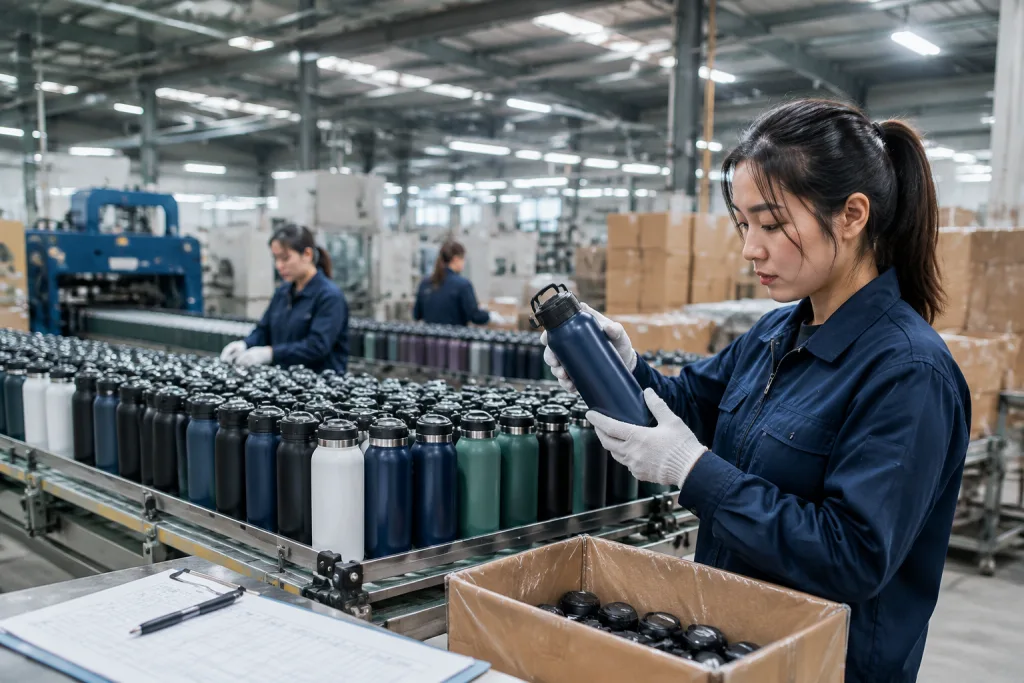
As a 304 stainless steel fitness water bottle manufacturer in Hangzhou, Zhejiang, we see the same sourcing mistake at least 6 times a month: the buyer asks for one unit price before fixing capacity, lid system, coating, logo process, carton packing, and inspection level. The math doesn’t work. On our line, a 650 ml bottle with laser logo and PE bag packing is not the same job as a 1,000 ml bottle with gradient powder coating, silicone boot, color box, and AQL 2.5 inspection; those details can move the FOB price by USD 0.40-1.80 per unit and add 7-20 days to the schedule.
Start with the real bottle specification
A serious quote for a custom fitness water bottle starts with engineering details, not a mood board. For gym chains, we quote 600 ml, 750 ml, and 1,000 ml most weeks; last month 19 of 27 gym-bottle RFQs sat in those three sizes. The 750 ml bottle is usually the safer retail size: it misses some tight car cup holders compared with 600 ml, but the shelf value looks better for a member welcome pack or retail wall. Ask for the diameter in mm. We had one buyer flag a 78 mm base after the artwork was approved because it would not sit in their treadmill bottle tray.
For 304 stainless steel, confirm whether the bottle is single-wall or double-wall vacuum insulated before you discuss logo price. A single-wall bulk sports water bottle is lighter and cheaper, usually 0.45-0.55 mm wall thickness, and we check it with a digital thickness gauge on the line. A vacuum bottle normally uses 0.4-0.5 mm inner and outer shells, with copper plating optional for better heat retention. If you want a bulk gym water bottle for cold water in training areas, insulation matters. If it is mainly for protein mixing, the wrong question is “how many hours hot”; weight, mouth diameter, and easy cleaning decide whether members keep using it.
The lid causes the most complaints. QC pulled the sample more than once because the straw lid leaked after a 1.2 m drop test onto the corner of the cap. Flip straw lids sell well for cardio and group classes, but they need silicone bite valves and proper pull-force testing, not just a nice rendering. Screw caps with carry loops are simpler and cheaper. A custom shaker bottle needs a mixing ball, whisk insert, or internal grid; each option changes mold cost, cleaning result, and carton weight, so we run the packing test before final PI instead of guessing from the 3D file.
Ask your China supplier for the material split: 304 stainless body, PP or Tritan lid, LFGB or FDA silicone seals, and coating type. For Europe, REACH and LFGB are common buyer requirements. For North America, FDA food-contact expectations and, for kids or youth programs, ASTM-related checks can apply. We ship better when the PO says “Tritan lid, black powder coating, FDA silicone” instead of “eco material”; one typo on a PO turned “PP lid” into “PC lid” and cost 6 days of back-and-forth. If the supplier cannot define these at quotation stage, the low price will go sideways.
FOB cost ranges you can budget
For a plain 304 stainless steel fitness water bottle manufacturer quote, FOB Ningbo or Shanghai is the number we use for budgeting, not EXW. EXW looks cleaner on a spreadsheet, but the math gets messy once the forwarder adds export declaration, local trucking, and port handling. In Zhejiang, our normal FOB ranges for 3,000-5,000 pcs are: USD 2.20-3.60 for a 750 ml single-wall sports bottle with a standard screw cap, USD 3.80-6.20 for a 750 ml vacuum insulated bottle after the leak tester and vacuum check, and USD 4.20-7.50 for a custom shaker bottle with stainless body and a mixing lid that needs separate fit testing. QC pulled 32 pcs from one 5,000 pc run last month because the buyer flagged a 0.4 mm lid wobble. Small detail. Real cost.
Capacity changes cost, but not in a straight line. Moving from 600 ml to 750 ml may add USD 0.15-0.35 because the body blank uses more 304 stainless, the stretch-forming time increases, and the master carton usually jumps by 10-18 mm on one side. Moving to 1,000 ml may add USD 0.45-0.90, especially if the diameter changes and we need a new coating jig instead of reusing the 73 mm fixture on the line. This is where buyers ask the wrong question: “How much per ml?” Bottle pricing does not work like juice filling.
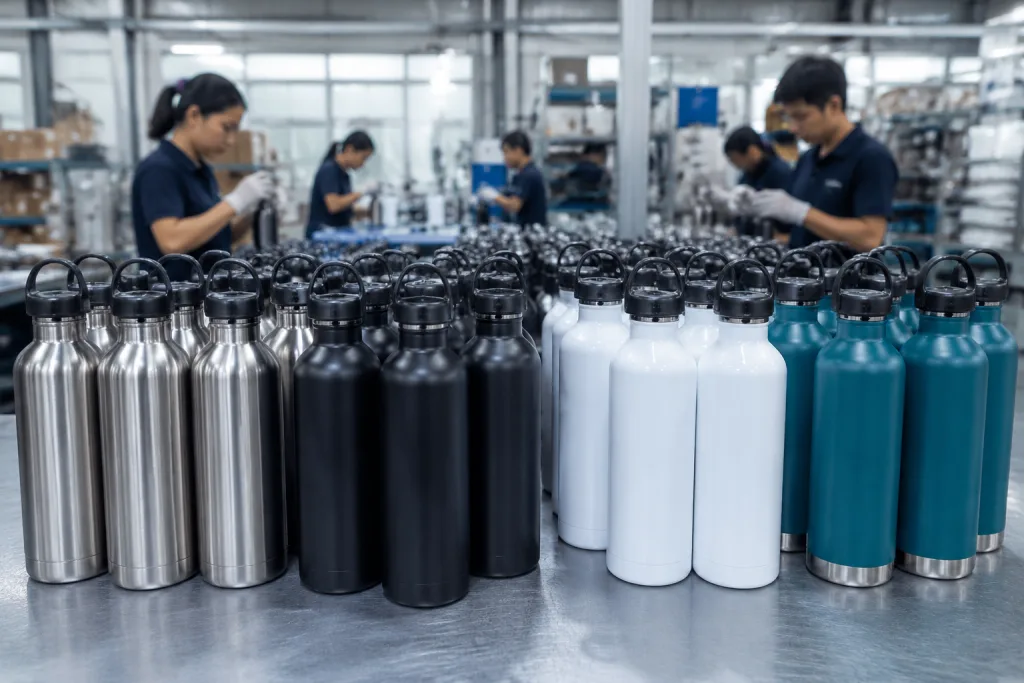
Surface finish drives the quote faster than some buyers expect. Brushed stainless is the most stable because we can check it with a light box and a simple scratch panel before packing. Powder coating usually adds USD 0.35-0.80 per unit depending on color, coating thickness, and reject allowance; our gym orders normally run 60-80 micron thickness, checked with a coating thickness gauge before AQL 2.5 inspection. Gradient coating or rubberized matte finish can add USD 0.70-1.30 and needs 5-7 extra approval days because color drift shows up under warehouse LEDs. For gym retail, powder coating is the safer middle ground: premium enough on shelf, still controllable in mass production.
For logos, one-color silkscreen may be USD 0.06-0.15 per position. Laser engraving is often USD 0.12-0.35 depending on logo area, and we measure the artwork in mm before quoting because a 28 mm chest logo and a 95 mm vertical logo do not run at the same speed. Full-wrap heat transfer or UV printing may add USD 0.40-1.20. If you are buying a custom logo shaker bottle for 12 gym locations, keep the bottle color constant and change the logo print. We have seen this go sideways when a PO said “black matte” but the attachment showed charcoal grey; the buyer saved USD 0.18 on print setup and lost 9 days approving coating chips.
MOQ tiers and price breaks
MOQ is not a punishment. It is the point where a 304 stainless coil buy, spray line setup, logo jig change, and AQL 2.5 inspection stop swallowing the margin. In our Hangzhou, Zhejiang factory, a standard bottle can start at 1,000 pcs per color when we run an existing mold with an existing lid. For a customized sports water bottle with a new powder coating and logo, 3,000 pcs is the cleaner planning number. For a custom made shaker bottle with new lid tooling, 5,000-10,000 pcs is closer to the real line cost, especially after the mold room adds 15-20 days for T1 samples.
At 1,000 pcs, the unit price climbs because the silk-screen plate, coating booth washout, and carton artwork plate are spread over fewer bottles. Simple math. A 750 ml bulk fitness water bottle that costs USD 3.25 at 3,000 pcs may be USD 3.70-4.10 at 1,000 pcs. At 10,000 pcs, the same item may drop to USD 2.85-3.05 if the specification stays fixed and the buyer does not overbuild the packing with 350 gsm gift boxes, foam inserts, and a 5-color sleeve. We have seen this go sideways after QC pulled the sample and found the gift box added 0.42 kg per carton.
For gym chains, MOQ planning should match rollout reality. If you have 25 clubs and each club needs 120 bottles for launch, that is 3,000 pcs before replenishment. A distributor sports water bottle program may need 6,000-12,000 pcs across two colors and three logo versions. Distributors gym water bottle buyers often underestimate mixed-SKU complexity: 2 colors x 3 logos x 2 lids is already 12 production combinations. The buyer flagged this on one PO only after our merchandiser noticed “mat black” typed instead of “matt black” on line 7.
We advise keeping the first order simple: one body size, one lid, two colors maximum, and one packaging structure. The math does not work when a launch order tries to carry 8 SKUs at 500 pcs each. After sales data arrives, we can build a customizable fitness water bottle range with more colors or a premium lid. That protects cash and cuts the first lead time from about 45 days to 32 days when the line can stay on one cap assembly and one carton size.
Tooling, sampling, and approval costs
If we run an existing body and lid, sample cost is usually USD 50-150 per design, including a basic logo. Air freight is separate; for 2 pcs of 750 ml bottles, DHL can be USD 65-95, so the courier bill beats the sample charge. A normal pre-production sample takes 7-12 days after artwork confirmation. For a customized shaker bottle with a new lid, mold design and trial sampling can take 25-40 days before mass production even starts, and QC will still pull the sample for leak testing on the vacuum tester before we sign off.
New tooling is where about 6 out of 10 first-time buyers get surprised. A simple PP lid adjustment may cost USD 800-2,500. A new flip-straw lid can cost USD 3,000-8,000 depending on part count, silicone components, mold cavities, and whether we need a separate TPE plug. A fully custom shaker mechanism may cost USD 5,000-15,000. The wrong question is “can the factory pay the mold first?” The cleaner question is ownership: if your brand needs exclusivity, put that in the purchase agreement, or the tool may be buyer-funded but not buyer-owned.
Artwork approval also changes the bill. A small front logo is easy. A 360-degree wrap on a tapered bottle is not. Curved surfaces stretch graphics, so we need AI or PDF vector files, Pantone references, print size in mm, and position tolerance; last month a buyer sent “logo 6cm wide” on the PO, then flagged the sample because the mark sat 4 mm too high. For a custom sports water bottle with laser logo, simplify the artwork because thin 0.2 mm lines can burn patchy on powder coating.
For a customizable gym water bottle program, ask for a sample matrix before you approve production: bottle body, lid, coating swatch, logo method, carton, barcode label, and any insert card. That list sounds boring. It saves money. If you sell through retail or online channels, confirm UPC, FNSKU, carton marks, and warning labels at sampling stage; we have seen one typo in an FNSKU force 1,200 cartons back to the packing line. Changing labels after packing can add 3-5 days and unnecessary labor cost.
A realistic production calendar
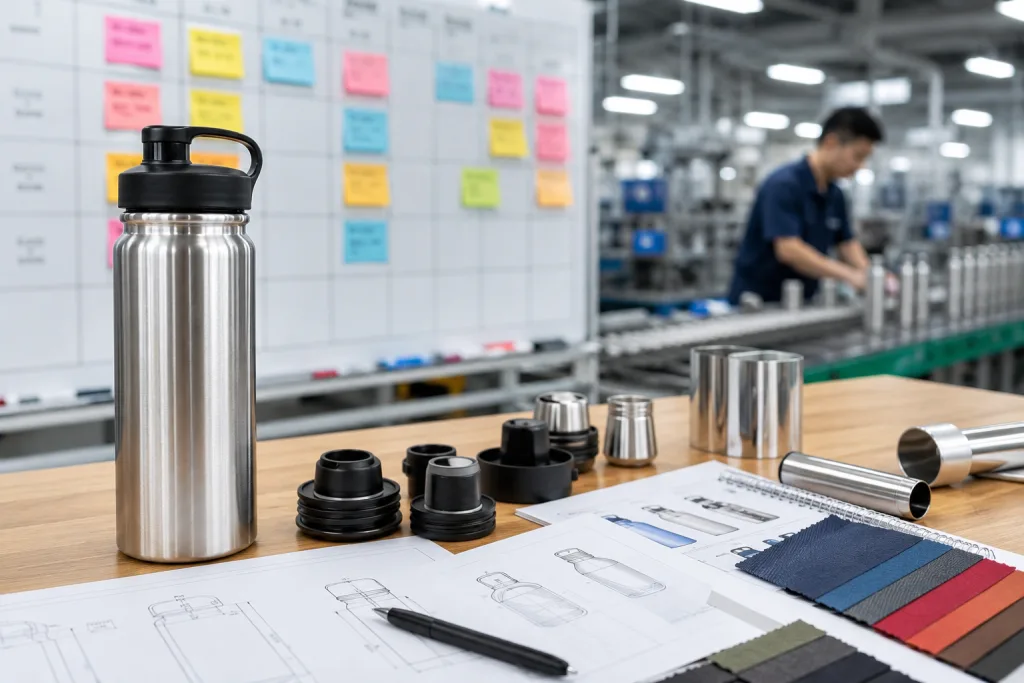
For an existing 304 stainless bottle, a workable calendar is 30-45 days after deposit and final sample approval. We usually spend the first 3-5 days locking stainless sheet or tube, buying lids and silicone rings, and putting the job into the production board. Body forming, welding, polishing, and ultrasonic cleaning take about 7-12 days, with the swing coming from order size and how many molds are already on the line. On a 5,000 pcs run, QC pulled 12 bottles after welding last month because the mouth ovality was over 0.35 mm. Vacuum bottles need extra time. Every bottle has to pass vacuum and leak checks before we let it move forward.
Coating and printing usually take 5-10 days. Powder coating has to cure at the right oven temperature; if a buyer asks us to cut one day here, this is the wrong place to save time. The math doesn't work when a chipped bottle becomes a 2-star review. Logo printing or laser engraving comes after coating, then we run assembly, water leak testing, cosmetic inspection, and packing. For a bulk gym water bottle order with 3,000-5,000 pcs and a one-color logo, this flow is clean. For a customized fitness water bottle with four colors and individual retail boxes, line balancing slows down because one missing PMS color or a 2 mm box artwork shift can hold the whole packing table.
Book inspection before packing is finished, not after the ship date is already missed. Buyers often use AQL Level II, with critical defects at 0, major at 2.5, and minor at 4.0. We check capacity with a measuring cylinder, coating adhesion by cross-hatch tape test, logo rub resistance, leak performance, odor, carton drop, and barcode scan. For a distributor shaker bottle order, lid fit and seal compression need extra attention; protein powder residue gets into a 0.2 mm gap fast, and customers blame the bottle, not their cleaning habit.
Ocean freight to Europe or North America adds 25-45 days port to port, depending on route and season. Air freight can save a launch, but it adds USD 1.50-4.00 per bottle, and we have seen buyers reject that number after the cartons were already packed. If your gym opening date is fixed, place the purchase order 90-110 days before you need bottles in your warehouse. Safer is better here. We ship late orders too, but nobody likes paying air freight because one PO had the logo file name typed wrong.
Quality standards that prevent returns
Gym users beat bottles up. They toss them into lockers, leave them in 55°C cars, and soak lids in alkaline detergent after a protein shake leaks in the bag. A good customized gym water bottle has to survive abuse, not just look clean on a showroom shelf. For 304 stainless steel, we run wall-thickness checks with a micrometer, check internal polishing under a bore light, feel the weld seam with a cotton swab, and verify passivation after welding. QC pulled one 750 ml sample last year where the steel grade was correct, but the inside shoulder had rough polishing marks; after 48 hours with lemon water, the buyer flagged odor. The steel was not the problem. The finishing was.
Leakage is usually lid engineering, not bottle body magic. Silicone hardness, thread engagement, vent size, and straw tolerance all matter. A flip lid can pass a 10-second upside-down water test and still leak after 500 open-close cycles on the hinge jig. For higher-volume distributor fitness water bottle programs, we recommend cycle testing, 1-meter drop testing on filled samples, and dishwasher simulation if the carton or Amazon listing says dishwasher safe. We have seen this go sideways: one buyer wanted the dishwasher-safe icon printed before testing, then the coating whitened after 20 wash cycles at 70°C. If the test data is not there, do not print the claim on the box.
Compliance depends on the sales market and the retail channel. For EU buyers, REACH, LFGB food-contact testing, and packaging waste rules are common. For US buyers, FDA food-contact material documentation and California Proposition 65 review may be requested. BSCI or Sedex factory audits are often required by larger retailers, especially when the PO is above 5,000 pcs and ships under a private label. Our China export documentation normally includes commercial invoice, packing list, bill of lading, and certificate of origin when required. Small detail, big headache: we once had a PO typo showing “304 stainless steal,” and the customs broker asked for corrected paperwork before release.
Do not rely only on a golden sample. That is the wrong question to ask. A golden sample proves the line can make one good bottle; it does not prove the line can hold 8,000 pcs without drift. Mass production needs incoming material inspection, in-line QC, and final AQL inspection. A customizable sports water bottle with a nice sample can still fail if the coating supplier changes powder batch or the silicone gasket dimension drifts by 0.2 mm. On the line, we check gasket OD with a digital caliper and log coating thickness in µm before packing, because returns usually start with small misses nobody wrote down.
How to keep landed cost down
The easiest way to cut landed cost is not pushing the factory for another USD 0.05. It is cutting the parts count. Use one bottle diameter for 600 ml and 750 ml when the hand feel still works, run one shared lid across the range, and keep the first order to 2 coating colors. On our line, a bulk shaker bottle with one PP lid and two body colors usually clears coating changeover in 35 minutes; a six-color launch with three lid molds can lose half a shift before packing even starts.
Packing hits cost harder than 7 out of 10 new brand teams expect. A color retail box may add USD 0.18-0.45 per unit and increase carton volume, which means you pay again in freight. A kraft box with one-color print costs less and still fits a fitness brand if the artwork is clean. For e-commerce, we run a stronger mailer or drop-test carton, especially for Amazon FBA; last month QC pulled the sample after a 76 cm corner drop because the cap scuffed through the inner tray. For gym counter sales, a master carton with hangtag is often enough.
For distributors fitness water bottle programs, consolidate purchase orders. Do not place four separate 1,000 pc orders if the forecast is already there; combine them into one 4,000 pc production run with scheduled shipments. The math works better: coil purchasing is cleaner, setup loss drops, and coating color stays closer across batches because we spray from the same approved swatch. FOB terms are easier for factory comparison. DDP can hide freight and duty assumptions, and we have seen this go sideways when the buyer flagged a “free delivery” quote that jumped after the vessel was booked.
If you are comparing suppliers in China, give every factory the same specification sheet: capacity, steel grade, wall thickness, lid material, coating, logo size, packing, compliance tests, AQL level, Incoterm, and delivery deadline. Better yet, add the drawing tolerance in mm and confirm whether 304 stainless is required for both inner and outer walls. A 304 stainless steel fitness water bottle manufacturer can quote reliably only when the target is pinned down. Vague RFQs produce cheap numbers first and change orders later; we once had a PO typo showing 0.4 mm wall thickness instead of 0.5 mm, and the buyer only caught it after the pre-production sample felt too light.
Send your bottle spec for a costed quote
Share capacity, lid style, logo method, quantity, packing, and target market. We will return MOQ, FOB price, sample time, and lead time.
Frequently asked questions
What is the best MOQ for a first custom sports bottle order?
For most fitness brands, 3,000 pcs is the best starting point for a custom sports water bottle using an existing 304 stainless body and lid. It gives enough volume for stable coating, logo setup, and carton printing without tying up too much cash. We can sometimes support 1,000 pcs per color, but the unit price may be USD 0.40-0.80 higher than at 3,000 pcs. If you need a custom shaker bottle with new lid tooling, plan around 5,000-10,000 pcs because the mold cost and trial production need more volume to make sense.
How much should we budget for a custom logo shaker bottle?
A stainless custom logo shaker bottle usually ranges from USD 4.20-7.50 FOB China at 3,000-5,000 pcs, depending on capacity, lid complexity, mixing insert, coating, and logo process. A basic screw-lid shaker with a stainless mixing ball is cheaper than a flip lid with multiple silicone seals. Laser engraving may add USD 0.12-0.35 per unit, while full-wrap printing can add USD 0.40-1.20. If you need retail packaging, add about USD 0.18-0.45 per bottle for a printed box, more for e-commerce protective packaging.
Can we mix colors and logos within one bulk fitness water bottle order?
Yes, but each split affects cost and lead time. A practical structure is 3,000 pcs total with two colors and one logo, or 5,000 pcs with two colors and two logo versions. When you split into many small combinations, coating setup loss rises and QC becomes harder. For example, 6,000 pcs divided into 12 SKUs is only 500 pcs per SKU, which is inefficient for a bulk fitness water bottle line. If you need location-specific gym logos, keep one bottle color and change only the print artwork.
What lead time should a gym chain allow before launch?
For an existing mold and normal logo customization, allow 30-45 days for production after deposit and sample approval. Add 7-12 days for sampling and 25-45 days for ocean freight to Europe or North America. A safe launch plan is 90-110 days from purchase order to warehouse arrival. If you need a new lid mold or a custom made shaker bottle mechanism, add 25-40 days before mass production. Air freight can rescue a late launch, but it may add USD 1.50-4.00 per bottle.
What tests should we require for distributor sports water bottles?
For distributor sports water bottle programs, request AQL Level II final inspection with critical 0, major 2.5, and minor 4.0 as a baseline. Tests should include leak testing, coating adhesion, logo rub resistance, capacity check, odor check, lid cycle testing, and carton drop testing. For EU sales, ask about LFGB and REACH. For US sales, confirm FDA food-contact documentation and Proposition 65 review if applicable. If the bottle will be marketed as dishwasher safe, require test evidence instead of accepting a verbal claim.