Key Takeaways
- A practical MOQ for custom 304 stainless steel sports bottles starts at 1,000-3,000 pcs per color
- FOB China pricing usually ranges from USD 3.20-8.80 depending on capacity, lid, finish, and packaging
- Sampling takes 7-15 days; bulk production normally needs 30-45 days after deposit and artwork approval
- Logo method, powder coating, carton packing, and inspection level can change the schedule by 3-10 days
If you run a fitness brand or gym chain, the bottle is not a giveaway. It sits on rubber gym flooring, retail peg hooks, and member welcome-kit tables. QC pulled one sample last month with a 0.35 mm paint chip near the base after a tape test; the buyer flagged it before we even discussed carton marks. A leaking lid or weak insulation becomes a brand problem fast.
As a 304 stainless steel fitness water bottle factory in Zhejiang, China, we hear the same sourcing questions every week: what does a bulk sports water bottle cost, where does MOQ start, how long does a custom logo take, and which options slow the line down? The honest answer: the math comes from 12 to 18 small choices, not one unit price. Logo method, lid mold, powder coating, carton drop-test standard, and even a PO typo like “matte back” instead of “matte black” can add 3 days before we ship.
Where the unit cost starts
For a 304 stainless steel fitness water bottle factory, the first cost line is the body, not the logo. Capacity, steel thickness, forming loss, vacuum structure, and lid tooling decide the quote before printing is discussed. A single-wall 750 ml bottle can sit near USD 3.20-4.20 FOB Ningbo or Shanghai at 3,000 pcs. A double-wall vacuum insulated 750 ml bottle is more often USD 5.20-7.40. A 1,000 ml model with powder coating, carry handle, and straw lid may reach USD 7.20-8.80. On the line, our forming tech checks the neck diameter with a digital caliper; a 0.3 mm drift can mean the cap feels loose even when the drawing looks fine.
Most fitness buyers ask for 304 stainless steel inside because it is food-contact safe, corrosion resistant, and accepted by European and North American distributors. The common construction is 0.4-0.5 mm inner wall and 0.5-0.6 mm outer wall for vacuum bottles. Going thinner saves money, but the math doesn't work if cartons arrive with dents after one hard unloading at the gym distributor’s warehouse. Going thicker gives better hand feel, then the buyer flags the carton weight and asks why freight jumped. QC pulled one 1,000 ml sample last month at 418 g empty weight; the buyer wanted it under 390 g, so we had to adjust the outer wall spec.
For a bulk gym water bottle or bulk fitness water bottle program, lid cost catches 6 out of 10 first-time buyers. A simple screw cap may add USD 0.35-0.55. A flip straw lid with silicone seal, carry loop, and dust cover can add USD 0.90-1.60. If you need a bulk shaker bottle with a mixing ball or internal agitator, add roughly USD 0.20-0.45 depending on stainless steel grade and packing method. Small parts matter. We run a lid torque check and a 24-hour upside-down leak test because one weak silicone ring can kill the whole PO, even if the bottle body passes visual inspection.
We usually tell buyers in China to lock the bottle structure first, then negotiate decoration. Saving USD 0.15 on printing means little if the lid leaks at 80 kPa pressure testing. We have seen this go sideways: one PO had “matte black” typed as “mate black,” the sample room still understood it, but the lid seal spec was missing and that caused a 12-day approval delay.
MOQ tiers that actually matter
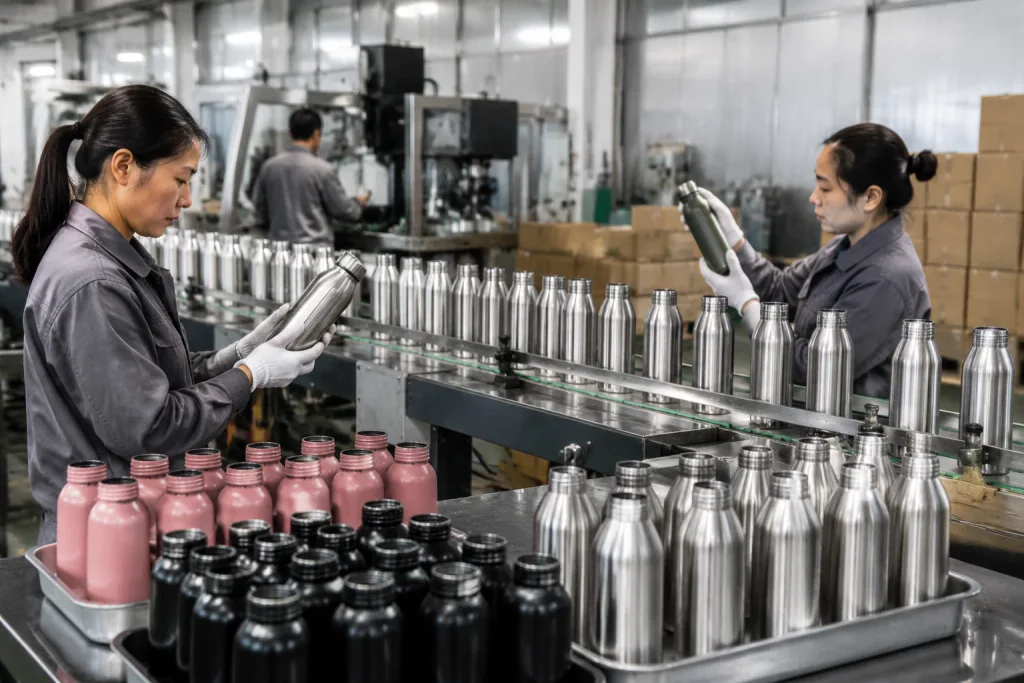
MOQ is not a penalty. It is how we cover setup time, coating loss, screen setup, carton printing, and QC labor. At our Zhejiang plant, standard sports bottle output is about 450,000 units per month across stainless steel bottle lines, and the line changeover for one color takes about 45 minutes before the first good bottle comes off the conveyor. For a standard custom sports water bottle, the workable MOQ is usually 1,000 pcs per SKU if you accept existing molds and stock colors. For a private color, 3,000 pcs per color is a more realistic floor.
At 500 pcs, we can run samples or a small trial order, but FOB pricing looks ugly because the powder coating booth, laser logo setup, and packing table still need the same crew. QC still pulls bottles for coating thickness, logo position, and leak test, even if the order is only 20 cartons. At 1,000 pcs, a custom fitness water bottle with laser logo is possible, but color choice is often limited to stock powder. At 3,000 pcs, you can ask for Pantone-matched powder coating and custom carton marks with better unit pricing. At 5,000-10,000 pcs, the factory can plan 304 stainless sheet purchase earlier and reduce the unit cost by roughly 4-9% versus 1,000 pcs.
For distributor sports water bottle programs, the better structure is one shared body with two lid variants, not a new body for every channel. We have seen this go sideways when a buyer wants six shapes at 1,000 pcs each; the math does not work after mold adjustment and lid fit testing. You may sell it as a distributor fitness water bottle, distributor gym water bottle, or custom shaker bottle, but we run faster when the stainless steel bodies stay common and tooling changes stay low.
If you need 20 gym locations to carry slightly different logos, ask about split-logo production. For example, 5,000 pcs total with five laser logos of 1,000 pcs each is often easier than five separate 1,000 pc orders with different colors and packaging. Last month, the buyer flagged a PO typo where “matte black” and “black matte” were treated as two colors, so we now confirm the color code, logo file name, and carton mark before releasing the laser jig.
Customization costs beyond the logo
Most buyers tell us they need a custom logo shaker bottle or custom gym water bottle. Fair, but the logo is not where the bill stops. Decoration method changes cost, line speed, and rework rate. Laser engraving is clean and durable, and it usually adds USD 0.12-0.35 per pc depending on logo size; on the fiber laser, a 35 mm chest logo runs much faster than a 90 mm wrap mark. One-color silk screen printing often adds USD 0.08-0.22 per pc, plus a screen charge around USD 30-60 per design. Heat transfer or full-wrap graphics can add USD 0.45-1.20 per pc and needs tighter artwork control. We had one PO with “matte sliver” instead of “matte silver,” and QC pulled the sample before the wrong film went to the line.
Powder coating is common for a customizable sports water bottle because it feels better in the hand and resists scratches better than ordinary spray paint. Standard matte black, white, or navy costs less because we run those powders almost every week. Pantone matching normally adds 3-7 days and may require 3,000 pcs per color; below that, the math doesn't work after powder changeover, gun cleaning, and color-panel approval. Metallic, gradient, rubberized, or glitter finishes cost more and create more rejection during visual QC. Last month, the buyer flagged two 0.8 mm black specks on a cream bottle, and the inspection table caught 47 pcs before packing.
For a customized shaker bottle, check the mixing system early. Do it before artwork. A stainless mixing ball is cheap and simple. A built-in plastic grid or removable agitator needs mold compatibility, food-contact testing, and a tolerance check, especially if the bottle is vacuum insulated. We measure lid fit with a go/no-go gauge because a 0.3 mm gap can turn into leakage after the customer shakes protein powder for 20 seconds. Not every sports lid works with hot liquid, carbonated drinks, or protein powder residue, and we’ve seen this go sideways when a buyer chose a flip lid meant only for cold still water.
Packaging also affects cost. A plain white box may be USD 0.18-0.35. A printed retail box is often USD 0.35-0.75. If you need barcode labels, FNSKU labels, warning stickers, or gym-chain location sorting, budget extra labor and 2-4 production days. We ship cartons through a drop-test station at 76 cm, and weak retail paper shows up fast at the corners. A customized sports water bottle that looks simple online may have ten separate bill-of-material lines in the factory system, from the PE bag thickness to the master carton mark.
Lead time from sample to shipment
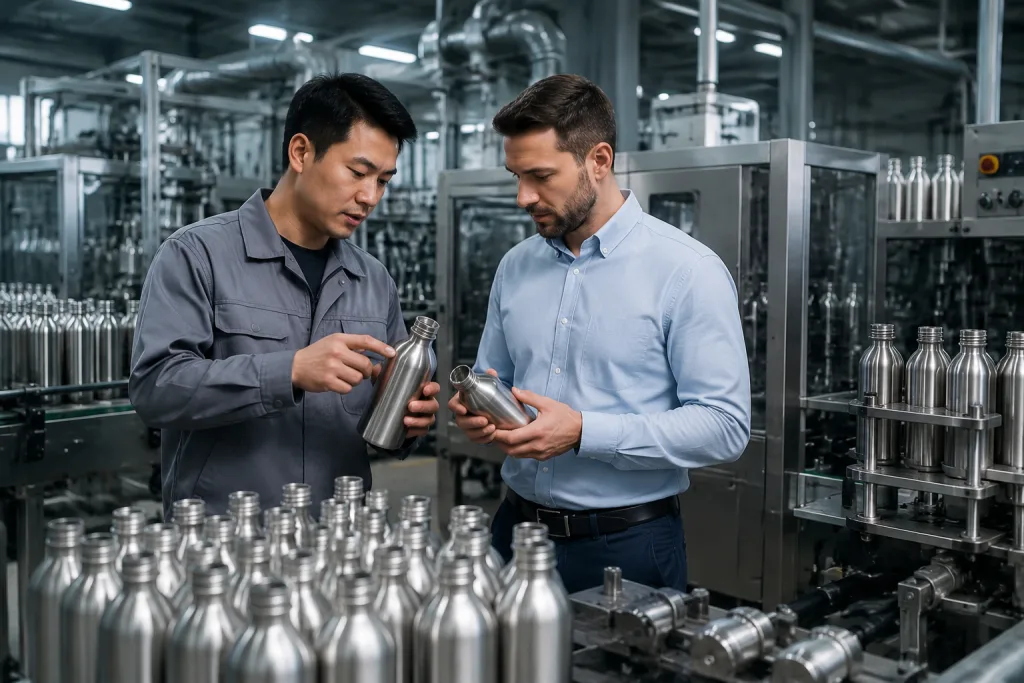
A realistic schedule for a custom made shaker bottle or custom sports water bottle starts from approved artwork and deposit, not from the first email. We’ve seen this go sideways when a buyer counts from the inquiry date and then pushes the line for a launch we never booked. If you use an existing bottle mold, a physical sample normally takes 7-10 days for laser logo and 10-15 days for custom color or printed retail box. If a new lid mold is needed, add 25-40 days for tooling, T0 testing, and corrections; our mold room will check the lid thread with a go/no-go gauge before we let QC pull the sample.
Bulk production for 1,000-3,000 pcs usually needs 30-35 days after sample approval. For 5,000-20,000 pcs, 35-45 days is safer, especially in China before Chinese New Year or during summer peak fitness promotion seasons. Sea freight to the US West Coast can add roughly 18-25 days port to port; to major European ports, 30-38 days is common. Air freight is faster, but the math doesn't work for a bulk sports water bottle unless the order is small or the delivery date is already burning; one buyer flagged a USD 1.62 per bottle freight jump on a 3,000 pcs reorder and moved it back to sea.
A clean timeline looks like this: 2-3 days for quotation and product confirmation with capacity, coating, and carton size checked; 3-5 days for artwork adjustment if the logo file is AI or PDF, not a low-res JPG; 7-15 days for sampling; 2-4 days for sample review by your team; 30-45 days for mass production; 2-5 days for final inspection and booking, then international freight. Short plan, big risk. If your launch date is fixed, work backwards at least 90 days, because AQL 2.5 inspection can still pull issues like a 0.3 mm logo shift or a dented inner carton corner.
Delays usually come from unclear artwork and late packaging files, with color approval causing the most arguments. If your gym chain has strict brand colors, send Pantone C numbers, not screenshots; a phone photo of “navy blue” under office lighting is the wrong question to ask the factory. If your distributors fitness water bottle program needs multiple countries, confirm labeling languages before production starts. We once stopped a PO for 2 days because “BPA FREE” was spelled “BAP FREE” on the bottom sticker file.
Quality checks fitness buyers should require
Gym bottles get abused: drops on rubber flooring, sweat, protein powder, wrong dishwasher cycles, then a hard throw into a locker. A visual check is not enough. For 304 stainless steel bodies, ask for the steel mill declaration, material grade statement, and food-contact reports for your sales market, such as LFGB, FDA, REACH, or California Proposition 65 when applicable. On our line, QC checks the incoming 304 coil paperwork against the heat number before cutting; if the PO says “304” but the supplier tag says “201,” the lot stops. For children or youth gym programs, also check packaging warnings and small-part risk against ASTM-related requirements.
A workable inspection plan uses AQL, usually AQL 2.5 for major defects and AQL 4.0 for minor defects. For a 5,000 pc customized gym water bottle order, a third-party inspector or factory final random inspection will often pull 200 pcs under general inspection level II. Major defects we reject include leakage at the lid seal, vacuum failure, sharp rim edges over the mouth, cracked flip lids, logo position off by 2 mm or more, and coating peel after tape testing. Minor defects include dust points under coating, light hairline scratches, or print density that looks uneven under the inspection lamp. We once had a buyer flag “Pantone 286C” typed as “286U” on the PO; that small typo changed the logo shade, so QC now checks artwork files against the approved sample before packing.
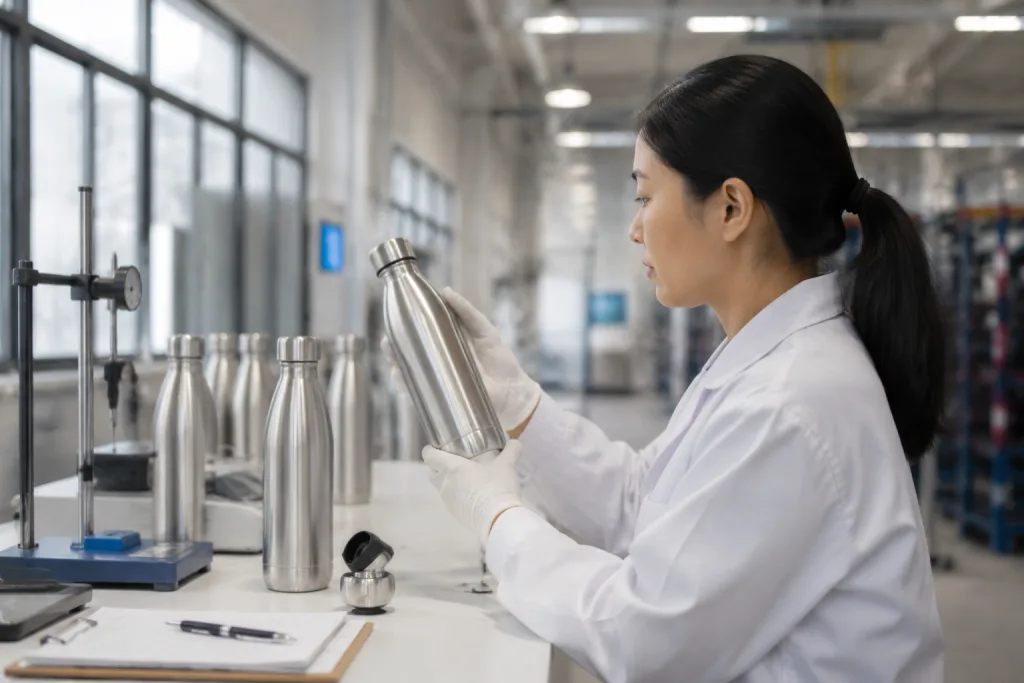
Our regular factory tests cover vacuum insulation check, 100% leak test for selected lid types, coating adhesion cross-cut test, salt spray sampling for metal parts, carton drop test, and torque check on screw lids. The tools are simple but strict: 3M tape for cross-cut, a torque meter for the cap, a 1.2 m drop height for export cartons, and a water bath station beside the assembly line. A double-wall vacuum bottle should normally keep hot water above 55-60°C after 6 hours depending on capacity and room temperature. If you sell a customizable fitness water bottle with strong insulation claims, define the test method before printing the retail box; we have seen this go sideways when marketing promised “24 hours hot” on a 500 ml bottle that passed the factory standard but not the claim.
Do not approve a golden sample after checking only the logo. This is the wrong shortcut. Fill the bottle, shake it 20 times, leave it upside down for 30 minutes, then test it again after protein powder dries around the gasket. QC pulled one sample last quarter that looked perfect on the table, but the silicone ring held odor after one night. A nice-looking distributor shaker bottle that traps smell will bring repeat complaints from gym users.
How to control landed cost
FOB unit price is only one line in landed cost. Count the carton cube. A bulk gym water bottle order still carries carton volume, duty, freight, inspection, financing, and local handling. A 750 ml stainless steel bottle may pack 24 pcs per master carton, with carton size around 48 x 36 x 28 cm and gross weight near 11-14 kg depending on lid and box. On our packing bench, we check the final carton with a 5 m tape after the drop test, because a 2 cm height increase across 600 cartons changes the booking. If you choose oversized gift boxes, your sea freight cost per bottle can rise by 10-18% even when the FOB price stays the same.
For North America, confirm HS code and duty treatment with your broker before you approve the model. For Europe, check EPR packaging obligations, REACH documentation, and local language requirements. We have seen this go sideways: the buyer flagged a PO with the wrong country sticker text after cartons were sealed, and the rework took 2 line workers half a day with 60 x 40 mm labels. If your customized fitness water bottle ships to multiple countries, standardized cartons with country-specific sticker labels usually cost less than separate printed boxes.
One practical cost-control method is to build a good-better-best range using the same bottle body. The basic customized shaker bottle can stay with a single-color logo, plain brown box, and shared master carton; the retail custom logo shaker bottle can add powder coating, printed box, and barcode label for shelf sale; the premium custom fitness water bottle can use the same 304 stainless body but add a straw lid and silicone boot. Same tooling helps. On the line, we keep the neck gauge, logo jig, and leak-test fixture unchanged, so changeover is mainly lid bins and packing materials, not a new bottle setup.
Payment terms matter too. A common China factory term is 30% deposit and 70% balance before shipment. Established buyers with repeat orders may negotiate against inspection release or credit insurance, but first orders normally stay conservative. QC pulled the sample for one fitness bottle order last month, found a scuffed powder-coated lid on the approval set, and the buyer held balance until we replaced the lids. If your margin depends on a USD 0.05 saving, the math doesn't work. Remove an expensive packaging feature before you weaken the bottle wall.
Questions to settle before quotation
A clean RFQ saves about 5 working days. When you ask a 304 stainless steel fitness water bottle factory for pricing, send capacity, wall structure, lid type, target MOQ, logo size in mm, surface finish, packaging style, destination port, and selling market for compliance. If the email only says “need bulk fitness water bottle with logo,” we have to guess, and the price range gets too wide to use. Last month QC pulled a 750 ml sample because the buyer’s PO said matte black, while the artwork file said gloss black.
For gym chains, spell out how the bottles move after delivery. Are they sold at the front desk, packed into membership kits, issued to staff, or split across 18 franchise locations? A distributor gym water bottle program needs carton marks, mixed pallet planning, and sometimes 6 bottle colors under one SKU. A retail custom shaker bottle needs barcode accuracy and shelf-ready packaging that survives a 1.2 m drop test. A promotional customizable gym water bottle may only need plain K=K cartons and one-color branding. We’ve seen this go sideways when the buyer flagged carton labels after production, not before.
Ask the factory what is standard and what is custom. Existing molds are the safer choice. The line is already tuned, the leak test jig fits, and the first samples usually move in 7 days instead of 18 days. New shapes make sense if your annual demand is above 30,000-50,000 pcs, but the tooling and testing budget must be real. A stainless steel bottle body mold may cost USD 1,500-4,000. A complex plastic lid mold can cost USD 3,000-8,000 or more depending on moving parts and sealing structure. If the buyer wants a new flip lid for 3,000 pcs, the math doesn't work.
From Zhejiang, China, we prefer to quote two options when possible: the lowest stable specification and the specification we would choose for repeat retail sales. That usually means we run one quote with standard 304 stainless body, existing lid, and plain white box, then a second quote with better coating, tighter logo control, and export cartons marked for your warehouse. You can then decide whether this is a one-time bulk sports water bottle order or a long-term customized sports water bottle line.
Price your stainless fitness bottle program with real numbers
Send capacity, logo, MOQ, packaging, and destination. We will return a practical FOB quote, sample plan, and lead-time estimate.
Frequently asked questions
What is the normal MOQ for a custom stainless steel sports bottle?
For an existing mold, the practical MOQ is 1,000 pcs per SKU for laser logo or simple printing. For custom powder coating, 3,000 pcs per color is more realistic because the coating line has setup loss and color-change cleaning time. If you want a full retail box, Pantone body color, and several lid colors, plan around 3,000-5,000 pcs. For gym chains with multiple branches, we can sometimes split one 5,000 pc production run into several logo versions, such as 1,000 pcs per location, if the bottle color and packaging stay the same.
How much does a custom gym water bottle cost FOB China?
A single-wall 304 stainless steel gym bottle is usually around USD 3.20-4.20 FOB at 3,000 pcs. A double-wall vacuum insulated 750 ml bottle normally runs USD 5.20-7.40. A larger 1,000 ml bottle with powder coating, straw lid, silicone boot, and retail box can reach USD 7.50-9.50. Logo cost is often smaller than buyers expect: laser engraving may add USD 0.12-0.35 per pc, while one-color screen printing may add USD 0.08-0.22 per pc plus screen setup.
How long should we allow before a fitness campaign launch?
For a standard custom sports water bottle, allow at least 75-90 days before your launch date if shipping by sea. Sampling takes 7-15 days, internal approval may take 2-7 days, and bulk production normally takes 30-45 days after deposit and artwork approval. Sea freight then adds about 18-25 days to the US West Coast or 30-38 days to major European ports. If you need new tooling, add 25-40 days before the sample stage.
Can we order a custom shaker bottle in stainless steel instead of plastic?
Yes, but the design must be checked carefully. Stainless steel works well for protein shakes because it reduces odor retention compared with many plastics, but the lid and mixing system are critical. A stainless mixing ball is simple and low risk. A built-in plastic agitator needs food-contact testing and must not interfere with sealing. For a vacuum insulated shaker, avoid carbonated drinks and confirm whether the lid is rated for hot liquid. We recommend testing with powder residue before approving mass production.
Which certifications should a distributor ask the factory for?
For Europe, ask for LFGB or EU food-contact documentation, REACH compliance for coatings and components, and packaging information for EPR reporting. For North America, FDA food-contact expectations and California Proposition 65 review may apply depending on sales channel. Factory audits such as BSCI or ISO 9001 are useful but do not replace product testing. For a 3,000-10,000 pc distributor sports water bottle order, also use AQL inspection, commonly AQL 2.5 for major defects and AQL 4.0 for minor defects.