Key Takeaways
- Lock steel grade, wall thickness, capacity tolerance, lid material, and MOQ before comparing USD prices
- A realistic MOQ is 1,000 units per color for most custom fitness water bottle projects
- Sample approval should check leak rate, coating adhesion, logo position, carton drop, and barcode placement
- A proper PO should list Incoterms, AQL level, spare parts, packaging, lead time, and inspection rights
A 304 stainless steel fitness water bottle custom project looks simple until 3 factories quote it with 3 different body weights, lid sets, powder coatings, and carton packs. We see this every month. For a gym chain or fitness brand, that gap turns into real money fast: one supplier writes 0.45 mm steel on the PI, another runs 0.55 mm on the caliper, and both still call it “premium.”
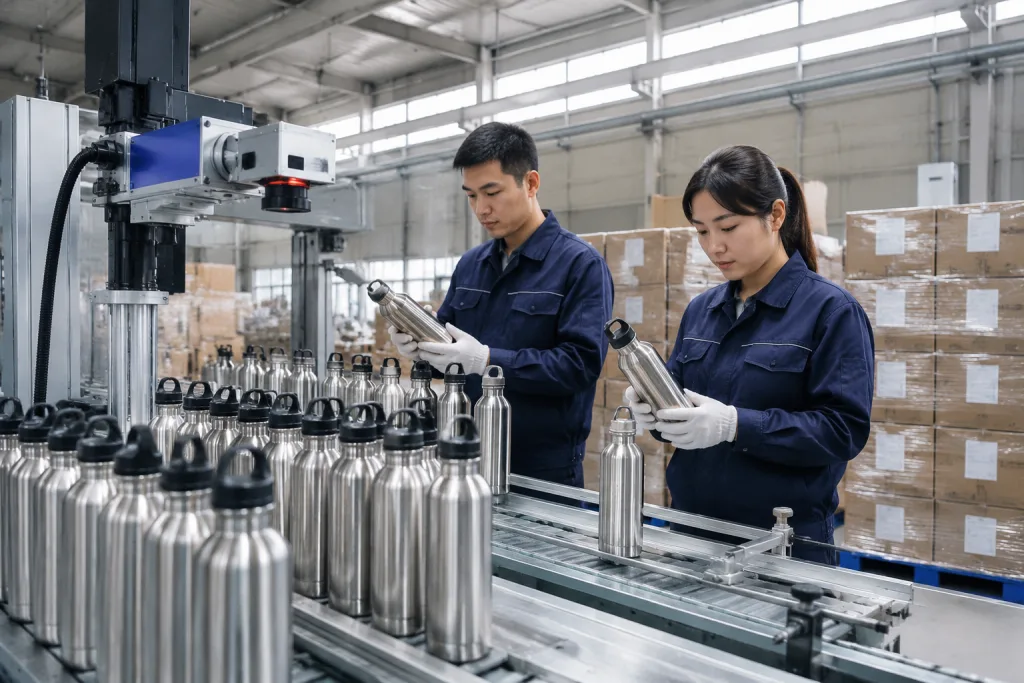
We manufacture in Hangzhou, Zhejiang, and ship from Ningbo or Shanghai, China. Our standard MOQ for a custom sports water bottle is 1,000 units per color, sample lead time runs around 7-10 days, and bulk production runs around 25-35 days after approval. The cleanest sourcing process starts with a tight RFQ, not a pretty mockup; we have seen buyers send a logo file but forget lid type, then QC pulled the sample and the buyer flagged the straw as the wrong length by 18 mm.
Start with an RFQ that works
Your RFQ should not say “send price for 304 stainless steel fitness water bottle custom.” Good for search. Bad for buying. On our quotation desk, that wording can mean a 600 ml single-wall bottle, a 750 ml double-wall vacuum bottle, or a 1,000 ml shaker with a 304 mixing ball. Last month we had one PO typo showing “7000 ml” instead of “700 ml”; QC pulled the sample before the mold room wasted half a day.
For a serious custom fitness water bottle RFQ, send a buying brief with hard specs. Start with capacity, target retail price, order quantity, market, and real use case. We run different packaging plans for a bulk gym water bottle for daily member resale and a premium welcome-kit bottle for a 120-location gym chain; the first buyer pushed back on every USD 0.08, while the second cared more about a clean 0.3 mm logo edge and no scuff marks on the gift box.
RFQ line items you should include:
- Capacity: 600 ml, 750 ml, or 1,000 ml, with tolerance such as ±5%
- Material: inner and outer 304 stainless steel, food-contact lid PP or Tritan
- Construction: single-wall or double-wall vacuum insulation, with heat retention target if needed
- Steel thickness: for example 0.45-0.55 mm body wall depending on design
- Finish: powder coating, spray painting, brushed steel, or electro-polish; tell us the Pantone code if the line must match gym branding
- Logo: laser engraving, silk screen, heat transfer, or full-wrap print, with artwork size in mm
- Packaging: white box, kraft box, retail color box, or mailer box; confirm if drop-test packing is needed for e-commerce
- Testing: LFGB, FDA, REACH, BPA-free, and food-contact migration reports if required
If you compare a bulk sports water bottle quotation from China with a local importer’s offer, check the Incoterm first. This is the wrong question to ask: “Which unit price is lower?” FOB Ningbo at USD 4.10 is not the same deal as DDP Germany at USD 6.80. We ship FOB and CIF every week, and the math goes sideways when freight, duty, VAT, and warehouse handling sit outside the first quote.
Choose the right bottle platform
Pick the bottle platform before you talk about logo size. We hear “customizable sports water bottle” on 6 or 7 RFQs each week, but the buyer often means two different jobs: a stainless fitness bottle for retail and a cheaper giveaway bottle for new members. Forcing one SKU to cover all channels gives you a bottle that is too costly for promotion and too plain for retail. We have seen this go sideways after QC pulled a 500 ml sample and the gym buyer flagged the 62 mm grip as “too small for men’s training packs.”
A 304 stainless steel bottle works best when the brief needs shelf value and no plastic smell after 30 days of use. It fits a distributor fitness water bottle program, retail merchandising, staff kits, or premium gym membership packs when the target price allows double-wall vacuum construction. A custom shaker bottle is another build. It needs an 82-90 mm mouth, a printed ml/oz scale, and a mixing insert that does not trap protein powder under the rim after dishwasher cycles. On the line, we check this with a go/no-go thread gauge before the lid moves to assembly.
If you want a custom logo shaker bottle in stainless steel, first decide whether it is a true shaker or a wide-mouth sports bottle with “shaker” on the PO. That is the wrong question to leave open. A custom made shaker bottle with 304 body and PP lid usually costs more than a plastic shaker, but it gives stronger brand positioning for gyms selling paid member packs. For distributors shaker bottle programs, we run simpler lids whenever possible because 8 out of 10 replacement complaints we see come from small caps and silicone seals, not the steel body.
For a custom gym water bottle, check grip diameter with a caliper, not just a 3D render. A 750 ml cylinder around 73-78 mm diameter fits most cup holders and gym equipment holders. A 1,000 ml bottle looks strong on a shelf, but it can feel bulky beside treadmills and spin bikes, especially when the filled weight passes 1.25 kg. If your buyers are gym chains, not outdoor stores, convenience beats extreme capacity. The math doesn’t work if the bottle looks premium but members leave it in the locker.
Do not approve a design only from a rendering. Ask for bottle weight, lid weight, opening diameter, and carton quantity before you commit.
At our Zhejiang facility, monthly capacity for stainless sports bottles is about 450,000 units across standard lines, but special lids and custom tooling can choke the schedule. A standard 750 ml platform can ship in 25-30 days after sample approval; a new lid tool can push that to 45-55 days before mass production even starts. China production is fast when the platform is standard. It slows down when every part is new, and we have rejected POs before because the buyer wrote “mat black” instead of “matte black” while the color chip showed satin black.
Price the project like a buyer
After you choose the sourcing platform, ask for a formal quote sheet, not a chat-message price. A workable quote for a customized sports water bottle should split out bottle body, logo, packaging, tooling, sample fee, and test cost. We run quotes this way because buyers often miss target by USD 0.20, then need to see whether the saving comes from the gift box, the laser logo, or the lid choice. On our costing desk, the merchandiser checks the BOM against a 0.01 g scale reading from the sample room before we send the sheet.
As a working reference, a 750 ml double-wall 304 stainless bottle with powder coating and one-position laser logo might quote around USD 4.20-5.60 FOB Ningbo at 3,000 units, depending on lid style, coating, and packaging. A single-wall bulk fitness water bottle can sit lower, sometimes around USD 2.20-3.40 FOB for simpler models. A stainless customizable shaker bottle with mixing ball, scale marking, and leak-resistant flip lid may land around USD 4.80-6.50 FOB at similar volume. One buyer flagged a USD 0.42 gap last month; the difference was not labor, it was a thicker 5-layer export carton and a Tritan flip lid instead of PP.
Quote comparison line items, checked the same way our line checks a pre-production sample:
- Base unit price by quantity: 1,000 / 3,000 / 5,000 / 10,000 units, with the MOQ and carton loading written on the same sheet
- Logo cost: included or charged at USD 0.08-0.35 per position, with laser, silk screen, or heat-transfer method named
- Setup charge: screen plate, laser jig, heat-transfer film, or mold fee, plus who owns the tooling after payment
- Packaging cost: polybag, box, insert card, barcode label, master carton, with carton thickness and drop-test requirement stated
- Compliance documents: existing report or new lab test cost, including FDA, LFGB, or your market’s required file if needed
- Spare parts: extra lids, seals, straws, balls, or handles at 1-2%, packed by SKU so the warehouse team does not sort loose parts by hand
Watch the cheap quote. The math often does not work. A distributor sports water bottle order can be made cheaper by cutting steel gauge, using a softer coating, thinning the carton board, or changing the lid material without saying it clearly. QC pulled samples before shipment where the inner wall was 201 stainless, while the PO said 304 stainless. Ask the supplier to state material grade on the proforma invoice and confirm that the inner wall is 304 stainless steel, not 201. For North America and Europe, this is the wrong place to accept loose wording.
Turn samples into decisions
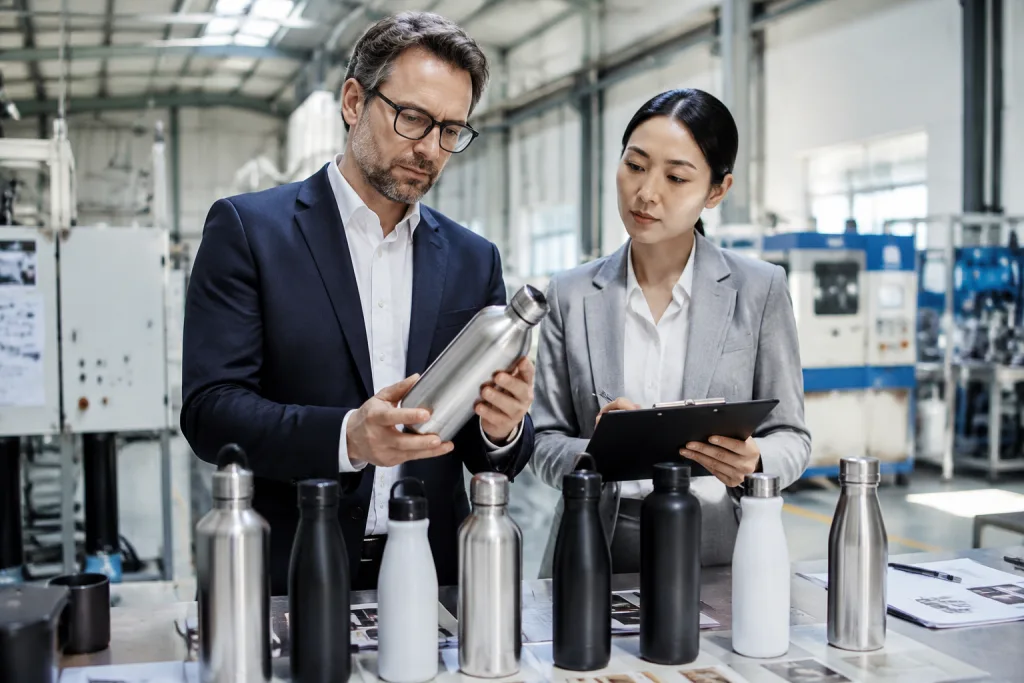
Sampling is where a custom sports water bottle project stops being a drawing and becomes a part on the bench. Do not approve it just because the logo looks clean. Wrong question. A sample needs to show whether the bottle can take normal customer abuse: sweaty hands, a gym bag zipper rubbing the coating, a car cup holder, dishwasher habits, and that sour protein smell after 36 hours. QC pulled one 304 stainless sample last week with a nice laser logo, but the lid squeaked after 20 open-close cycles.
Ask for two sample stages if the order is above 5,000 units or if the lid is new. First, we run a stock-body sample with your logo and the closest available color, usually checked against a Pantone card under a D65 light box. Second, ask for a pre-production sample with correct material, final logo, retail packaging, barcode, and carton markings copied from your PO. For a custom shaker bottle, test powder mixing with 30 g whey and check whether the mesh insert traps residue. For a customizable fitness water bottle with straw lid, test suction, cap alignment, and seal compression; a 0.3 mm gasket gap is enough to create returns.
Sample PO line items:
- Sample quantity: 2-5 pieces per SKU and color, with one piece kept sealed for final comparison
- Sample fee: often USD 50-150 per model, refundable against bulk PO if agreed in writing
- Logo method: exact artwork file, Pantone number, and logo size in mm, not a screenshot from WeChat
- Courier terms: DHL, FedEx, or UPS collect account, usually 4-7 days transit after the line finishes printing
- Approval criteria: leak test result, color match under light box, logo position tolerance, and packaging check against the buyer’s carton mark file
Run practical tests. Fill the bottle with water, lay it on its side for 8 hours, shake it 30 times, and leave it in a warm room near 35°C. Check whether the coating scratches with keys, because retail buyers do the same thing at the sample meeting. For vacuum bottles, test heat retention with 95°C water and measure after 6 hours using a probe thermometer, not a finger test. You do not need a lab for every early check, but you need a checklist; we have seen this go sideways when one sample passed by memory.
When you approve the sample, write “approved for bulk production subject to AQL inspection and no material change.” Boring sentence. It protects you when the buyer flagged a lid color shift later and the factory tried to say the sample was only for logo confirmation.
Write a PO that controls risk
A purchase order is not just for accounting. It is the control sheet we run against on the bottle line. If your PO only says “customized shaker bottle, 3,000 pcs, black,” the production manager will fill in the blanks, and your SGS or BV inspector will have nothing solid to check against. We once had QC pull a pre-production sample where the lid gasket was clear silicone, while the buyer expected black. The PO was silent.
Bulk PO line items should include:
- Product name and SKU: for example 750 ml 304 stainless steel double-wall fitness bottle, plus lid type and finish if the same SKU has 2 lid options
- Quantity by color: 1,500 matte black, 1,500 white, MOQ 1,000 per color, with carton split shown if colors ship to different warehouses
- Unit price and Incoterm: FOB Ningbo, FOB Shanghai, EXW Zhejiang, or DDP if agreed, including the named port or delivery address
- Material: 304 stainless steel inner and outer body, PP lid, silicone gasket, with any coating requirement listed as powder coat or spray paint
- Logo: laser engraving 45 mm wide, front center, tolerance ±2 mm, checked with calipers on the curved bottle body
- Packaging: 1 pc/white box, 24 pcs/master carton, FNSKU or EAN label if needed, with label position shown on one carton drawing
- AQL: general inspection level II, critical 0, major 2.5, minor 4.0, used for final random inspection before balance payment
- Lead time: 30 days after deposit, artwork, and pre-production sample approval, not 30 days after the first email inquiry
- Payment: 30% deposit, 70% before shipment after passed inspection, with failed inspection rework responsibility written down
If you are a distributor gym water bottle buyer supplying 8 gyms, add carton marks by customer or region. Do it on the PO, not in a WeChat message. If you ship to an Amazon or 3PL warehouse, barcode placement and carton dimensions matter because one wrong FNSKU sticker can hold 120 cartons at receiving. We have seen this go sideways. Cheap to prevent, expensive to fix after arrival.
For a customized fitness water bottle program with multiple logos, do not mix artwork versions by email. Issue a PO attachment with file names, Pantone or laser position references, and quantity per artwork. The buyer once flagged a file named “final_logo_new2.ai” because marketing approved a different “final_logo.ai”; that small typo cost 12 days, not 2. The math does not work when the line is booked and the holiday vessel cutoff is close.
Inspect before the balance payment
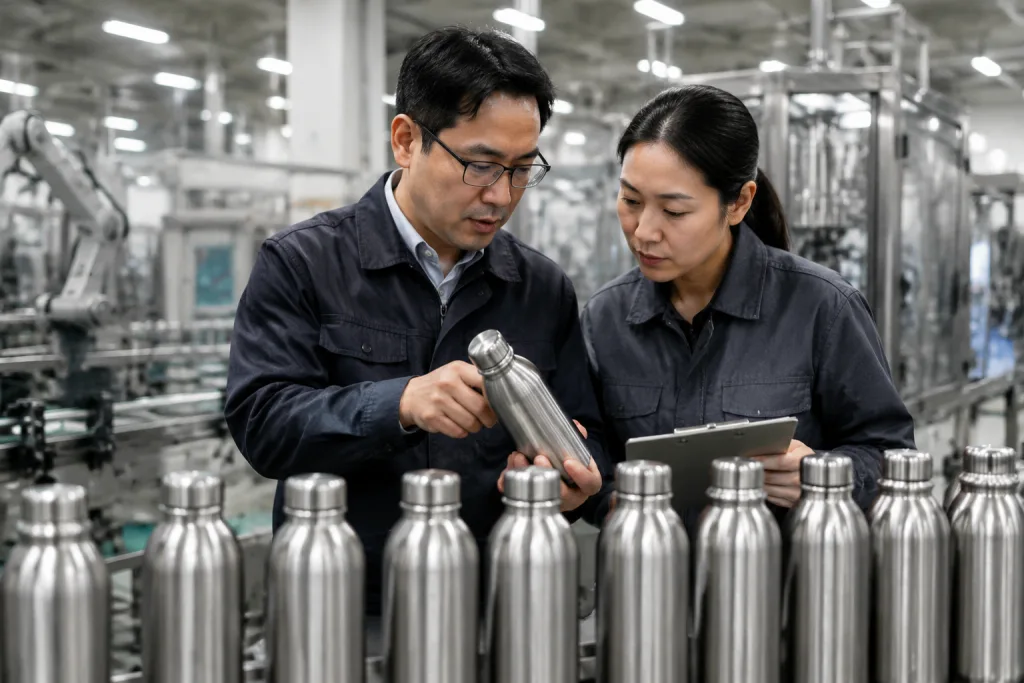
Inspection should happen when production is 100% finished and at least 80% packed. For custom made shaker bottle orders with 5 to 8 lid parts, we also check during assembly. Small parts get mixed fast. The goal is not to catch the factory out; it is to find problems while the line can still swap gaskets, re-torque lids with a simple torque tester, or re-pack cartons in Zhejiang before the container leaves China.
A standard pre-shipment inspection for a custom sports water bottle checks workmanship, dimensions, quantity, color, logo, packaging, and basic function. For stainless bottles, use the magnet check only as a rough screen, not final proof of stainless grade. Better checks are inner wall finish under a flashlight, lid thread fit, gasket seating, odor, burrs on the mouth, coating adhesion, and leak performance. We run 10 filled bottles upside down for 30 minutes; if QC sees one wet neck ring, the buyer will flag it later.
Inspection PO or booking line items:
- Inspection standard: ANSI/ASQ Z1.4 or ISO 2859-1 sampling plan, written on the booking sheet so the inspector does not guess the sample size
- AQL: critical 0, major 2.5, minor 4.0 unless your brand requires stricter
- On-site tests: leak test, rub test, tape test, carton drop test, barcode scan, with 3M tape and a phone scanner named in the report
- Reference samples: approved pre-production sample and signed color panel, sealed in one carton with the buyer’s signature across the tape
- Defect rules: define major scratches over 3 mm, dents on the shoulder, logo misalignment over 1.5 mm, dirty packaging with visible dust or oil marks
For a distributor shaker bottle order, watch mixed components. A carton with black bottles and white lids can pass a fast count and still fail customer acceptance. We have seen this go sideways. For a customizable gym water bottle with 4 SKUs, tell the inspector to open cartons from at least 3 pallets, including the back row, not only the neat top cartons near the warehouse door.
If the inspection fails, do not cancel on the first email. Ask for a defect breakdown. A 3% minor carton scuff issue is not the same as a 12% leak failure. Good China suppliers will sort, rework, and re-inspect; QC pulled the sample for a reason. Your strongest position is before the 70% balance payment is released, because after payment the math does not work in your favor.
Move from first order to program
The first order proves the bottle. The second order proves the factory. After your 304 stainless steel fitness water bottle custom project ships and sells through, lock it into a repeat program instead of rebuilding the SKU every season. We keep the golden sample in the QC room with a 0.01 mm caliper note on mouth diameter, because one loose lid fit can eat the margin on the next PO.
Ask your supplier to keep one specification sheet for each custom gym water bottle and custom sports water bottle SKU. Ours normally shows CAD drawing revision, 304 stainless grade and silicone spec, empty bottle weight in grams, print artwork file name, color box dieline, carton size, net weight, gross weight, and inspection history with AQL notes. This matters for distributors fitness water bottle and distributors gym water bottle programs, where a reorder may come from a new sales team using an old PDF. We have seen a PO typo change “matte black” to “metal black.” QC pulled the sample before packing, so the buyer only lost 2 days, not 2,000 pcs.
Reorder planning is not paperwork. It is line control. Powder-coated bottles need coating line slots, and retail color boxes need a print queue at the paper factory. If your peak season delivery is September, do not issue the PO in late July and expect the math to work. A safer reorder calendar is 7-10 days for sample confirmation if any change is made, 25-35 days for bulk production, 25-40 days ocean transit to 18 EU or North American ports we ship to often, then customs and inland transport. Our planner checks the coating rack capacity in kg per batch before confirming the ETD.
For fitness brands, keep the core bottle stable and refresh the colorway or sleeve packaging. Simple works. This keeps MOQ under control and reduces tooling risk, especially when the lid thread and body shoulder already passed the first shipment. If you change the lid, body shape, and coating process in the same PO, you are not making a reorder. You are launching a new product, and we have seen this go sideways when the buyer still expects the old 35-day lead time.
Our view from Hangzhou, Zhejiang is simple: the best buyers are not the ones pushing the lowest price on day one. They define the product clearly, approve samples with a real checklist, and use first-shipment data to improve the next PO. Last month a buyer flagged a 3 mm logo height difference during sample approval, not after delivery. That is the kind of detail that makes a program run clean.
Send your bottle RFQ for factory review
Share capacity, quantity, logo method, market, and target price. We will return practical specs, MOQ, sample timing, and FOB China pricing.
Frequently asked questions
What MOQ should we expect for a 304 stainless steel fitness water bottle custom order?
For most standard stainless sports bottle models, plan on 1,000 units per color and 3,000 units total for a comfortable first order. Some simple laser-logo stock programs can start at 500 units, but color coating, retail packaging, or a custom lid usually pushes MOQ higher. If you need a bulk fitness water bottle across three gym locations, it is better to use one bottle body and split logo or carton labels than create three separate molds. Custom tooling for a new cap or body shape normally needs 5,000-10,000 units to make commercial sense.
Is 304 stainless steel always required for a custom gym water bottle?
For Europe and North America, 304 stainless steel is the safer standard for food-contact fitness bottles because it has better corrosion resistance than 201 and is widely accepted by buyers. For a custom gym water bottle used with water, electrolytes, or cold brew, 304 inner wall is the minimum we recommend. Some brands use 316 for premium lines, but it increases cost and is not necessary for most gym applications. Ask the supplier to state 304 stainless steel on the PI, specification sheet, and inspection documents, and request food-contact test reports such as LFGB or FDA where applicable.
Which logo method works best for a custom logo shaker bottle?
For stainless steel, laser engraving is the most durable and normally costs about USD 0.08-0.20 per position at bulk volume. It will not peel, but it gives a metal-tone mark rather than a bright Pantone color. Silk screen is better for simple colored logos, usually 1-2 colors, but it can scratch if the coating or curing is weak. Heat transfer or full-wrap printing is suitable for larger artwork and retail designs, but setup cost is higher. For a custom logo shaker bottle handled daily in gyms, we usually recommend laser for premium lines and silk screen for promotional volume.
How long does sampling and bulk production take from China?
For a standard 304 stainless bottle with existing mold, logo sample time is usually 7-10 days after artwork confirmation. A pre-production sample with final coating and packaging may take 10-15 days. Bulk production is commonly 25-35 days after deposit and sample approval for 1,000-10,000 units. Add inspection booking, export documents, and freight time. Ocean freight from China to Europe or North America can add 25-40 days port-to-port, depending on route. If you need a hard launch date for a gym chain, work backward at least 10-12 weeks.
Can one supplier make bottles, shakers, and retail packaging together?
Yes, if the supplier has the right supply chain control. A stainless bottle factory may produce the metal body in-house and source PP lids, silicone gaskets, mixing balls, color boxes, and insert cards from nearby partners. That is normal in Zhejiang and other China manufacturing clusters. The key is one accountable supplier managing the final QC. For a bulk shaker bottle or customizable sports water bottle program, ask who owns lid testing, packaging proofing, barcode checks, and AQL inspection. If every component comes from a different vendor with no final control point, small defects become your warehouse problem.