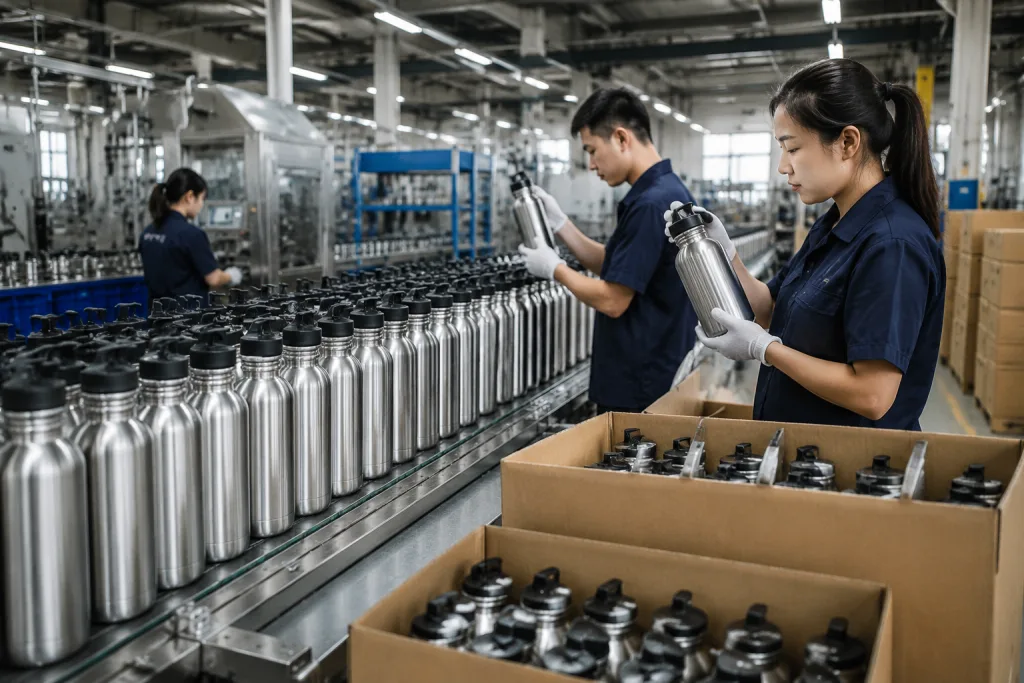
Key Takeaways
- For 304 stainless steel fitness water bottle bulk orders, start with 0.45-0.55 mm inner wall thickness and 1,000 pcs MOQ per color.
- A leak-resistant gym lid costs more than a basic screw cap, but reduces after-sale claims by a meaningful margin.
- Laser engraving is durable for gym handling; silk screen is cheaper for large, colorful fitness branding.
- Use AQL 2.5/4.0 inspection, LFGB or FDA food-contact checks, and carton drop testing before balance payment.
If you are buying a 304 stainless steel fitness water bottle bulk order for a gym chain, supplement brand, or fitness retail program, finding a factory in China is the easy part. The hard part is locking the right spec before you spend money on tooling, cartons, and freight. We have seen a bottle pass photo review, then fail in real use because the grip feels slick, the lid seeps after 300 shake tests, or the powder coat chips where a dumbbell knocks it in a gym bag. That is where orders go sideways.
From our Hangzhou, Zhejiang export desk, we ask buyers to decide on four items first: bottle body, lid system, branding method, and inspection standard. BottleForge Industrial produces up to 450,000 stainless drinkware units per month in Zhejiang, China, with typical MOQ from 1,000 pieces per color for standard molds and 35-45 days production after sample approval. On the line, QC pulled one 750ml sample last month because the silicone gasket sat 0.6 mm high after assembly; the buyer had only asked whether it was “leakproof,” which is the wrong question to ask without a test method.
Start With The Bottle Architecture
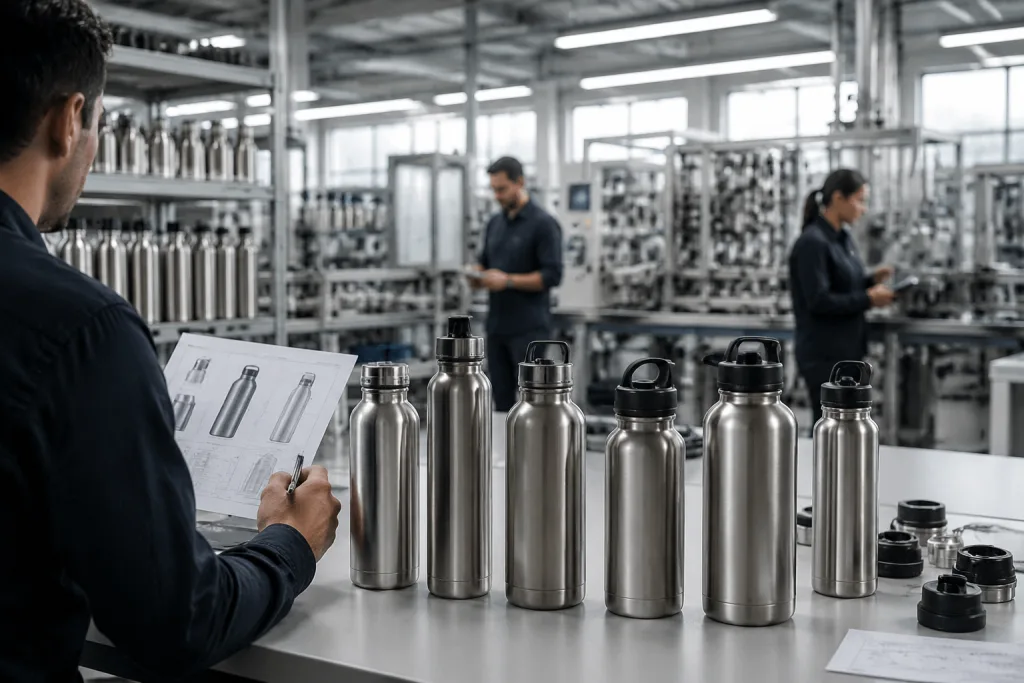
The first call is the bottle build: single-wall stainless, double-wall vacuum insulated, or shaker-style with a mixing ball. For most gym chains and fitness brands, double-wall vacuum 304 stainless steel sells better at retail because it keeps water cold, leaves no sweat marks on benches, and feels heavier in hand. Cost goes up. Weight does too. A 750 ml vacuum bottle normally lands around 300-380 g before packaging, while a single-wall bottle can be 180-240 g. On our line, QC weighs the first 20 pcs with a 0.1 g bench scale before we release mass production, because one wrong body gauge changes both freight math and hand feel.
For a serious 304 stainless steel fitness water bottle bulk program, we run 304 stainless steel for the inner liner and 201 or 304 stainless steel for the outer shell, based on your target FOB. Inner wall thickness is commonly 0.45-0.50 mm, outer wall 0.50-0.60 mm. Thinner material can reduce FOB cost by USD 0.15-0.30 per piece, but dent resistance drops. This is where buyers sometimes ask the wrong question. The cheapest shell is not always the cheapest delivered product. Last season, QC pulled the sample after a 1.2 m drop test and found two shoulder dents near the weld seam; if your bottles are sold through gym front desks or bundled with annual memberships, that dent becomes your brand problem, not the factory’s problem.
Capacity needs a commercial call, not a designer’s vote. A 500 ml custom fitness water bottle fits yoga studios and boutique classes where bags are small. A 750 ml or 1,000 ml bulk gym water bottle fits strength training and team sports better, especially when members train for 60-90 minutes. Big bottles need stronger carry loops and wider carton spacing. We normally check loop pull strength with a 10 kg hanging load, then confirm the master carton after a 24-hour stack test. If spacing is too tight, your Amazon or distributor cartons arrive crushed, and we have seen this go sideways after a buyer approved artwork but skipped carton testing.
Do not approve the shape until you test it inside an actual treadmill cup holder, car cup holder, and gym backpack side pocket; one buyer flagged a 3 mm base overhang only after the PO was signed.
Choose A Lid Before A Logo
About 7 out of 10 buyers send us the logo file first, usually an AI or PDF with no lid decision. That is backwards. For a bulk sports water bottle or distributor gym water bottle program, the lid decides daily complaints before the artwork does. A nice print on a bottle with a cheap lid turns into a refund ticket fast. We run five common lid types on the line: screw cap for simple retail packs, flip straw lid for gym use, chug lid for faster drinking, push-button lid for one-hand opening, and shaker lid with mixing ball or agitator.
A screw cap is simple, lower risk, and usually USD 0.20-0.45 cheaper than a straw or button lid. It fits a distributor sports water bottle order where the buyer wants fewer moving parts and less after-sales noise. A flip straw lid works better on treadmills and in group classes, but the silicone straw, hinge pin, and air vent need real testing, not just a clean catalog photo. We measure the gasket groove with a 0.02 mm caliper because a small mismatch can make the cap sweat in a carton. For a bulk shaker bottle or custom logo shaker bottle, the lid has to deal with protein powder residue, dishwashing habits, and repeated shaking. A loose thread or weak gasket shows up within the first 48 hours of use. The math doesn't work if the lid saves USD 0.18 but creates replacement claims.
For fitness buyers, we usually test lids in four ways: 100% leak test on the assembled bottle, inverted static test for 4 hours, 1.2 m carton drop test, and open-close cycle testing on sample lids. QC pulled the sample last month on a 304 stainless gym bottle because 3 caps out of 50 clicked unevenly after 300 cycles. Small issue. Big warning. On a custom made shaker bottle, we also check whether powder clumps near the internal mixer and whether the cap can be opened with wet hands after a 10-second shake test.
If you need a customizable shaker bottle for supplements, ask whether the lid material is PP, Tritan, or another food-contact plastic, and confirm BPA-free documentation before the PO is signed. For EU programs, REACH and LFGB are commonly requested. For North America, FDA food-contact compliance and California Proposition 65 screening may be relevant depending on your sales channel. We have seen this go sideways when a buyer approved the bottle body but forgot the lid resin code; the PO said “Trian” instead of Tritan, and the lab report had to be reissued, costing 6 extra days.
Set Branding By Use Case
Your branding method should match how the bottle gets used. A customized sports water bottle for a paid retail line needs stronger decoration than a giveaway bottle for a six-week gym challenge. Cheap print is not always cheap after rejects. One-color silk screen printing is still the lowest-cost route, often adding around USD 0.08-0.18 per logo position at volume. It runs well on powder coating, but tiny gaps and 0.2 mm hairlines will fill in on the mesh; our printing master checks this on a 300-mesh screen before mass production. We normally ask for vector files in AI, EPS, or PDF, and we have seen a PO typo change “white logo” to “while logo.” QC pulled the sample before the line started.
Laser engraving suits a custom gym water bottle that gets handled daily, washed often, and dropped into metal lockers. It removes the coating and exposes the 304 stainless underneath, so there is no ink layer to peel. The catch is color. Laser will not solve full-color artwork, and pushing it to do that is the wrong question to ask. For 26 oz bottles, we usually keep the laser logo under 45 mm wide on curved bodies to avoid distortion at the edges. For premium gym chains, matte black powder coating with a laser logo usually looks cleaner than a busy print, and buyers flag fewer “logo scratch” complaints after shipment.
UV printing gives more color room for a customized fitness water bottle with gradients or a small mascot graphic. It costs more and needs adhesion testing on the exact coating, not on yesterday’s similar black. We run a 3M tape test and cross-hatch check after curing; if the ink lifts at the edge, the math does not work for a 5,000 pcs order. Heat-transfer printing can wrap larger artwork, but curved bottle shoulders are unforgiving. For a customizable sports water bottle, the body needs a flat enough printable area, usually at least 70 mm height on a straight wall, or the line will fight wrinkles all afternoon.
Private label buyers should decide packaging early. A basic white box may cost USD 0.12-0.25. A printed retail box can be USD 0.35-0.80 depending on board thickness, lamination, and insert structure. We ship both. For distributors fitness water bottle programs, plain master cartons with barcode labels are often enough, especially when cartons are opened in a warehouse and the bottle goes straight to a team kit. For gym chain retail shelves, packaging changes perceived value more than buyers expect; one buyer pushed back on a USD 0.42 color box, then lost the shelf test because the plain box looked like spare parts.
Build A Real Cost Model
The FOB price of a 304 stainless steel fitness water bottle bulk order is one line, not the model. A buyer should cost the bottle, logo, color box or egg-crate carton, inland trucking in China, export documents, freight, duty, inspection, and local fulfillment. For a standard 750 ml double-wall bottle with powder coating and one logo, we see roughly USD 3.20-5.20 FOB China depending on lid structure, steel gauge, PMS color count, and order quantity. A custom shaker bottle with a protein-grid lid may add USD 0.40-1.20. Last month QC pulled the sample because the buyer’s logo was 0.6 mm too close to the bottom curve; that small artwork fix changed the pad-printing setup and the quoted logo cost.
MOQ matters because stainless bottle production has real setup work: coating line cleaning, fixture setup, logo screens, carton printing, and QC labor. For standard molds, BottleForge usually starts at 1,000 pieces per color, with better pricing at 3,000-5,000 pieces. Below that, the math doesn't work. The line still needs the same spray gun cleaning, hanging rack changeover, and first-article check, whether we run 600 pieces or 3,000 pieces. For a fully customized gym water bottle using new mold work, tooling can range from USD 800 for a simple lid adjustment to USD 5,000+ for a new bottle body and cap system.
Lead time is a cost too. Normal sampling takes 7-12 days for logo samples if the mold exists. Bulk production is usually 35-45 days after deposit and sample approval. Add 25-40 days for sea freight to European or North American ports, depending on route and season; Ningbo to Los Angeles and Ningbo to Hamburg do not behave the same in peak season. We once had a PO typo showing matte black on page one and gloss black on the color appendix, and it cost 2 days before the buyer flagged it. If your promotion date is fixed, approving samples late and asking the factory to “catch up” is the wrong question to ask.
For FOB Ningbo or Shanghai shipments from Zhejiang, China, consolidation is practical if you also buy towels, bags, or accessories. We ship mixed container loads this way, but carton dimensions need to be locked early; a 52 x 38 x 28 cm master carton can change pallet count fast. For DDP shipments, be careful: ask what duty code, VAT handling, and delivery address limits are included. A cheap DDP quote with vague terms is not a sourcing strategy. We’ve seen this go sideways when a buyer assumed Amazon warehouse delivery was included, then rejected the extra appointment and tail-lift charges.
Quality Standards You Should Specify
Fitness bottles usually fail in the same spots: lid leakage, coating scratches, dented bodies, weak carry handles, silicone odor, poor vacuum insulation, and logos drifting off center. No written standard, no clean QC call. Put the key tests into the PI before deposit; we have seen a buyer write “black logo” on the PO while the approved artwork file showed dark gray, and the line stopped for 3 hours while sales, printing, and QC argued over it.
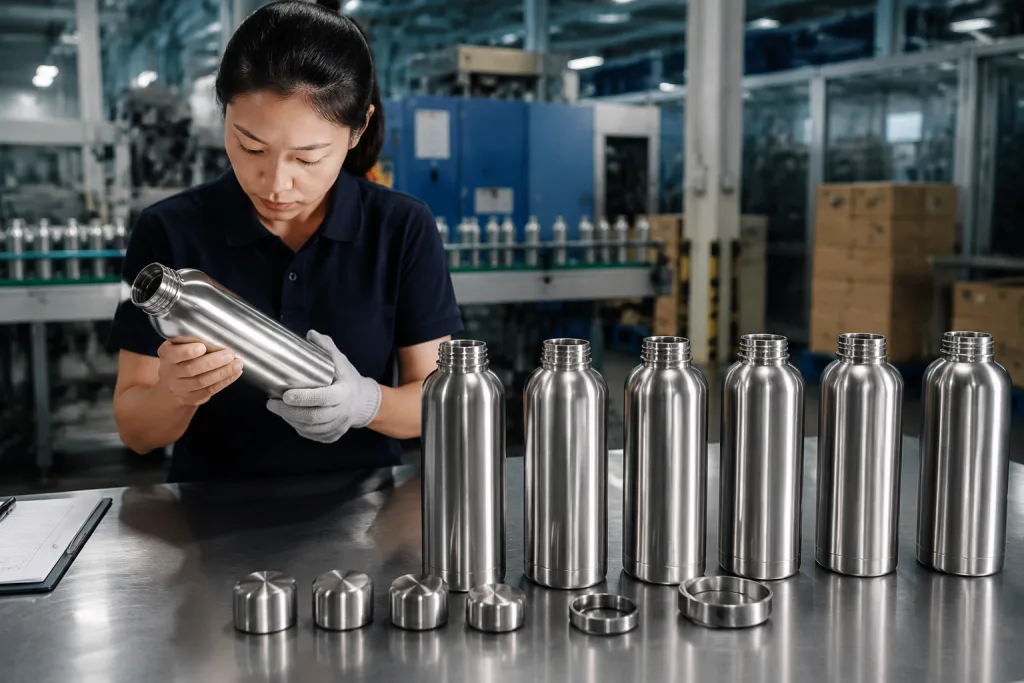
For stainless drinkware, specify material verification for 304 stainless steel, vacuum performance testing, coating salt spray or adhesion testing, food-contact documents, and AQL inspection. A practical level is AQL 2.5 for major defects and 4.0 for minor defects, using ANSI/ASQ Z1.4 or ISO 2859-1 sampling. Critical defects, such as sharp edges or obvious leakage, should be zero tolerance. QC pulled the sample with a digital caliper and found one rolled rim at 0.28 mm burr height; that is not a “minor feel issue” when the bottle goes into a gym bag.
Vacuum performance should be checked with hot water temperature-drop testing over a fixed period, or with vacuum detection equipment on the line. For a bulk fitness water bottle sold on cold retention, write the test condition clearly: starting water temperature, room temperature, fill volume, and test duration. Short sentence. No guessing. A claim like “24 hours cold” needs controlled data, not warehouse gossip; we run 95°C hot-water checks in a 25°C room because the math changes fast when the warehouse door is open in January.
For coatings, cross-hatch adhesion testing shows whether the powder coat is bonding or just looking good for the photo. Check color against Pantone or the approved sample under the same light box, not beside a window at 5 p.m. State logo position tolerance, such as plus or minus 2 mm vertically and horizontally. If you sell through distributors shaker bottle channels, inconsistent logo placement creates arguments across buyers; we had one order where the buyer flagged a 3 mm logo shift after delivery to 40 gym locations, and the math did not work for rework.
Fit The Channel, Not Just The Product
A bottle for a national gym chain is a different job from a distributor fitness water bottle for regional wholesale. Gym chains push for brand control, repeat supply, and the same member handout at 80 branches. Distributors buying gym water bottles push us on carton cube, blank packaging, fast reorder dates, and tier pricing at 1,000, 3,000, and 5,000 pcs. Supplement brands buying a customized shaker bottle care first about powder mixing and lid sealing; last year QC pulled 12 samples after a buyer flagged powder stuck under the flip cap hinge.
If you sell through gyms, run mixed color cartons with one SKU per branch only when your inventory system can read it cleanly. Otherwise, single-color master cartons cause fewer warehouse mistakes. A 750 ml stainless bottle often packs 24 pieces per master carton, but the carton size changes once you add a gift box, handle lid, or silicone boot. Big retail boxes hurt freight. We have seen this go sideways: a 62 cm carton saved shelf space in the buyer’s planogram, then pushed the shipment into a higher volumetric weight bracket. The math doesn't work. For North American e-commerce, FNSKU labels at 35 x 20 mm, suffocation warnings on polybags, and carton weight under 22 kg keep fewer cartons from being rejected at the warehouse door.
For European distribution, documentation discipline matters more than a fancy mockup. Buyers ask for BSCI factory audit files, REACH declarations with current SVHC wording, LFGB food-contact reports, packaging waste information by material weight, and country-of-origin marking on the bottle or retail box. For North America, FDA food-contact documents, ASTM-related packaging checks for children’s items, and Proposition 65 screening show up in the RFQ folder. If the bottle is for adults only, do not use cartoon animals or school-sports artwork unless you are ready for stricter testing. We once had a PO typo reading “kids fitness bottle,” and the buyer’s compliance team paused the whole order for 6 days.
A customizable gym water bottle program also works well for regional logos. Keep the same bottle body and lid, then change laser artwork by city or club. MOQ for logo variation is usually easier than MOQ for coating color variation because we swap the laser file, not the powder coating line setup. On our line, a new logo file takes about 15 minutes to load and test on the rotary laser jig; a new coating color needs cleaning, masking checks, and a separate first-piece approval. This suits distributors sports water bottle buyers who want choice without stocking five bottle colors.
Approve Samples With Discipline
Sampling is where 6 out of 10 delayed bottle orders start. A buyer approves a photo, then the courier sample lands on the desk and the bottle feels slick, top-heavy, or 4 mm too wide for the gym bag side pocket. For a 304 stainless steel fitness water bottle bulk purchase, approve a physical pre-production sample whenever the project has a new color, new lid, new logo method, or new packaging. Photos help with layout. They do not test hand feel, and this is the wrong place to save 3 days.
A proper sample review checks weight on a 0.1 g bench scale, capacity, mouth diameter, coating texture, logo sharpness, lid thread fit, gasket seating, odor, carton layout, barcode scan, and drop resistance. If you are buying a custom logo shaker bottle, mix 30 g protein powder with 400 ml water and shake it hard for 30 seconds. Then leave it sideways for 10 minutes. QC pulled one sample like this last season and found seepage at the silicone ring after 7 minutes; the studio photo looked perfect.
After approval, freeze the golden sample. Both buyer and factory should keep one signed sample with date, PO number, Pantone code, and logo position marked in mm on masking tape. During mass production, we run first-article checks and final inspection goods against that sample. If you approve matte navy blue, do not accept glossy royal blue because someone says it is “close.” We have seen this go sideways when a powder coating batch changed by Delta E 2.8 and the buyer flagged it only after 18 cartons were packed.
At BottleForge Industrial in Hangzhou, Zhejiang, we prefer buyers to make decisions early and write them cleanly on the PO. It makes the line faster and disputes rarer. A custom sports water bottle is not complicated, but it has enough small parts to punish vague purchasing; one missing gasket spec or a typo like “siliver lid” can stop packing for half a shift. Decide the bottle architecture, lid, branding, cost model, and QC terms before chasing the lowest unit price. The math does not work if a 2-cent saving creates a 12-day rework.
Send Your Fitness Bottle Spec For Factory Review
Share capacity, lid style, logo method, quantity, and target market. We will reply with MOQ, FOB estimate, sampling plan, and realistic lead time.
Frequently asked questions
What MOQ should I expect for a 304 stainless steel fitness bottle bulk order?
For existing bottle molds, a realistic MOQ is usually 1,000 pieces per color, with stronger pricing at 3,000 or 5,000 pieces. If you only change the logo on a standard black, white, or silver bottle, some factories may accept lower trial orders, but setup costs still apply. For a new powder-coated color, 1,000 pieces is a practical minimum because coating line setup and color matching take time. For a custom made shaker bottle with new lid tooling, expect higher commitment and tooling fees, often USD 800-5,000 depending on complexity.
Is 304 stainless steel necessary for a gym water bottle?
For the inner liner, yes, 304 stainless steel is the normal choice for a quality custom gym water bottle because it has better corrosion resistance than cheaper grades and is widely accepted for food-contact drinkware. Some buyers use 201 stainless steel for the outer wall to control cost, while keeping 304 inside. That can be acceptable if the product positioning is mid-range. For premium retail, we usually suggest 304 inner and 304 outer, especially if the bottle will be used hard in gyms, backpacks, and cars.
Which logo method is best for a fitness brand?
For daily gym use, laser engraving is the most durable because it does not peel or crack. It works best on powder-coated stainless bottles and gives a clean metallic logo. For colorful brand graphics, silk screen or UV printing is better. Silk screen is cheaper for one or two colors, often around USD 0.08-0.18 per position at volume. UV printing costs more but handles more complex artwork. If you are selling a customized sports water bottle at retail, ask for adhesion testing on the approved coating before mass production.
How long does production take after I approve the sample?
For a standard customizable fitness water bottle using an existing mold, sample preparation usually takes 7-12 days, and mass production takes about 35-45 days after deposit and sample approval. Complex lids, new colors, retail packaging, or peak-season factory loading can add 7-15 days. Sea freight from China to Europe or North America often adds another 25-40 days depending on port and route. If you have a gym opening, product launch, or holiday campaign, start sourcing at least 90 days before your required delivery date.
Can one factory handle bottles for multiple gym locations or distributors?
Yes, but you should structure the order correctly. Keep the same bottle mold, lid, and coating color, then vary the laser engraving or printed logo by location. Logo variation is easier than color variation. For example, 5,000 pieces total can sometimes be split across several club logos if artwork setup is clear and cartons are labeled correctly. For distributors shaker bottle programs, ask for SKU-level carton marks, barcode labels, and a packing list by logo version. This prevents warehouse confusion when goods arrive.