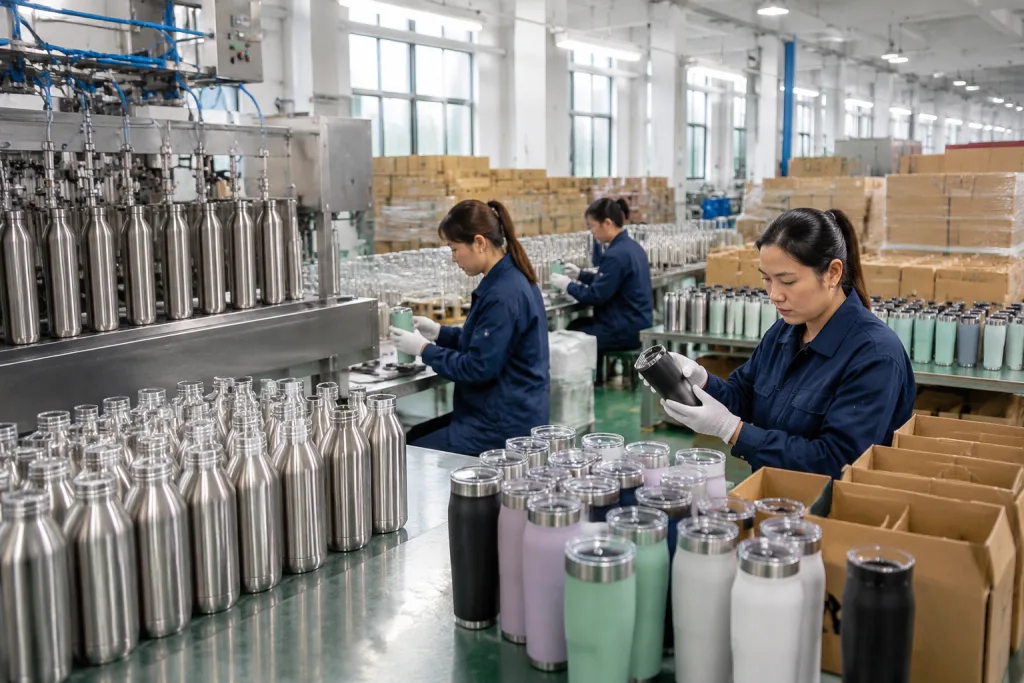
Key Takeaways
- Confirm SUS304 inner and outer steel with 0.4-0.5 mm wall thickness for most vacuum drinkware
- Treat MOQ by decoration method: 500 pcs for laser logo, 1,000-3,000 pcs for custom color
- Use AQL 2.5/4.0 inspection plus 24-hour leak and vacuum retention sampling before shipment
- FOB China pricing can vary 18-35% when packaging, coating, and compliance documents change
If you source 304 stainless steel drinkware wholesale for a retail line, promo order, or distributor catalog, suppliers are easy to find. The harder call is what you freeze before the deposit: steel grade, real capacity, wall thickness, finish, logo process, packing, test standard, and who pays when QC pulls 32 failed pieces from a 1,200-piece inspection lot.
From our Hangzhou, Zhejiang factory, we see this go sideways about 6 times a month. A buyer asks for the “best” wholesale drink bottle, then compares quotes for different builds. A 500 ml bottle with 0.4 mm inner wall, powder coat checked by cross-cut tape, laser logo, and 5-layer export carton is not the same job as a thin promo bottle packed loose to hit a low target price. The math doesn’t work. China can make both; your RFQ should lock the spec before anyone argues over USD 0.18.
Start With The Product Role
Before you ask for drinkware wholesale pricing, pin down the job first. This is the wrong question to ask if the buyer only says “send your best bottle price.” A retail hydration bottle and a corporate giveaway use different walls, lids, cartons, and inspection points. Last month QC pulled 12 samples from a 3,000 pcs logo order because the PO said “matte black,” but the approved sample was powder-coated black with a 60 gloss reading.
For daily-use bottles and tumblers, 304 stainless steel is the safe default we run on the line. It resists corrosion better than 201 steel and avoids the extra cost of 316 for coffee, tea, water, beer, and carbonated drinks. A clean spec is SUS304 body, food-contact silicone seal, and PP lid parts. If the bottle will hold lemon water or cocktails overnight, ask for migration testing; a verbal “food grade” promise does not pass a buyer’s lab check.
The first decision is capacity. Most wholesale drinkware programs sit at 350 ml, 500 ml, 750 ml, or 1,000 ml, with MOQ often starting at 1,000 pcs per color for custom coating. Canteen wholesale and wholesale canteen orders often move to 600-1,200 ml because outdoor buyers want more carry time. Bulk growler and beer growler bulk projects usually start at 1.9 L, equal to 64 oz, since brewery and taproom buyers already know that size.
The second decision is insulation. Single-wall is cheaper, lighter, and we can ship it faster because there is no vacuum pumping step. Double-wall vacuum insulation costs more, but retail buyers accept the shelf price more easily. For a 500 ml vacuum bottle, ask for hot retention testing from a 95°C water start temperature, checked after 6 hours with a calibrated probe. For a beer tumbler wholesale bulk order, cold retention matters more than hot performance, so ask for ice retention or surface condensation testing.
The third decision is use environment. Outdoor canteen bulk orders need stronger caps, wider handles, and coating that survives a 3M tape pull plus basic abrasion checks. Office drinkware bulk can use finer finishes because the cup sits on a desk, not in a backpack side pocket. Alcohol flask bulk orders need tight cap threading and leak testing; we test with water, invert for 30 minutes, and reject caps that show seepage around the gasket. Small failures show up fast in gift packaging.
Set The 304 Steel Baseline
Do not buy “stainless steel” as a loose line item. For 304 stainless steel drinkware wholesale, write SUS304 or AISI 304 on the purchase order for every food-contact metal surface, including the inner wall, lid insert, tea filter, or straw if those parts touch the drink. If the outer shell is also 304, say so in the spec sheet and on the PO. We still see buyers send a PO with “SS bottle” typed in one cell, then get a quote based on 304 inner with 201 outer because the math is 6% to 9% cheaper. That can work for a short low-price campaign. It is the wrong surprise to find after QC pulls the sample at pre-shipment.
A practical baseline for vacuum bottles is 0.4 mm inner wall and 0.5 mm outer wall before forming, though the right gauge changes with shape and capacity. Thin bodies look fine on the desk. Then the carton drop test tells the truth. We have seen 0.32 mm outer shells pass a photo sample review and still dent at the shoulder after 18 days in ocean freight, especially when the master carton hit 13 kg. For growler wholesale and beer growler wholesale bulk, do not squeeze the wall thickness too hard; the product is heavier, and bar staff grab it by the neck, bang it on counters, and stack it wet after closing.
Ask for material evidence, but read each document for what it actually proves. A steel mill certificate shows the coil composition, heat number, and chemical range. It does not prove every finished bottle in your order used that coil. A handheld XRF test at inspection gives more direct grade screening; our QC uses a Niton gun on the inner wall and rim after polishing, because mixed parts sometimes show up there first. It still does not replace full food-contact migration testing. For EU orders, discuss LFGB or EU 1935/2004 migration expectations before artwork approval. For North America, check FDA food-contact expectations and California Proposition 65 risk by product, coating, and printed logo ink.
China has a wide spread of stainless drinkware factories, including trading companies that do not control welding, polishing, or vacuum testing. In Zhejiang, stronger suppliers usually run dedicated lines for bottle forming, automatic welding, vacuum pumping, powder coating, and assembly, with a vacuum leak check station sitting right after the pump oven. At BottleForge Industrial, typical monthly output is 300,000 units, with MOQ from 500 pcs for stock-shape laser logo orders and 3,000 pcs for custom powder colors. Those numbers matter. A factory that is too small may take your order, then send welding or coating outside the gate without telling you; we have seen this go sideways when the buyer flagged color drift between two cartons from the same shipment.
Choose Finish Before Quoting
Surface finish changes cost, lead time, defect rate, and carton protection. If you compare drinkware bulk prices before locking the finish, the math doesn't work. Last month QC pulled 32 pcs from a 500 pcs pre-shipment check because the black coating rubbed at the carton divider, while the same bottle in brushed steel passed with no touch-up.
Powder coating is the standard choice for retail bottles and tumblers. It gives a clean hand feel and sells well on the shelf, but color matching needs tight control. For custom Pantone colors, allow 5-7 days for sprayed color panels and another 2-3 days if adjustment is needed. We run panels in a D65 light box, then record the approved sample with a Delta E target, not a phone photo from the sales chat. Small detail. Big difference.
Spray painting can cost less on simple colors, but it scratches faster in carton rub and drop tests. Electroplating and gradient finishes look premium, but rejection risk climbs around shoulders, seams, and base edges where the spray gun angle gets tight. Raw brushed stainless is honest and durable, though some retail buyers call it too plain on the first mockup. For wholesale growler or beer growler in bulk programs, brushed stainless with a laser logo is often the safest combination because breweries care about durability and easy cleaning; we have seen brewery buyers reject glossy coating after a 30-cycle dishwasher test.
Decoration is a separate decision. Laser engraving works well on 304 stainless and stays stable at low MOQ, even at 300 pcs when the logo is under 45 mm wide. Silkscreen handles larger logos and colors, but curved bodies and textured coatings create limits; the line usually asks for a 2 mm safety gap near the cup taper. Heat transfer and water transfer cover more area, yet they add setup cost and need stronger abrasion testing with 3M tape and alcohol rubs. For alcohol flask wholesale, laser engraving or one-color silkscreen usually gives the cleanest result on small surfaces.
A buyer-friendly quote should show finish and decoration separately. For example: 750 ml vacuum bottle, SUS304 inner and outer, powder coated, one-position laser logo, individual kraft box, FOB Ningbo. If the supplier only gives one lump number, ask for a breakdown. We have seen this go sideways when a PO said “matte black” but the approved sample was “sand black,” and the buyer flagged it after 12 days of production. You need to know whether a 6% saving came from thinner steel, cheaper coating, or simpler packaging.
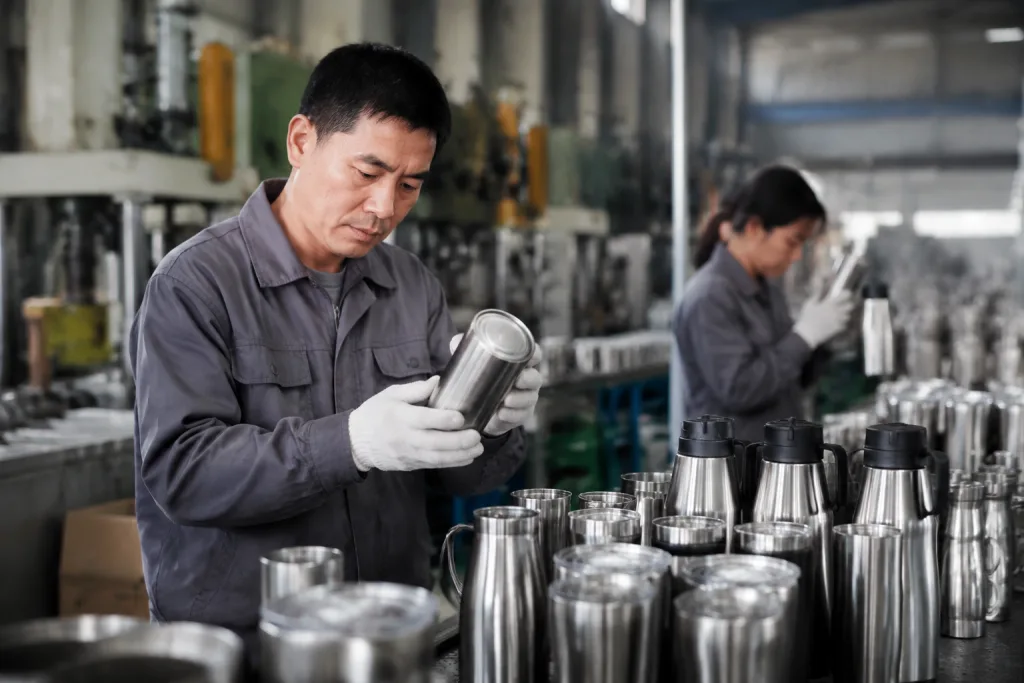
Match MOQ To Real Demand
MOQ is not a moral position. It is the break-even point where coil buying, line changeover, printing fixtures, QC sampling, and export cartons stop losing money. For 304 stainless steel drinkware wholesale, we usually price MOQ by body shape, color count, and logo process; last month our line changeover on a 600 ml tumbler took 2.5 hours before the first good piece came off the conveyor.
Stock-shape wholesale drinkware with a laser logo often starts at 500 pcs per model. That works because we run the same body and only swap the laser jig. For custom powder coating, 1,000 pcs per color is the cleaner number; below that, the powder booth loses too much time flushing color, and QC pulled the sample twice for shade drift against a Pantone chip. New mold, special cap, private tooling, or a unique body profile usually means 3,000-5,000 pcs per SKU and tooling fees from USD 800 to USD 4,500 depending on complexity.
For canteen bulk and wholesale canteen programs, MOQ climbs when the cap or carrying system is customized. A basic 1 L canteen may work at 1,000 pcs, but a custom lid with compass, carabiner, or insulated cup assembly can push MOQ to 3,000 pcs. Ask about spare caps early. We have seen this go sideways when a distributor sold through in 9 weeks, then found the replacement cap MOQ was another 1,000 pcs because the silicone gasket tool was stored under a separate PO number.
For growler bulk, the math changes. A 64 oz beer growler bulk order uses more stainless steel per unit and eats carton space fast; one 12 kg master carton may hold only 12 pcs after foam bag and divider packing. Suppliers may accept 500-1,000 pcs, but the freight hit is larger. Beer growler wholesale buyers should calculate landed cost per sellable unit, not just FOB price. A bulky product can look cheap at the factory and expensive after ocean freight, inland trucking, and warehouse handling.
One practical warning: do not force MOQ too low if you need stable color and packaging. Small mixed-SKU orders create more handling errors; our packing table once caught 38 wrong color sleeves in a 720 pcs mixed order before carton sealing. If the launch budget is tight, the wrong question is “How many SKUs can we squeeze in?” Pick fewer SKUs and make each one clean.
Price The Whole Export Package
FOB China pricing is one line in your landed-cost file. For 304 stainless steel drinkware wholesale, we price the whole export package: cup body, cap set, logo setup, retail or bulk packaging, AQL 2.5 inspection, CI/PL documents, truck to Ningbo, sea or air freight, duty, broker fee, warehouse receiving, and rework if QC pulled the sample for scratches or lid leakage.
As a working reference, a standard 500 ml double-wall 304 stainless bottle with stock cap, powder coating, laser logo, and individual white box may sit around USD 3.20-4.80 FOB Ningbo at 1,000-3,000 pcs, depending on finish and cap. A 750 ml sports bottle may range from USD 4.10-6.20. A 64 oz stainless beer growler wholesale order can range from USD 7.50-12.50 FOB. Alcohol flask in bulk orders are smaller and often cheaper per unit, but gift packaging can add USD 0.40-1.20 fast; last month one PO typo changed “white box” to “gift box” and added USD 680 on 1,000 pcs.
Packaging is where 7 out of 10 cheap quotes go sideways. A plain polybag and egg-crate carton is not the same as a printed retail box with barcode, instruction sheet, 2 g desiccant, master carton marks, and 1.2 m drop-test design. If you sell online or into distributors, packaging damage lands on your desk, not the factory’s. For Amazon-style prep, ask for FNSKU labeling, suffocation warning if polybags are used, carton weight under 15 kg where possible, and outer carton dimensions before production; our carton scale and tape measure catch this before the line seals 300 cartons.
Payment terms change the price. A normal structure is 30% deposit and 70% before shipment after inspection. For larger repeat buyers, negotiated terms may improve after 2-3 clean orders. If a supplier gives a low price but demands 100% upfront for a standard item, slow down. We’ve seen this go sideways when the buyer approved a sample cap in black PP, then production shipped mixed PP and AS caps because the payment was already cleared.
The cleanest way to compare drinkware wholesale quotes is to build a quote sheet with 12 fixed fields: steel grade, capacity, wall thickness, insulation, cap material, finish, logo method, packaging, MOQ, lead time, FOB port, and compliance documents. Anything missing is not a small detail. This is the wrong place to save five minutes; one blank wall-thickness cell can mean 0.38 mm instead of 0.45 mm when the caliper hits the body sample.
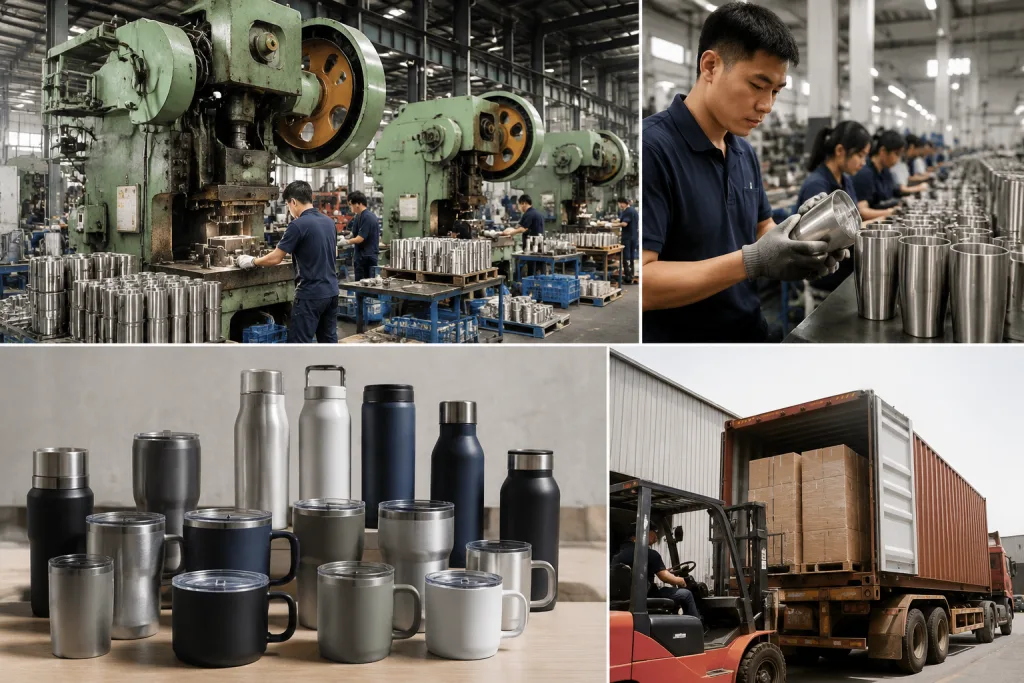
Control Quality Before Shipment
Quality control has to be agreed before the deposit, not fought over when 120 cartons are already sealed. For 304 stainless steel drinkware wholesale, we run it in a plain sequence: pre-production sample sign-off with Pantone and logo position marked in mm, in-line checks on the line, final random inspection, then shipment release only after the report passes.
Use AQL sampling for appearance and workmanship. A common setup is AQL 2.5 for major defects and 4.0 for minor defects, with critical defects not accepted. Major defects include leaking, poor vacuum performance, wrong logo, exposed rust, loose cap, sharp edges, severe dents, and barcode errors; last month QC pulled a sample where the EAN sticker missed one digit from the buyer’s PO. Minor defects are smaller issues such as 1-2 coating specks, light polishing lines under 30 mm, or packaging scuffs inside the approved limit.
Functional testing matters more than showroom cosmetics. For vacuum bottles and beer tumbler bulk orders, test insulation with controlled water temperature and time; we usually log starting temperature, room temperature, and the reading after 6 hours with a probe thermometer. For canteen wholesale orders, run leak testing with the bottle inverted and shaken for 30 seconds. For alcohol flask wholesale bulk, fill testing must include cap seal checks because flask complaints are usually about leakage, not steel grade. This is the wrong question to ask if the buyer only asks, “Is it 304 stainless?”
At our Zhejiang facility, final inspection normally happens when 80-100% of goods are packed. A typical order lead time is 25-35 days after sample approval for stock molds and 45-60 days for new tooling or complex color work. If your launch date is fixed, do not plan inspection on the last possible day. Leave 5-7 days for sorting or rework if the first inspection fails; we have seen a 3,000 pcs bottle order lose 4 days just because 11 cartons had mixed black and navy lids.
Compliance is part of quality, not paperwork decoration. Ask whether the factory has BSCI, ISO 9001, or similar audits if your retailer requires them, and match the certificate name to the factory shown on the proforma invoice. For Europe, discuss REACH for coatings and packaging inks, plus food-contact migration. For the US, confirm CPSIA if the item is for children and ASTM expectations for kids’ bottles. A kids’ bottle and a beer tumbler in bulk order do not carry the same compliance burden, and the math does not work if testing is quoted after the goods are finished.
Pick A Supplier You Can Manage
The best supplier is not the one shaving USD 0.08 off the FOB quote. It is the one you can manage from first sample to vessel closing. Ask for engineering comments within 24 hours, tooling ownership in writing, stable spec sheets, and defect standards tied to AQL 2.5 photos. We have seen a buyer save USD 420 on a 5,000 pcs order, then lose 12 days because the lid thread tolerance was never confirmed with a caliper.
Ask blunt questions. Who owns the mold? Is the vacuum line in-house? Is powder coating done on your line or sent to a coating shop 40 km away? What is the daily output for this model, 3,000 pcs or 8,000 pcs? Can you send carton drop-test photos with the 1.2 m corner impact shown? Can you support 2% spare lids after shipment? Can you pack mixed colors by inner carton without turning the PO into a mess? These questions separate a real factory from a catalog reseller. QC pulled the sample last month because the reseller could not explain why the carton mark said “matte balck.”
If you are buying wholesale drinkware for a brand launch, start with one hero SKU and one backup color. Do not launch 6 colors just because the renderings look clean. If you are buying beer tumbler wholesale or beer tumbler wholesale bulk for events, deadline and print registration matter more than a fancy coating name. We run pad print checks at 0.5 mm alignment tolerance because event buyers notice crooked logos before they notice the coating texture. If you are buying alcohol flask bulk for gift channels, approve packaging carefully; the box sells the flask on a shelf, and a weak insert will crush during a 15 kg master carton stack test.
For distributors, standardize parts across models. Use the same lid thread on 500 ml and 750 ml bottles where the design allows it. Use common silicone rings. Use common cartons. This cuts after-sales trouble and makes reorder planning less painful. We have seen this go sideways when a buyer used 4 lid styles across 7 SKUs, then could not match replacement lids after 3 months. For brand owners, spend the risk budget on what customers touch first: coating grip, lid seal, mouth feel, and retail packaging. The math does not work if you hide cost in tiny custom parts no customer notices.
BottleForge Industrial is based in Hangzhou, Zhejiang, close to Ningbo and Shanghai ports. That helps with China export consolidation, with Ningbo loading often 2 days faster for our mixed-container jobs than a Shanghai handover. Geography still does not fix weak sourcing. Clear specifications, realistic MOQ, controlled inspection, and honest lead-time planning do. We ship smoother when the buyer locks artwork before tooling and confirms MOQ by color before the line books powder. If your supplier says “confirm first, details later,” you are not buying a product. You are buying a future argument.
Send Your 304 Drinkware Spec For Factory Review
Share capacity, finish, logo, MOQ, target market, and launch date. We will check feasibility, pricing, samples, and export timing.
Frequently asked questions
What is the normal MOQ for 304 stainless steel drinkware wholesale?
For stock molds with laser engraving, 500 pcs per model is often workable. For custom powder-coated colors, plan on 1,000 pcs per color because coating line setup and color loss need volume. For private molds, custom caps, or unusual shapes, 3,000-5,000 pcs is more realistic. Canteen bulk and growler bulk orders may vary because larger products consume more steel and carton space. If a supplier offers 100 pcs with full custom color at factory pricing, check whether they are using existing stock, outsourced coating, or charging hidden setup fees.
Is 304 stainless steel always better than 201 for wholesale drinkware?
For food-contact drinkware, 304 is the safer default. It has better nickel and chromium content for corrosion resistance, especially with coffee, tea, sports drinks, and frequent washing. 201 can be used for low-cost outer shells, but it should not be quietly substituted for the inner liner. Your PO should state SUS304 or AISI 304 for food-contact surfaces. For EU or North American programs, ask for migration testing and material declarations. The price difference may be only USD 0.20-0.60 on a bottle, but the brand risk is much larger.
How long does a wholesale drinkware order take from China?
For an existing 304 stainless steel bottle or tumbler with standard packaging, expect 25-35 days after artwork and sample approval. Custom color panels usually add 5-7 days before bulk production. New tooling, special lids, or complex gift packaging can push lead time to 45-60 days. Ocean freight to Europe or North America can add 25-45 days depending on port and season. If you need drinkware wholesale goods for a fixed retail launch, approve samples at least 90 days before the required warehouse date.
What tests should I require before shipping bulk drinkware?
Use AQL final inspection, commonly 2.5 for major defects and 4.0 for minor defects. Add specific functional tests: 24-hour leak sampling, vacuum insulation checks at 6 hours, coating adhesion cross-cut testing, barcode scanning, carton drop testing, and cap torque checks where relevant. For beer growler wholesale and beer tumbler in bulk orders, include condensation and cold-retention checks. For alcohol flask wholesale, focus on cap leakage and surface scratches. Do not rely only on factory photos; arrange third-party or buyer-approved inspection before the 70% balance payment.
How should I compare FOB prices for drinkware bulk orders?
Compare only after fixing the same specification. Your quote sheet should list capacity, SUS304 inner and outer material, wall thickness, insulation type, cap material, coating, logo method, packaging, MOQ, lead time, and FOB port. A USD 3.60 bottle and a USD 4.20 bottle may look similar, but the cheaper one may use thinner steel, simpler box, or no compliance testing. For wholesale growler or beer growler wholesale bulk projects, also compare carton dimensions and units per container because freight can change landed cost by 10-20%.