Key Takeaways
- For 304 stainless steel drinkware private label, practical MOQ usually starts at 1,000-3,000 pcs per color and model
- 304 inner steel is the baseline; lid plastic, coating, and welding quality often cause more claims than the body
- Vacuum bottles, tumblers, canteens, and growlers fit different buyers; do not force one mold into every channel
- A realistic China production schedule is 30-45 days after artwork, sample, deposit, and packaging approval
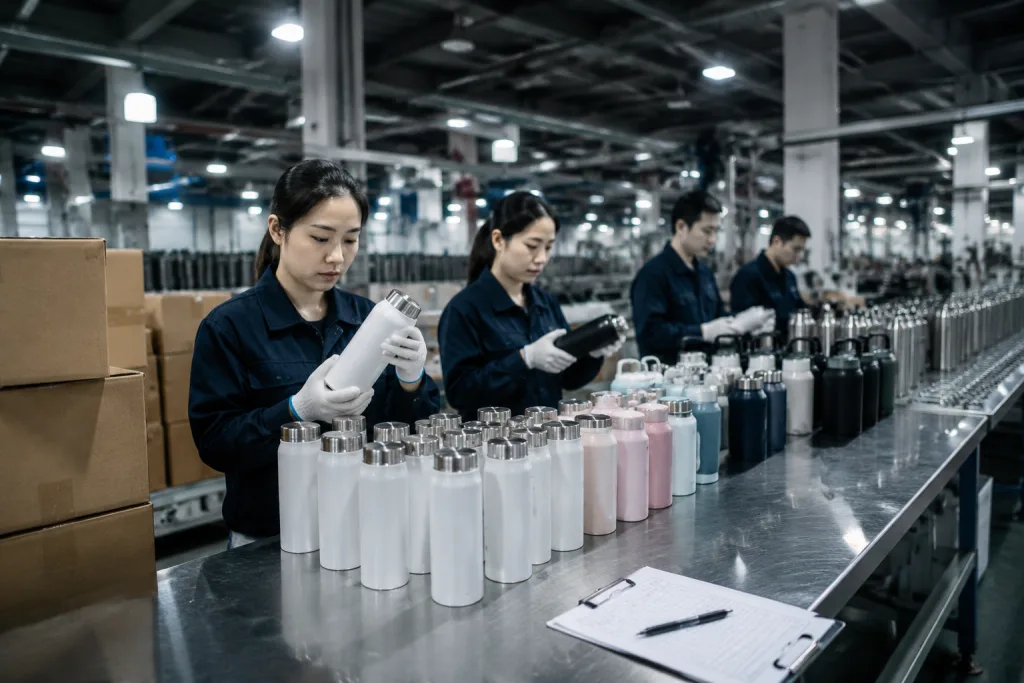
Buying 304 stainless steel drinkware private label is not a logo job. You are fixing the wall thickness in mm, vacuum hold time, PP or Tritan lid choice, powder coating adhesion, 1 pc/white box or color box packing, FDA or LFGB test scope, and whether the SKU can handle retail shelves, Amazon FBA, corporate gifting, or 3 reorder rounds with the same color match. On the line, we run a 0.50 mm body gauge check with a digital micrometer before polishing, because a nice sample means little if mass production saves steel later.
From our factory base in Zhejiang, China, we see the same mistake every month: buyers compare unit prices before locking the spec sheet. This is the wrong question to ask. A 500 ml bottle at USD 3.10 and another at USD 3.65 may look close, but they can differ in steel gauge, powder coating thickness, leak test time, 5-layer carton strength, and AQL 2.5 inspection level. Last season, QC pulled the sample after a 1.2 m carton drop because 6 lids cracked at the hinge; the buyer had approved the cheaper packing on the PO, and the math stopped working fast.
First compare the product type
Private label buyers often send us a PO line that says “stainless bottle,” then the spec sheet shows 3 separate items. A kids’ school canteen, a retail travel tumbler, and a distributor growler for outdoor stores sit on different tooling, lids, cartons, and test points. Wrong starting point. On our line in Hangzhou, QC pulled a 500 ml sample last month because the buyer wrote “304 stainless” but forgot the mouth diameter; that 8 mm difference changed the lid cost and packing height. The table below is where a serious canteen supplier or drinkware factory should start the conversation.
| Product type | Typical capacity | Best use case | Common MOQ | FOB China target range |
|---|---|---|---|---|
| Vacuum bottle | 350-1,000 ml | Retail, corporate, outdoor | 1,000-3,000 pcs | USD 3.20-7.80 |
| Travel tumbler | 300-900 ml | Commuter, coffee, promotional | 1,000-2,000 pcs | USD 2.80-6.50 |
| Custom canteen | 500-1,200 ml | Camping, military style, schools | 2,000-3,000 pcs | USD 3.50-8.20 |
| Custom growler | 1.0-2.0 L | Beer, outdoor, gift sets | 1,000-2,000 pcs | USD 6.80-14.50 |
If you are a canteen distributor selling to outdoor chains, a wide-mouth customized canteen with a carry handle and 0.5 mm outer wall can justify the extra USD 0.35. We run that wall thickness through a digital caliper check before polishing, because thin shoulders dent fast in drop tests. If you are buying canteen promotional stock for a one-time campaign, use a single-color powder coat and silkscreen logo to hold the cost down. Simple wins here. For distributor drinkware, reorder stability beats chasing the cheapest mold in Zhejiang; we’ve seen this go sideways when the second batch lid gasket came back 1.2 mm softer and failed the leak test.
304 steel is only the baseline
304 stainless steel is the right baseline for most private label drinkware. It keeps taste neutral and handles coffee, tea, and sports drinks without giving buyers an easy complaint. For Europe and North America, we normally run 304 stainless steel on the inner wall, then choose 304 or 201 stainless steel on the outer wall based on the target price. For premium customized drinkware, 304 inner and 304 outer is easier to sell and easier to explain during compliance review. Last month one buyer flagged “SUS304 inside only” on the carton mark because their Amazon listing said full 304, so we corrected the PO before mass production.
The steel grade alone does not make a good bottle. Ask for wall thickness and construction. A common double-wall vacuum bottle uses around 0.4-0.5 mm inner wall and 0.5-0.6 mm outer wall before forming. If a supplier saves 0.08 mm on the outer shell, the quote may look nice, but the math doesn't work after dent claims. We check shell thickness with a digital micrometer at incoming material inspection, and QC pulled one sample in March that measured 0.43 mm where the spec sheet said 0.50 mm. For a custom growler or customizable growler, we prefer a stronger bottom build because a 1.9 L filled unit is heavy, gets dropped into car trunks, and often ends up on outdoor tables or concrete floors.
Check surface passivation and welding before you approve the sample. Internal polishing matters too, because a rough weld line can trap milk powder, tea residue, or electrolyte drink mix. Poor vacuum sealing can turn an insulated bottle into a normal bottle after several weeks. We have seen this go sideways: the first sample held temperature, but the pilot run lost vacuum after cap assembly because the line overheated the base during polishing. At BottleForge Industrial in Zhejiang, China, standard vacuum inspection includes temperature retention checks and 100% leak testing on finished bottles. We ship about 450,000 stainless drinkware units per month, with normal private label lead time at 35-45 days after sample approval.
Do not pay a premium for the words “304 stainless” unless the supplier can explain thickness, weld process, vacuum testing, and food-contact documentation.
Use-case fit beats catalog shopping
A catalog photo hides the wrong fit. We sort 304 stainless drinkware by sales channel first, shape second. One canteen manufacturer may show 80 molds, but after we check carton length, logo area, target FOB, and FDA/LFGB paperwork, only five usually stay on the table. Last month QC pulled a 750 ml sample with a nice render but a 61 mm mouth, and the buyer flagged it because their ice-cube test needed 65 mm.
| Buyer type | Better choice | Why it fits | Risk to watch |
|---|---|---|---|
| Corporate gift buyer | 500-750 ml vacuum bottle | Clean logo panel, safe gift price, fits most desk use | Pantone color drift and gift box compression under 12 kg stacking |
| Outdoor canteen distributors | 750-1,200 ml canteen customizable model | Stronger outdoor look, carry strap, better match for camping shelves | Lid leakage after shake test and weak strap rivets |
| Retail brand owner | Travel tumbler or premium bottle | Repeat SKU demand, better shelf pull, room for upgraded coating | Powder coating scratch claims after rub test |
| Beverage or brewery buyer | 1.0-2.0 L customized growler | Large fill size, gift value, good branding space | Freight cost per unit jumps when carton CBM is ignored |
| School or youth program | Kids bottle or small custom canteen | Lighter body, easier carry, lower drop risk for younger users | ASTM/CPSIA parts review, small silicone parts, straw bite marks |
For a distributor canteen program, we run one body mold and change colors, lids, and logo methods. Simple wins. It keeps spare lids, inner cartons, and photo assets under control, and the line does not lose half a day swapping fixtures. For a distributor growler line, starting with two sizes beats six colors; the math does not work when one 2.0 L carton eats 0.085 CBM and the warehouse charges by pallet position. For customizable drinkware sold online, confirm FNSKU labels, barcode stickers, master carton marks, and polybag warnings before we cut the PO. We have seen this go sideways from one typo: “FNSK” on the artwork sheet, caught only when packing checked the 60 mm label roll.
Logo and finish change the economics
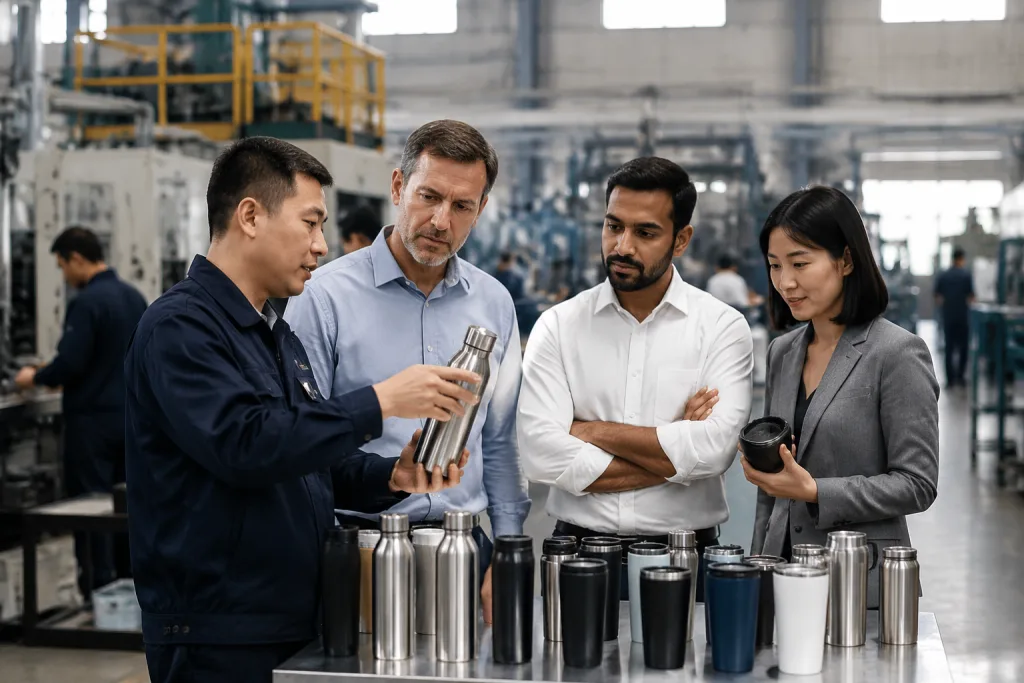
Buyers often chase a USD 0.03 cheaper bottle body, then lose USD 0.18 on decoration rework. We’ve seen this go sideways. For 304 stainless steel drinkware private label, we run silkscreen printing for simple spot-color marks, laser engraving for permanent metal logos, heat transfer or water transfer for wrap designs, UV printing for sharper multi-color artwork, and powder coating when the finish is part of the retail look. Each process changes landed cost and the defect rate. QC pulled one sample last month where the logo sat 4 mm off-center, and the buyer flagged it before we packed the master carton.
Silkscreen works for one- or two-color logos. It is affordable, usually around USD 0.08-0.25 per position depending on size and color count, and it fits canteen promotional orders where the logo is simple and the carton count is large. Laser engraving costs more than basic print, but it will not peel in a dishwasher test the way weak ink can. The mark shows the exposed stainless tone, not Pantone 186C red or Reflex Blue. It suits premium custom canteen and customized growler SKUs where the brand still needs to look clean after 12 months of use. On the line, we check the engraving with a 0.5 mm logo tolerance because thin letters can close up on curved bodies.
Powder coating is where 6 out of 10 low-price quotes start to look wrong. A stable outdoor-grade powder coat costs more than thin paint, and the math does not work if the supplier quotes the same price for both. For North American and European retail, we suggest testing adhesion with cross-hatch tape and basic abrasion checks. Matte black and white sell well, but they show scratches and dirt faster than textured dark gray, navy, or hammertone finishes. If your distributor drinkware passes through 3 warehouses before delivery, avoid fragile high-gloss coatings unless the packaging is upgraded. Our QC team uses 3M tape on the cross-hatch cut; if flakes lift at the grid edge, we stop the lot.
For private label packaging, budget early. A white box may add USD 0.12-0.25. A printed color box may add USD 0.25-0.60, with MOQ often 2,000-3,000 pcs. Gift tubes and molded inserts look good, but they increase carton size and freight; a 24 pcs master carton can jump from 13 kg to 16 kg after inserts. Short version: ask for the split cost. A professional canteen vendor should show decoration and packaging cost separately, not hide it inside a vague “all included” price. We once received a PO with “black logo” typed in the box section and Pantone black in the artwork file, which delayed approval by 2 days.
Compliance is not paperwork theater
If you sell in Europe or North America, put compliance into the RFQ, not after the artwork is approved. For stainless drinkware, we usually ask for LFGB or EU food-contact testing on the mouth-contact area, REACH screening for coating and plastic parts, FDA food-contact suitability for the U.S. market, and BPA-free declarations for lids. For children’s products, ASTM, CPSIA, and small-parts review may apply. Last month QC pulled a kids bottle sample with a 6.8 mm straw tip; that small detail changed the test plan.
Do not assume “304 stainless steel” covers the lid, gasket, paint, straw, handle, or printed ink. We see about 7 out of 10 claim questions come from silicone rings, sliding lids, powder coating, or UV ink, not from the steel body. Ask the canteen factory to name the lid plastic, silicone grade, coating supplier, and ink system. Ask before deposit. If the sales reply is only “food grade, no problem,” the math does not work. We once had a buyer flag a black PP lid because the PO said Tritan, one typo that stopped the line for 2 days.
Inspection terms also matter. We normally work with AQL 2.5 for major defects and AQL 4.0 for minor defects unless the buyer specifies stricter criteria. Critical defects such as leakage, sharp edges, contamination, and wrong logo are not acceptable. A pre-shipment inspection should include carton drop checks from 76 cm, barcode scan tests with the buyer’s FNSKU file, capacity verification using a graduated cylinder, coating appearance under a light box, torque or lid fit checks, and random leak tests after 30 minutes upside down. Small checks catch big claims.
For Amazon FBA drinkware, ask the canteen suppliers or drinkware vendors to prepare FNSKU labeling, suffocation warnings for polybags, carton weight control, and carton dimensions before mass production. We ship FBA cartons under the buyer’s carton spec, not whatever box is left near the packing table. Reworking 3,000 units after packing is slower and more expensive than setting the packing standard correctly on day one; we have seen a 12-day schedule turn into 18 days because the carton mark was approved after sealing.
Price comparisons need equal terms
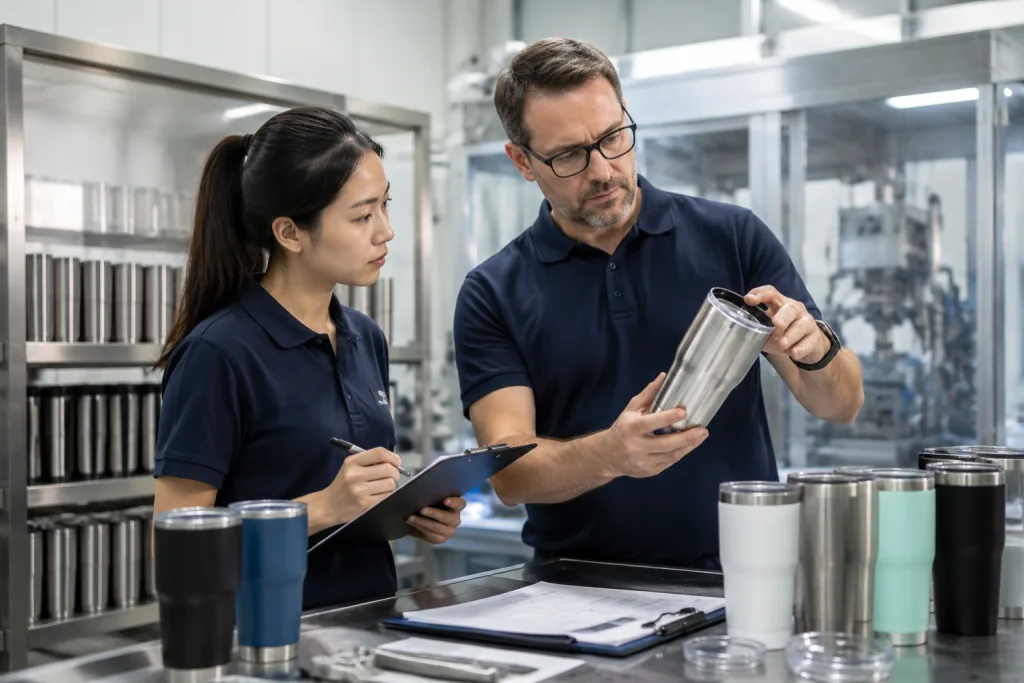
A fair price check needs the same Incoterm, packaging, decoration, inspection level, and ship date. FOB Ningbo or FOB Shanghai is normal for Zhejiang factories; from our Hangzhou line, the truck is usually booked as a 9.6 m vehicle and the forwarder knows both port cut-off rules. EXW looks cheaper on the quote sheet, but the math often breaks once domestic handling, export declaration, warehouse loading, and trucking are moved to your side.
Here is a simple head-to-head example. A 750 ml vacuum bottle in 304 inner and 201 outer, one-color powder coat, silkscreen logo, white box, 3,000 pcs might quote at USD 4.20-4.80 FOB China. The same bottle with 304 inner and outer, improved powder coat, laser logo, color box, and stricter inspection may land at USD 5.10-5.90 FOB. Not the same bottle. Last month QC pulled the sample and found the lower quote used a 0.32 mm outer shell instead of 0.40 mm, so calling the second quote “overpriced” was the wrong question to ask.
Payment terms are usually 30% deposit and 70% balance before shipment for new buyers. For repeat canteen distributors with stable volume, we can discuss staged releases or credit after 3-5 clean orders, not on the first PO. Sample timing is typically 7-12 days for stock mold with custom logo, and 20-35 days if a new lid, special coating, or custom packaging structure is involved. We have seen this go sideways when a PO says “mat black” instead of “matte black”; the line waits while sales, artwork, and the powder room confirm the Pantone chip under a D65 light box.
Be careful with quotes that skip artwork approval, Pantone tolerance, carton specification, test reports, or spare gasket policy. A responsible canteen manufacturer will ask annoying questions early: logo size in mm, carton burst strength, AQL 2.5, and whether the retailer requires a 1.2 m drop test. Good. The buyer flagged it once after production because the “customizable canteen” passed vacuum testing but failed the retailer’s packaging drop test, and nobody wanted to pay for 3,000 replacement color boxes.
How to brief a factory properly
A clear RFQ saves days. Send the product type, capacity, lid style, steel requirement, finish, logo method, quantity by color, packaging, sales market, compliance needs, delivery deadline, and target Incoterm. If you are unsure, give us the retail price and channel. With a USD 19.99 Amazon target, for example, the line may suggest a custom canteen instead of a custom growler because the carton CBM and lid cost change the margin fast. We run this check before quoting, not after the buyer has already built the listing.
For first orders, keep the private label program controlled. Choose 1-2 molds, 2-4 colors, and one decoration method. Twelve SKUs on the first purchase order sounds strong in a meeting, but we have seen it go sideways when mixed lids, mixed powder coatings, and mixed packaging all need approval at the same time. Last month a PO even listed “matte sand” in one tab and “matte black” in the carton mark file. QC pulled the sample. For most new 304 stainless steel drinkware private label projects, 3,000-5,000 total units across a small assortment is a practical test run.
Decide who owns the production standard before we cut steel or print film. Your purchase order should list material grade, capacity tolerance, logo artwork version, Pantone number, packaging drawing, inspection standard, and approved sample reference. The golden sample should be sealed in a PE bag, labeled with the PO number, and photographed before mass production. For distributor canteen and distributor drinkware programs, we recommend keeping one approved sample at your office and one at the China factory; during AQL 2.5 inspection, a 0.3 mm logo shift is much easier to discuss against a real sample than against an email thread.
China manufacturing works best when specifications are written, not guessed. Zhejiang has strong stainless drinkware supply chains, but the result still depends on how well the buyer and factory define the product. If you want a canteen customized for your market, treat the RFQ like an engineering file, not a mood board. Pretty reference photos are not enough. The wrong question is “Can you make this?” The better question is “Can you make this in 304 stainless, at this capacity tolerance, with this lid fit, this carton drop-test requirement, and this delivery date?”
Send your stainless drinkware specification for review
We will check material, MOQ, decoration, packaging, and FOB cost before you commit to a private label production order.
Frequently asked questions
What MOQ should I expect for 304 stainless steel drinkware private label?
For stock molds with your logo, expect 1,000-3,000 pcs per model, and often 1,000 pcs per color for powder coating. Color box packaging may push the practical MOQ to 2,000-3,000 pcs because printing suppliers have their own setup costs. For a custom canteen with a new mold, the first production run may need 5,000-10,000 pcs depending on tooling complexity. If you are testing a market, start with one proven mold, two colors, and one logo method. That usually keeps the first order manageable while still giving you enough volume for stable FOB pricing from China.
Is 304 stainless steel enough for Europe and North America?
304 stainless steel is the right baseline for the bottle body, but it is not the full compliance answer. You still need to check lid plastic, silicone gaskets, coating, printing ink, straws, and packaging. For Europe, buyers often request LFGB or EU food-contact testing plus REACH screening. For the U.S., FDA food-contact suitability and BPA-free declarations are common. If the item is for children, CPSIA and ASTM considerations may apply. Ask your canteen vendor for material declarations and recent test reports that match the actual components used in production, not just a generic stainless steel certificate.
Which is better for private label: bottle, tumbler, canteen, or growler?
It depends on your channel. A 500-750 ml vacuum bottle is the safest all-purpose private label SKU for retail and corporate gifting. A travel tumbler works well for commuter and coffee use, but lid design matters more. A customizable canteen fits outdoor, school, and rugged promotional programs. A customized growler is better for breweries, outdoor gift sets, or premium distributor growler lines, but freight cost is higher because 1.0-2.0 L products take more carton space. If you are a new brand owner, do not launch all four at once. Start with the format that matches your sales channel.
How long does a private label stainless drinkware order take?
For a stock mold with custom logo and standard packaging, sampling normally takes 7-12 days after artwork confirmation. Mass production is usually 30-45 days after sample approval and deposit. Custom packaging, special powder coating, new lids, or large multi-color orders can add 7-15 days. Sea freight to Europe or North America can add roughly 25-45 days depending on port and season. If your launch date is fixed, work backward and include time for artwork revision, sample shipping, inspection, export booking, and possible customs delays.
How do I compare two canteen manufacturers fairly?
Ask both canteen manufacturers to quote the same specification: capacity, 304 inner or 304 outer, wall thickness, coating type, logo method, packaging, test requirements, Incoterm, and AQL level. A USD 0.40 difference may be caused by better powder coating, stronger carton, laser engraving, or real inspection, not just margin. Request product photos, factory audit status such as BSCI if needed, lead time, sample cost, and monthly capacity. Also ask who handles FNSKU labels, barcode testing, and carton marks if you sell online. Equal terms make the cheaper quote either useful or suspicious.