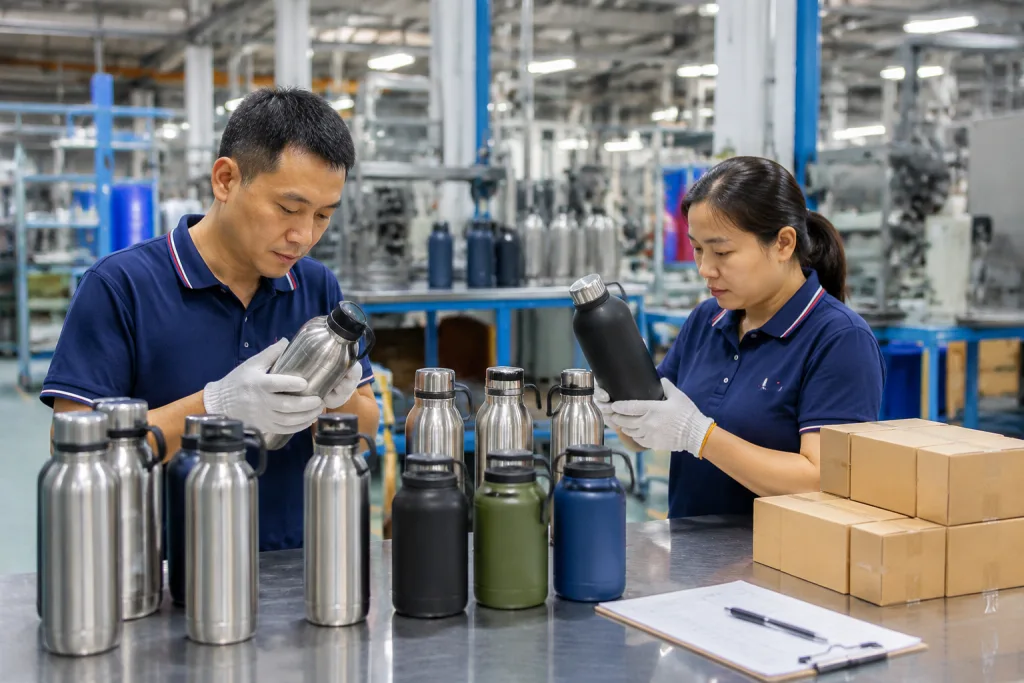
Key Takeaways
- For most custom drinkware, 0.4-0.6 mm inner 304 stainless steel is the practical range for durability and cost
- A realistic B2B MOQ is usually 1,000-3,000 units per color or model, depending on surface finish and packaging
- Lead time from approved pre-production sample is commonly 30-45 days for standard vacuum drinkware
- Use AQL 2.5 for major defects and 4.0 for minor defects unless your retailer requires stricter inspection
If you buy custom drinkware from China for retail, corporate gifting, outdoor distribution, or Amazon FBA, the material claim sits at the top of the spec sheet, but buyers often check it too late. Bad habit. We have seen a cup stamped 304 stainless pass the magnet check, then fail the program because QC pulled the sample and found a 0.32 mm wall instead of the 0.40 mm on the PO, plus rough weld beads, weak powder coating, loose lids, slow artwork approval, and missing FDA or LFGB files.
From our line in Zhejiang, the same questions come up on about 8 out of 10 new drinkware projects: steel grade, body structure, logo process, MOQ, and final inspection. A good 304 stainless steel drinkware manufacturer should show those trade-offs before sampling. After the deposit, the math gets ugly. If the buyer flags a leaking lid at AQL 2.5 inspection, fixing tooling or changing gasket hardness can turn a 12-day sample plan into 18 days fast.
Start With The Steel Claim
Start by asking where 304 stainless steel is needed, not whether the whole bottle needs a 304 sticker. On most vacuum bottles, travel tumblers, custom canteen runs, and custom growler orders, we run 304 stainless steel on the inner liner because it touches coffee, tea, juice, or beer. The outside shell is where buyers try to save money; 201 stainless outside can cut cost on a dry-use promo canteen. I would not use it for premium retail or outdoor distributor drinkware. We have seen this go sideways after a buyer flagged rust spots near the bottom paint edge after a 48-hour salt spray check.
Ask your canteen manufacturer for the material structure, not just food grade stainless steel on a quote sheet. A workable spec reads like this: inner wall SUS304, outer wall SUS304, cap PP, seal ring food-grade silicone, wall thickness 0.45 mm inner and 0.5 mm outer. Short and clear. For Europe, request LFGB or EU food contact test reports when your channel asks for them. For North America, FDA food contact compliance and California Prop 65 screening matter if you sell through Amazon, retail chains, or outdoor stores. QC pulled one pre-production sample last month because the PO said “304 inside/outside,” while the supplier worksheet only listed 304 inner and 201 outer.
The cost math is real. Moving both inner and outer shells to 304 usually adds about USD 0.20-0.60 per unit on a 500 ml bottle, depending on coil price, body diameter, and shape loss during stretching. On a customized growler with a 1.9 L body, the gap is bigger because the blank weight is bigger; our 1.9 L line uses a wider steel disc before deep drawing. If a quote sits USD 0.80 below 3 other factories, this is the wrong place to celebrate. Check steel grade and wall thickness first. In Zhejiang and across China, serious canteen suppliers can show coil purchase records or send third-party test samples when the order value justifies it, usually from 3,000 pcs and up.
Match Structure To The Sales Channel
The second decision is product architecture. A distributor canteen for outdoor shops does not need the same build as a bank giveaway canteen. Decide early: single-wall, double-wall vacuum, wide-mouth, straw lid, chug lid, handle lid, or beer growler format. Each choice changes the mold, leakage test, carton size, and AQL 2.5 inspection checklist; on our line, even a 3 mm lid gasket change can force a new torque test.
Single-wall 304 stainless steel drinkware is lighter and lower cost, so we run it for sports events, school orders, and basic canteen customized projects. No insulation claim. Double-wall vacuum construction costs more, but it gives the buyer a sellable claim: 500-750 ml bottles can hold hot liquid for 6-12 hours and cold liquid for 12-24 hours, depending on lid design and test conditions. Retail buyers will flag loose temperature wording fast. Test at 20-25°C room temperature, record the starting liquid temperature, and write the time window clearly; QC pulled one sample last month because the carton said “24H hot” while the test sheet only supported 12 hours.
For custom growler and distributor growler programs, watch the mouth diameter, cap seal, and pressure expectation. A stainless growler for beer transport is not automatically a pressure-rated vessel. If you need carbonation retention, say it before sampling. This is the wrong question to ask after artwork approval. A customizable growler with a swing cap, threaded cap, or screw lid behaves differently in leakage tests; we usually run an inverted 24-hour test plus a 30-minute shake test before we trust the cap.
A practical rule is simple: choose the structure by where the product will fail first. For Amazon FBA, dents and lid leakage hurt reviews. For supermarket retail, shelf face, barcode position, and color consistency matter; one buyer rejected a batch because the EAN sticker sat 6 mm too low on the belly band. For promotional buyers, unit price and logo visibility drive the order. For canteen distributors, repeatable replacement lids and stable color matching often beat the lowest FOB price, because the math does not work if they reorder 5,000 lids and half the colors miss the bottle body.
Decide Decoration Before Tooling
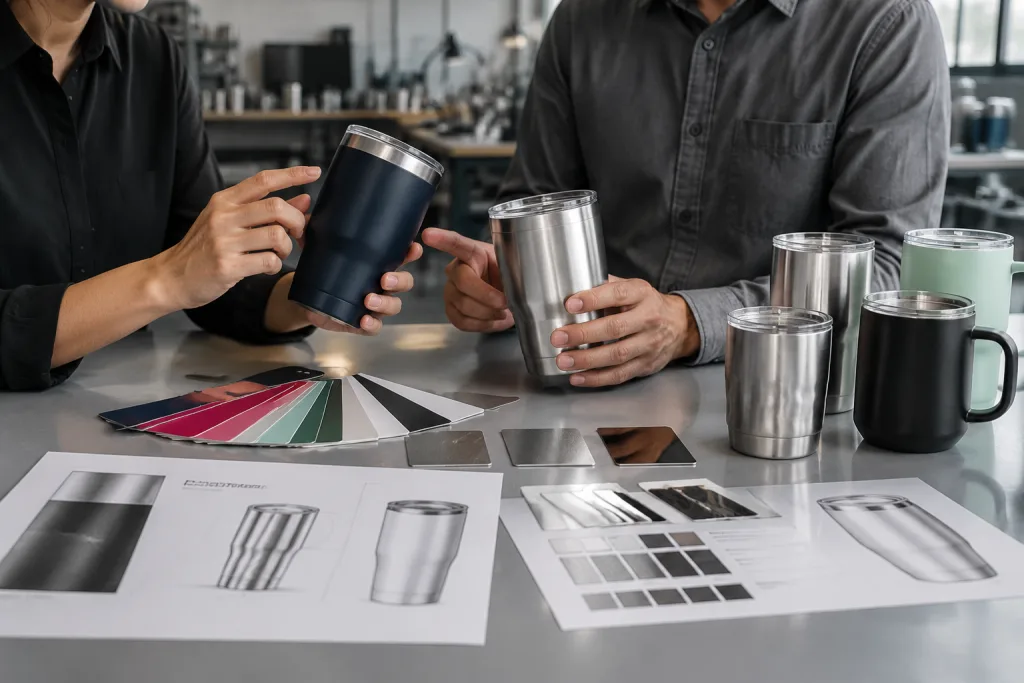
About 7 out of 10 new buyers leave decoration until the quote is almost approved. That is the wrong question to ask. Decoration changes surface finish, MOQ, scrap rate, fixture design, and lead time. A custom canteen with one-color silk screen on matte powder coating runs on a different setup from a 360-degree heat transfer print, laser engraved logo, or full-color UV print. Last month QC pulled a sample where the logo sat 3 mm too close to the bottom radius; the artwork looked fine on PDF, but the jig could not hold it cleanly. If you need customizable drinkware with 6 customer logos under one master order, we plan fixtures, films, and packing separation before tooling starts.
Silk screen still wins for simple logos. Low cost. Fast setup. It works well on cylindrical bottles when the print area stays narrow, such as 45 mm wide on a 500 ml body. Laser engraving looks cleaner on premium 304 stainless steel drinkware, especially over powder coating, because it cuts through to the steel and does not peel. UV printing handles gradients and small color details, but we run abrasion testing with 3M tape and alcohol rubs before we trust it for retail. Heat transfer covers more area, though the math does not work on small runs; the line usually needs higher MOQ and cleaner AI/PDF artwork with no missing fonts.
For canteen customizable programs, get decoration tolerance in writing. A workable logo position tolerance is often plus or minus 1.5-2.0 mm on standard bottles. Color matching should refer to Pantone, but powder coating will not match coated paper one-to-one, especially on beige, khaki, and metallic finishes. On a 3,000 unit customized canteen order, we normally recommend one approved production sample and one carton drop test before mass production. Simple pause. It saved one buyer from reworking 48 cartons after the buyer flagged a Pantone typo on the PO.
Packaging is decoration too. Retail boxes, belly bands, hang tags, insert cards, FNSKU labels, and master carton marks all need version control, not just “latest file” sent by email. We ship Amazon and distributor orders where a 2 mm barcode quiet-zone error can fail scanning at inbound. The line can make a good bottle and still lose money if box artwork is mixed between black lids and straw lids. A canteen vendor who can make the bottle but cannot control packaging files is not ready for serious distributor drinkware work.
Read MOQ And Price Together
The third decision is commercial: how much risk belongs in the first order. MOQ is not a random factory rule. It comes from steel coil purchasing, polishing drum batch size, powder coating line setup, logo jig cost, packaging printing, and the changeover time on the line. For our Hangzhou, Zhejiang export team, common MOQ ranges are 1,000 units for existing shapes with a simple logo, 2,000-3,000 units per color for powder coated custom drinkware, and 5,000 units or more for private mold or complex retail packaging. Last month QC pulled a sample from a 2,000-unit matte black run because the coating measured 0.03 mm thinner near the bottom curve, so batch size is not just sales talk.
FOB China pricing has to be checked line by line. A quote for USD 3.20 and another quote for USD 3.65 may describe different bottles. Check capacity, steel grade, wall thickness, lid material, coating type, carton quality, individual box, test report, and spare parts. For a 750 ml double-wall bottle, a realistic export price might sit around USD 3.00-5.50 FOB Ningbo or Shanghai for standard models, depending on finish and packaging. A customized growler or large canteen factory order can run higher because the body uses more 304 stainless and the forming speed drops from about 900 pcs per shift to 550 pcs on some shapes. The buyer flagged it once: “same photo, why higher price?” Same photo, different steel weight.
Do not push only for the lowest MOQ if your actual plan is repeat distribution. The math doesn't work. Small trial orders are fine for checking sell-through, but they raise unit costs and give you less room on color, packaging, and inspection. If you are a canteen distributor or distributor drinkware buyer, ask the factory for a price ladder at 1,000, 3,000, 5,000, and 10,000 units. You will see where the line starts running cleanly, usually after the coating gun, logo fixture, and carton packing table stop changing every few hours. We have seen this go sideways when a PO said “navy blue” but the artwork file said PMS 2965C.
Our typical stainless drinkware capacity is about 450,000 units per month across standard bottle, tumbler, and growler lines. That number matters only if your order is booked early. Peak season before summer and Q4 gifting can add 7-15 days to normal schedules in China, especially when powder coating ovens and carton suppliers are full. We ship faster when the buyer locks the color, logo size in mm, carton mark, and AQL inspection date before deposit, not after the first production slot is already gone.
Check Compliance Like A Buyer
The fourth decision is the level of verification your market will actually ask for. Compliance should follow the sales channel, not just the destination country. A 5,000 pcs corporate gift shipped to one office does not need the same file as a retail chain program, a children’s bottle, or an Amazon FBA listing. Ask this early. We have seen buyers send a PO with “FDA/LFGB needed” typed in the remarks box, then later reject the file because the lid gasket material was not listed on the test report. A serious 304 stainless steel drinkware manufacturer should be ready to discuss AQL, food contact tests, factory audits, and restricted substances before you issue a purchase order.
For Europe, REACH and LFGB are common requests, especially for silicone rings, plastic lids, coatings, and printed surfaces. For the United States, FDA food contact expectations, CPSIA for children’s items, ASTM requirements in certain use cases, and Prop 65 screening may apply. If the bottle is marketed for kids, do not treat it as a normal sports bottle with a shorter body. That is the wrong question to ask. Kids bottle projects need separate checks on small parts, bite valves under pull force, straw material grade, and drop performance from shelf height. On one 350 ml kids bottle, QC pulled the sample after the straw cap cracked at the hinge during a 1.2 m drop test.
Factory social audits such as BSCI, Sedex, or retailer-specific audits may also be required. Do not assume every canteen supplier in China has the same audit scope. Some canteen manufacturers assemble in one facility but send coating to a second workshop and polishing to a third. The audit report may cover only final assembly. We’ve seen this go sideways when a buyer’s compliance team asked for coating-line coverage 12 days before shipment, and the math did not work. If your customer requires audit coverage for all critical production steps, confirm the factory name, address, and process scope before sampling.
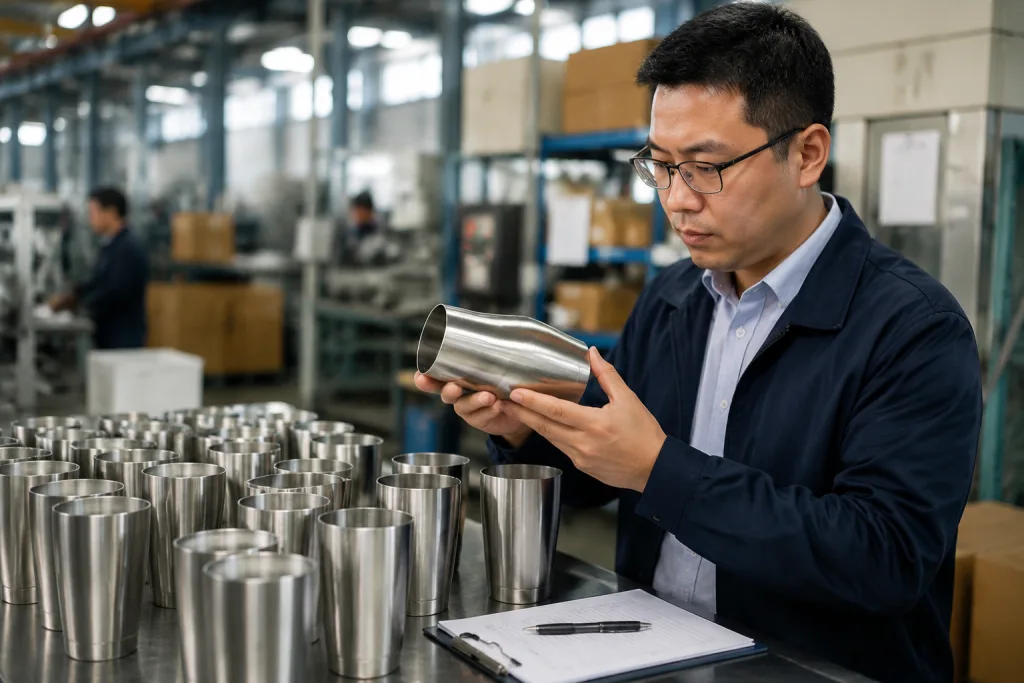
Inspection should be written into the order. A common approach is pre-production sample approval, during-production inspection at 20-30 percent completion for large orders, and final random inspection using AQL 2.5 major and 4.0 minor. Test leakage, vacuum performance, coating adhesion by 3M tape, logo rub resistance with 500 g pressure, carton drop, barcode scan, and unit weight. We run unit weight on a 0.1 g digital scale because it catches steel thickness drift before anyone argues about “same as approved sample.” It is not perfect. It works.
Choose A Supplier You Can Control
The final decision is not whether a canteen vendor can make one good sample. Plenty can. The real test is whether the supplier can repeat that sample for 3,000, 10,000, or 50,000 units with controlled defects, matching cartons, and straight answers when the line misses something. QC pulled a sample last month with a 0.35 mm lid gap; the sample looked fine, but the bulk would have failed shelf display. That is where you separate a trading-style canteen supplier from a production-capable partner.
Ask who owns the tooling, who controls the vacuum line, where powder coating is done, and how rejected units are handled. Ask for photos or video of the production line, but do not stop there. Request a process flow: tube cutting, water expansion or stretching, welding, vacuuming, polishing, coating, decoration, assembly, inspection, and packing. We run this against the traveler card on the floor, not against a pretty PDF. If your contact cannot explain why the vacuum oven is holding 560°C or where the leak-test fixture sits, they probably do not control the factory.
For private label or canteen promotional orders, communication discipline matters. You should receive a written quotation, artwork proof, sample comments log, production schedule, carton specification, and inspection standard. File control sounds boring. It saves orders. If you are managing 6 SKUs of customizable canteen, customizable growler, and customized drinkware at the same time, one wrong Pantone code or a PO typo like “matte black” versus “mate black” can send 120 cartons into rework.
A practical supplier scorecard can be short: material proof, sample accuracy, price transparency, audit readiness, defect handling, and lead time reliability. Do not score every line equally; this is the wrong question to ask if your channel has one pain point that costs money. For retail, a barcode label shifted 8 mm can hurt more than a small cosmetic scratch. For distributor canteen sales, replacement lids and color continuity across repeat orders decide whether customers reorder, especially when the buyer flagged “same red as last PO” and the coating shop still has two red powders in stock.
China remains one of the strongest supply bases for stainless drinkware because the supply chain is dense: steel forming, lids, silicone, coating, packaging, and export logistics sit within a short truck route. In Zhejiang, this matters for buyers who need custom drinkware without building every component from scratch. We ship mixed parts from Yongkang and Jinhua into Hangzhou consolidation; a lid change that takes 18 days elsewhere can often be settled in 12 days here if the MOQ and mold fit are clear.
Send Your Stainless Drinkware Specs For Review
Share capacity, logo method, target price, market, and delivery date. We will flag material, MOQ, packaging, and compliance risks before quoting.
Frequently asked questions
How do I verify a factory is using real 304 stainless steel?
Start with the written bill of materials, then confirm it with testing on production samples. The spec should state SUS304 or 18/8 stainless steel for the inner wall, not just food grade steel. For larger orders, ask for a third-party material test such as SGS, Intertek, or TÜV on the actual pre-production sample. A PMI test can quickly identify alloy composition, while full food contact testing checks migration safety. Also compare unit weight against the approved sample. If a 500 ml bottle suddenly becomes 20-30 g lighter in mass production, you should investigate wall thickness or component changes before shipment.
What is a normal MOQ for customized canteen orders?
For an existing bottle shape with one logo, 1,000 units is a common starting MOQ. If you need a custom powder coated color, retail box, or multiple logo positions, expect 2,000-3,000 units per color or SKU. A private mold canteen customized project usually starts at 5,000-10,000 units because tooling, fixtures, and test runs must be absorbed. Some factories accept 500 units, but the unit price is higher and decoration choices are limited. If you are testing a new market, ask for a price ladder at 1,000, 3,000, and 5,000 units so you can see the true cost curve.
Is 304 stainless steel enough for all drinkware markets?
For most custom drinkware, 304 stainless steel is the right default because it balances corrosion resistance, formability, availability, and cost. It works well for water bottles, tumblers, travel mugs, and many custom growler designs. However, the full product still matters. Lids, straws, silicone seals, coatings, inks, and packaging may create compliance issues even when the steel is correct. For children’s drinkware, check CPSIA or relevant market rules. For Europe, LFGB and REACH may apply to non-steel parts. For acidic drinks, salt exposure, or marine use, you may need extra testing rather than simply assuming 304 covers every condition.
How long does production take after sample approval?
For standard 304 stainless steel drinkware with existing tooling, production is commonly 30-45 days after pre-production sample approval and deposit. Add 5-10 days if you need new retail packaging, several colorways, or special accessories. Private mold projects can take 60-90 days before mass production because 3D design, tooling, trial samples, corrections, and testing all take time. Sea freight to Europe or North America then adds roughly 25-45 days depending on destination port and season. If you need goods for a fixed promotion date, lock artwork and packaging files early; late approvals are the most common cause of missed shipping windows.
What defects should I inspect before shipment?
Focus on defects that create returns: leakage, weak vacuum insulation, coating scratches, logo misalignment, dents, dirty interiors, lid fit, odor, carton damage, and wrong labels. For a typical B2B order, use AQL 2.5 for major defects and AQL 4.0 for minor defects unless your retailer has its own standard. Test a sample of units with inverted leakage checks, hot water temperature retention, tape adhesion on print, barcode scanning, and carton drop testing. For Amazon FBA, confirm FNSKU placement, suffocation warning if polybags are used, master carton weight, and carton dimensions. A clean inspection report is cheaper than sorting rejected goods overseas.