Key Takeaways
- 304 stainless steel is the standard inner material; wall thickness usually runs 0.4-0.6 mm for bottles and 0.5-0.8 mm for growlers
- A realistic MOQ is 1,000 units per SKU for standard shapes and 3,000-5,000 units for new tooling or complex color matching
- Laser engraving suits premium long-life logos; silkscreen and heat transfer are better for canteen promotional orders
- For Europe and North America, confirm LFGB or FDA food-contact testing, REACH coating compliance, AQL inspection, and export carton drop testing
Picking a 304 stainless steel drinkware factory is not hard because China lacks suppliers. It is hard because the wrong spec gets locked before the mold deposit, artwork approval, or PO wiring, and then the math doesn't work. A 500 ml sports bottle, 20 oz travel tumbler, 64 oz custom growler, and military-style custom canteen can all use 304 stainless steel, but they need different tooling, wall thickness, carton drop-test limits, and retail packing. We have seen this go sideways when a buyer approved a 0.45 mm body sample for a premium tumbler, then asked for a 30% lower target price after QC pulled the sample from the line.
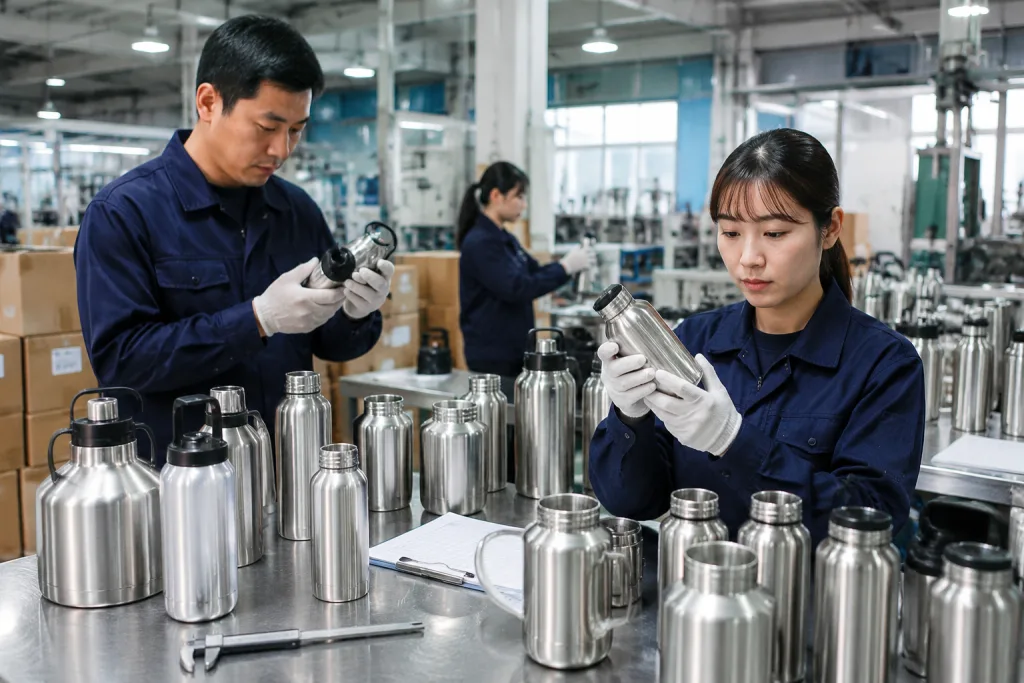
BottleForge Industrial runs export drinkware production from Hangzhou, Zhejiang, with typical MOQs from 1,000 units per SKU and monthly capacity around 280,000 units depending on finish mix. We wrote this for B2B buyers comparing canteen manufacturers, distributor drinkware programs, and customized drinkware projects without getting buried in sales talk. On our floor, a finish change from powder coating to full-wrap heat transfer can move a schedule from 12 days to 18 days, and the buyer usually flags it only after the ship date is tight. Better to price it correctly first.
Start with the product battlefield
Buyers often open with “customizable drinkware” before they know the product they need to sell. That is the wrong first question. A club canteen, a 32 oz distributor growler, and a powder-coated office tumbler can sit in one custom drinkware budget, but they do not run on the same line; last month QC pulled a tumbler sample with a 0.3 mm coating chip after the cross-hatch tape test, while the growler issue was vacuum loss after 6 hours.
We use this head-to-head check before we price a project:
| Product type | Best fit | Typical capacity | Common MOQ | Main risk |
|---|---|---|---|---|
| Sports bottle | Retail, gyms, schools | 500-1,000 ml | 1,000 pcs | Lid leakage |
| Travel tumbler | Corporate gift, coffee channel | 12-30 oz | 1,000 pcs | Coating scratch |
| Custom growler | Breweries, outdoor retail | 32-64 oz | 1,000-2,000 pcs | Vacuum retention |
| Custom canteen | Camping and military-style promo orders | 600-1,200 ml | 1,500 pcs | Shape tooling and strap fit |
If you are a canteen distributor, or you are checking 3 canteen vendors, make every canteen factory quote against the same table. We have seen this go sideways. One canteen supplier quotes 0.4 mm body steel, another quotes 0.6 mm, then the buyer flags a USD 0.18 gap and thinks the math works. It does not. In Zhejiang, new importers still compare China FOB prices by capacity and logo only, then we find the PO typo after sampling: “304 stainless” in the email, “201 stainless” on the attachment.
304 steel versus cheaper alternatives
For drinkware that touches water, coffee, beer, or acidic drinks, 304 stainless steel is the standard export-grade material we run for serious orders. It contains roughly 18% chromium and 8% nickel, so North American buyers often write “18/8 stainless” in the brief. Not magic. In salt-spray checks and daily use, it holds up better than 201 stainless, while 316 stainless usually makes the bottle too expensive unless the project has a marine or medical angle. Our incoming QC checks coil tags against the material declaration before the line starts cutting discs.
A serious 304 stainless steel drinkware factory should state exactly where 304 is used. On vacuum bottles, we often see 304 stainless steel on the inner wall and 201 or 304 on the outer wall, based on the buyer’s price target. For premium customized drinkware, we recommend 304 inner and 304 outer when the item will be used outdoors, sold at higher retail, or exposed to salty air. For budget canteen promotional projects, 304 inner with 201 outer can pass if the coating is strong and the buyer accepts the trade-off. The math does not work if a buyer asks for full 304, powder coating, gift box packing, and a giveaway price in the same PO; we have seen that go sideways after the buyer flagged rust spots around the bottom rim at pre-shipment inspection.
Typical wall thickness is 0.4-0.6 mm for single bottles, 0.45-0.6 mm per wall for vacuum tumblers, and 0.5-0.8 mm for larger customized growler bodies. Too thin, and dent complaints start after carton drop tests. Too thick, and FOB cost, unit weight, and ocean freight jump fast. We usually ask buyers to approve a target weight tolerance, for example ±5%, because a digital scale catches quiet material changes better than photos do. Last month QC pulled the sample on a 750 ml bottle after the body weight came in 18 g under the signed sample; the surface looked fine, but the gauge told the truth.
Do not approve only by appearance. Ask for material declaration, food-contact test scope, and sample weight before mass production.
Compare canteen, bottle, and growler specs
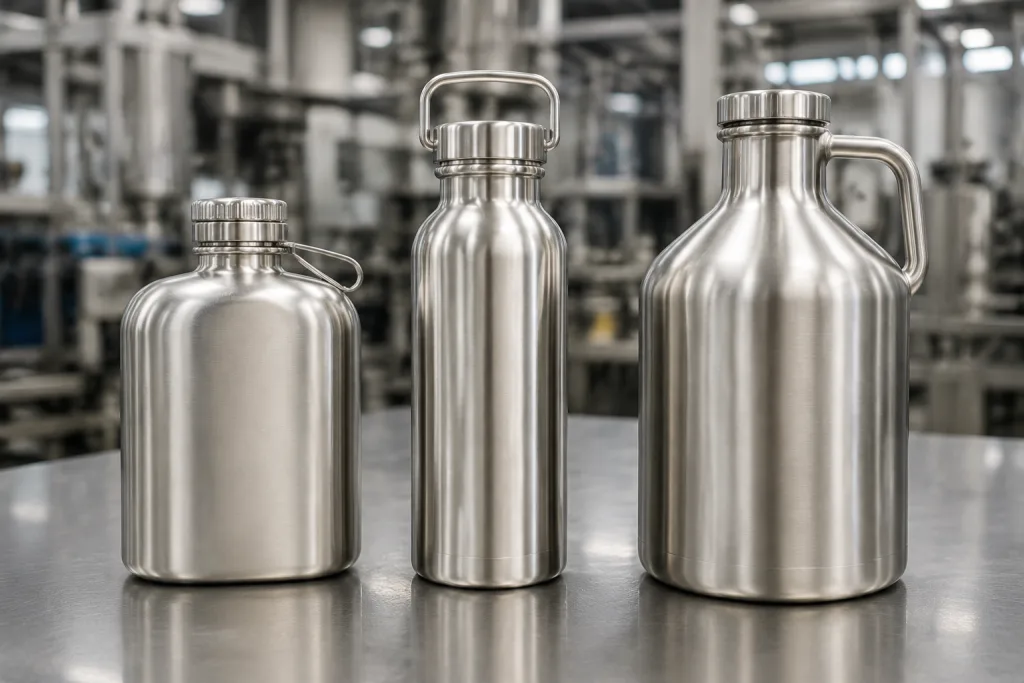
“Canteen” causes trouble on RFQs. One buyer means a flat hip-flask body, another means a round outdoor bottle with a strap, and another is asking for a military-style aluminum item we do not run on the 304 stainless line. Send a 2D drawing with height, body width, mouth ID in mm, and strap position. Adjectives get expensive.
| Spec point | Canteen customizable | Sports bottle | Customizable growler |
|---|---|---|---|
| Body shape | Oval body, flat hip-flask body, or round body with shoulder lugs | Straight cylindrical body for faster spinning and polishing | Wide cylindrical body, usually with larger weld and polish area |
| Vacuum option | Possible, but flat shapes limit insulation performance | Common for 304 stainless double-wall items | Recommended for 64 oz brewery and gift programs |
| Logo position | Flat side for screen print; curved side needs fixture checking | Front body, usually easiest for laser or silk print | Large front panel, better for brewery logos and gift artwork |
| Accessory risk | Strap, pouch, carabiner; check rivet pull strength | Cap, straw, handle; check leak test after assembly | Threaded lid, gasket; QC must check torque and seal |
| Retail advantage | Outdoor identity with a less common shelf shape | Volume SKU for promo and retail programs | Premium gift or brewery use, higher carton weight |
A customized canteen sells because it does not look like another commodity bottle. The math changes fast. Nylon pouch stitching, shoulder strap hardware, compass caps, and custom Pantone color matching often come from 2 or 3 outside workshops, not the same building as the bottle line. We have seen a clean 30-day schedule become 45 days after deposit because the buckle supplier missed one PO line: “black hook” typed as “blank hook.” Put the accessory BOM on the purchase order before deposit.
A distributor canteen program needs packing discipline, not nicer copywriting. QC pulled the sample last May and found rub marks after a 1.2 m carton drop test because the pouch was pressed against fresh powder coating for 18 hours. For 750 ml sizes, we normally suggest tissue wrap plus individual polybag or paper sleeve, then 24 pcs per export carton. For a distributor growler, carton strength matters more. A 64 oz unit is heavy, and 5-ply cartons beat thin 3-ply cartons when the container is stacked six layers high.
Logo and finish choices that survive
Decoration is where custom drinkware projects lose margin fast. Last month, QC pulled a 950 ml bottle sample with a perfect AI rendering on the PO, but the logo wrapped 6 mm too far around the curve and broke at the seam. Buyers fall in love with the mockup first. Then the line has to deal with radius, coating texture, dishwasher claim, and real pad-print limits. A practical factory should push back here; asking “can you print this?” is the wrong question to ask.
For stainless drinkware, laser engraving is the most durable option and suits corporate gifts, brewery growlers, and premium distributor drinkware. It removes the coating and exposes the steel underneath. The trade-off is color limitation: you get a silver mark, not a full-color graphic. Silkscreen printing costs less and works for one or two colors, mainly on straight-wall bottles; we run a 70 mm logo height more safely than a 110 mm wrap on a tapered body. Heat transfer gives better detail and gradients, but it needs clean surface control and adds setup cost. UV printing can look sharp, though adhesion must be tested on powder coating, and we have seen it fail after 3M tape pull if the surface energy is wrong.
Powder coating is our default recommendation for North American outdoor and retail orders. A good coating thickness is often 60-90 microns. Too thin scratches easily; too thick can create lid-fit problems near the neck if masking is poor. We check this with a coating thickness gauge before packing, especially on 304 stainless tumblers with threaded lids. Gloss spray paint may cost less, but it performs worse in abrasion tests. For Europe, confirm REACH compliance for coating and LFGB or equivalent food-contact testing for components touching the drink.
For canteen promotional orders, the sweet spot is 1-color silkscreen on a powder-coated body at 1,500-3,000 pcs. The math works there: one screen charge, stable registration, and fewer rejects on the line. For a premium customized growler, choose laser engraving or a debossed metal badge if the budget allows. We ship both, but for gift-channel buyers who hate after-sales emails, engraving is the safer call and the complaint rate is lower.
Factory controls buyers should demand
A canteen vendor can send polished showroom samples. Easy part. It does not prove the line can repeat that finish on a 5,000-piece run. Ask to see control points by process: incoming 304 stainless coil check with a handheld PMI gun, forming die setup, weld seam check, vacuum test if the model uses double-wall construction, polishing, powder coating or spray painting, logo position, assembly, and final packing.
For vacuum bottles, every unit should pass a vacuum insulation check, or a high-frequency inline leak and heat-retention screen if the structure calls for it. We run the heat check with logged water temperature and reject units that drift outside the agreed range after the holding time. For non-vacuum canteens, focus on weld bead consistency, cap thread smoothness, gasket fit, and inner wall polishing. Rust complaints often start from lazy cleaning after welding, not from the 304 stainless itself. QC pulled one sample last month with black residue 8 mm from the bottom seam; the steel was fine, the cleaning step was not.
For final inspection, use AQL instead of the phrase “factory QC.” That phrase is too soft. A common standard is AQL 2.5 for major defects and 4.0 for minor defects, with critical defects set to 0. Critical means sharp edges, leakage, unsafe contamination, or wrong material. If your order is for children, add stricter checks and confirm applicable ASTM or CPSIA requirements for the market. We have seen this go sideways when a buyer approved the color chip but skipped the lip-edge check; 23 cartons were held because the rim felt sharp under a simple cotton-glove test.
BottleForge Industrial in Zhejiang usually schedules pre-production samples in 7-10 days for standard models, mass production in 30-40 days after sample approval, and final inspection before balance payment. For China export orders, we quote FOB Ningbo or Shanghai, and for Amazon or warehouse programs we apply FNSKU labels and carton marks when the buyer sends the files before packing starts. Send them late and the math does not work: relabeling 120 cartons after sealing costs time, tape, labor, and usually 1-2 extra days. We ship cleaner when the PO, artwork file, and carton mark all match from the start.
Cost comparison without pretending
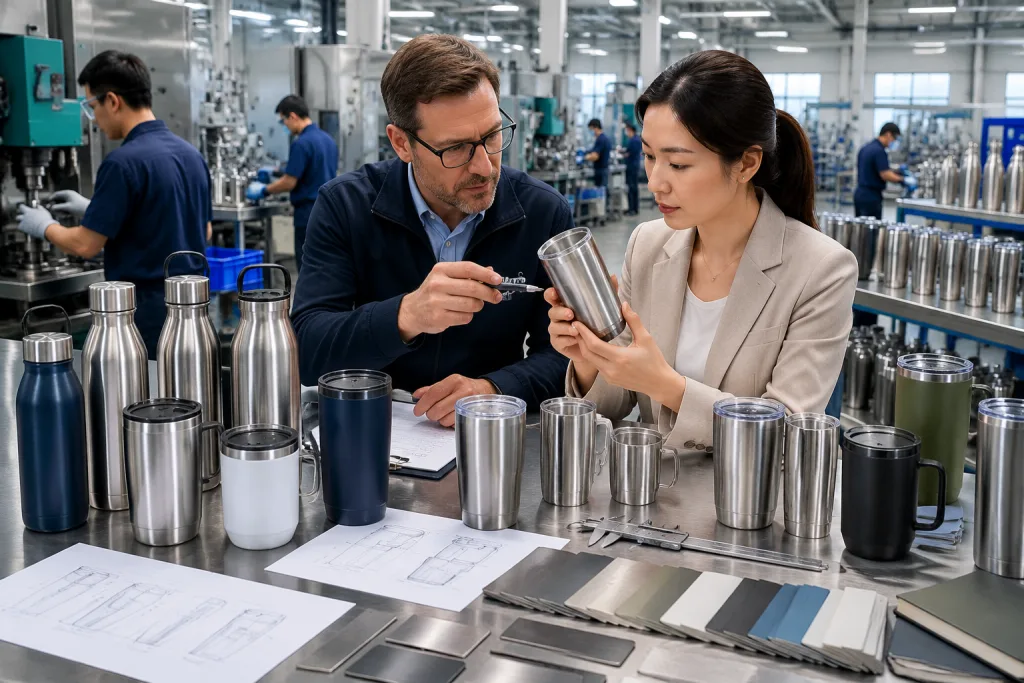
There is no single price for a 304 stainless steel drinkware factory order. We run the same 750 ml bottle at USD 3.20 FOB or USD 6.80 FOB, depending on 0.4 mm vs 0.6 mm wall thickness, vacuum structure, coating, lid, logo, box, and test requirements. Big gap. If a canteen supplier quotes in 10 minutes without asking for lid drawing, logo size, carton drop-test level, or FDA/LFGB needs, they are pricing the easiest build, not your real SKU.
| Cost driver | Low-cost choice | Higher-grade choice | Buyer note |
|---|---|---|---|
| Steel structure | 304 inner / 201 outer | 304 inner / 304 outer | Use 304/304 for premium outdoor SKUs; QC checks wall material before polishing |
| Finish | Spray paint | Powder coating | Powder is usually worth it if the buyer hates scratch claims |
| Logo | 1-color print | Laser or heat transfer | Match to retail price; a 35 mm logo behaves differently from a 90 mm wrap |
| Packing | White box | Custom color box | Color box adds time and damage risk if E-flute paper is weak |
| Testing | Factory declaration | Third-party LFGB/FDA/REACH | Needed for serious import programs; test samples must match mass production |
As a rough export range, a standard 500 ml single-wall 304 bottle may land around USD 2.20-3.80 FOB at 3,000 pcs. A 20 oz vacuum tumbler often sits around USD 4.00-6.50 FOB. A 64 oz custom growler may be USD 8.50-14.00 FOB depending on lid and coating. A canteen customized with pouch and strap can swing widely, from USD 4.50 to more than USD 9.00 FOB. Last month QC pulled the sample because the strap hook was 1.8 mm thinner than the approved one, and that tiny part changed both cost and return risk.
Price negotiation is normal in China, but cutting 5% after the spec is fixed is not the same as cutting 20% by quietly changing steel thickness, gasket material, or carton grade. The math does not work. Put the spec sheet into the proforma invoice, including 304 stainless grade, coating type, lid material, carton size, AQL 2.5 if used, and even the logo file name; we once saw a PO typo change “matte black” to “metal black,” and the buyer flagged it only after pre-production samples.
How to brief the factory
A clear brief usually saves 3-5% before anyone argues about price. Send the factory one document with buyer market, target capacity in ml, 304 stainless requirement, AI or PDF logo file, finish sample, lid type, packing method, compliance list, order quantity, ship date, and Incoterm. Simple wins. If you are comparing canteen suppliers or canteen vendors, make all of them quote against the same sheet; last month one PO said “matte black” in the email and “gloss black” in the attachment, and the line stopped for 40 minutes while QC checked the approved color chip.
For a first order, we push standard tooling unless the brand needs its own silhouette. Standard tooling lets you test sales with 1,000-3,000 pcs, while a new canteen customized body may require 3,000-5,000 pcs plus tooling cost. New molds also add trial time; a normal sample can leave in 7-10 days, while a body mold trial often runs 18-25 days before the caliper readings are stable. The math doesn't work for a one-time event. It can work for a distributor canteen line that will reorder twice a year.
Use-case fit should decide the product, not the prettiest catalog photo. For corporate gifting, we run travel tumblers with laser logos, a safe retail box, and a drop test on the gift carton. For outdoor retail, choose powder-coated 304/304 bottles with strong handles; QC pulled one sample last quarter where the handle pin measured 2.1 mm instead of 2.5 mm, and the buyer flagged it before loading. For brewery or camping channels, a customized growler with steady vacuum performance beats a cheap large bottle. For canteen promotional programs, keep accessories simple and inspect strap stitching carefully.
If you want a straight answer from a canteen manufacturer in Zhejiang, send target product photos, annual forecast, required certifications, and your acceptable FOB range. We also need the logo size in mm and the carton limit in kg if your warehouse has rules. A serious factory in China can tell you what is realistic in 24-48 hours, before you spend three weeks chasing a price that breaks at mass production.
Send your drinkware spec for a factory quote
Share capacity, finish, logo, MOQ, and target FOB price. We will tell you what is realistic before sampling starts.
Frequently asked questions
Is 304 stainless steel always required for custom drinkware?
For the inner surface touching beverages, yes, 304 stainless steel is the safest normal choice for export drinkware. It is suitable for water, coffee, tea, beer, and most acidic drinks used in everyday retail. Some low-cost factories quote 201 stainless steel to reduce price, but it has weaker corrosion resistance and is not our recommendation for Europe or North America. For premium outdoor products, we suggest 304 inner and 304 outer. For price-sensitive promotional projects, 304 inner with 201 outer can work if the buyer approves it clearly and coating quality is controlled. Ask for material declaration and sample weight, not just the words “stainless steel.”
What MOQ should I expect from a 304 stainless steel drinkware factory?
For existing molds, a realistic MOQ is usually 1,000 pcs per SKU and color. Some simple models can be discussed at 500 pcs, but the unit price and logo setup cost will be higher. For custom canteen shapes, custom growler tooling, or special lids, expect 3,000-5,000 pcs because tooling, welding fixtures, and coating setup need volume. Color matching also affects MOQ; a standard black powder coating is easier than a custom Pantone finish. If you are a distributor testing a new line, start with standard tooling and reserve new tooling for repeat orders.
How long does production take after sample approval?
For standard stainless steel bottles or tumblers, production normally takes 30-40 days after deposit and sample approval. Pre-production samples usually need 7-10 days if the model is existing and the logo file is clean. A canteen customized with pouch, strap, or special hardware may take 40-50 days because accessory workshops and packing tests add time. New mold development can add 20-35 days before mass production. Before placing the order, confirm the schedule in writing: sample date, material purchase date, coating date, final inspection date, and FOB delivery date.
Which logo method is best for distributor drinkware orders?
It depends on the sales channel. For premium distributor drinkware, laser engraving is the safest long-term method because it does not peel and looks clean on powder-coated stainless steel. For canteen promotional orders, 1-color silkscreen is usually more cost-effective at 1,500-3,000 pcs. Heat transfer is useful for multi-color artwork, but you should test adhesion on the coating before production. UV printing can handle detail, though it is not always the best choice for rough outdoor use. Always approve a physical printed sample, not only a digital mockup.
What compliance documents should I request for Europe or North America?
For Europe, ask for LFGB or EU food-contact testing on parts touching the drink, plus REACH compliance for coatings and plastic or silicone parts where relevant. For North America, FDA food-contact compliance is common, and children’s products may require CPSIA or ASTM checks depending on design and market. Also request BSCI or similar social audit information if your retailer requires it. For quality control, define AQL levels before production, commonly 2.5 for major defects and 4.0 for minor defects. Test reports should match the material and coating used in your actual order, not an unrelated showroom sample.