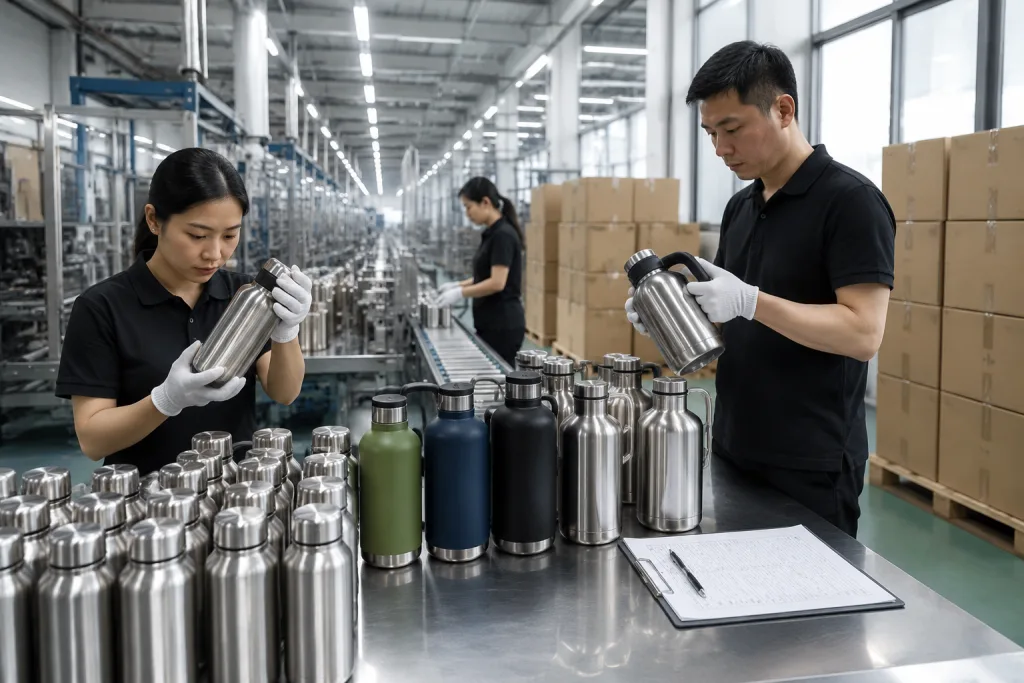
Key Takeaways
- Typical MOQ for 304 stainless steel custom drinkware is 1,000-3,000 pcs per shape and color
- 304 stainless steel is the practical baseline for food-contact bottles, tumblers, canteens, and growlers
- Laser engraving, silkscreen, UV print, and powder coating each carry different cost and durability tradeoffs
- A pre-shipment AQL inspection at 2.5/4.0 catches most leakage, cosmetic, and packaging issues before FOB China
Buying 304 stainless steel drinkware custom is not hard. The costly part is assuming the desk sample tells the whole story. QC can still pull the same cup later for a 1.2 m carton drop failure, powder-coat odor after curing, leakage at 60°C, or a logo shifted 3 mm off the approved artwork.
If you source custom drinkware from China for retail, promo, corporate, or distributor programs, the catalog price is the wrong first question to ask. Ask for 304 stainless proof, MOQ by finish, decoration limits by logo size, AQL terms, and where the line usually loses time. We run about 600,000 stainless units per month from our Zhejiang factory, and we have seen orders go sideways over small things, including a PO that said matte black while the signed sample was gloss black.
What should 304 really mean?
If your PO says 304 stainless steel drinkware custom, “stainless steel” is not a complete material spec. For food-contact drinkware, we normally run SUS304 on the inner liner, also sold as 18/8 stainless steel. The outer shell can be 304 as well, but some cost-down programs use 201 outside to save about 3% to 6% on the body cost. That is not a scandal. It must be written on the quote, because corrosion resistance, carton marking claims, and buyer test wording all change. Last month QC pulled a pre-production bottle with “S/S” only on the BOM, and we stopped it before mass production.
For vacuum bottles, tumblers, a custom canteen, or a customized growler, confirm these items before quotation: inner steel grade, outer steel grade, lid material, gasket material, and coating type. Common lid materials are PP, Tritan, silicone, and stainless-steel wrapped PP, but the exact grade still matters. We have seen buyers approve a sample lid, then reject bulk because the PO said Tritan and the factory used AS plastic. If you sell in the EU, ask for LFGB or EU 1935/2004 food-contact test reports. For North America, buyers often request FDA food-contact compliance, and for kids’ products they may ask for ASTM F963 or CPSIA-related documentation. Get the lid drawing too; a 0.3 mm mismatch on the silicone ring can turn into leakage on the line.
Wall thickness matters. Many standard bottles use 0.40 mm to 0.50 mm stainless sheet. Premium models may use 0.55 mm to 0.60 mm for better dent resistance, but the bottle gains weight and the unit price rises. For distributor canteen programs, 0.45 mm is often a practical balance. This is the wrong question to ask if the buyer only says “make it stronger”; we need target weight, drop-test requirement, and carton pack method. On our 750 ml canteen line, moving from 0.45 mm to 0.55 mm can add around 18 g per bottle, which affects air freight quotes fast.
Ask the canteen manufacturer for current material test reports, not a file from five years ago. A serious canteen factory in Zhejiang, China should provide an SGS, Intertek, TÜV, or equivalent report for representative materials and coatings. Check the report date, tested part, color coating, and applicant name. Small detail, big trouble. We once had a buyer flag a report where the coating code on page 2 did not match the artwork sheet, and shipment sat for 6 days while the lab reissued the document. If the supplier avoids the question, you learned something before paying a deposit.
Questions before you request pricing
A clean RFQ saves 2 to 4 working days of back-and-forth and cuts the risk of a misleading low quote. Instead of asking, “How much for customized drinkware?”, send a one-page technical brief. On our line, the costing clerk checks the lid BOM, carton size, and 0.01 g weight sheet before quoting; without capacity, finish, lid type, packaging, order quantity, and delivery terms, the price is guesswork.
Use this buyer checklist before you ask canteen vendors for FOB pricing. We run the quote sheet in 8 boxes, and QC pulled a sample last month because the PO said “matte black” while the artwork file said “black sand powder.” Small wording. Big delay.
- Product type: pick the body first: bottle / travel tumbler / custom growler / sports bottle / canteen customizable model. A 500 ml bottle and a 500 ml tumbler do not share the same mold set.
- Capacity: state the exact size: 350 ml / 500 ml / 750 ml / 1 L / 1.9 L growler / your requested mold size. If the buyer’s brief says “about 20 oz,” we ask again.
- Insulation: single wall / double wall vacuum / copper-coated vacuum / no insulation. Copper coating changes both cost and heat-retention test results.
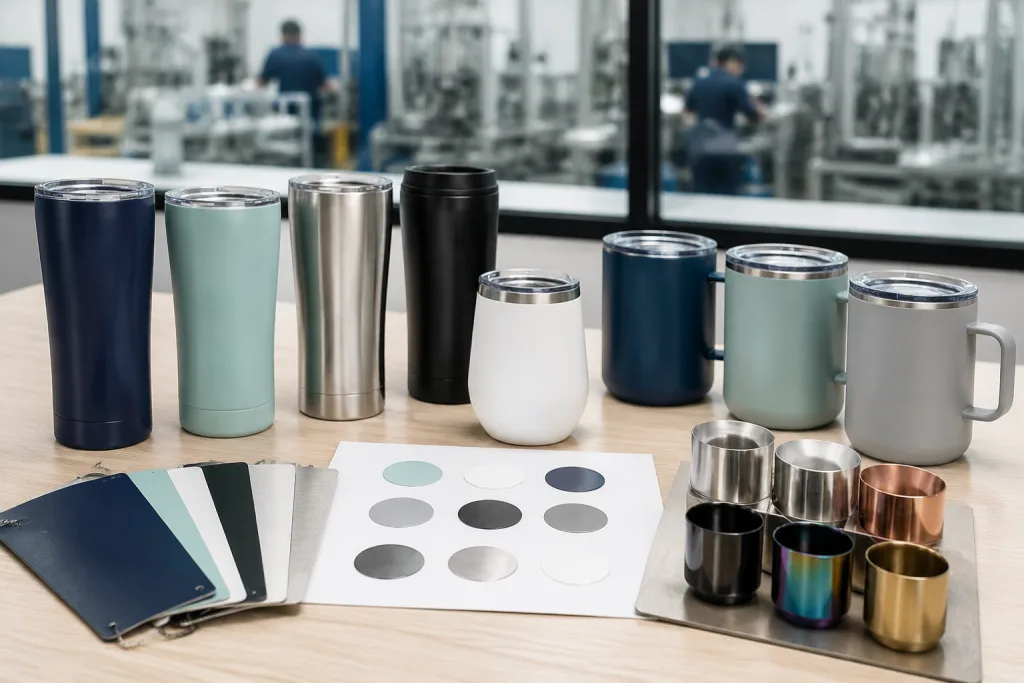
- Surface finish: raw stainless / spray paint / powder coating / rubber paint / gradient coating / electroplating. Powder coating needs color chips, not just a Pantone number on email.
- Logo method: silkscreen / laser engraving / UV print / heat transfer / embossing / full-wrap design. A 35 mm logo on a curved bottle behaves differently from the same logo on a flat proof.
- Packaging: white box / kraft box / color box / PDQ / mailer box / Amazon FBA-ready carton. Tell us the carton drop-test rule if your retailer has one.
- Compliance: LFGB / REACH / FDA / Prop 65 / BSCI / ISO 9001 / your retailer manual. Send the manual early; we have seen buyers flag label text after mass production.
- Incoterm: FOB Ningbo / FOB Shanghai / EXW Zhejiang / CIF / DDP / delivered warehouse. DDP needs the destination ZIP code, not only the country.
For most standard custom drinkware, a realistic MOQ is 1,000 pcs per color and model. Fully customized canteen shapes or new lids may require 3,000 to 5,000 pcs because tooling, color setup, and production changeover cost more than buyers expect. If your first order is only 300 pcs, stock models with laser logo are the honest route. The math doesn’t work for a new mold at that volume, and we’ve seen this go sideways when a buyer approves tooling before checking the real launch quantity.
Logo and finish choices
Decoration is where 7 out of 10 304 stainless steel drinkware custom projects get messy. A logo that looks sharp on a flat business card can break up on a curved 750 ml bottle with powder coating; we saw QC pull one sample last month because the “R” closed up after printing. Before you approve artwork, ask for a placement drawing showing logo size in millimeters, distance from the base, and the print area limit.
Laser engraving is durable and clean. It fits corporate custom canteen programs and distributor growler orders where the buyer wants a permanent mark that will not rub off in warehouse handling. Color is the limit. Laser removes or discolors the coating, so it cannot match a full-color brand identity. Silkscreen usually costs less for one- or two-color logos and works well for canteen promotional campaigns, but the line must control curing time and run adhesion testing; we use a 3M tape pull after the oven, not just a thumb rub. UV print handles gradients and small text, though abrasion becomes the weak point unless a protective layer is specified.
Powder coating is popular because it feels premium and hides fingerprints. A normal coating thickness is around 60-90 microns. Too thin, and the bottle scratches during carton packing; too thick, and threads, lids, or cup holders start causing complaints. The math doesn't work if a buyer asks for thick soft-touch coating and tight lid fit without checking tolerance. For a canteen customized in matte black or white, request a cross-hatch adhesion test and a 3M tape test after curing; our inspector checks the cut grid under a desk lamp before releasing the sample. For dishwasher claims, be careful. About 8 painted stainless bottles out of 10 are not truly dishwasher safe after 50 cycles.
If you need a customizable growler for breweries or outdoor retail, consider laser logo on powder coating plus individual kraft boxes. It looks professional, controls cost, and avoids the reject rate we see with complex full-wrap graphics on curved steel; one brewery buyer flagged a 2 mm seam misalignment on a wrap print, and the order nearly went sideways.
How MOQ and price move
Unit price is not just steel weight. It also covers mold amortization, powder coating loss from the spray booth, packing labor at the end of the line, carton CBM, AQL 2.5 inspection time, and the cost of stopping one line for a 600 pcs color run. Line stoppage hurts. This is why two canteen manufacturers in China can quote different prices for what looks like the same 304 bottle.
As a working reference, a standard 500 ml double-wall 304 stainless bottle may quote around USD 3.20-5.20 FOB China at 3,000 pcs, depending on lid type, coating spec, and whether the gift box needs 350 gsm white card or a plain brown box. A 1.9 L custom growler can run USD 8.50-14.00 FOB because steel weight, vacuum processing time, and carton size go up; we have seen one growler carton jump from 0.055 CBM to 0.082 CBM after the buyer added a side handle. A simple single-wall custom canteen for promotional use may start lower, but it will not keep drinks hot or cold.
MOQ usually changes by finish. Laser logo on stock color can start near 500-1,000 pcs if raw inventory is available; QC just checks logo position with a 0.5 mm tolerance gauge before mass marking. Custom Pantone powder coating is usually 1,000-3,000 pcs per color because the coating room needs setup time and color purge. A new canteen factory mold may need 8,000-20,000 pcs to make financial sense, especially if you want a unique cap, handle, or silicone boot.
Be cautious with low quotations. We have seen this go sideways when a buyer chased USD 0.25 savings and QC pulled the sample for 201 stainless, thinner 0.35 mm sheet, non-food-grade paint, weak cartons, or no inspection allowance. The math doesn't work if you save USD 0.25 per unit and then lose USD 2.00 per unit in returns, replacements, and air freight. A procurement manager should compare landed cost and defect risk, not only FOB unit price.
Sampling and approval checkpoints
Samples should answer production questions, not just make the marketing slide look good. For custom 304 stainless drinkware, we run sampling in 3 checks: first a stock body to confirm grip, lid fit, and capacity; then a decorated pre-production sample to lock logo, color, and box copy; then a mass-production confirmation pulled from the line. Skipping the decorated sample is the wrong place to save 7 days. We have seen this go sideways when QC pulled the sample and the buyer flagged a 2 mm logo shift after 18,000 pcs were already packed.
A stock sample checks basic ergonomics, capacity, lid structure, leak resistance, and hand feel. It may cost USD 10-50 per piece plus courier freight. A decorated sample with your logo, Pantone color, and packaging usually takes 7-12 days after artwork approval. If the coating color needs a new powder batch, allow 3-5 more days, because the spray line has to clean the gun and test the powder on a curved body, not a flat color card. Our Hangzhou, Zhejiang sales engineers usually ask buyers to approve the physical color under daylight and office light; matte coatings can read one shade warmer under a 4000K office lamp.
Your sample approval should include a signed spec sheet. At minimum, list model number, capacity tolerance, material, finish, logo size, packaging, carton quantity, gross weight, and barcode position, with the approved PDF file name written on the sheet. Simple detail. It saves arguments. For Amazon or retailer shipments, confirm FNSKU, suffocation warning, carton marks, and master carton dimensions early; one PO typo we saw changed a 48 pcs carton to 24 pcs, and the warehouse only caught it at carton weighing. Changing these details after production starts can add 3-7 days and create rework charges.
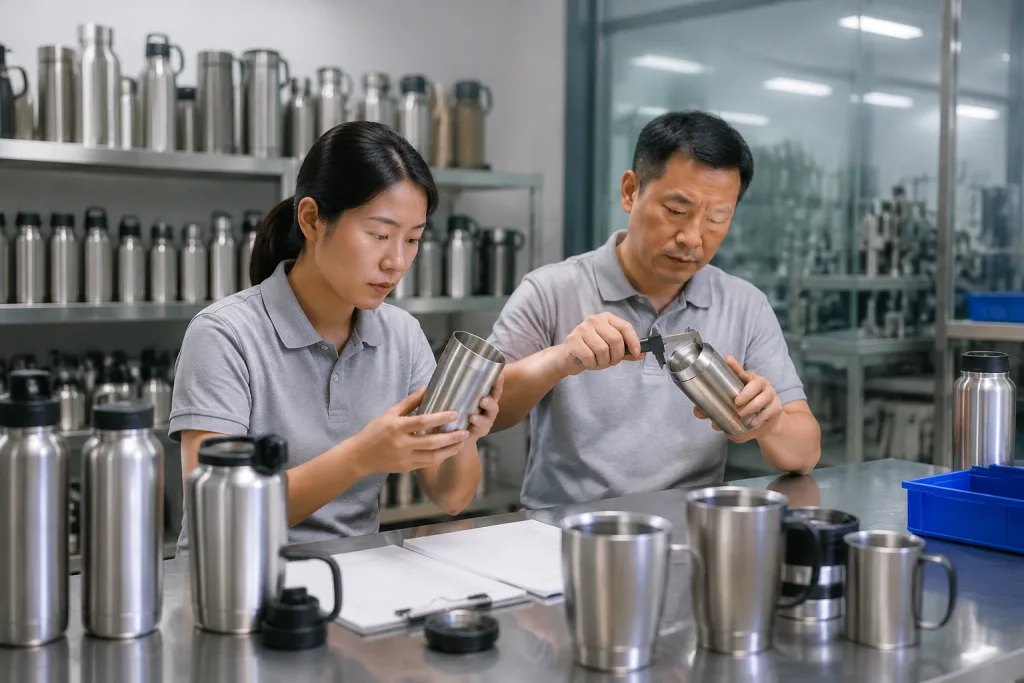
For a canteen distributor or distributor drinkware buyer, keep 1 approved sample in your office and ask the canteen supplier to keep 1 sealed sample at the factory. During inspection, the QC team can compare mass goods against the sealed sample with a caliper, a 3M tape test, and a 500 ml water fill check if the model calls for it. This cuts down arguments about color shade, logo sharpness, and lid feel. We ship smoother when both sides point to the same sealed sample instead of old WhatsApp photos.
Quality control you should specify
Quality control is not a slogan on a website. It is a written inspection plan with measurable limits, signed before mass production starts. For stainless drinkware, we recommend AQL 2.5 for major defects and 4.0 for minor defects unless your retailer manual requires stricter levels. Critical defects, such as sharp edges, oil contamination inside the cup, severe leakage, or unsafe materials, should be zero tolerance. QC pulled one 304 stainless sample last month with a 0.4 mm burr on the inner rim; the buyer called it “minor,” but we stopped the line because lips touch that edge.
Your QC checklist should include vacuum performance, leakage, appearance, capacity, coating adhesion, logo position, odor, lid assembly, carton drop, and barcode scan. For vacuum bottles, a common heat retention check is filling with 95°C water and measuring temperature after 6 hours or 12 hours, depending on your claim. We use a calibrated probe thermometer, not a kitchen gun. For leak testing, factories often invert filled bottles for 30 minutes, but for travel tumblers with drinking lids you need a real use test: 10 shakes, 5 minutes on the side, then check the lid seam and air vent. Not every lid belongs in a backpack. Asking for “100% leakproof” on a straw tumbler is the wrong question to ask; the math does not work with an open drinking path.
Cartons are not boring. They protect your margin. For export, ask for 5-ply master cartons, clear shipping marks, and a carton drop test matched to the pack weight. If goods are going through parcel networks instead of palletized B2B delivery, packaging must be stronger. We have seen 18 kg cartons survive warehouse handling but fail after 12 parcel drops at the corner. At least 7 out of 10 low-price canteen quotes we review use thin cartons unless the buyer writes the requirement on the PO, including carton size, gross weight limit, and shipping mark layout.
A responsible canteen manufacturer in Zhejiang will accept third-party inspection from SGS, QIMA, Intertek, or your own QC partner. Plan inspection when 80% of goods are packed and 100% are produced. If you inspect too early, you miss packaging defects. If you inspect after loading, you have no leverage. We run final inspection with sealed cartons, barcode scanner, 3M tape test, and a carton scale on the floor; one buyer once flagged a PO typo that said “mat black” instead of “matte black,” and catching it before packing saved a full rework.
Choosing the right supply partner
The right canteen supplier is not always the cheapest one, or the biggest name on Alibaba. This is the wrong question to ask. Match the factory to the order. For annual retail programs, you need steady welding, vacuum, polishing, coating, and packing capacity, with real control at each station. On our line, QC checks mouth roundness with a 0.02 mm caliper before bottles move to polishing. For event canteen promotional orders, speed and decoration flexibility usually beat a lower unit price by USD 0.08.
Ask direct questions. How many vacuum lines do you run? What is your monthly capacity for 500 ml bottles? Do you outsource powder coating? What is your normal lead time after deposit and sample approval? Can you support FOB Ningbo and FOB Shanghai? Do you have BSCI or ISO 9001? How do you separate 304 and 201 stainless material in the workshop? We keep 304 stainless coils on marked racks, and QC pulled one sample last month after a supplier label was printed with “SUS304” but the heat number was missing.
At BottleForge Industrial in Hangzhou, China, typical production lead time is 30-45 days after deposit and pre-production sample approval for standard customized canteen and tumbler orders. Complex customized growler projects, new molds, or multi-color retail sets can take 55-75 days. That timing is not marketing padding. It covers material purchasing, forming, welding, vacuum testing, polishing, coating, decoration, packing, and final inspection. For a 10,000 pcs 750 ml order, vacuum testing alone can eat 2 working days if the buyer asks for 100% testing instead of sampling.
For canteen distributors and distributor growler buyers, build the relationship before rush season. Share your forecast by quarter, not just the first PO. We can reserve coating capacity, check raw material availability, and warn you when Chinese holidays will squeeze production. We have seen this go sideways: one buyer sent an October PO with the delivery port typo “Ningbo” changed to “Shanghai” after carton printing, and the math did not work once air freight was added for 38 cartons.
Send your 304 drinkware brief for factory review
Share capacity, quantity, logo method, market, and target ship date. We will respond with practical MOQ, pricing, and production risks.
Frequently asked questions
What MOQ should I expect for 304 stainless steel custom drinkware?
For standard factory models, expect 1,000-3,000 pcs per model and color for custom coating and logo. If you choose stock color with laser engraving, some suppliers can start around 500 pcs, but the unit price will be higher. A new custom canteen mold normally requires 8,000-20,000 pcs across the first production run to justify tooling and setup. For promotional projects below 500 pcs, use existing inventory and simple logo decoration rather than asking for a fully customized canteen.
Is 304 stainless steel enough for EU and North American sales?
304 stainless steel is the normal baseline for food-contact drinkware, but the steel grade alone is not enough. You also need compliant lids, silicone seals, coatings, inks, and packaging. For Europe, ask for LFGB or EU 1935/2004 test reports and REACH information for coatings. For North America, buyers often request FDA food-contact documentation, Prop 65 review, and sometimes ASTM or CPSIA documents for children’s items. Make sure reports match the product materials you are buying, not just a similar bottle from three years ago.
How long does a custom drinkware order take from China?
A normal 304 stainless steel drinkware custom order takes about 30-45 days after deposit and pre-production sample approval. Sampling usually adds 7-12 days, and sea freight to Europe or North America can add 25-45 days depending on port and season. New molds, new lids, special coatings, or customized growler programs may require 55-75 production days. If you need goods for a fixed launch date, work backward from the warehouse delivery date, not the factory ship date.
Which logo method is best for a canteen promotional order?
For a canteen promotional order, silkscreen is usually the most cost-effective for one- or two-color logos at 1,000 pcs and above. Laser engraving is better when durability matters and the logo can be single-color or tone-on-tone. UV print works for full-color logos but costs more and should be tested for abrasion on the chosen coating. If the product will be handed out at events, use a proven stock shape, 0.45 mm stainless body, and a simple logo to control both price and delivery risk.
What should I check before paying the balance?
Before paying the balance, arrange pre-shipment inspection when goods are 100% produced and at least 80% packed. Check AQL 2.5/4.0 results, leakage, vacuum performance, coating adhesion, logo position, carton strength, barcode scans, and shipping marks. Compare mass production against the sealed approved sample. For distributor drinkware orders, also verify carton quantity, gross weight, pallet plan, and FNSKU or retailer labels if required. Once goods leave FOB China, fixing defects becomes much slower and more expensive.