Key Takeaways
- Typical MOQ for 304 stainless steel drinkware bulk is 3,000 units per SKU, with lower test runs possible at higher unit cost
- FOB China pricing usually ranges from USD 2.10 to USD 7.80 depending on capacity, wall thickness, lid type, finish, and packaging
- A realistic OEM timeline is 45-60 days after deposit and artwork approval, not including sea freight
- Logo, packaging, AQL inspection, and compliance testing can add USD 0.10-0.80 per unit if not planned early
Buying 304 stainless steel drinkware bulk for a retail launch, corporate program, or distributor range is not hard because suppliers are scarce. The hard part is reading the quote: a USD 2.40 offer may work for a single-wall cup, but the math breaks fast on a powder-coated vacuum tumbler with a 0.5 mm body, laser logo, and color box. A buyer last month flagged a 35-day lead time on the PO; our production planner pushed back after checking the welding line schedule.
From our factory network in Zhejiang, China, we see the same sourcing errors about 8 times a month: buyers compare a 500 ml tumbler with a 750 ml sports bottle, skip carton volume, approve a cheap lid, then lose margin when the forwarder quotes air freight by volumetric weight. QC pulled the sample on one order because the lid gasket sat 1.2 mm loose after the dishwasher test. A normal OEM order here starts at 3,000 units per SKU, with 45-60 days from deposit to shipment depending on finish and packaging.
Start with the bottle type
Procurement teams often ask for wholesale drinkware pricing before they lock the bottle type. Wrong first question. Last month we had a PO that said “750 ml tumbler” in one line and “canteen” in the artwork file, and our tooling clerk had to stop the quote because the diameter changed from 73 mm to 82 mm. A 20 oz travel tumbler, 750 ml bulk canteen, 64 oz bulk growler, and 6 oz alcohol flask bulk order may all use 304 stainless steel, but the cost sheet is built from different parts.
For double-wall vacuum items, we price around steel weight and welding difficulty first, then check vacuum failure rate, lid assembly, and surface finish. QC pulled 60 pcs from the last 500 ml straight bottle run and found 2 weak vacuum samples after the hot-water test, which is manageable. A straight 500 ml bottle with a standard PP lid is simple. A powder-coated beer tumbler bulk order with a sliding lid, silicone base, retail sleeve, and four-color carton adds more stations on the line, more hand checks, and more chances for scratches near the rim.
As a working FOB China range, you can expect these rough levels at 3,000-5,000 units per SKU: 500 ml single-color sports bottle at USD 2.10-3.20, 20 oz travel tumbler at USD 3.10-4.80, 32 oz canteen wholesale item at USD 4.20-6.20, 64 oz beer growler wholesale bulk item at USD 6.50-9.80, and compact alcohol flask wholesale bulk designs at USD 1.80-3.50. These are not catalog promises. We ship inside these lanes when the steel is 304 food grade, the vacuum rate is controlled, and the export carton passes a 10 kg drop-stack check in our packing area.
If you are building the best wholesale drink bottle range for a retail channel, do not start with the lowest unit price. Start with sell-through logic: capacity matched to shelf space, drinking occasion matched to lid style, and carton size matched to your freight plan. The buyer flagged this on a 32 oz bottle project after the master carton hit 58 x 42 x 36 cm and lost pallet efficiency. A bottle that saves USD 0.25 but increases freight by USD 0.40 is not cheaper. The math does not work.
What actually changes the FOB cost
For 304 stainless steel drinkware bulk, the steel grade is only one line in the cost sheet. The inner wall is normally SUS304. The outer wall may be 304, or 201 on tight-price projects if the buyer signs off before sampling. For Europe and North America, we still recommend 304 inner and 304 outer for premium wholesale drinkware, especially when the listing says reusable, durable, or suitable for acidic drinks. We check this on the incoming coil label before the line starts.
Wall thickness matters. On 500 ml to 1,200 ml drinkware bulk orders, we usually see 0.4-0.5 mm stainless steel sheet. Moving from 0.4 mm to 0.5 mm can add roughly 8-15% to steel weight, but it improves dent resistance and hand feel. The math changes fast. For a bulk growler or beer growler in bulk, we push buyers toward stronger construction because a 64 oz body gets dented during carton drop tests and retail handling. QC pulled a 64 oz sample last month after a 76 cm drop and found a flat spot near the shoulder.
Lids are an easy place to lose money. A simple screw lid may cost USD 0.18-0.35. A flip straw lid can reach USD 0.45-0.85. A leakproof handle lid with stainless trim can exceed USD 1.00. Silicone seals should be food grade, and if you need LFGB, REACH, or FDA documentation, ask before sampling, not after mass production. We had one PO with “FDA lid” typed only in the packing note, and the buyer flagged it after the mold shop had already cut the gasket groove.
Surface finish changes cost and lead time. Stainless polish is fastest. Powder coating adds about USD 0.35-0.90 per unit depending on color, coating thickness, and reject rate. Gradient paint, rubber coating, glitter, and ceramic-look coatings cost more and slow the line. Laser engraving is clean for canteen bulk and alcohol flask wholesale orders, while silk screen works better for large logos but needs Pantone control and 3M tape testing. We run a 100-grid adhesion test before approving coated samples.
If two suppliers quote the same bottle with a USD 0.70 gap, check steel weight, lid build, coating process, and AQL level first. It is rarely magic.
MOQ tiers and price behavior
MOQ is not just a rule on a quote sheet. It comes from coating line changeover, logo jig setup, carton artwork plates, steel purchasing, and how fast assembly can keep the line moving. In Zhejiang, China, we usually run a practical MOQ of 3,000 units per SKU and color for custom 304 stainless steel drinkware bulk. For stock shapes with a simple laser logo, 1,000 units sometimes passes, especially if the logo fits our standard 60 mm rotary laser jig. For custom molds or special lids, 5,000-10,000 units is the honest starting point. Below that, the math doesn't work.
Price usually moves like this. At 1,000 units, you pay a small-run penalty because coating, printing, and packing lines stop too often. At 3,000 units, the quote starts to settle. At 5,000-10,000 units, buyers may save 4-9% depending on body size, lid type, and finish. Above 20,000 units, savings still exist, but they shrink unless we can buy steel, cartons, and lids under one program. Last month QC pulled a sample after powder coating because the color drifted 1.2 Delta E from the approved chip; that kind of reset costs time on small runs.
For wholesale canteen and canteen wholesale programs, color count hits MOQ fast. Ordering 3,000 units split across six colors is not the same as 3,000 units in one color. Each color needs coating setup and QC sign-off before packing starts. The buyer often flags this late, after the PO already says “assorted colors” with no split by Pantone code. If your distributor network needs variety, start with 3 core colors on the first order, then add seasonal colors after real sell-through data.
For growler wholesale and beer growler bulk projects, MOQ often runs higher because larger bodies eat warehouse space and carton volume. A 64 oz growler bulk order uses more stainless steel and usually needs stronger packing, often 5-ply export cartons with dividers. If the factory quotes the same MOQ and lead time as a small tumbler, ask how many units per month they actually run on that shape. We ship about 450,000 units/month across bottles, tumblers, canteens, and growlers, but one welding line will not produce every body at the same speed. We have seen this go sideways when a supplier promised 18 days and needed 32 days after the cartons failed a drop test.

Sampling, tooling, and approval costs
Sampling is where buyers lose 14 days fast. A plain existing sample usually leaves our Hangzhou sample room in 3-5 days after the DHL address and logo file are confirmed. A custom color sample needs 7-12 days because we run a small powder-coating batch, then QC checks it under a D65 light box. A new lid, new body mold, or custom-capacity bulk canteen takes 20-35 days before you see a serious sample. If your launch date is fixed, this is the wrong question to ask: do not burn three rounds moving a logo by 1 mm unless the retail price pays for that delay.
Sample fees follow the labor, not the mood of the sales rep. A standard bottle sample may be USD 30-80 including basic logo. A custom powder color sample may be USD 80-150, especially when the line has to clean the spray gun and run only 2 pieces. New mold tooling for a stainless steel body can range from USD 800 to USD 3,500, while lid tooling can range from USD 1,200 to USD 8,000 depending on mechanism and number of plastic parts. Tooling can sometimes be refunded after 20,000-50,000 units, but get that written into the PI; we have seen buyers flag this only after the deposit, and the math doesn't work then.
For alcohol flask in bulk, tooling stays cleaner if you use standard 6 oz or 8 oz shapes. We normally pull a caliper check on the mouth diameter and cap thread before quoting anything with a funnel. The cost rises when you add embossed logos, special caps, gift boxes, or leatherette wraps with stitching that must line up on the front face. For alcohol flask wholesale programs, check the destination market rules for product claims and packaging language, especially if selling through large retailers.
Approval needs more than a pretty photo. Ask for a pre-production sample showing actual logo, coating, lid, gasket, packaging, barcode, and carton mark, then sign it and send one piece back to the factory as the golden sample. For Amazon or 3PL delivery, confirm FNSKU label position, suffocation warning if polybags are used, carton weight under warehouse limits, and scannable barcodes; QC pulled one sample last month where the barcode printed 2 mm too close to the carton edge. A USD 60 courier sample can prevent a USD 6,000 repacking problem in China.
Lead time from deposit to vessel
A normal OEM stainless steel drinkware schedule is not 20 days, even if a supplier says it on a rushed call. We see that promise go sideways. For existing molds with standard powder coating or spray paint, plan 45-60 days after deposit, artwork approval, and sample confirmation; our merchandiser starts counting only after the signed PI and logo file match the PO. For special coating, a new mold opened on the CNC side, or retail packaging with insert cards and color boxes, plan 60-90 days. Sea freight to North America or Europe then adds another 25-45 days port-to-port, depending on route and season.
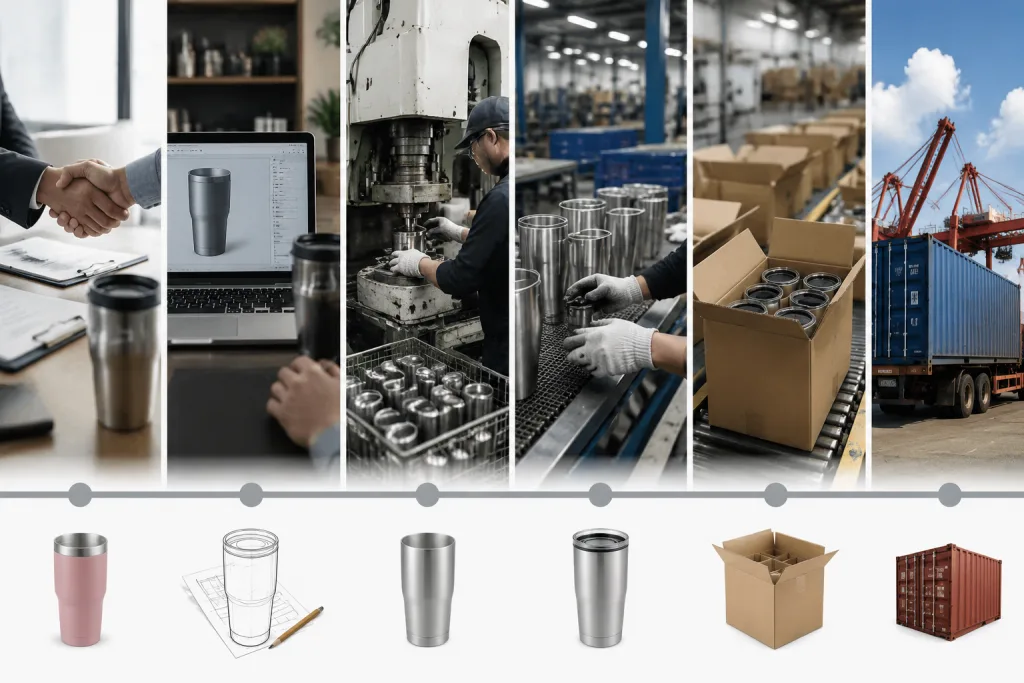
A practical timeline looks like this: quotation and spec lock, 2-4 days, including capacity, material grade, carton size, and lid type; sample preparation, 7-15 days for standard customization; sample shipping and buyer review, 5-8 days, assuming no typo on the PO or Pantone mismatch; deposit and material purchasing, 3-7 days; body forming and welding, then the vacuum process, 10-18 days; polishing and coating, 7-14 days, with QC checking coating thickness in microns and obvious pinholes under the light box; logo and packaging, 5-10 days; final inspection and booking, 3-7 days.
For beer tumbler wholesale bulk and beer tumbler in bulk orders, the lid often becomes the bottleneck. Sliding lids, magnetic closures, and multi-part splashproof lids are not sitting loose beside the tumbler line; they need separate injection production, silicone ring fitting, and assembly checks. If the tumbler body is ready but the lid is late, your order is late. Simple math. We prefer to confirm lid inventory or lid production slots before accepting tight delivery windows, especially when the buyer flags a fixed retail launch date.
Chinese New Year changes everything. If you need shipment before the holiday, confirm the order at least 75-90 days before factory closure. Zhejiang factories usually slow down 2-3 weeks before the official holiday because workers return home early; on our floor, polishing benches and packing tables can lose half the team before the notice board says “closed.” After the holiday, production does not restart at full speed on day one. If your promotion launches in March or April, order planning should begin before December.
Quality checks buyers should budget
Quality control belongs on the cost sheet, not in the “factory will handle it” column. For 304 stainless steel drinkware bulk, we normally run material verification with an XRF gun, capacity check by gram scale, vacuum insulation test, leak test, coating adhesion, logo position check, odor check, carton drop test, and AQL final inspection. A common inspection level is AQL 2.5 for major defects and 4.0 for minor defects; stricter retail buyers often write 1.5/2.5 into the PO. Good. Budget for it. Last month QC pulled 32 samples from a 12,000 pcs tumbler order and found two logo prints drifting 3 mm left, which is exactly the kind of issue buyers flag before shipment, not after.
For vacuum items, we test insulation with hot water at a fixed starting temperature, then measure after 6, 12, or 24 hours based on the claim on the carton or Amazon page. A typical double-wall bottle should keep water hot above 55-60°C after 6 hours when the starting water is near 95°C, but capacity, lid design, and mouth diameter change the result. Wide-mouth growlers lose heat faster than narrow-mouth bottles. No surprise there. On the line, we use a probe thermometer and log the reading by cavity number; if cavity 8 keeps showing 52°C while the others sit at 58°C, the math points to a vacuum problem, not a marketing problem.
Compliance needs planning before tooling or color samples, not three days before vessel booking. For Europe, buyers often ask for LFGB, REACH, and food contact documentation. For the US, FDA food contact expectations and sometimes California Proposition 65 screening apply. Kids items may need CPSIA-related checks and tracking labels. If you are sourcing a kids bottle, do not treat it like a standard sports bottle with a smaller body. We have seen this go sideways when a buyer approved a cute silicone straw cap, then the lab report flagged the pigment batch; that delayed shipment by 9 days and forced us to re-run 500 lids.
Third-party inspection usually costs USD 180-350 per man-day in China. Lab testing may range from USD 150 to over USD 1,000 depending on materials and standards. That feels painful on a 1,000-unit order, but on a 20,000-unit wholesale drinkware program it is cheap insurance. The worst inspection is the one done after the goods have reached your warehouse. One buyer once pushed back on USD 260 for a final inspection, then paid for 18 cartons of replacement lids by air because the original PO had “matte black” typed correctly, while the artwork file said “gloss black.”
Freight, packaging, and landed margin
The FOB unit price is only half the purchasing story. Drinkware eats space fast, especially canteens, growlers, and tumblers with handles. We run carton checks with a tape measure on the packing table, because 10 mm added to a handle cutout can change the 40HQ loading count. A carton of 24 small bottles may stack cleanly, while a carton of 12 large beer growler wholesale units can waste container volume. Before you approve packaging, ask for outer carton L × W × H in cm, gross and net weight in kg, plus the loading quantity for 20GP, 40GP, and 40HQ.
Retail packaging can add USD 0.15-0.70 per unit. A plain white box is cheap. A four-color gift box with matte lamination and an insert tray costs more, and the print lead time is often 12 days vs 18 days if the buyer changes artwork after the blue-line proof. For club stores or gift channels, stronger packaging may be necessary; we have seen corner crush on a 0.8 kg tumbler gift box after the drop test. For distributor wholesale drinkware, bulk packing with individual polybags is usually enough, but ask your customer about plastic reduction rules before the PO is issued.
Air freight rarely works for heavy stainless drinkware unless the order is small and urgent. Simple math. A 500 ml bottle may weigh 280-380 g before packaging. A 64 oz growler can exceed 700 g. Air freight can add USD 2-8 per unit, and the margin disappears before the goods reach your warehouse. For urgent launches, we usually ship 5-10% by air for photos, marketing kits, or first deliveries, then move the balance by sea; the buyer flagged this once after seeing a DHL quote higher than the product value.
If you compare alcohol flask wholesale, beer tumbler wholesale, wholesale growler, and wholesale canteen options, calculate landed cost per sellable unit. Include product cost and logo charge, packaging and inspection, China inland trucking and ocean freight, then duty, customs clearance, warehouse handling, and a defect reserve. QC pulled the sample from a 3,000 pcs lot last month because the barcode sticker was 4 mm off-center, which sounds small until a retailer rejects cartons at receiving. The wrong question is “who has the lowest FOB?” The right product arrives on time, passes inspection, fits your channel, and still leaves margin after handling costs.
Send your target SKU list for a real quote
Share capacity, lid, finish, logo, MOQ, packaging, and delivery market. We will price the order with lead time and inspection notes.
Frequently asked questions
What is the normal MOQ for 304 stainless steel drinkware bulk?
For custom OEM production, the normal MOQ is 3,000 units per SKU and color. If you use an existing mold, standard lid, and laser logo, 1,000 units may be possible, but the unit price is usually 8-15% higher. For custom powder colors, retail boxes, or new lids, 5,000 units is a safer planning number. Large items such as beer growler bulk or wholesale growler orders may also need higher MOQ because coating setup, carton volume, and production line allocation are less efficient than small bottles.
How much should I budget per unit FOB China?
At 3,000-5,000 units, a standard 500 ml 304 stainless bottle often sits around USD 2.10-3.20 FOB China. A 20 oz tumbler is commonly USD 3.10-4.80. A 32 oz wholesale canteen may be USD 4.20-6.20, while a 64 oz beer growler wholesale item can reach USD 6.50-9.80. Logo, coating, lid structure, and packaging can move the price quickly. Always compare by capacity, steel thickness, lid type, finish, carton size, and testing requirement, not just the product photo.
Can I mix different colors within one bulk drinkware order?
Yes, but color splitting affects MOQ and price. A factory may accept 3,000 units total in three colors, such as 1,000 black, 1,000 white, and 1,000 navy, if the coating line schedule is flexible. Six colors at 500 units each is harder and may add USD 0.15-0.40 per unit. Each color needs setup, approval, and QC control. For a first drinkware wholesale order, three core colors usually give enough shelf variety without creating production waste.
How long does a custom logo drinkware order take?
For existing molds and standard finishes, plan 45-60 days after deposit and final artwork approval. Sampling may take 7-15 days before that. If you need custom color matching, new mold tooling, special packaging, or complex lids, 60-90 days is more realistic. Sea freight to Europe or North America usually adds 25-45 days port-to-port. If your order must ship before Chinese New Year, confirm it 75-90 days before factory shutdown to avoid late production and rushed inspection.
Is 304 stainless steel required for all drinkware bulk programs?
For food-contact inner walls, 304 stainless steel is the practical standard for export drinkware. Some low-cost products use 201 stainless steel on the outer wall, but we recommend 304 inner and 304 outer for premium wholesale drinkware, canteen wholesale, and beer tumbler wholesale programs. It improves corrosion resistance and buyer confidence, especially for acidic drinks, outdoor use, and retail claims. If a supplier quotes unusually low, ask for material test reports and confirm whether both inner and outer walls are 304.