Key Takeaways
- For 304 stainless steel drink bottle wholesale, set AQL 2.5 major and 4.0 minor at minimum
- Ask for 304 inner wall and 201 or 304 outer wall clearly, not just “stainless steel”
- Typical MOQ is 1,000-3,000 pcs per color, with 30-45 days production after artwork approval
- Vacuum bottles should pass 95°C water testing for 6-24 hours depending on the product type
A 304 stainless steel drink bottle wholesale order usually fails in small, boring places: a lid gasket with odor after 70°C water soak, a laser logo that shows rust after 24-hour salt spray, a vacuum rate that passes at 6 hours but drops badly at 24 hours. Not glamorous. You do not need a prettier quotation; you need a spec sheet that stops predictable factory mistakes before the deposit hits our account.
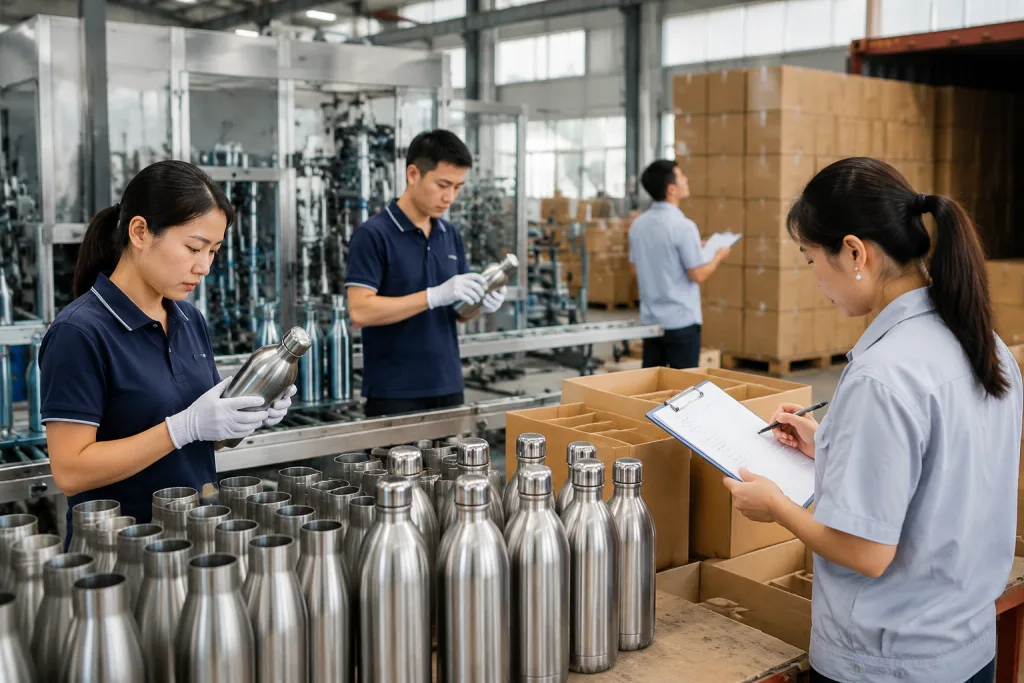
From our Hangzhou, Zhejiang production base, we see buyers in Europe and North America repeat the same sourcing mistakes on wholesale drinkware from China. They compare FOB prices line by line, then skip steel grade proof, coating thickness in μm, AQL level, carton drop testing, and the gap between a sample room bottle and a 50,000-piece production run. QC pulled one sample last month with a perfect outer finish, but the inner wall failed the 304 stainless check on the XRF gun. The buyer flagged the $0.06 price difference; that was the wrong question to ask.
The steel grade gets blurred
The first failure mode is quiet. The buyer asks for a 304 stainless steel drink bottle wholesale quote. The supplier sends a sharp price, and the PO says “304 bottle” with no material stack. Then QC pulled the sample and the pre-production unit had 304 inside, while mass production used 201 stainless steel on the outer shell. We’ve also seen cap screws spot after 23 days at sea because the screw was lower-grade steel. Some suppliers still call this a “304 bottle” because the food-contact inner wall is 304. That is only acceptable if you approved it in writing. Otherwise, the math doesn’t work.
For drinkware bulk sourcing, write the material stack line by line: inner wall SUS304, outer wall SUS304 or SUS201, cap insert PP or Tritan, gasket LFGB-grade silicone, straw material if included. Be blunt. If you need full 304, write “inner and outer shell SUS304” on the quote sheet and PO, not just in a WeChat message. Expect a higher FOB price, usually USD 0.25-0.60 more per unit on a 500-750 ml vacuum bottle compared with a 304/201 structure. On our line, that difference also changes the coil spec and polishing time, so a buyer asking for “same price, full 304” usually gets stuck before sampling.
Do not rely only on supplier wording. For Europe, ask for REACH, LFGB, and food-contact migration reports matching the actual material, not a generic old report from another SKU. For the US, FDA food-contact compliance and ASTM-related packaging or child-use requirements may apply, especially for kids bottles. We run a simple incoming XRF test on random production parts before assembly, often 5 pieces per color per lot, and it catches the ugly surprises early. In Zhejiang, China, serious factories are used to this. If a factory refuses XRF or says steel certificates are “not necessary,” treat it as a sourcing warning, not a negotiation point.
Vacuum performance is overpromised
A vacuum bottle can look perfect and still fail its only real job. We see weak vacuum insulation come from pinhole welds, dust or oil left before vacuum sealing, thin wall deformation, and annealing that ran outside the set temperature window. For standard 500 ml to 1,000 ml bottles, roughly 7 of 10 new wholesale drink bottle buyers focus on print, color, and carton marks first. Then the claims start. The bottle sweats, hot water drops too fast, or QC pulled the sample after 60 minutes and the outer wall was already warm to the hand.
Spec the test method before mass production. Do it on paper. A practical factory test is filling the bottle with 95°C water, closing the lid, and measuring temperature after 6 hours with a probe thermometer recorded on the line sheet. For higher-grade products, use 12-hour or 24-hour retention standards and define the minimum passing temperature by capacity and lid design. A wide-mouth bulk growler or beer growler bulk order will not perform like a narrow 500 ml thermos. Mouth diameter, cap structure, and air gap change the result; this is the wrong question to ask if the buyer only says, “keep hot 24 hours” without a pass temperature.
Wall thickness affects consistency. Most factories we compete with run 0.4 mm to 0.5 mm stainless steel for common vacuum bottles. Go too thin and the unit price looks better, but the math does not work after denting, weld stress, and vacuum loss during sea freight are counted. For a 64 oz wholesale growler or beer growler wholesale bulk project, ask about shell thickness, bottom structure, and handle reinforcement. A filled growler is heavy. We have seen handle weld zones fail after a 1.2 m drop test when the buyer pushed for a lighter shell to save a few cents.
Price pressure usually cuts invisible process control first. Vacuum reliability is one of the first parts to suffer.
At BottleForge Industrial in Hangzhou, Zhejiang, a normal vacuum bottle line can produce around 280,000 units per month, but we still separate vacuum inspection from cosmetic inspection. Different defects. Different stations. The vacuum check uses heat-retention records and outer-wall temperature checks, while cosmetic inspection catches paint specks, logo shift, and carton label errors such as a PO number typed one digit wrong.
Lids leak after the sample
Lids create more returns than steel bodies. We see it on the line every season. A sample lid is often picked from the best 10 pcs, assembled by a senior worker, then checked once in a basin. Mass production is different: gasket hardness shifts from 50A to 55A, thread fit opens by 0.2 mm, push-button parts show flash, or the straw valve sits 1 mm off-center. That is where canteen wholesale and travel tumbler programs lose margin; the bottle body passes, but QC pulled the sample because the lid wept at the hinge.
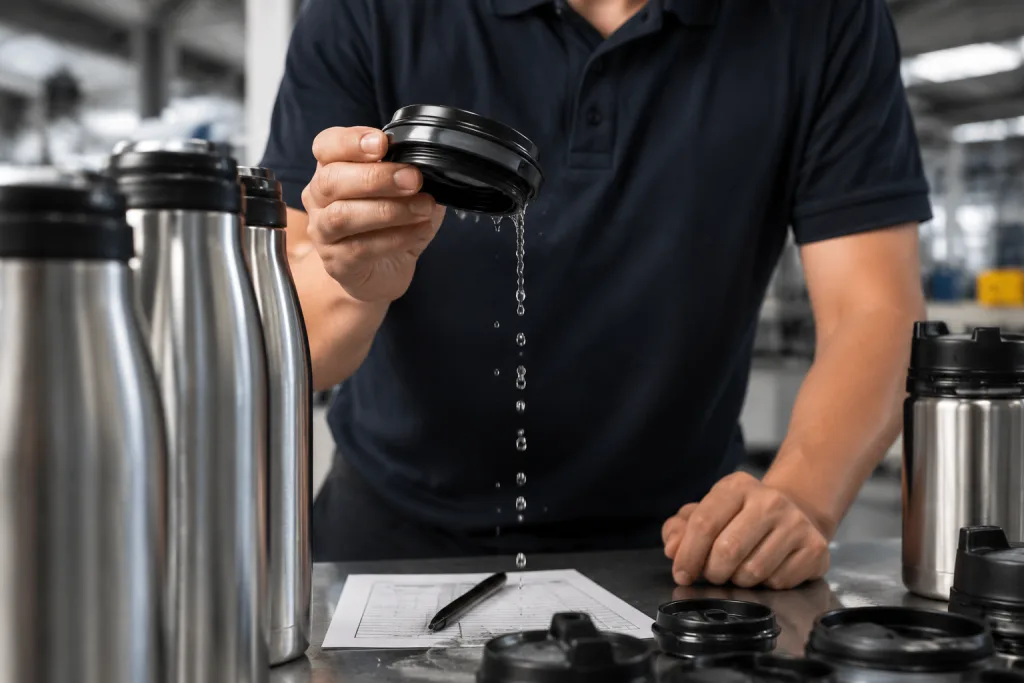
For a bulk canteen or wholesale canteen order, write the leak test by lid type on the PO, not in a loose email. A basic screw lid should pass an inverted leak test for 30 minutes after filling with room-temperature water. A flip lid or straw lid should pass a shake test, such as 30 seconds at 45 degrees and then inverted for 5 minutes. We run this with a simple angle jig and a timer at final inspection, usually under AQL 2.5 unless the buyer asks for tighter. For carbonated beverages, the math doesn't work unless the cap and thread are built for pressure. Standard stainless bottles are not pressure bottles. This matters for beer tumbler wholesale, beer tumbler in bulk, and growler wholesale projects where one buyer flagged “sparkling cider safe” on the artwork but left it off the engineering sheet.
Ask the factory to list gasket material and hardness, not just “food grade silicone.” Food-grade silicone is common, but smell, oil residue, and compression set change by supplier lot; we have rejected 3,000 gaskets after a boiling-water odor check in a stainless test cup. If your customers complain about odor, better photos will not fix it. Specify LFGB or FDA silicone, check boiling-water odor, and ban recycled gasket material in writing. For kids products, review pull-force and small-parts risk with the actual assembled lid, not a render. For alcohol flask wholesale or alcohol flask in bulk programs, cap sealing needs closer control because alcohol exposes gasket odor and leakage faster than water.
Put replacement gasket and lid availability into the commercial agreement. If you sell through retail or marketplace channels, a 1% lid failure on 20,000 pcs becomes 200 service cases. Spare parts are cheaper than refunds. We usually suggest 1.5% spare lids and 3% spare gaskets packed by color code, because we have seen this go sideways when a buyer ordered matte black bottles and the spare lids arrived glossy.
Decoration fails real handling
Decoration is where brand owners burn money on the visible part and forget the abuse test. We see it every month. A logo can look clean in a sample photo, then fail after 20 dishwasher cycles, 6 hours of carton rub on a vibration table, or 30 days in a humid Yiwu warehouse. For custom 304 stainless steel drink bottle wholesale orders, we run silk screen printing for simple one-color marks, laser engraving on coated shells, pad printing for curved caps, powder coating for full-body color, plus water transfer, heat transfer, and UV printing when the artwork demands it. Each one fails in its own way, and QC pulled the sample before packing more than once because the logo passed the photo check but lost ink under tape.
Silk screen is economical for one-color logos, often adding about USD 0.06-0.18 per position depending on size and quantity. The problem is not the screen. It is the ink match, curing time, and whether the operator rushed the drying tunnel at 160°C because the line was behind schedule. Laser engraving is durable on powder-coated bottles, but if the outer shell is not truly stainless or the engraving cuts into weak material, rust specks show up after salt spray or wet use. Powder coating feels premium. Thin coating chips at the bottom edge and shoulder when the bottle hits a carton divider or a retail shelf lip. A typical coating thickness might be 60-90 microns; if the factory gives you no range and no coating thickness gauge reading, they are controlling by eye, and the math does not work for repeat orders.
For drinkware wholesale and drinkware bulk branding, require a decoration test plan: 3M tape adhesion test, cross-hatch test where suitable, 24-48 hour water soak, alcohol rub test, and carton abrasion simulation. We usually test 5 pcs from pilot output, not the golden sample from the sales desk. For dishwasher-safe claims, stay careful. Around 7 out of 10 coated stainless bottle projects we see are safer as hand-wash recommended, even when the buyer pushes hard for a dishwasher claim on the carton. If your sales team wants “dishwasher safe,” ask for cycle testing data, water temperature, detergent type, and photos after testing. Optimism does not pass AQL 2.5.
Artwork control also matters. Lock Pantone numbers, logo position tolerance such as ±1.5 mm, print size, and orientation relative to the lid or handle. One PO typo, like “PMS 186C” entered as “PMS 168C,” can turn a red campaign into a brown reject pile. This is the wrong question to ask at pre-shipment; it must be fixed before film output or laser jig setup. It matters even more for a canteen bulk run with front-and-back graphics or a beer tumbler wholesale bulk order where retail shelf appearance drives acceptance, because the buyer flagged it when the handle seam sat 3 mm off center.
Cartons are treated as afterthoughts
Packaging failure hurts because it shows up after the line has packed the order and the booking is already made. We have seen 18 cartons opened at final inspection with dented shoulders, coating rub on the front panel, crushed gift boxes, wet corners, barcodes that would not scan on a Zebra scanner, and inserts short by 2 pieces. That becomes chargebacks and repacking labor. For North American and European procurement teams, carton and unit pack specs belong in the product spec, not in a late email after mass production.
Start with the unit pack. A plain white box works for some B2B promotional drinkware bulk orders, but retail usually needs a color box with an instruction sheet, barcode, country of origin, recycling marks, and importer details printed in the right panel. For marketplace programs, each unit needs FNSKU labeling and carton labels that scan at 300 dpi. If you sell mixed colors, state single-color cartons or assortment packing on the PO; last spring a buyer flagged “24 pcs assorted” because the factory read it as 24 pcs per color. Warehouse teams hate surprises.
For outer cartons, specify 5-ply export cartons for heavier items like bulk growler, growler bulk, or beer growler in bulk shipments. A 64 oz stainless growler punishes weak cartons fast, especially when the gross weight passes 14 kg. Use dividers or molded pulp where the bottle shoulder touches the next unit, and require an ISTA-style drop test or a practical carton drop test: one corner, three edges, and six faces from a defined height, commonly 60-80 cm depending on carton weight. Small saving, big risk. If the product arrives dented, the FOB math does not work.
Moisture is the quiet troublemaker on China export routes. Sea freight from Ningbo or Shanghai puts cartons in humid air for 30-40 days door to door, and QC has pulled samples with soft box corners after only 24 hours in our humidity room at 38°C. Use poly bags, add desiccants for premium gift boxes, and avoid raw paper surfaces that rub against coated bottles. For alcohol flask wholesale bulk and beer tumbler bulk programs, the retail box carries the brand story; when it arrives crushed, buyers judge the bottle as cheap even if the 304 stainless body is fine.
QC timing is too late
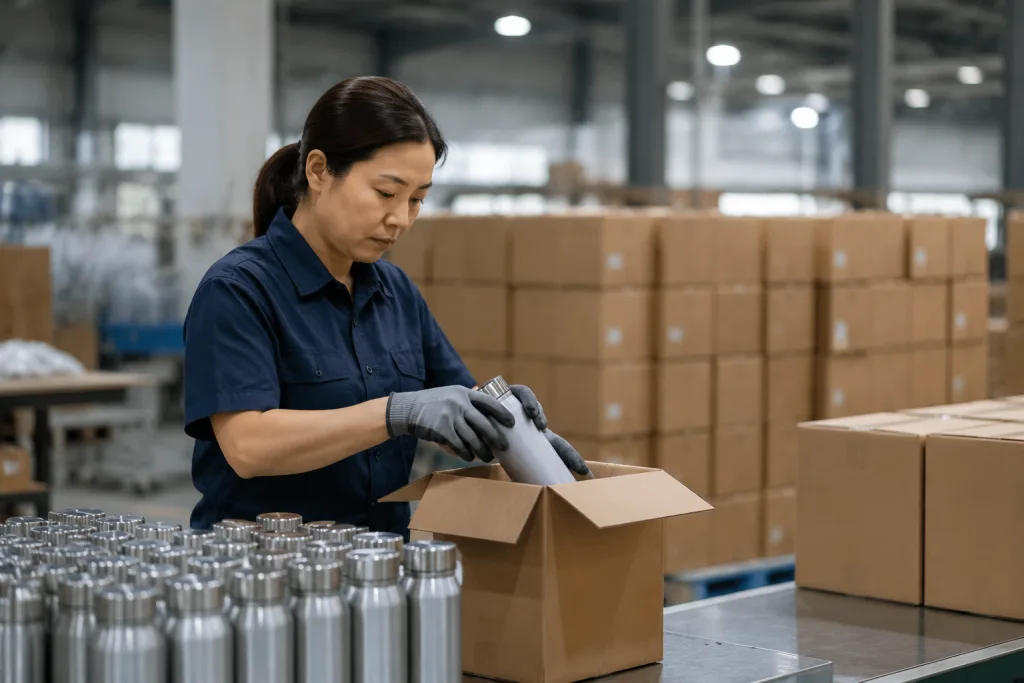
About 70% of new buyers we meet schedule one final inspection after 100% of goods are packed. That beats no inspection, but it is late. If QC pulls a 500 ml bottle and finds a welding pinhole, color mismatch, or lid tolerance issue at final random inspection, we are reopening cartons, sorting pallets, reworking thousands of units, or losing the vessel booking. We have seen this go sideways. A smarter plan checks the order at three control gates.
First, approve a golden sample with the exact steel structure, lid, gasket, coating, decoration, packaging, and barcode printed from the same artwork file. Keep one signed sample at your office and one at the China factory; our sample room tags it with the PO number and buyer signature. Second, run an inline inspection when 10-30% of production is complete. This is when the line can still fix weld burn marks, loose silicone rings, or spray coating drift before 20,000 bottles are finished. Third, perform final inspection when at least 80% is packed and 100% is produced. Use AQL, not feelings. A common setting is AQL 0 for critical defects, 2.5 for major defects, and 4.0 for minor defects.
Define critical defects clearly: sharp edges that catch a cotton glove, leakage after an inverted water test, wrong material, foreign matter inside bottle, failed vacuum, unsafe small parts, moldy packaging, or wrong compliance labeling. Major defects include visible dents, logo misplacement over tolerance, coating chips, poor cap fit, or wrong carton marks; QC usually measures logo position with a steel ruler or caliper, not by eye. Minor defects are small cosmetic marks within agreed limits, such as a 1 mm dot on the base area. Do not let every scratch become a shipment-stopper. The math does not work.
For 304 stainless steel drink bottle wholesale from Zhejiang or other China production bases, normal lead time is 30-45 days after deposit and artwork approval for repeat structures, and 55-75 days if new molds or custom lids are involved. In peak season, the vacuum test bench, powder coating line, and packing team all get booked. If a supplier promises 15 days for a fully custom wholesale drinkware order during peak season, ask what step they are skipping.
Price comparisons miss the build
The best wholesale drink bottle is not the lowest FOB line on a spreadsheet. It is the bottle whose wall thickness, test report, carton strength, and defect rate fit your sales channel. A distributor selling promo bottles for a one-week event might live with a lighter body and plain K=K carton. A retail brand selling a premium bulk canteen or wholesale growler cannot take that bet; we have seen QC pull 32 scratched lids from a 500 pcs pilot run because the buyer chose the cheaper loose-pack lid option.
Send your bottle spec before you request pricing
BottleForge will review steel grade, lid risk, decoration, packaging, MOQ, and lead time before quoting your wholesale drinkware program.