Key Takeaways
- Specify inner 304 stainless steel, 0.45-0.55 mm body wall, and food-contact test requirements before quoting
- Use AQL 2.5 for major defects and 4.0 for minor defects on finished custom drinkware inspections
- Logo methods fail differently: laser is durable, silk screen needs adhesion testing, powder coating needs cross-cut checks
- For distributor canteen programs, lock carton dimensions, barcode labels, and spare lid ratios before mass production
A cheap bottle quote looks fine on the spreadsheet. Then the first container lands with leaking lids, 0.38 mm walls instead of 0.45 mm, cloudy powder coating, or a logo that fails after two dishwasher cycles. If you buy custom drinkware for retail, promo campaigns, or distributor programs, the unit price is the wrong question to ask; the real cost shows up in the failure mode.
As a 304 stainless steel drink bottle supplier in Zhejiang, China, we see the same 4 buyer mistakes every season: loose steel specs, no lid torque target, artwork approved only from a PDF, and inspection plans written after the line is already running. On our Hangzhou line, QC pulled one sample last month where the PO said “matte black” but the artwork file named it “soft touch black” — two different coatings, two different prices. We run up to 480,000 stainless bottles per month, with typical MOQ from 1,000 pieces per SKU and 30-45 day lead time after sample approval.
When 304 is not specific enough
About 7 out of 10 RFQs we see say “304 stainless steel” and stop there, as if that line controls the whole bottle. It does not. A reliable 304 stainless steel drink bottle supplier should state where 304 is used, what thickness the line will run, and which tests prove food-contact safety. The safe spec is 304 stainless steel for the inner wall and drinking-contact surfaces, with 201 or 304 for the outer shell depending on target price. For premium retail or warranty programs over 2 years, use 304 inside and outside. Last month QC pulled the sample from a 750 ml trial run and the XRF gun showed 304 inside, 201 outside; fine for the buyer’s promo channel, wrong for their warranty claim.
The first failure mode is material substitution. It is not always cheating. Sometimes a canteen factory quotes one structure, then the buyer changes color, capacity, or cap style and the BOM is not updated. We have seen this go sideways after a PO typo changed “304 inner/201 outer” to “304 body,” and nobody caught it until pre-production. Require material traceability for coil batches and keep the right to run random SGS, TÜV, or Intertek testing. For EU and North American programs, ask for LFGB or FDA food-contact testing, plus REACH attention on coatings and silicone components. Paperwork matters here.
Wall thickness is another quiet problem. A 500 ml bottle with 0.35 mm body material can pass a quick sample review, then dent after 3 cartons are drop-tested at 76 cm. The math does not work if the buyer wants a cheap canteen price and outdoor-store durability. We usually quote 0.45-0.50 mm for mainstream custom canteen projects and 0.50-0.55 mm for outdoor or distributor growler lines. If you are comparing canteen suppliers in China, ask each vendor to state the body gauge, not just capacity and steel grade; the line technician will know the difference before the sales sheet does.
Leaks start at drawing stage
Leaks do not surprise the factory. We usually see the problem on the drawing: lid ribs not defined, gasket material too soft, or a thread copied from a 500 ml body onto a 750 ml canteen. A customized canteen with a straw lid, flip lid, or carry handle needs more than a clean 3D rendering. Put the sealing surface tolerance, gasket hardness, and leak-test method on the purchase order. One buyer once sent a PO with “leakproof lid” only; QC pulled the sample and found a 0.35 mm gap under the silicone ring.
For screw lids, we run silicone gaskets around Shore A 50-60. Too soft, and the gasket twists or rolls. Too hard, and it cannot cover small rim variation after forming and polishing. Our normal production leak test is 100% water fill, inverted for 30 seconds, plus random shake testing by carton lot. Simple test. For vacuum bottles, add a thermal retention test: for example, 95°C water loaded at room temperature, then temperature checked after 6 or 12 hours depending on your claim. The line records this with a probe thermometer, not a hand guess.
If you are buying a canteen customizable for different caps, “same mouth size” is the wrong question to ask. Threads, straw length, vent holes, and handle clearance change by capacity. A canteen manufacturer should make pre-production samples using mass-production tooling, not only CNC or 3D-printed mockups. We have seen a 650 ml straw touch the bottom and a 900 ml straw sit 18 mm short on the same project. For large distributor drinkware programs, we recommend keeping 1%-2% spare lids in the shipment, especially for promotional or school-use projects where replacement speed matters.
Do not approve a lid from a photo. Approve it after leak testing, drop testing, and repeated open-close cycling.
Coating defects hide until packing
Powder coating and spray painting cause 7 out of 10 coating complaints we see on 304 stainless bottles: orange peel, pinholes, color drift, patchy matte finish, and chips on the drinking rim. Retail buyers do not treat these as small cosmetic marks, and premium canteen promo clients are even stricter. The coating is what the customer touches first. It is also where a weak canteen vendor saves 3 minutes by cutting pre-treatment or shortening oven time on the line.
Color should be checked against a physical Pantone or RAL chip, not only a PDF on a screen. For matte black, white, and pastel colors, ask for a signed color panel; we keep one beside the spraying booth and ship one to the buyer’s QA team. A normal color tolerance can be set at Delta E ≤ 1.5-2.0 for tighter retail work, or slightly wider for low-cost promotional runs. Coating thickness needs a gauge reading, not a guess: too thin chips at the rim, too thick creates lid fit problems when the thread allowance is only 0.2-0.3 mm.
Adhesion testing should be simple and recorded on paper. We run a cross-cut tape test, a boiling water test, then a 3M tape pull after printing, because QC pulled the sample more than once and found logo ink lifting even when the powder coat looked fine. If you need dishwasher-safe claims, state the cycle count and test method, for example 50 cycles under your internal standard. The wrong question is “is it dishwasher safe?” The right question is whether the print, coating, and seal survive the same wash test, because on most customizable drinkware the decoration fails before the 304 stainless body.
Factories in Zhejiang, China, can produce strong finishes if the schedule leaves room for degreasing, phosphating or blasting where needed, full curing, and AQL 2.5 inspection before packing. We have seen a 20,000-piece customized drinkware order pushed 5 days earlier, then the buyer flagged rim chips during carton opening in their warehouse. The math does not work. Save 5 days in production, lose 18 days in sorting and replacement shipments.
Logos fail by the wrong method
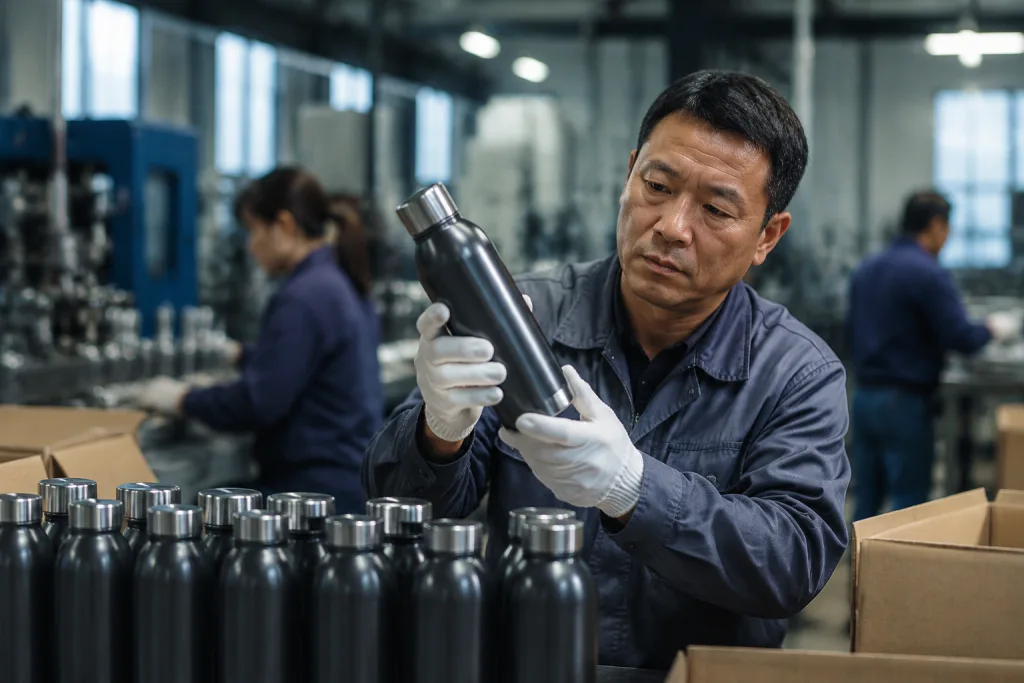
Branding is where a plain bottle turns into a custom canteen, custom growler, or private-label shelf item. It is also where 7 out of 10 decoration complaints start in our sample room. Laser engraving, silk screen printing, heat transfer, UV printing, and embossing all work, but they are not interchangeable. We run a 20 cm tape rub, alcohol wipe, and cross-hatch test before we trust a logo. A good canteen supplier should push back if your artwork, surface finish, or compliance wording does not fit the decoration method.
Laser engraving is the safest choice on powder-coated stainless steel when the buyer cares about wear. It cuts through the coating and shows the metal underneath. Good for one-color logos and outdoor distributor canteen orders. Silk screen keeps cost down for simple one- or two-color logos, but adhesion must pass testing on the actual powder batch, not yesterday’s panel. UV printing handles full-color artwork and gradients, but curved walls, black coating, and orange-peel powder texture can blur small text. QC pulled a sample last month where the 6 pt slogan looked fine on the PDF and muddy on the 750 ml curved body.
Set artwork rules before sampling. Minimum line width should usually be 0.2-0.3 mm for laser and 0.3-0.5 mm for screen printing, depending on logo size. For a 750 ml bottle, a common logo area is 45 x 80 mm, but the safe zone changes with taper and weld position. We mark that zone with a caliper and paper wrap on the first sample, because a 3 mm shift can put the logo too close to the seam. If you are ordering canteen customized for multiple markets, check whether each country needs recycling marks, capacity marks, FNSKU labels, or importer address details. Asking “which logo method is best” is the wrong question; ask which method survives your coating, artwork, packing, and claims.
For Amazon-style distributor drinkware, do not leave barcode placement to the packing team. FNSKU and carton labels should be on the approved packaging drawing, with scan testing before mass packing. We ship after scanning 10 inner boxes and 3 master cartons from the line, not after someone says “barcode is okay.” We have seen this go sideways from one PO typo: FNSKU ending in 8 on the file, ending in B on the sticker.
Cartons damage good bottles
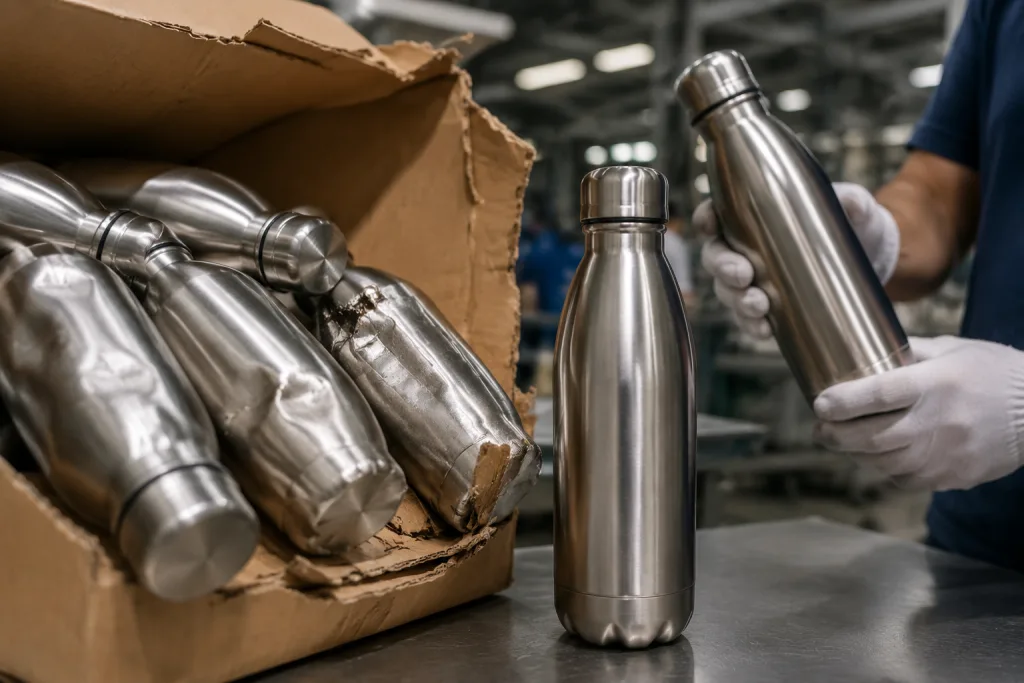
A bottle can pass production QC and still lose the order if the export carton collapses. We saw this on a 5,000 pcs canteen order to Germany: bottles left the line clean, but QC pulled 11 dented samples after a 68 cm carton drop because the carton wall was too soft. Sea freight, pallet re-stacking, courier last-mile delivery, and warehouse grabs all add compression and vibration. Customers do not care where the dent happened. They just reject the bottle.
For most stainless bottles, we run an individual polybag or paper wrap, a printed color box or kraft box for retail shelves, then a five-layer export carton. Carton bursting strength and edge crush strength need to match the packed weight, not just look good on the packing spec. A 24-piece carton of 750 ml bottles may weigh 9-13 kg depending on structure and packaging. Saving USD 0.03 per unit with a thinner carton is the wrong question to ask if the final carton hits 14 kg and your warehouse team has to hand-stack 380 cartons in one shift.
Drop testing is not optional for retail programs. We usually copy an ISTA-style check: carton drops from 60-76 cm depending on carton weight, with corner, edge, and face drops recorded on the inspection sheet. For glass-lined or special coating products, add vibration testing once the order is large enough to justify the test cost. If you are shipping mixed canteen customizable SKUs, carton marks must clearly show item number, color, capacity, quantity, gross weight, net weight, and country of origin. Small detail, big headache: one buyer flagged a PO typo where “matte black 500 ml” became “matte blank 500 ml,” and the warehouse froze 96 cartons until we sent corrected marks.
FOB Ningbo or FOB Shanghai is common from Zhejiang. Confirm pallet requirements before artwork approval, because carton size locks in faster than buyers expect. European warehouses often prefer Euro pallet planning, while North American distributors may need 40 x 48 inch pallet layouts. We ship both, but the math changes: a 385 x 295 x 255 mm carton can stack well on one pallet plan and waste space on another. Packaging design affects freight cost as much as unit price.
Inspection plans written too late
The weakest QC plan is the one written after the line has finished packing. Too late. At that point, the factory can sort cartons, rework bottles, or start arguing over who pays for the delay. For a new canteen manufacturer, lock the checkpoints before the deposit: incoming 304 stainless coil check with a handheld XRF, first article sample before mass logo printing, in-process leak testing, final random inspection, and loading supervision for orders above 1 x 40HQ or high-value retail sets. We have seen this go sideways when the PO had “matte black” in one line and “black glossy” in the artwork file.
A normal final inspection uses ANSI/ASQ Z1.4 sampling with AQL 2.5 for major defects and 4.0 for minor defects. Critical defects should be zero. Major defects include leaking at the cap thread, wrong material, wrong logo size by more than 1 mm, sharp drinking edges, serious dents, failed barcode scanning, and coating peeling after tape test. Minor defects include small dust spots, tiny color variation against the approved PMS chip, or slight carton printing marks within agreed limits. For custom drinkware, keep a signed golden sample at the factory and another with your team or inspection agency; QC should pull it from the cabinet, not guess from a WeChat photo.
Inline inspection pays for itself on programs above 10,000 pieces. Catching a logo position error after 500 pieces is annoying. Catching it after 25,000 pieces is a bill nobody wants. The math does not work. If you buy from 3 canteen vendors, use the same defect classification sheet for every vendor, with photos for dents, weld marks, lid scratches, and logo drift, so price talks do not turn into quality arguments during the final week.
Ask your supplier in China for production photos, semi-finished stock counts, and a packing schedule with dates by carton quantity. Serious canteen manufacturers will not treat that as offensive. We ship export orders every week, and buyers ask for evidence because promises do not pass inspection. A simple update like “8,400 bodies polished, 6,000 lids assembled, 220 cartons packed” is better than a perfect-looking sample on the sales desk.
Pricing traps in custom programs
The lowest FOB price is not always the lowest landed cost. We see this on the line every month. A quote for a 600 ml stainless bottle at USD 2.10 can leave out the retail box, logo setup, Pantone color matching, inner 304 upgrade, spare parts, inspection support, or 5-layer export cartons. A USD 2.35 quote can land cheaper when it avoids rework, replacement lids, and a launch slipping from 12 days late to 18 days late. The math does not work if the buyer only checks the first number.
When comparing canteen suppliers, ask for a line-by-line quotation with capacity, steel grade, wall thickness in mm, lid material, gasket material, coating method, logo method, packaging, MOQ, sample cost, tooling cost if any, lead time, payment terms, and FOB port. Our usual MOQ in Hangzhou is 1,000 pieces per color for standard bottles and 3,000-5,000 pieces for new mold or special lid development. Pre-production samples normally take 7-12 days; mass production takes 30-45 days after deposit and approved sample. Last week QC pulled the sample because the PO said “304 stainless” but the artwork file named the item “201 sport bottle.” Small typo. Big argument.
For a customized growler or distributor growler, watch the cap structure and pressure claim first. A beer growler, insulated food container, and sports bottle can look close in a catalog photo, but the seal design and test method are not the same. We run leak testing with the bottle upside down for 24 hours, then check the gasket seat with a 0.02 mm feeler gauge if the cap looks loose. Do not ask one generic “best price” question and expect the right product. That is the wrong question to ask.
The cleaner approach is to send your target market, order quantity, price range, compliance needs, and the failures you cannot accept. Tell us if your buyer flagged coating chips, lid odor, carton crush, or barcode placement on the last order. A practical 304 stainless steel drink bottle supplier will tell you where to spend money and where to leave the spec alone.
Send your bottle spec before you request pricing
We will review steel grade, lid risk, logo method, MOQ, packaging, and QC checkpoints before your custom drinkware order moves into sampling.
Frequently asked questions
What MOQ should I expect from a 304 stainless steel drink bottle supplier?
For standard shapes already in production, a realistic MOQ is usually 1,000 pieces per color or design. If you need a new lid, special powder color, molded silicone part, or customized growler body, MOQ often moves to 3,000-5,000 pieces because tooling, setup, and material purchasing become less flexible. For distributor canteen programs with mixed colors, ask whether the factory can combine colors under one model. Some factories in China allow 3 colors at 1,000 pieces each; others require 3,000 pieces per single color. Always confirm whether MOQ includes logo printing and retail packaging, because blank-stock MOQ and customized drinkware MOQ are not always the same.
How do I verify the bottle is really 304 stainless steel?
Start by writing the material structure into the PO: for example, “inner wall 304 stainless steel, outer wall 304 stainless steel, food-contact silicone gasket.” Ask for coil material certificates, but do not rely only on paperwork. For new suppliers, run random third-party testing through SGS, TÜV, BV, or Intertek on pre-production or mass-production samples. A handheld XRF test can check alloy composition quickly, though food-contact migration testing is still separate. For EU orders, discuss LFGB and REACH requirements. For North America, FDA food-contact expectations and California Proposition 65 screening may apply depending on your sales channel and risk policy.
Which logo method is best for customized drinkware?
For durability, laser engraving on powder coating is usually the safest choice because it does not rely on ink adhesion. It works well for distributor drinkware, outdoor bottles, and canteen promotional items that will be handled often. Silk screen printing is cheaper for simple one- or two-color artwork, but you should require a 3M tape test and rub test before mass production. UV printing is useful for full-color logos, gradients, and small runs, but curved surfaces can distort fine details. For most B2B orders, we recommend approving one physical decorated sample, then checking logo position and adhesion again during the first 200-500 pieces of production.
What inspection standard should I use for custom canteen orders?
A practical standard is ANSI/ASQ Z1.4 with AQL 2.5 for major defects and 4.0 for minor defects. Critical defects should be zero. Define critical defects as unsafe material, sharp metal burrs, contamination, broken glass if applicable, and severe leakage. Major defects include wrong logo, failed leak test, coating peel, wrong capacity, barcode failure, and serious dents. Minor defects can include small specks, light scratches, or slight carton mark variation within approved limits. For orders above 10,000 pieces, add an inline inspection at 20%-30% completion. It is much cheaper to stop a wrong logo at 800 pieces than reject a finished 20,000-piece shipment.
How long does production take for canteen customized projects?
For standard stainless steel bottles with logo and existing packaging, sample production usually takes 7-12 days after artwork confirmation. Mass production commonly takes 30-45 days after deposit and approved sample. Add 7-15 days if you need a custom color, special retail box, new lid component, or extra compliance testing. A new mold or heavily customized canteen can take 45-75 days before the first shipment because tooling, pilot testing, and corrections are needed. If your launch date is fixed, tell the factory the required warehouse arrival date, not only the ex-factory date. Ocean freight and customs can easily add 25-45 days depending on destination.