Key Takeaways
- A practical first OEM order is usually 3,000-5,000 units per color with 35-45 days production after sample approval
- Specify SUS304 for the inner wall, food-contact lid materials, and LFGB or FDA migration testing before paying the balance
- For retail and distributor drinkware orders, use AQL 2.5 for major defects and AQL 4.0 for minor defects
- Logo method, carton strength, FNSKU labels, and spare lids should be locked before mass production, not after inspection
You are not buying a bottle. You are buying repeatable 500 ml or 750 ml capacity, clean 304 stainless steel, decoration that survives tape test, cartons that pass a 76 cm drop, and a supplier who still replies after the 30% deposit lands. That matters when your first 5,000-unit custom drinkware order is headed to retail shelves, corporate kits, or distributor warehouses in Europe and North America.
At BottleForge Industrial in Hangzhou, Zhejiang, we see the same order problem at least 12 times a year: the buyer asks for a “304 bottle,” but the PO leaves out the steel grade test, wall thickness, lid material, logo tolerance, AQL level, and packing drop requirement. The line then has to guess. Bad plan. A serious 304 stainless steel drink bottle factory in China should lock those points before production starts; we’ve seen this go sideways when QC pulled the sample and the laser logo was 1.5 mm off-center.
Start with one real purchase order
Start with a real PO. You source for a regional outdoor distributor, and your sales team needs a 750 ml insulated bottle for a spring promo. The order target is 5,000 pieces: matte black body, one-color logo, individual kraft box, and export cartons that can sit cleanly on pallets for a 3PL in Germany. The same buyer asks us to price a 1.9 L custom growler for brewery accounts later in the year. Last month, QC pulled a pre-production sample for a similar Germany order and found the carton mark had “750ML” while the PO said “750 ml”; small typo, but the buyer flagged it before booking inspection.
This is where a 304 stainless steel drink bottle factory should slow the conversation down. Cheap FOB Ningbo in 30 minutes is the wrong question to ask. First we lock the product spec, otherwise the quote is just a guess with a shiny photo attached. Is the inner wall SUS304 and the outer wall SUS201, or are both walls SUS304? Are we running standard double wall vacuum, or copper-coated vacuum for stronger heat retention? Is the cap PP with a silicone seal, full stainless, or PP outside with stainless trim? For coating, our line checks matte powder at 60-80 microns with a coating thickness gauge; “matte black” in a PDF does not tell us enough.
For this PO, a workable spec would read like this: 750 ml double-wall vacuum bottle, SUS304 inner wall, SUS304 outer wall if the retail story says premium, 0.45 mm inner wall thickness, 0.50 mm outer wall thickness, food-grade silicone gasket, leak-proof screw lid, and temperature retention tested from a 95°C water start temperature. Simple. Testable. We would also ask for a 180° cap thread check, 24-hour leak test on 12 filled samples, and logo position tolerance within 1.5 mm because that is where complaints start. A canteen manufacturer that cannot talk through these items clearly is not ready for serious B2B work.
Our Hangzhou, Zhejiang team asks for target retail channel, compliance market, packaging style, and annual forecast before confirming MOQ. We ship different answers for supermarket, outdoor specialty, brewery merch, and corporate gift buyers because the math does not work the same. BottleForge can run around 450,000 stainless drinkware units per month across standard bottles, travel tumblers, sports bottles, canteen customized programs, and distributor growler projects. For a new mold-free bottle order, MOQ is commonly 3,000 pieces per color; for custom cap tooling, budget 45-60 days and higher volume. On the factory floor, that means opening a tooling file, checking the 2D cap drawing, and reserving CNC time before the buyer’s deposit hits our account.
Translate marketing words into specs
Buyers send phrases like “premium canteen,” “eco bottle,” or “customizable drinkware for corporate gifting.” Good for a sales deck. Weak on the line. A canteen factory needs measurable specs, not mood words. For a custom canteen for outdoor retail, write capacity, body diameter, total height, target weight, coating, lid type, logo print area, and carton pack quantity. For a distributor canteen program, state the color count and forecast pattern, such as 3 colors at 1,000 pcs each with repeat orders every quarter. Last month a buyer wrote “matte green bottle” on the PO; our QC pulled the sample and found two approved greens, Pantone 5605C and 5743C. That small miss can stop packing for 1 day.
For the 750 ml order, your specification sheet should include capacity tolerance, usually ±5%; body diameter, for example 74 mm; bottle height, for example 275 mm with lid; net weight target, perhaps 340-380 g depending on construction; and mouth diameter, such as 44 mm for ice cubes. Put these into a drawing, not only an email thread. We run calipers on the first 20 pcs after the mold trial, and a 2 mm neck change can make the lid feel loose even when the bottle still holds water. If you also plan a customized growler, do not copy the same cap design. A 1.9 L growler has different torque, sealing force, and pressure requirements, especially when brewery customers fill chilled carbonated beer.
The most common material mistake is writing only “304 stainless steel” without saying which part uses it. We have seen this go sideways. Some bottles use SUS304 for the inner wall and SUS201 for the outer wall to control cost. That is acceptable when the outer wall is coated and not in food contact, but it must be written on the spec sheet. For North American and European buyers, we recommend this wording: “Food contact stainless steel shall be SUS304; supplier to provide material declaration and pass heavy metal migration testing where required.” Ask for the material declaration before deposit if your compliance team needs it; waiting until pre-shipment inspection turns a normal 12-day document check into an 18-day argument.
Decoration also needs technical language. A canteen promotional order may use one-color silk screen at USD 0.06-0.12 per position, depending on size. Laser engraving may add USD 0.12-0.25 per unit but gives better durability on powder-coated bottles. Full-wrap heat transfer costs more and needs artwork distortion checks on the curved body; our print room uses a film ruler and wrap template before mass printing. For a canteen customizable program with 8 customer logos, include a logo proof approval step for each design, not just the master sample. The buyer often flags this late: “Logo looks 3 mm too low.” At that point the math does not work unless you planned an approval loop.
Price the bottle, not a photo
Quoting a canteen from one photo is the wrong question to ask. We have seen 6 suppliers price the same-looking 750 ml bottle from USD 3.10 to USD 5.20 FOB China, and half of that gap comes from parts nobody can see in the image. One line may run 0.38 mm stainless walls, a thin spray coating, a 58 g lid, a tight carton, and no third-party testing. Another quote may cover SUS304 outer wall, 70-80 μm powder coating checked by film thickness gauge, custom packaging, and pre-shipment inspection support. Same photo. Different bottle. Lock the scope first.
A clean RFQ should ask for unit price by quantity break, mold fee if any, sample cost, logo setup cost, packaging cost, spare part cost, FOB port, production lead time, payment terms, and validity period. For Zhejiang and wider China manufacturing, FOB Ningbo or FOB Shanghai is common. If you ship to Amazon or another marketplace 3PL, ask for carton dimensions and gross weight on day 1; one buyer flagged a 63 cm master carton after PO approval, and the freight math did not work.
For a first 5,000-piece customized drinkware order, we would price the cost model line by line: bottle body USD 3.60, powder coating included, one-color screen logo USD 0.08, kraft gift box USD 0.22, master carton USD 0.06 per unit, barcode label USD 0.02, and third-party inspection shared or billed separately. If you need a hang tag, instruction leaflet, or retail sleeve, add the exact paper weight and size before the proforma invoice is signed. QC pulled the sample once because the PO said matte black, but the approved artwork file was labeled “glossy_blk_v2.” That goes sideways fast.
Do not ignore payment terms. Many canteen vendors offer 30% deposit and 70% balance before shipment. That is normal in China export manufacturing, but the balance payment should connect to inspection release. A practical clause is: “Balance payable after passed final random inspection according to agreed AQL and before shipment.” Serious canteen manufacturers will accept it because it protects both sides. It stops the buyer from using inspection to cut USD 0.15 at the last minute, and it stops the supplier from pushing unchecked goods onto the truck after the line is packed.
Approve samples like an inspector
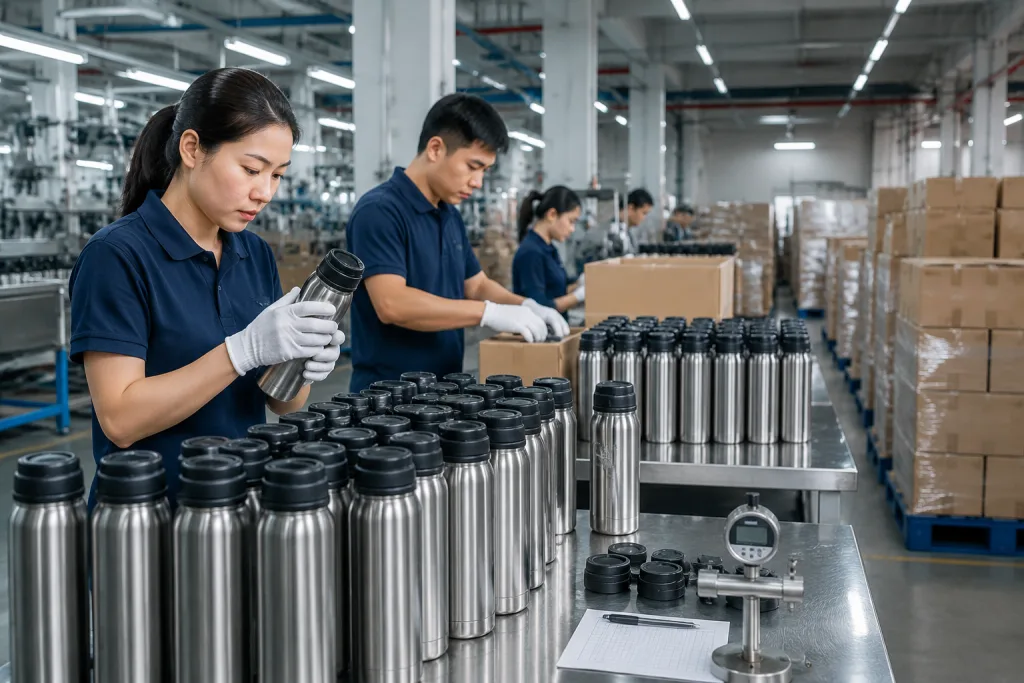
The sample stage is where buyers either protect the order or build the future complaint file. A pre-production sample should never pass because it “looks nice.” Check it against the written spec line by line. We measure capacity with a graduated cylinder, height and diameter with a digital caliper, plus mouth opening, net weight, coating thickness, logo position, lid fit, odor, and leak performance. Do the shake test. Take photos with a ruler in frame, then keep one signed sample in your office and one sealed sample at the factory.
For the 750 ml order, ask for three samples: one plain bottle for construction review, one logo sample for decoration approval, and one packed sample with gift box and carton label. We ship canteen promotional stock for events every season, and this is where buyers get squeezed by the calendar. A typical schedule is 7-10 days for standard color and laser logo, 12-18 days for custom powder color, and 20-25 days if packaging requires print proofing. If the event date is fixed, approving artwork two days late usually costs more than arguing over USD 0.03. Production should not start until the sample is approved in writing.
Testing does not need to be excessive, but it must match the sales market. For the EU, buyers commonly request LFGB or food contact migration testing, REACH screening for coatings where relevant, and packaging material compliance if retail requires it. For the US, FDA food-contact expectations and California Proposition 65 screening may apply depending on customer requirements. For kids’ bottle programs, ASTM and CPSIA questions must be raised early. A general adult stainless bottle is simpler, but waiting until goods are finished to ask for test reports is the wrong question to ask; QC pulled one finished-lot sample last year and the coating report name did not match the PO brand spelling.
Logo QC deserves special attention. On matte powder coating, screen print adhesion should pass a 3M tape test after curing. Laser engraving should be checked for burn marks, inconsistent depth, or poor contrast. For canteen customized programs with several logos, set a tolerance such as logo position ±1.5 mm and color ΔE within an agreed range if brand color is critical. We have seen this go sideways: the buyer flagged 5,000 bottles because the logo sat 6 mm too low, and the line had already packed 42 cartons before anyone measured the first tray.
Control production before final inspection
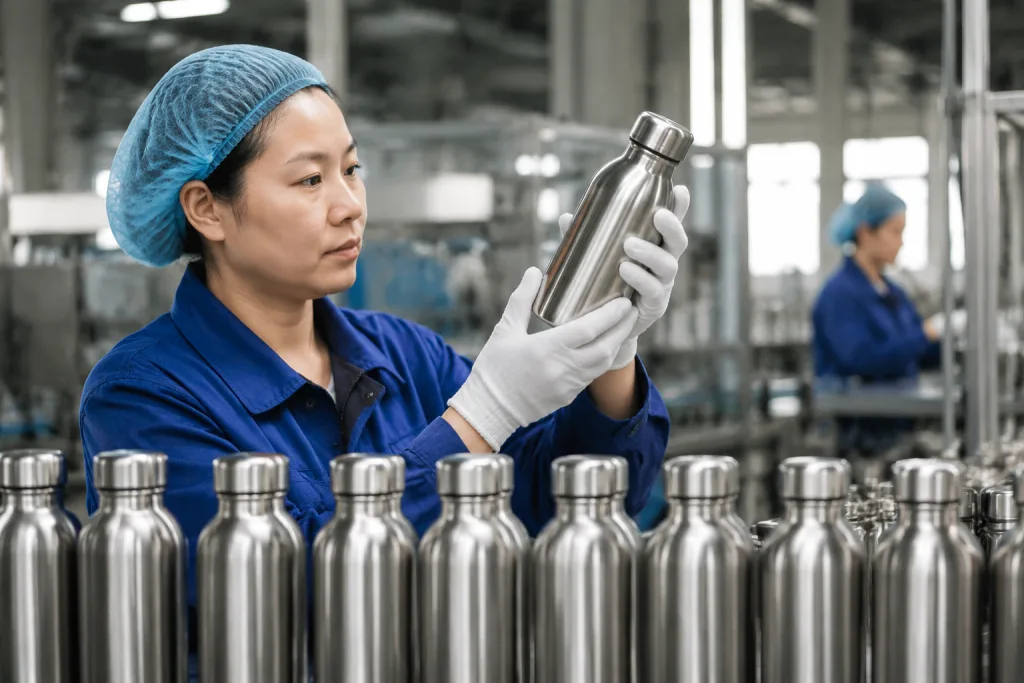
Good QC starts before the inspector arrives. For vacuum bottles, the line runs through tube cutting, forming, welding, vacuuming, leak testing, polishing, coating, decoration, assembly, and packing. A canteen supplier that waits for finished cartons is already late. Ask for the in-process control sheet, not just the final report. At BottleForge, we run vacuum performance checks and leak checks inside the production flow, then add final random inspection before shipment. QC pulled a sample last month after the vacuum station showed 3 weak pieces in 200, and the batch was still early enough to rework. That is the point: catch process drift while goods are still fixable.
For your order, set a mid-production checkpoint when 20-30% of units are completed. Use a factory video call, an internal QC report, or a third-party during-production inspection for higher-risk orders. Check coating color against the approved sample, logo registration in mm, lid assembly torque, carton printing, and barcode labels. Small stuff blocks shipments. If you sell through distributor drinkware channels, carton labeling is not cosmetic. We have seen a buyer flag one wrong digit in the SKU on a PO versus the carton mark, and the warehouse refused receiving even though the bottles were fine.
Final inspection should use ANSI/ASQ Z1.4 sampling or equivalent. A common standard is general inspection level II, AQL 2.5 for major defects, AQL 4.0 for minor defects, and 0 for critical safety defects. Major defects include leakage, heavy dents, wrong logo, poor lid fit, failed vacuum insulation, or incorrect material. Minor defects include coating specks under the agreed size limit, slight print feathering, or carton scuffs within the signed standard. Critical defects include sharp metal burrs, contamination, unsafe odor, or non-food-contact material substitution. The wrong question is “Can we inspect harder at the end?” The better question is whether welding, polishing, and coating each had recorded checks before cartons were sealed.
Functional tests should be written into the inspection checklist. Use a leak test with the bottle filled, closed, inverted, and shaken; we usually ask the inspector to hold it upside down over kraft paper so one drop is visible. Use a hot water retention test on sampled units; for example, fill with 95°C water, measure at 6 hours and 12 hours, and compare to the approved sample. Check carton drop strength if the route includes courier or FBA-style handling. A 5-ply export carton may be needed for heavy customized canteen or distributor growler orders, especially when one master carton passes 18 kg. Cheap cartons look good on the quote sheet, but the math doesn't work when claims start at the pallet level.
Pack for the actual sales channel
Packaging should match the sales channel, not our factory default carton plan. Promo orders often run with one polybag per bottle and a 5-layer bulk carton because every USD 0.08 matters. A retail canteen distributor usually asks for kraft boxes, UPC labels, warning text, multilingual care cards, and display-ready carton marks with the barcode facing out. Marketplace sellers have different headaches: FNSKU labels, suffocation warnings on polybags, and carton weight under 22 kg so the warehouse does not reject or surcharge the inbound. We have seen this go sideways when the PO says “Amazon label required” but the buyer sends the label file after the line has already packed 60 cartons.
For the 5,000-piece Germany shipment, we would normally suggest one bottle per kraft box, 24 pieces per export carton, carton weight around 11-14 kg depending on bottle model, and palletization if the buyer wants cleaner receiving. On our side, QC checks carton drop corners after packing, and the warehouse measures the finished carton with a tape before we confirm CBM to the forwarder. Carton marks should show item number, color, quantity, gross weight, net weight, carton size, and country of origin if required by the receiving process. If you need “Made in China” on the product or packaging, specify size and position before mass printing; a 6 mm mark under the base is not the same as a 20 mm mark beside the logo.
Spare parts are a small line on the quote, but they save after-sales arguments. For a distributor canteen range, order 1-2% spare lids and gaskets. Lids are lost, dropped, or cracked more often than bottle bodies, and QC pulled one sample last month with a gasket pinched by 1 mm during lid assembly. If you sell a customizable growler to brewery clients, spare caps matter even more because a missing seal makes the product unsellable. The wrong question is “can we skip spare parts to reduce cost?” The math does not work when one replacement lid costs more to courier than to buy with the original order. A good canteen vendor should quote spare parts separately and keep components consistent across repeat orders where possible.
Shipping terms should fit your internal team, not the cleanest-looking price on a supplier sheet. FOB is common for experienced importers with their own forwarder; we ship a lot of orders as FOB Ningbo or FOB Shanghai because buyers want control of the vessel, AMS filing, and destination charges. CIF may look easier, but you get less control once the goods arrive. DDP can work for smaller trial shipments, but you must know who is importer of record and who carries compliance responsibility. For a first China order, 7 out of 10 new drinkware buyers we handle choose FOB Ningbo or FOB Shanghai, then let their forwarder manage ocean freight, customs, and final delivery. One buyer flagged this only after seeing a destination charge line on the invoice. Too late.
Build the second order smarter
The best time to fix your canteen customized program is right after the first container lands, not six months later when the reorder PO is marked “urgent.” Ask the warehouse for 5 numbers: customer complaints, sell-through by color, lid failure rate, carton damage rate, and returns by SKU. QC should also cut open 2 returned bottles and check the weld line, silicone ring, and powder-coat scratch marks under a 3M tape test. If black sold through in 18 days but white took 46 days, cut the color count. If retail boxes arrived crushed on the bottom layer, move from weak E-flute to stronger board or change the master carton structure. If buyers keep asking for a handle lid, book that mold trial before the next production slot.
For repeat custom drinkware orders, ask the factory to keep a golden sample, artwork file, Pantone reference, packaging dieline, carton mark file, and QC checklist under your item number. Put the item number on everything. We have seen a reorder go sideways because the PO said “matte navy” while the approved sample tag said Pantone 296C, and the buyer flagged the mismatch after pre-production photos. Good records reduce arguments on the next PO. They also make it easier to add related SKUs, such as a 350 ml custom canteen for schools, a 1.2 L customized growler for brewery merchandise, or a travel tumbler under the same distributor drinkware line.
A long-term relationship with a 304 stainless steel drink bottle factory should give you fewer surprises, not just a lower unit price. You should expect sampling in 7 days instead of 12 days, steadier color matching, production photos with caliper readings, and earlier notice when the line is short on lids or cartons. In Zhejiang, China, schedules tighten before major holidays, especially before Chinese New Year. This is where the math does not work: if you need March delivery in Europe or North America, issuing the PO in late January leaves no room for sample approval, mass production, AQL 2.5 inspection, and vessel booking.
For BottleForge Industrial, the cleanest projects are not the biggest ones. They are the orders where the buyer defines the product, checks the sample with a ruler and a scale, uses realistic AQL, and treats the factory as a technical supplier rather than a catalog vending machine. We run better when the approved sample says 304 stainless, 0.45 mm body thickness, lid torque requirement, logo size, and carton drop-test standard. That is how canteen distributors, promotional agencies, and private-label brand owners avoid the usual first-order damage: wrong steel assumptions, weak cartons, drifting logos, and inspection failures that were preventable from day one.
Send your bottle spec before you place the PO
BottleForge will review steel grade, MOQ, logo, packaging, QC, and FOB shipping details for your next stainless drinkware order.
Frequently asked questions
What MOQ should I expect from a 304 stainless steel drink bottle factory?
For an existing bottle shape with standard cap, a realistic MOQ is 3,000 pieces per color for OEM logo production. Some canteen suppliers may accept 1,000 pieces, but the unit price, packaging cost, and color control are usually worse. For a new custom cap or body mold, expect higher volume, often 10,000-20,000 pieces, plus tooling cost and 45-60 days development time. At BottleForge in Zhejiang, China, we usually recommend a first commercial order of 3,000-5,000 units so you can test sell-through without paying sample-order pricing.
How do I confirm the bottle is really 304 stainless steel?
Do not rely on a catalog line saying “304.” Put the material requirement in the PO: SUS304 for all food-contact stainless steel parts, with a material declaration and testing when required. For higher-risk orders, request third-party material verification or migration testing. XRF screening can help identify stainless composition, but food-contact migration reports are also important for EU and North American buyers. Clarify whether the outer wall is SUS304 or SUS201. SUS201 outside may be acceptable for coated non-food-contact use, but it should be disclosed before pricing is agreed.
Which logo method is best for custom drinkware orders?
For simple promotional canteen orders, one-color silk screen is cost-effective at roughly USD 0.06-0.12 per logo position, depending on size and order volume. Laser engraving usually costs more, about USD 0.12-0.25 per unit, but it is more durable and good for premium powder-coated bottles. Heat transfer or full-wrap printing works for colorful retail designs but needs tighter artwork proofing and higher rejection control. For distributor drinkware programs, approve a physical logo sample and define position tolerance, such as ±1.5 mm.
What lead time should I plan for a customized canteen order?
For an existing 304 stainless steel bottle with standard color and one logo, plan 35-45 days for mass production after sample approval and deposit. Add 7-18 days for sample development depending on logo, color, and packaging. Custom powder colors, printed retail boxes, or multiple SKU labels can push the schedule longer. Ocean freight to Europe or North America often adds 30-45 days port to port, plus customs and inland delivery. If your delivery deadline is fixed, work backward from the warehouse date, not the factory ship date.
What should my final inspection checklist include?
Use AQL inspection, commonly general level II with AQL 2.5 major and AQL 4.0 minor, unless your customer requires stricter terms. Check quantity, appearance, coating, logo, barcode, packaging, carton marks, lid assembly, odor, sharp edges, leakage, and insulation performance. For leak testing, fill sampled bottles, tighten lids, invert, and shake. For retention testing, compare sampled units against the approved sample using hot water, such as 95°C start temperature. Also check carton drop resistance and gross weight, especially for distributor canteen and customized growler shipments.