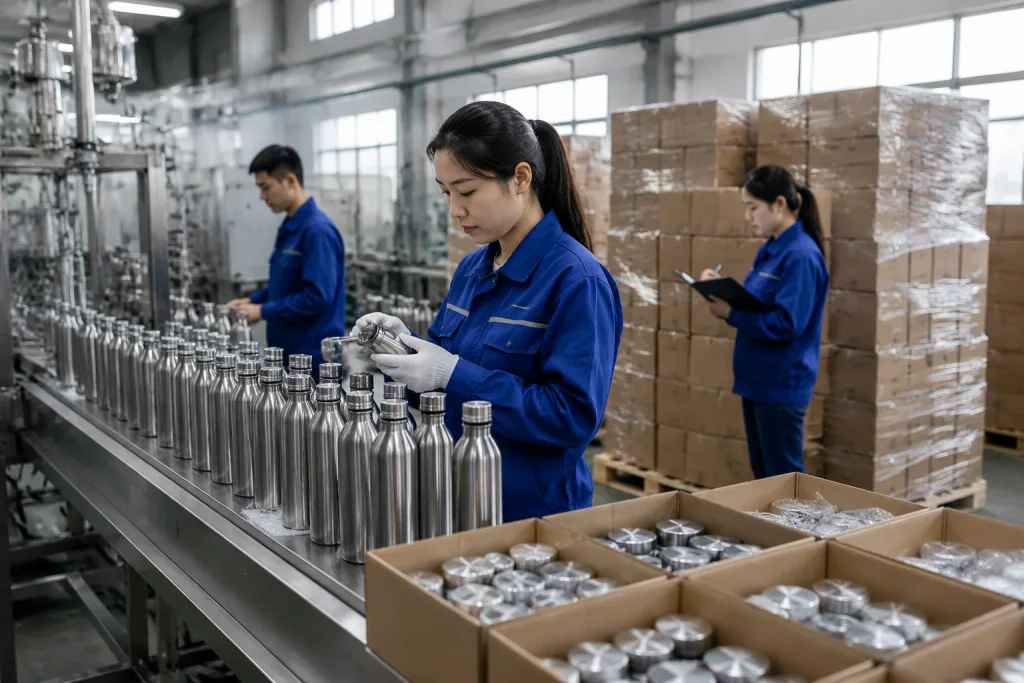
Key Takeaways
- A standard 500 ml 304 bottle usually lands at USD 2.40-4.20 FOB at 3,000-10,000 pcs
- Realistic MOQ is 1,000 pcs for stock shapes and 3,000-5,000 pcs for custom color or lid changes
- Normal lead time is 25-35 days after deposit and artwork approval, not including sea freight
- AQL 2.5/4.0 inspection, LFGB or REACH checks, and drop testing should be quoted before production
You do not buy 304 stainless steel drink bottle bulk orders from a catalog photo. You buy the steel thickness, the lid mold, the spray line time, the carton spec, and the inspection risk. A 500 ml bottle that looks simple can move from USD 2.40 to USD 5.80 FOB depending on 0.4 mm vs 0.5 mm steel gauge, lid design, coating, logo method, carton packing, and inspection requirements. Looks similar. Costs differently.
From our Zhejiang factory, we see buyers lose
Start with the real specification
The phrase 304 stainless steel drink bottle bulk is too loose for a factory quotation. Put the body size, lid type, surface finish, packing method, compliance target, and order split into the RFQ. Otherwise two China suppliers can quote the same-looking bottle with a 25% price gap, and both can defend the price. We see this weekly: one quote uses a 58 mm PP lid with a thin silicone ring, the other uses a 62 mm stainless cap and food-grade silicone gasket.
For most wholesale drinkware programs, start with capacity and structure. Common sizes are 350 ml, 500 ml, 750 ml, 1,000 ml, and 1,900 ml for bulk growler or beer growler in bulk projects. A single-wall 304 bottle uses less steel and lands cheaper, but it sweats with cold drinks and gives no heat retention. A double-wall vacuum bottle costs more because the line has to form inner and outer shells, weld the base, pull vacuum, run leak testing, and control the mouth tolerance within about 0.2 mm. QC pulled the sample. The thread was fine, but the rim was oval after polishing.
Write the steel grade into the purchase file, not just the email subject. We usually recommend 304 for the inner wall and either 304 or 201 for the outer wall depending on market position. For Europe and North America, 304 inside is the safer baseline for drink contact. If you sell premium wholesale canteen products or the best wholesale drink bottle range for a retail chain, do not let a supplier quietly switch the inner wall to 201 to save USD 0.12. The math does not work after one failed LFGB spot check or one buyer complaint about metallic taste.
Wall thickness matters. A typical 500 ml double-wall bottle uses around 0.40-0.50 mm inner steel and 0.45-0.55 mm outer steel before forming. Going thinner cuts cost, but dent risk rises during sea freight and customer use. We have seen this go sideways: after a 1.5 m carton drop test, QC found 7 dented bottles in a 24 pcs master carton. For a bulk canteen used in outdoor channels, we would rather adjust the cap, color process, or carton spec than cut steel too far.
FOB cost drivers you can control
For a standard 500 ml double-wall 304 bottle, we usually see FOB Ningbo or Shanghai at USD 2.40-4.20 when the order sits around 3,000-10,000 pcs. A plain single-wall canteen can land below that if the buyer accepts a stock mold and neutral carton. A wide-mouth 1,900 ml beer growler bulk model with powder coating and swing handle often runs USD 6.50-11.00, mainly because the lid set, handle rivets, and gift box eat cost fast. Not a promise. It is a guardrail; last month QC pulled 12 pcs from a 3,000 pcs pre-production lot because the PO said “matte black” while the approved sample was black sand texture.
Material weight drives the bill first. We buy stainless steel by kg, then lose some through trimming, deep drawing, mouth cutting, polishing, and scrap bins beside the hydraulic press. A taller bottle with a narrow diameter does not automatically cost less than a short fat one; if the forming die needs slower draw speed or the wall thinning fails at 0.38 mm, the math does not work. Vacuum insulation adds welding, vacuuming, copper coating for stronger heat retention models, temperature retention testing, and rejection risk when the line finds slow leaks in the water bath.
The lid is the next big swing. A basic PP screw cap with silicone ring is cheap, especially when we run an existing mold. A bamboo top, flip straw lid, carry handle, steel loop, or leak-proof drinking mechanism adds bought-in parts, hand assembly, and leak testing at the bench. For alcohol flask bulk and alcohol flask wholesale programs, the cap thread and gasket quality matter more than the body decoration; we have seen this go sideways when a buyer pushed for a shiny logo but ignored a 0.2 mm thread mismatch on the gauge.
Decoration comes after that. One-color silkscreen may add USD 0.08-0.18 per unit. Laser engraving is often USD 0.15-0.35 depending on logo size and position; a 45 mm tall logo on a curved shoulder takes more fixture time than a small front mark. Powder coating usually costs more than spray painting, but it survives rub testing better when QC runs the 3M tape pull and 500 g scratch check. Full-wrap printing, gradient color, rubber paint, and special metallic finishes raise price and reject rate. For drinkware bulk promotion orders, keep decoration simple. For retail margin, pay for finish durability.
Packaging gets missed too often. A white box may cost USD 0.12-0.25. A four-color retail box can be USD 0.25-0.55. Insert cards, barcode labels, FNSKU labels, master carton drop-test grade, and pallet rules add cost, but they can save more later if Amazon or a chain store starts issuing chargebacks. We ship cartons with 5-layer K=A when the buyer asks for tougher drop-test performance; the buyer sometimes flags the extra USD 0.18 per set, then changes his mind after seeing one crushed 18 kg master carton photo.
MOQ tiers and what changes
I’ll rewrite the section in place, keep the HTML tags and heading structure intact, and tighten the sales-engineer tone with more concrete factory details.MOQ is not a penalty. It is where setup time, powder loss, carton printing, and line changeover start to make sense. At our Zhejiang plant, stainless bottle output runs around 450,000 units a month, but that number gets split by body shape, finish, lid type, and AQL 2.5 inspection. We can ship 1,000 pcs on an existing mold and stock color. A new mold, custom PMS coating, and three lid options? The math does not work.
For stock-shape wholesale drinkware, we run these tiers: 1,000 pcs for a simple logo on an existing bottle; 3,000 pcs for custom color plus carton; 5,000 pcs for custom lid color or mixed SKUs; 10,000 pcs and up for better component pricing and a cleaner production slot. On one PO, the buyer flagged a 3 mm logo shift, and QC pulled the sample before packing. For canteen wholesale programs with outdoor retailers, 3,000-5,000 pcs per style is the better starting point because barcode stickers, compliance copy, and carton rules usually add more work than the bottle itself.
Bulk growler and growler wholesale orders play by different numbers. A 1,900 ml or 2,000 ml bottle eats more rack space, uses larger cartons, and slows the coating line at the hanging point. We have seen a 2,000 pcs order sit on the floor because the cartons were 10 mm too tall for the pallet plan. A factory may quote 1,000-2,000 pcs MOQ, but the landed cost moves with carton CBM, not just FOB unit price. That is the wrong question to ask if you want a clean comparison.
For alcohol flask in bulk, MOQ can stay lower when the shape is standard, but the print position and finish decide the real risk. Mirror polish shows scuffs fast. Matte black hides handling marks better. If you want alcohol flask wholesale bulk with gift box packaging, the packaging MOQ becomes the bottleneck, often 2,000-3,000 boxes per design. We ship those boxes flat, and a typo on the insert can stop the whole line.
Small MOQ helps with market tests. It does not build the cheapest stable wholesale drinkware program.
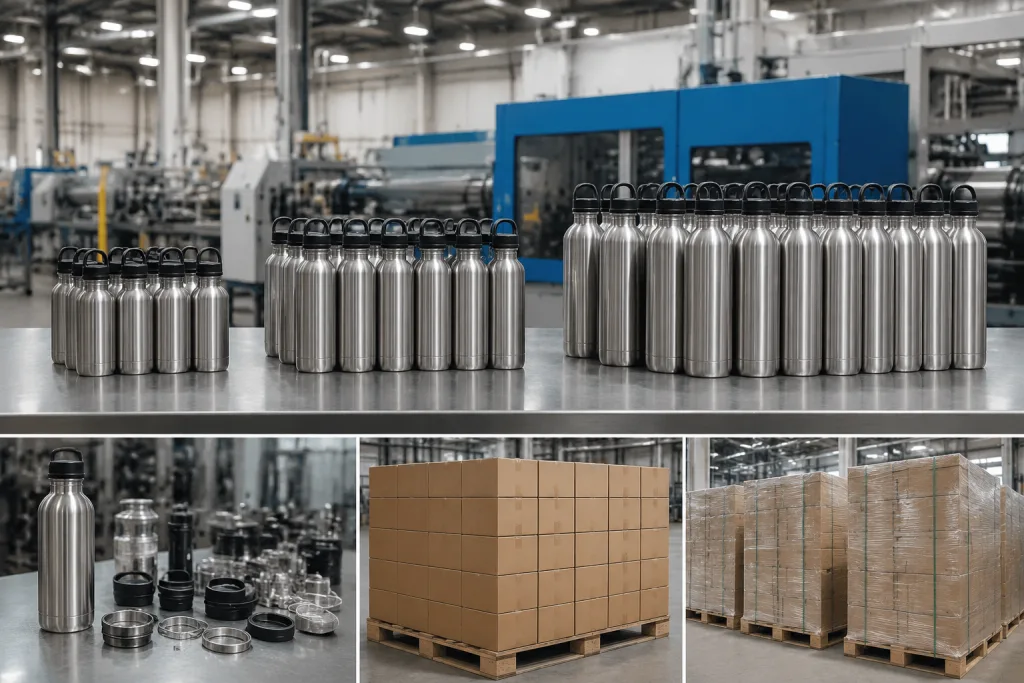
Lead time from quote to shipment
A standard 304 stainless bottle order from China usually runs 60-80 days from deposit to a North American warehouse on a first order. The line may only need 25-35 days for mass production, but the clock starts before the 30% deposit hits our account. For a seasonal launch, count backward from warehouse receiving date, not from PO issue date. We had one buyer send a PO with “matte balk” instead of “matte black”; that typo cost 2 days because the color card had to be re-signed.
A clean timeline looks like this. Quotation and specification confirmation: 2-4 working days if your brief includes capacity in ml/oz, 304 stainless thickness, lid type, logo size in mm, carton pack, and target MOQ. Pre-production sample: 7-12 days for logo, color, and packaging mockup; 15-25 days if a new lid or mold adjustment is involved. Sample courier to Europe or North America: usually 3-6 days. Artwork correction and approval: 2-5 days if your team signs off without sending version 6 after version 5 was already plated. Mass production after 30% deposit and signed sample: 25-35 days for common bottles, 35-50 days for complex powder coating, full-wrap print, bulk growler, or mixed-SKU programs. The wrong question is “how fast can you ship?” Ask what is already open on the line and whether the powder booth has your color scheduled this week.
Inspection and loading need their own space. Final random inspection under AQL 2.5 major / 4.0 minor usually takes 1 day, but booking an inspector may require 3-5 days notice. QC pulled the sample last month and found 3 leaking lids in 200 pcs during a 45-degree inverted water test; that batch stopped before carton sealing. If the order fails for leakage, coating adhesion, barcode errors, or carton strength, rework can add 5-10 days. Do not schedule vessel departure the morning after inspection unless you enjoy paying change fees.
Sea freight adds another layer. Ningbo to Los Angeles can be around 16-25 days port to port in normal periods. Ningbo to Rotterdam or Hamburg is often 30-40 days. Add customs clearance, inland trucking, and warehouse receiving; we usually allow 5-8 days after container discharge before the 3PL confirms inbound count. A safe planning window for wholesale drinkware from Zhejiang, China to a North American warehouse is 60-80 days from deposit for a first order. Faster is possible on repeat SKUs, but the math does not work if artwork, sample approval, inspection booking, and vessel cut-off all sit in the same week.
Testing, compliance, and inspection costs
I’ll keep the HTML intact and rewrite the prose to sound like a factory-side sales engineer: tighter, more specific, and less generic. Then I’ll do a quick pass to make sure the numbers, certifications, and structure stay unchanged.Compliance is not decoration. We treat it as a line item, because it lands in the landed cost either way. For Europe, buyers usually ask for LFGB food-contact testing, REACH-related checks for coatings, and sometimes BSCI or factory social audit records. For the United States, FDA food-contact expectations, CPSIA for children’s products, and ASTM-related performance or labeling concerns may apply depending on the item. A kids bottle and a beer tumbler wholesale program do not carry the same risk, and the buyer who mixes them up usually pays for it later.
Third-party lab testing can cost roughly USD 250-900 per material set, depending on scope. If the lid uses PP, silicone, stainless steel, paint, and printed ink, each contact surface needs a look. We had one PO where the buyer flagged a “dishwasher safe” claim, but the sample only passed two hot cycles before the print faded. For a beer tumbler in bulk or beer tumbler wholesale bulk order, coating adhesion and dishwasher claims need hard test data, not sales copy.
Factory QC should include incoming steel check, welding inspection, vacuum performance test, leak test, coating adhesion cross-hatch test, salt spray where relevant, lid torque check, and carton drop testing. On mass orders, we run third-party final inspection with ANSI/ASQ Z1.4 sampling, usually AQL 2.5 for major defects and 4.0 for minor defects. Critical defects stay zero tolerance. QC pulled the sample on the line once and found a 0.3 mm lid gap; that was enough to stop the packing team before the pallet was closed.
Inspection cost is usually USD 250-350 per man-day in China. For a 10,000 pc drinkware bulk order, that is cheap insurance. If you are shipping to Amazon FBA or a retail DC, barcode, FNSKU, carton mark, and polybag warning checks should be on the inspection sheet. We saw one shipment miss a carton mark typo by one digit, and the whole load sat at the warehouse gate for 12 days. A perfect bottle in the wrong carton is still a failed shipment.
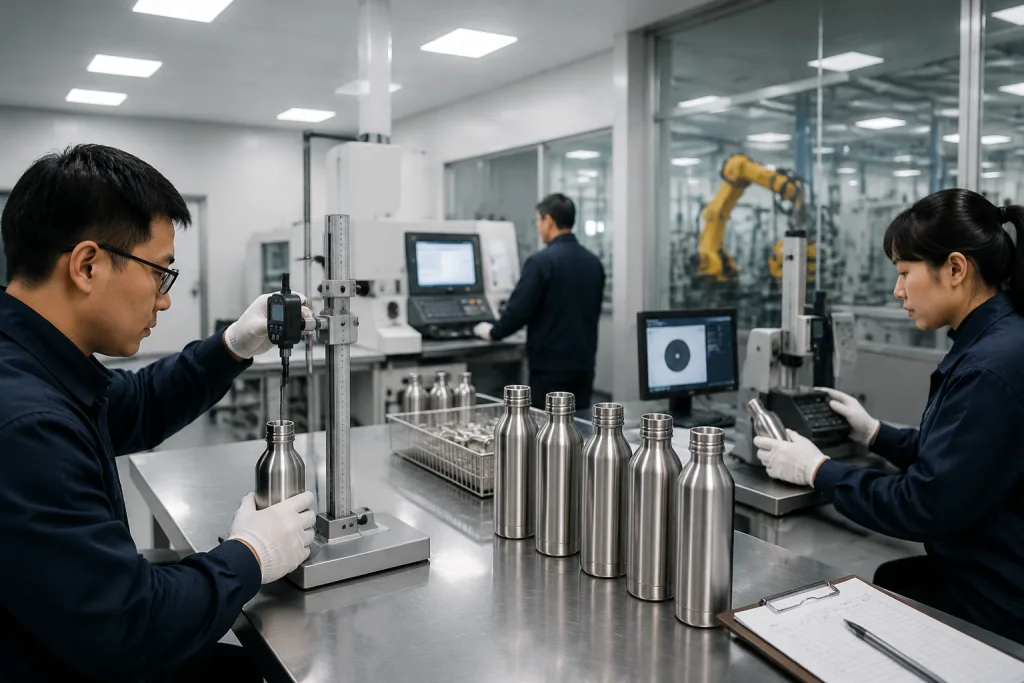
How to compare supplier quotations
When you receive three quotations for 304 stainless steel drink bottle bulk, do not pick the lowest line item. Build one comparison grid: capacity, inner and outer steel grade, wall thickness in mm, lid material, gasket material, finish, logo method, packaging, MOQ, lead time, payment terms, FOB port, testing included, inspection standard, and validity period. We run this sheet before opening a mold or booking the line; last month QC pulled a 750 ml sample that looked identical on paper, but one quote used 0.38 mm outer wall and another used 0.45 mm.
Watch vague wording. “Stainless steel” is not enough. “Eco paint” is not a standard. “Pass test” means nothing unless the supplier names LFGB, REACH, FDA, ASTM, or your exact protocol. “About 30 days” must state whether the clock starts from deposit date, artwork approval, or pre-production sample approval. Big difference. Hangzhou and Yongkang lines fill up before Canton Fair and Chinese New Year; a quote sent on September 12 may be 30 days, while the same order discussed on November 3 can become 45 days with no price change. We have seen this go sideways when the PO only said “ship ASAP.”
Payment terms change the real cost. A normal first order is 30% deposit and 70% before shipment after inspection. Some buyers ask for 60-day credit on a 3,000 pc first order. The math doesn't work. That cost comes back through unit price, fewer color choices, tighter carton tolerance, or a direct refusal from the factory. If you need wholesale growler, beer growler wholesale, or alcohol flask wholesale with several SKUs, use shared components where the design allows it. One lid across three bottle sizes cuts spare-part confusion; our warehouse once found 2,400 wrong gaskets because the buyer’s PO had “black lid” on one tab and “charcoal lid” on another.
The best wholesale drink bottle supplier is not always the one with the widest catalog. It is the one that asks annoying questions before production: target market, filling temperature, dishwasher claim, carton drop height, barcode format, and retail shelf requirement. Those questions save money. A buyer once flagged a 1.2 m drop-test failure after mass production, and the fix was not the bottle body; it was a 3 mm change to the inner tray and a stronger K=K export carton.
A practical buying path
If you are new to stainless drinkware wholesale, start with one strong base model instead of six weak SKUs. Pick a 500 ml double-wall 304 bottle, one powder-coated color, one laser logo, and one retail carton with a 5-layer K=A outer. Order 3,000 pcs, run inspection at AQL 2.5, and track sell-through against return rate and customer comments for 30 days. Keep it tight. After that, add a 750 ml size or a bulk canteen variant when the data says the shelf can carry it, not because the catalog looks thin.
For distributors, SKU discipline matters. A canteen bulk program with five colors, two lids, and three carton languages looks good in a meeting, but the math doesn't work when each color only gets 600 pcs and the line has to change powder twice in one shift. We have seen slow stock start this way. If you need multilingual packaging for Europe, use a neutral master carton and add a country-specific sticker or insert; QC can check the sticker position with a 150 mm steel ruler during packing. It is less polished than five printed boxes, but it protects cash on the first purchase.
For brand owners, spend money where the customer touches the product: lid feel, coating durability, mouth finish, and leak performance after a simple upside-down test. A heavier carton is not visible online, but a 6 kg drop test often shows whether retail boxes will arrive crushed. A better silicone ring may add only USD 0.03-0.06, yet it can cut leakage complaints when the buyer’s service team starts counting emails. For beer growler in bulk and wholesale growler projects, put more attention on handle welding and cap thread fit than on a busy print effect; QC pulled one sample last season where the artwork passed, but the cap wobbled by 1.5 mm.
Our view from Zhejiang, China is simple: lock the specification, approve a real sample, pay for inspection, and keep the first order controlled. We ship cleaner orders when the PO says “304 stainless” and the carton mark matches the approved PDF, not when a buyer changes lid color three days before mass packing. After one successful container, you can negotiate harder on price, improve packaging, and expand into beer tumbler wholesale or larger growler bulk programs with far less guesswork.
Get a costed stainless bottle quote before booking production
Send your capacity, finish, logo, packaging, and target market. We will return MOQ, FOB price, sample time, and production schedule.
Frequently asked questions
What is a realistic MOQ for 304 stainless steel drink bottle bulk?
For an existing factory mold, 1,000 pcs is often workable if you accept stock color, standard lid, and simple logo decoration. For custom powder coating, printed retail box, or mixed colors, plan on 3,000 pcs per style. If you need a new lid, special body shape, or custom mold, 5,000-10,000 pcs is more realistic. Bulk growler and beer growler bulk orders may start at 1,000-2,000 pcs because the unit value is higher, but freight efficiency becomes a bigger issue. For first-time buyers, 3,000 pcs is usually the best balance between price, production priority, and market testing.
How much should I budget per bottle FOB China?
A standard 500 ml double-wall 304 stainless bottle usually falls around USD 2.40-4.20 FOB at 3,000-10,000 pcs, depending on steel weight, lid, coating, logo, and packaging. A simple single-wall wholesale canteen may cost less. A 1,900 ml bulk growler can run USD 6.50-11.00 because it uses more steel, larger packaging, and slower handling. Add USD 0.08-0.35 for common logo methods, USD 0.25-0.55 for color retail packaging, and USD 250-350 per inspection day. Always compare by full specification, not only by the FOB unit price.
How long does production take after I approve the sample?
For a normal 304 stainless steel bottle with standard lid and one-color decoration, mass production is usually 25-35 days after deposit and signed sample approval. If you need custom PMS powder coating, full-wrap printing, several SKUs, or beer growler wholesale bulk packaging, expect 35-50 days. Pre-production sampling adds 7-12 days for simple logo work and 15-25 days for lid or mold changes. Final inspection, rework buffer, and vessel booking can add another 5-10 days. For a first shipment from Zhejiang to Europe or North America, planning 60-80 days from deposit to warehouse is sensible.
Which tests should I request for Europe or North America?
For Europe, ask about LFGB food-contact testing, REACH checks for coating or printed surfaces, and factory audit documents such as BSCI if your customer requires them. For North America, confirm FDA food-contact suitability and review CPSIA if the product is for children. For performance, specify leak testing, vacuum retention testing, coating adhesion cross-hatch, lid torque, and carton drop testing. A final random inspection using AQL 2.5 for major defects and 4.0 for minor defects is a practical baseline. If you claim dishwasher safe, test the finished bottle and decoration before printing that claim.
Can I mix canteen, growler, tumbler, and flask items in one order?
Yes, but mixing many categories can weaken pricing and complicate inspection. A canteen wholesale item, beer tumbler in bulk, alcohol flask in bulk, and wholesale growler may use different production lines, cartons, lids, and testing scopes. You may still consolidate them into one shipment, but MOQ is usually calculated per model, not across the full PO. If each SKU is only 500 pcs, the factory may treat them as four small orders. A better approach is 2-3 core models at 1,000-3,000 pcs each, with shared colors, shared carton style, and one inspection checklist.