Key Takeaways
- Specify 304 stainless steel for inner wall at 0.40-0.50 mm thickness, not just “stainless steel”
- Use AQL 2.5 major / 4.0 minor with leak, vacuum, coating, and torque tests written into the PO
- Confirm MOQ by body shape, lid type, coating color, and logo method; 1,000 pcs is not always 1,000 finished bottles
- Ask for pre-production samples after tooling and before mass coating, not only polished catalog samples
A 304 stainless steel double walled bottle wholesale order usually fails in dull places: a silicone lid gasket sitting 0.6 mm off-center, powder coating chipped on the bottom rim after the drop test, or a vacuum rate that passes in the sample room but falls after the welding line speeds up. We’ve seen this go sideways. By the time your distributor finds the problem, the cartons are already in Rotterdam, Los Angeles, or Toronto.
If you buy wholesale drinkware from China, the wrong question is “Does the catalog photo look good?” Write the purchase spec around failure modes. Our Hangzhou, Zhejiang team sees the same preventable issues across bulk drinkware, wholesale canteen, growler wholesale, and private-label bottle programs; last month QC pulled a random sample and found 7 lids with weak thread bite before packing. A normal run can be 30,000-80,000 units/month, MOQ from 1,000 pcs per color, and 25-40 days lead time after artwork approval.
When the steel spec is too vague
The first failure starts before welding: the buyer writes “stainless steel vacuum bottle” on the RFQ and assumes it means food-grade 304. In China, that wording is too loose. We have seen quotes built with 201 outer wall, 0.32 mm sheet, or mixed-grade tea infusers while the sample tag still says “304”. For a 304 stainless steel double walled bottle wholesale order, the inner wall should be SUS304, commonly 0.40-0.50 mm before forming. The outer wall may be 304 or 201 depending on your price target, but it must be declared on the PI and packing spec. On our line, QC checks incoming coils with an XRF gun before deep drawing; one batch last year read 201 on the outer shell after the PO typo said “304 in/out”. If you sell into the EU, ask for material declaration and REACH-related coating compliance. For the US, confirm FDA food-contact expectations for the inner surface, PP lid, silicone gasket, and paint.
The practical problem is not just safety. Wrong steel changes forming behavior, weld quality, corrosion resistance, and hand feel. A 500 ml bottle made with thin material may pass a desk sample check, then dent during 1.2 m drop testing or arrive with oval mouths after carton compression. We’ve seen this go sideways. For bulk canteen, canteen wholesale, and drinkware wholesale programs, I usually advise buyers to define target weight tolerance, not just capacity. For example, 500 ml straight bottle: 260 g ± 10 g depending on lid and finish. If the production sample is 235 g and the approved sample was 265 g, something changed. QC pulled the sample. The caliper showed the mouth out of round by 1.6 mm, and the buyer flagged loose lid fit during pre-shipment inspection.
Put the material grade, sheet thickness range, passivation requirement, and test documents into the RFQ. Also state whether 201 outer wall is accepted; this avoids the “same as sample” argument after mass production starts. If you want the best wholesale drink bottle for a premium retail line, the math doesn't work with a one-line quotation that only says “304 bottle, good quality.” We run better when the spec is written like a drawing note, not a slogan: SUS304 inner wall, declared outer wall grade, 0.40-0.50 mm inner sheet before forming, passivation confirmed, FDA or REACH documents attached before deposit.
Vacuum failure hides until transit
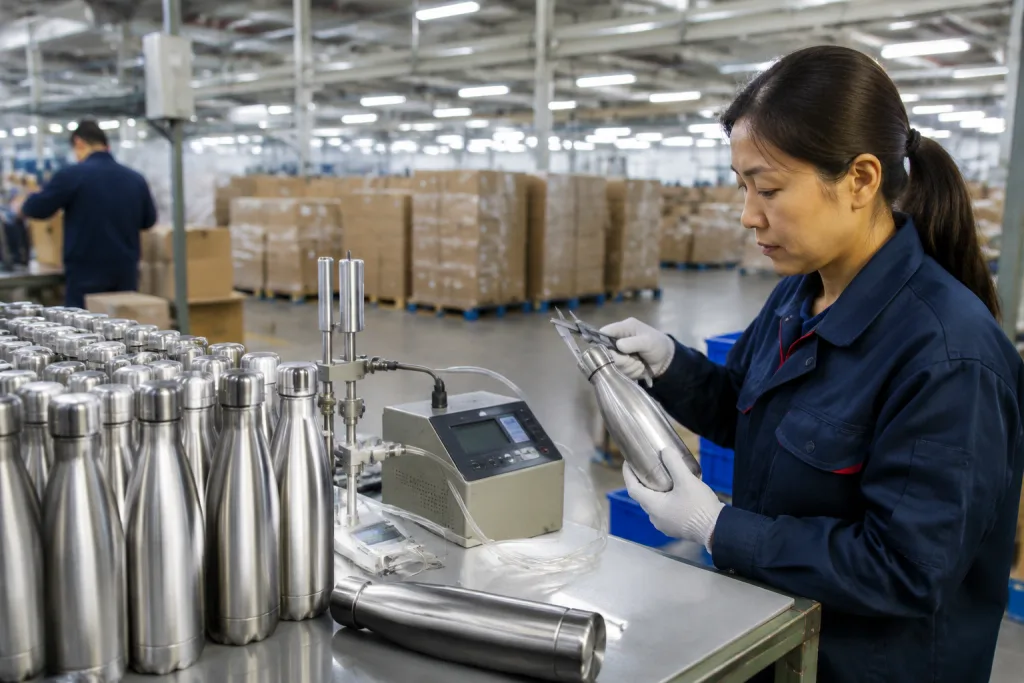
Double wall performance comes from vacuum integrity, not the word “insulated” printed on the carton. Watch the base seal and the mouth weld first; on our line, QC checks the bottom plug with a hot-water tank set at 85°C and looks for a thin bubble trail. Later finishing can damage it too, especially if the curing oven runs too hot. A bottle can hold hot water for 2 hours in a sample test and still fail after 20 days on the sea because micro-leaks open under temperature cycling and container vibration. We have seen this go sideways when a factory rushes a drinkware bulk order and cuts vacuum aging from 24 hours to 8 hours.
For wholesale drinkware, put the thermal test in the PO, not in a chat message. A typical specification is: fill with 95°C water, close lid, measure after 6 hours at 20-25°C room temperature. A 500 ml double wall bottle should often retain above 60°C, but the pass mark moves with the mouth diameter, the cap seal stack, and whether the body is slim or fat. Details matter. Wide-mouth bulk growler and beer growler bulk formats lose heat faster than narrow bottles, so one pass mark for every SKU is the wrong question to ask. Last month a buyer flagged a 2°C drop between the pre-production sample and bulk; the root cause was a wider silicone gasket groove, 0.4 mm off drawing.
Ask the factory how it screens vacuum loss before you discuss carton artwork. Stronger lines run hot-water immersion, vacuum detector equipment, and a 12-24 hour aging process before coating, with failed pieces marked by paint pen beside the conveyor. At BottleForge in Zhejiang, we prefer to test vacuum before powder coating and again by random sampling after final assembly, because a coated failure costs more to scrap. The math does not work. For growler wholesale, beer growler wholesale bulk, and beer tumbler wholesale bulk, also test cold retention and condensation with ice water filled to the shoulder. If condensation appears on the outer wall within 30 minutes after ice water filling, the vacuum has failed or the wall structure is wrong; QC pulled one sample like this after the base weld showed a 1 mm heat stain.
Do not approve a bulk order only because the golden sample keeps coffee hot. Ask how the other 9,999 units are screened.
Lids leak for mechanical reasons
Leak complaints usually start with mechanics, not mystery. We see four main causes on the line: gasket Shore A, thread bite, closing torque, and one lid design forced onto 6 body shapes. A lid that seals a 12 oz kids bottle will not automatically seal a 64 oz wholesale growler with a wider mouth and heavier fill weight. Same problem with flip lids. Fine for still water, then the buyer flags wet cartons after carbonated beer sits in a sports bag for 2 hours. If you are sourcing beer growler in bulk or alcohol flask wholesale, pressure behavior beats catalog capacity. This is the wrong question to ask if the first question is only “how many ml?”
Put numbers in the lid spec. Silicone gasket hardness is often 45-55 Shore A for a normal water bottle, and QC should check it with a Shore A durometer, not a fingernail press. Cap torque can be checked with a torque meter; for screw lids we often run 0.8-1.2 N·m as a practical closing torque range, though thread pitch and gasket compression decide the final number. Leak testing should include upright, inverted, and horizontal positions for at least 30 minutes. For sports caps, add a 1 m drop test on filled bottles, because one hit on the mouth can deform the rim by 0.2 mm or shake a hinge pin loose.
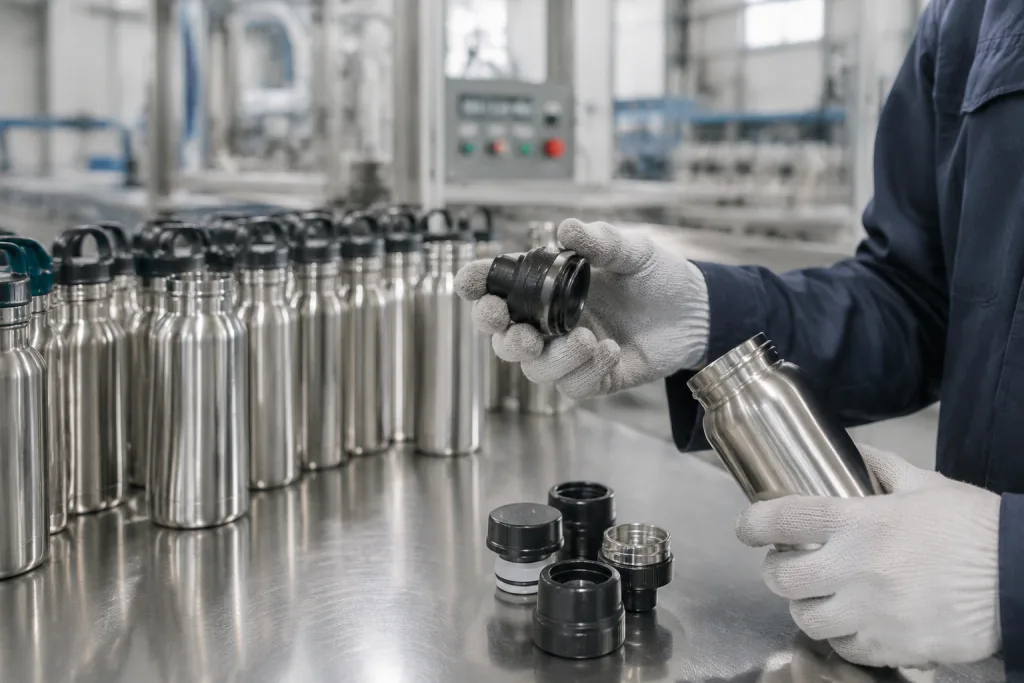
For canteen bulk, bulk canteen, and wholesale canteen programs, check whether the lid has a carry loop, straw, spout, or carabiner. More parts mean more leak paths. We have seen a PP hinge pass 50 showroom cycles and crack after 500 retail cycles, especially when the buyer wants low-cost resin to hit a promotion price. For alcohol flask bulk and alcohol flask in bulk, inspect the cap chain, hinge weld, and mouth edge burrs under a simple 10x loupe. A 0.1 mm stainless burr can slice the gasket and create the slow leak customers find after the first weekend trip.
Do not accept “leak-proof” as a spec. Define the liquid, filling level, test time, orientation, and
Coating defects are usually predictable
Powder coating, spray paint, UV printing, laser engraving, and silk screen fail in different ways, so we check them with different tools on the line. Color drift is the defect we see most often between the pre-production sample and the shipment; last month QC pulled 32 matte black bottles from a 3,000 pcs lot because the lower body read half a shade light under the D65 light box. Pantone matching on stainless steel is not paper matching. A matte black powder coating can look expensive, but if the film thickness gauge reads 42 μm at the bottom rim, it chips after one carton drop. If it builds up to 115 μm near the thread, the cap starts to feel tight.
For a 304 stainless steel double walled bottle wholesale program, lock down the finish method, color reference, gloss level, adhesion test, and the rub standard before we cut the PO. A basic cross-hatch adhesion test using 3M tape should show no major peeling; if the tape lifts flakes at the grid corner, the math does not work for retail. For powder coating, a film thickness around 60-90 μm is common, though the right window depends on powder type and curing temperature in the tunnel oven. For silk screen logos, ask for a rub test with 95% alcohol, 500 g load, and 50 cycles if your market expects heavy use. For laser logos, confirm whether the mark is silver, darkened, or exposed stainless, because each finish reads differently on colored coating.
This matters for beer tumbler bulk, beer tumbler in bulk, and beer tumbler wholesale orders because these cups get wet hands, rings, keys, and bar tools hitting the coating all day. For private-label drinkware wholesale, the logo is not decoration; it is the brand mark the buyer will photograph. We have seen this go sideways: the buyer flagged a 2 mm logo lean during AQL 2.5 inspection, and 18 cartons had to be reworked with a positioning jig. A crooked logo by 2 mm may pass on a cheap giveaway, but not on a retail bottle priced at USD 18.99. Put logo position tolerance in the artwork approval, such as ±1.5 mm from the centerline and ±2° rotation.
Confirm carton protection before mass packing starts. Individual polybags stop surface rub, but they do not stop rim impact; QC can still find crescent dents after a 76 cm drop test if the divider is thin. For premium China export orders, we run paper sleeves for light scuff control or egg-crate dividers with reinforced master cartons when the finish is soft-touch powder coating or the destination has rough inland trucking.
Capacity and carton claims go wrong
Capacity looks simple on a spec sheet, then marketing, engineering, and compliance each use a different line on the same bottle. A “500 ml bottle” might mean brimful capacity at overflow, usable fill below the thread, or just the catalog category. The customer does not fill to overflow. They stop under the thread. For alcohol flask wholesale bulk, beer growler wholesale, and bulk growler orders, this turns into a real claim because alcohol volume labeling gets checked. We had QC pull a 64 oz growler sample with a graduated cylinder, and it only reached 60 oz at the practical fill height. The buyer flagged it. Fair complaint.
Define capacity at one measurable line. For threaded bottles, we run practical capacity to the lower thread or to a marked fill line, with tolerance such as -0 ml / +15 ml or ±3%. Put that line on the drawing in mm from the mouth, not only in the sales quote. For beer growler bulk programs, confirm whether the product is for carbonated beverage transport or for pressurized fermentation storage. Those are not the same product. We have seen this go sideways when a buyer asked for “growler” and assumed pressure use, while the line was making a standard 304 stainless transport growler. Put the warning in the user instructions before artwork approval.
Carton data fails the same way. A buyer books warehouse slots from the quote, then the final master carton comes out 8% larger because the factory changed from a thin egg-crate divider to a 3 mm corrugated inner grid. Now the pallet plan is wrong. If you ship FBA or follow strict retailer routing, the math does not work. Ask for final carton dimensions, gross weight, net weight, HS code, barcode placement, and FNSKU label position before mass packing starts. For Amazon-style prep, carton weight should usually stay below 22.5 kg unless your program has special approval. Last month we caught a PO typo listing 48 pcs per carton, while the packing trial on the floor only fit 36 pcs without crushing the gift boxes.
For drinkware bulk from Zhejiang or other China production hubs, FOB pricing depends on packing almost as much as bottle cost. A thicker gift box may add USD 0.18-0.45 per unit and reduce container loading by 10-18%. That is not a rounding error. If the order is 12,000 pcs, one packaging change can eat the margin before the container leaves Ningbo. Decide early: shelf presentation or freight efficiency. We ship both, but mixing the two goals late in the order is where problems start.

Inspection must match your risk
A final inspection that only counts cartons is stock counting, not quality control. For 304 stainless steel double walled bottle wholesale, the inspection plan has to follow the failure points we see on the line: vacuum loss, lid leakage, coating chips, wrong steel grade, and rough drinking lips. Use ANSI/ASQ Z1.4 sampling with AQL 2.5 for major defects and 4.0 for minor defects as a common baseline. Critical defects, such as sharp metal burrs, heavy rust, toxic material mismatch, or severe leakage, should be zero tolerance. We run a 0.02 mm feeler gauge on lid fit and a magnet check at incoming material; QC pulled the sample once because the outer carton looked fine but 7 bottles inside had wet threads after the leak test.
Separate defects by severity. A 1 mm dust speck under coating may be minor. A leaking lid is major. A cut hazard on the drinking lip is critical. Vacuum failure is major or critical depending on your product claim. This is where buyers ask the wrong question. They ask, “Can you inspect before shipment?” instead of asking when defects become expensive to fix. For wholesale drinkware going into retail chains, I recommend a during-production inspection at 20-30% completion for new molds or new suppliers, then a final random inspection at 80-100% packed. Waiting until everything is packed makes rework slow and expensive; opening 600 cartons with tape guns and re-bagging bottles usually turns a 12-day ship plan into 18 days.
Your purchase order should include a checklist: material certificate, capacity check, wall thickness check, thermal retention test, leak test, coating adhesion, logo position, barcode scan, carton drop test, and spare gasket count if supplied. Put the test method beside each line, not just the item name. For example, we ship fewer arguments when the PO says “logo position ±1.5 mm from centerline” and “barcode scan 10 pcs per SKU” instead of “logo correct.” For canteen wholesale, growler bulk, alcohol flask wholesale, and beer tumbler wholesale bulk, add product-specific checks such as handle strength at 15 kg pull, cap chain pull, straw fit, and pressure warning label. We have seen a PO typo list “1 spare gasket/carton” when the buyer meant “1 spare gasket/pc”; the cost difference was not small.
Factory audits help, but they are not magic. BSCI, ISO 9001, or Sedex-type documents can show management systems and social compliance, yet they do not guarantee your custom lid will seal. Ask how many units/month the line produces, how many QC staff are assigned per shift, and what rework rate they saw on similar bottles in the last 3 months. A serious Zhejiang factory should answer those questions without drama. In our shop, one inspector normally covers 2 packing tables, and the buyer flagged it fast when a supplier claimed 300,000 bottles/month with only 1 final QC person on night shift. The math doesn't work.
Pricing that creates future defects
Price pressure is normal. The bad kind starts when the target FOB cannot cover 304 stainless, coating, leak testing, cartons, and a pre-production sample. For a standard 500 ml 304 inner double wall bottle, a workable China FOB range is often USD 3.20-5.80, depending on steel thickness, lid parts, powder coating, logo process, packaging, and order quantity. On the line, we see a 500 ml body use about 0.50 mm inner steel; drop that to 0.42 mm and the quote looks nicer, but dent complaints start. A 1,000 ml bottle or wholesale growler body costs more because it uses more steel, needs slower forming, and ships in larger cartons. A quote 20% below the market is not a miracle. It usually means one process has been cut.
The cut process may be thinner steel, 12-hour vacuum aging instead of 24-hour aging, cheaper powder, fewer leak tests, weaker 3-ply cartons, or no pre-production sample. Photos will not show it. QC pulled one sample last month that looked clean outside, but the lid gasket failed after 6 hot-water shake tests at 95°C. You see the real cost when return rates hit 3-6% instead of below 1%. For brand owners, saving USD 0.25 per unit is the wrong math if it creates refund tickets and bad reviews.
When comparing alcohol flask wholesale bulk, beer tumbler wholesale, canteen bulk, or best wholesale drink bottle quotes, put the quotes on the same basis. Match the capacity definition and material grade first, then compare lid structure, coating thickness, logo method, packing spec, and Incoterm. FOB Ningbo and EXW Hangzhou are not the same quote; we had one buyer flag this after the PO said “FOB” but the supplier’s proforma invoice still charged local trucking separately. A supplier offering “free logo” may be moving that cost into lower-grade coating or a higher mold charge.
For a new program, start with a pilot MOQ you can inspect properly: often 1,000-3,000 pcs per color for bottles, higher for custom molded lids. We run AQL 2.5 on carton-open inspection, and that needs enough cartons pulled from different pallets, not just 5 pretty samples from the top layer. Once the first shipment survives market use, scale to 10,000 pcs or mixed-container bulk drinkware. Slow is fine. We have seen this go sideways when a buyer fills a warehouse with elegant defective metal before testing the first 2 pallets.
Send us your bottle spec before you quote
We will check material, lid, coating, MOQ, and packing risks before your next China drinkware order goes into production.
Frequently asked questions
What MOQ should I expect for 304 stainless steel double walled bottles?
For existing bottle molds, a practical MOQ is usually 1,000 pcs per color and per logo design. If you need a custom powder color, some factories ask for 2,000-3,000 pcs because powder setup and cleaning waste are real costs. A custom lid, custom body mold, or special bulk growler shape can require 5,000-10,000 pcs plus tooling. Ask whether the MOQ is for blank bottles, finished bottles, or each SKU. A 2-color order with 2 logos may count as 4 SKUs, not one bulk drinkware order.
Is 304 stainless steel required for both inner and outer walls?
The inner wall should be 304 stainless steel for normal food-contact drinkware. The outer wall can be 304 or 201 depending on your market position and cost target, but it must be disclosed. For premium wholesale drinkware, using 304/304 improves corrosion resistance and buyer confidence. For a lower-cost promotional bottle, 304 inner and 201 outer is common in China. Do not let the quotation say only “stainless steel.” Require SUS304 inner wall, material certificate, and a thickness range such as 0.40-0.50 mm before forming.
How do I test insulation performance before approving mass production?
Use a repeatable thermal test. Fill the bottle with 95°C water to the defined fill level, close the lid, keep it in a 20-25°C room, and measure after 6 hours. For many 500 ml narrow-mouth bottles, above 60°C after 6 hours is reasonable, but wide-mouth beer growler wholesale products may perform lower because the opening loses heat faster. Test at least 3 pre-production samples, then require random testing during final inspection. Also check for outer-wall condensation after filling with ice water for 30 minutes.
Which logo method is safest for drinkware wholesale orders?
Laser engraving is durable and good for smaller premium logos, but it may expose silver stainless under coating. Silk screen is cost-effective for one or two colors, often around USD 0.05-0.15 per position at volume, but it needs adhesion and alcohol rub testing. UV printing handles multi-color artwork but costs more and is more sensitive to surface preparation. For beer tumbler bulk or retail bottle programs, specify logo tolerance, rub test cycles, and whether the logo must survive dishwasher exposure. Many vacuum bottles are hand-wash recommended unless tested otherwise.
What inspection standard should I put in the purchase order?
Use ANSI/ASQ Z1.4 with AQL 2.5 for major defects and 4.0 for minor defects as a baseline. Set critical defects at zero tolerance. Major defects include leakage, vacuum failure, wrong material, serious dents, missing parts, and unreadable barcodes. Minor defects include small cosmetic specks within your approved limit. Add functional tests: 30-minute inverted leak test, thermal retention test, coating cross-hatch tape test, capacity check, carton drop test, and barcode scan. For a first order above 5,000 pcs, add a during-production inspection at 20-30% completion.