Key Takeaways
- For a 5,000-unit 304 stainless bottle order, expect 35-45 days production after deposit and artwork approval
- A practical AQL setting is 2.5 major and 4.0 minor for distributor drinkware orders
- 304 inner steel, vacuum leak testing, and coating adhesion matter more than cosmetic sampling photos
- FOB Ningbo or Shanghai is usually cleaner than chasing a slightly lower EXW price in China
You are not buying a bottle. You are buying a repeatable supply chain item that has to hold temperature, pass import checks, carry your logo without ghosting, and land with fewer than 2.5% major defects. We’ve seen this go sideways: the buyer approves a clean 1-piece sample, then QC pulled the sample from mass production and found 0.3 mm lid wobble plus color drift under the D65 light box.
Here is a real order shape we run: 5,000 units, two colors, one logo, FOB Ningbo, retail-ready packaging. BottleForge Industrial runs stainless drinkware production in Zhejiang, China, with typical output around 300,000 units/month and private label MOQ from 1,000 units per SKU. The buyer flagged carton strength last quarter, so for jobs like this we check the 5-ply outer carton, barcode position, and the PO line that always gets mistyped: “304 stainless steel double walled bottle” becomes “304 single wall” if nobody catches it.
Start With The Real Use Case
A buyer emails asking for a 304 stainless steel double walled bottle private label quote. Quoting straight from a catalog page is where projects start to wobble. A school canteen promo order, a gym retail range, and a distributor program can all pick the same 500 ml body, but the cap thread, powder coating, carton burst strength, and test file will not match. We run this check before pricing: bottle mouth ID in mm, cap gasket material, carton layers, and which logo file is actually final. Last month QC pulled a sample because the PO said “mat black” while the artwork said “matte black”. Small typo. Big delay.
For this case, assume you are a European distributor selling drinkware to outdoor retailers and corporate gifting clients. You need a 750 ml insulated bottle with matte powder coating, stainless steel inner wall, leakproof screw cap, retail kraft box, and outer cartons strong enough for palletized sea freight. Two colors: black and forest green. The logo is one-color laser engraving. Your target landed cost leaves room for a FOB China price of USD 4.20-5.10 per unit, depending on cap construction and packaging. The line will treat a PP screw cap with silicone ring differently from a full stainless cap, and the difference shows up in both cost and assembly speed.
At this stage, a good canteen supplier should ask boring questions. Good. Boring saves money. What temperature claim will you print? Six hours hot and 12 hours cold is safer than 24 hours hot on a slim bottle, because the vacuum test data usually does not support that claim after normal handling. Do you need EU food contact testing, LFGB, REACH for coating, or US FDA-grade material declarations? Will the same bottle move to Amazon FBA later with FNSKU labels and carton weight limits under 15 kg? We have seen buyers approve a 16.8 kg master carton, then ask for FBA labeling two weeks before shipment. The math doesn't work.
Private label buyers sometimes ask for “best quality” and “lowest price” in the same email. That is the wrong question to ask. A better starting point is: 750 ml, 304 inner, 201 or 304 outer, 0.45-0.55 mm body sheet, copper-coated vacuum layer if required, powder coat with 3M tape adhesion test, 1.0 m drop test on packed carton, AQL 2.5/4.0 final inspection. Add MOQ by color, laser position in mm from the bottom, and whether the kraft box needs a barcode. Then the canteen manufacturer can quote the same bottle you plan to sell, not a cheaper cousin that fails on the shelf.
Lock The Bottle Specification
The steel grade gets the buyer’s attention, but the small construction choices decide whether the bottle survives daily use. For a mid-market private label bottle, use 304 stainless steel on the inner wall because it touches the drink. The outer wall can be 201 or 304, depending on your shelf price. Be careful with the claim “304 stainless steel bottle” if only the liner is 304. Last month one EU buyer flagged that wording during artwork approval, and our QC team had to match the carton copy, PO description, and material declaration before the line could run.
For this order, we would specify 304 inner and 201 outer unless your retail box must say full 304 construction. Full 304 costs more, often USD 0.25-0.45 extra on a 750 ml bottle, but the math works if your brand sells premium outdoor products. Don’t leave wall thickness as “standard.” We run 0.45 mm for standard bottles and 0.50-0.55 mm for heavier-duty custom canteen projects. Thinner steel cuts cost, then dents show up after sea freight; we have seen 11 dented bodies in one 125-piece carton after a loose divider test.
The vacuum process matters. No shortcut here. A double walled bottle only earns its name if the vacuum stays stable after welding, polishing, powder coating, and transport. During production in Zhejiang, each unit should pass vacuum checking before packing; our line uses a vacuum tester after the bottom getter process, then QC pulls samples before carton sealing. For higher-value customized canteen or custom growler orders, request random thermal retention testing from the production lot: fill with 95°C water, close the cap, record temperature after 6 hours, and compare it with the approved benchmark.
Cap design is not decoration. A cheap cap can ruin a good body, and this is the wrong place to save USD 0.08. For a distributor growler or sports bottle, define the gasket material, thread fit, handle strength, and any plastic part that contacts liquid. Silicone gaskets should be food-grade and removable for cleaning. If the order is for children or schools, check ASTM or relevant local requirements for small parts and sharp edges; QC pulled one sample with a 0.6 mm burr on the flip lid hinge, and the buyer rejected it. Good canteen manufacturers will push you to confirm these details before the sample, not after mass production starts.
Quote The Order Without Guesswork
After the specification is locked, the quote stops being a guessing game. For this 5,000-unit order, we quote 2,500 black and 2,500 forest green bottles. MOQ is not a sales trick; it comes from coating line setup, laser jig setup, carton printing plates, and 304 stainless material purchasing. On our line, the powder room needs about 35 minutes to change from matte black to forest green, then QC checks the first 12 pcs under a D65 light box. A realistic MOQ for a private label 750 ml stainless bottle is 1,000 units per color for stock shape, or 3,000-5,000 units for a custom mold, special cap, or body profile.
A clean quote should show the bottle, decoration, packaging, testing, and logistics terms as separate lines. Example: bottle FOB Ningbo USD 4.55; laser logo included for one position; kraft box USD 0.18; printed instruction insert USD 0.03; color carton master packing included; EU food contact test quoted separately if not already valid for the exact material set. We ask sales to mark logo size in mm on the PI, because one buyer once approved “front logo” and later expected a 70 mm logo on a curved body. If a canteen vendor gives one attractive number without these lines, the math does not work later. You cannot see which cost will move.
FOB terms usually work better for B2B buyers than EXW unless you already control China trucking and customs handoff. From Zhejiang, we ship through Ningbo or Shanghai. FOB Ningbo gives a cleaner comparison between canteen suppliers because local inland handling and export clearance are already inside the price. For a 5,000-unit 750 ml order, expect roughly 16-18 kg per master carton depending on packing count; our packing table shows 24 pcs per carton at 62 x 42 x 48 cm for one common stock bottle. Carton planning matters for container loading, pallet height, and warehouse handling.
Payment terms also show whether both sides are serious. Standard private label terms are 30% deposit and 70% before shipment after inspection, though established canteen distributors sometimes negotiate after 3-4 smooth orders. Tooling or mold fees are normally paid upfront. If you are comparing three canteen vendors, do not chase a USD 0.12 saving while ignoring inspection access, remake policy, and lead time discipline. We have seen this go sideways: QC pulled the sample, found coating chips on 9 pcs under AQL 2.5, and the buyer’s promo date left no room for rework. A delayed promotional order costs more than the bottle margin.

Approve Samples Like Production Units
Sampling is where buyers get too visual. A nice photo is not approval. For this canteen customized bottle, request two physical pre-production samples in each color, with the real logo process, real retail box, and real inner packing. If the order uses laser engraving, check engraving depth with a loupe, logo centerline within ±1.5 mm, and contrast on both black and green coating. QC pulled one sample last month where the black version looked sharp, but the green coating swallowed the logo under warehouse lighting. If you choose silkscreen, lock the Pantone code, print size, oven curing setting, and rub resistance before the line starts.
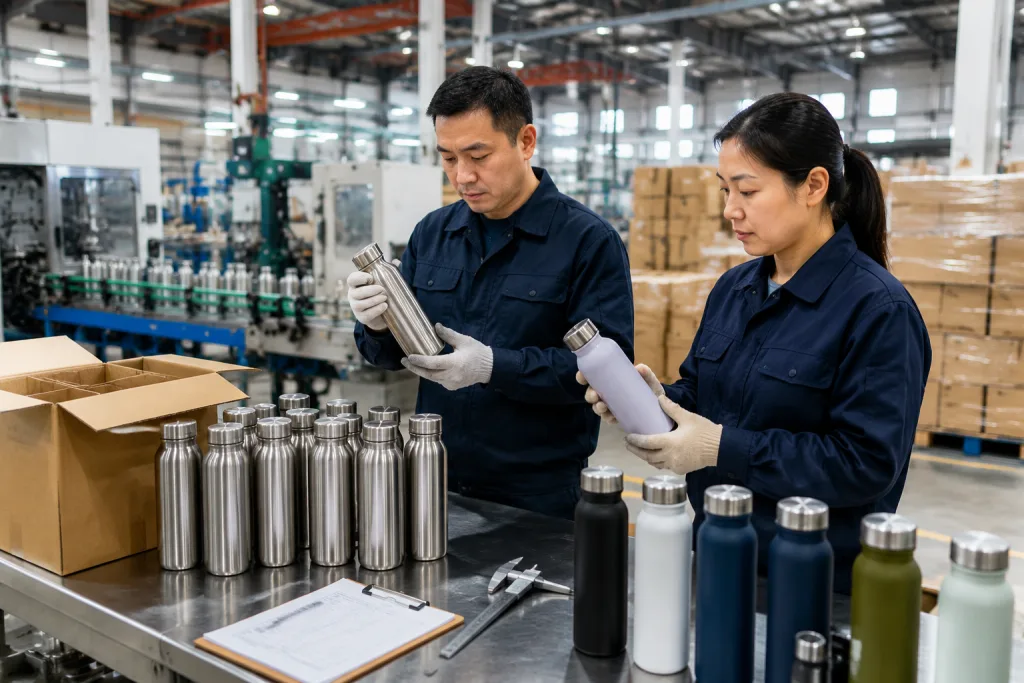
For a 304 stainless steel double walled bottle private label order, the sample checklist should cover measured height and diameter, practical capacity, empty weight in grams, cap fit, gasket seating, odor after hot-water rinse, coating feel, logo position, box fit, and barcode scan at 30 cm. Use calipers, a digital scale, and a measuring jug. Do not approve by hand feel. Capacity should be measured to the practical fill line, not brim-only marketing capacity. A 750 ml bottle that only holds 710 ml comfortably will create customer complaints if your packaging promises 750 ml.
Run simple abuse tests before approving the sample. Fill the bottle, invert it for 4 hours, and check leakage around the thread and gasket with dry tissue. Pour boiling water in, close it for 10 minutes, and touch the outer wall; clear heat transfer points to vacuum failure. For powder coating, use a cross-hatch adhesion test if you have the blade, or run a tape pull and fingernail scratch against the approved color chip. These checks do not replace lab testing, but they catch weak designs before we cut cartons and print 3,000 inserts.
Packaging samples need the same review. Retail box board should match the sales channel, not just look clean in a PDF. For ecommerce or Amazon FBA, an individual kraft box alone will not protect the bottle unless the master carton uses dividers or strong B-flute/E-flute construction. Confirm FNSKU label area, carton marks, country of origin, and suffocation warnings if polybags are used. We have seen this go sideways: the buyer approved the bottle, then flagged crushed corners after a 12 kg carton drop because the PO said “gift box” but the artwork file said “mail box.” About 6 out of 10 customizable drinkware complaints we see at shipment stage come from late packaging decisions, not the bottle itself.
Control Production Before It Drifts
After deposit and signed sample approval, production starts. On a normal Zhejiang schedule, we run material preparation for 5-7 days, forming and welding for 7-10 days, polishing and vacuum work for 5-8 days, coating for 5-7 days, then logo and packing for 5-8 days. A realistic total lead time is 35-45 days after artwork approval; before Christmas or major China holiday periods, plan closer to 45-60 days. The line usually waits on small things, not big machines: last month QC held 3 pallets because the PO showed “matte balck” while the approved coating chip said matte black.
The final inspection is the wrong control point to rely on. Confirm the first mass production units before the full batch is decorated and packed. Ask your canteen manufacturer to send production photos and 10-20 second videos at three checkpoints: raw body after forming with caliper readings on mouth diameter, coated body before logo, and packed master cartons with shipping marks visible. For orders above USD 25,000, or when the delivery date cannot move, book a third-party inline inspection. We have seen this go sideways: the buyer approved the bottle shape, then flagged the logo height after 8,000 pcs were already printed.
Color drift is common in powder coating. Define tolerance with a physical approved sample, not a screen image. For black, texture and gloss variation show faster than shade; a 10° gloss difference can make two bottles look like different SKUs under warehouse lights. For green, Pantone matching on curved metal is never perfect, so approve a working range before bulk coating. If your custom canteen line reorders every quarter, keep one signed golden sample at the factory and one in your office. Simple rule. QC pulled the sample from our shelf more than once to settle a repeat-order dispute in 3 minutes instead of 3 days.
Logo placement needs a written tolerance, for example ±2 mm vertical and horizontal from the approved artwork position. Without this, final inspection turns into an argument. Apply the same discipline to carton printing, barcode grade, and mixed-color packing ratios; write “6 black + 6 white per inner carton” if that is what you need. A practical factory metric: BottleForge can pack around 12,000-18,000 stainless bottles per day on standard private label lines when packaging is approved and materials are ready, but a missing insert or wrong barcode can stop the line as fast as a broken heat-transfer jig. The math doesn't work if artwork approval is loose and the vessel date is fixed.
Inspect With AQL, Not Hope
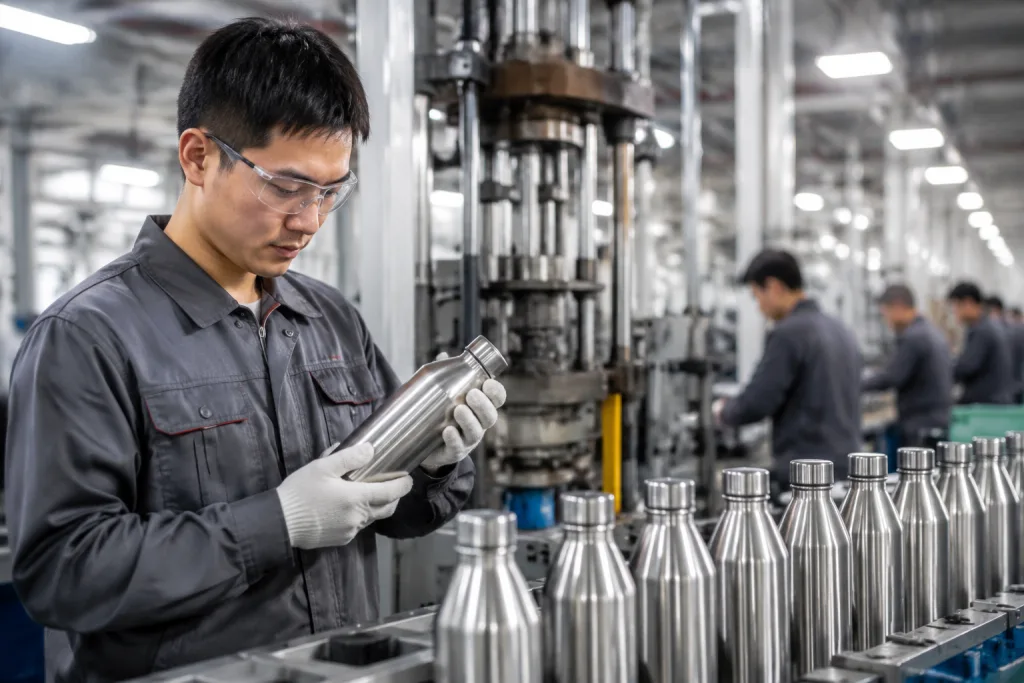
Run final inspection when at least 80% of the order is packed and 100% is produced. For distributor drinkware orders, AQL 2.5 for major defects and 4.0 for minor defects is a workable baseline; critical defects are zero, not “we’ll see.” Define the buckets before the inspector reaches the warehouse. A leaking cap, failed vacuum, rust inside, wrong logo, or unsafe sharp edge belongs in major or critical. A 0.3 mm coating speck on the bottom can sit in minor if the user will not see it during normal use. We had one PO where the logo color was typed as “Pantone 286C” in the artwork but “268C” on the order sheet; QC pulled the sample before packing, which saved 5,000 wrong bottles.
For a 5,000-unit order, an inspector might sample 200 units under a common general inspection level II plan, depending on the standard used. The inspection needs visual checks and capacity checks, plus barcode scans, carton drop test, logo adhesion or engraving position, cap leakage, odor, and basic function. Use a scale, measuring cylinder, 3M tape, torque check, and a simple water-fill leak test. For insulated bottles, test a smaller sample for thermal retention because it takes hours, not minutes. We run 8-13 units for extended thermal testing if the schedule allows, and the buyer should accept that a heat test started at 10:00 will not give a clean answer at 10:20.
Do not let the inspection report turn into 68 photos with no pass/fail rules. Your purchase order should state what happens if the batch fails: sorting with a signed record, rework, replacement, discount, or shipment hold. Pick the remedy before money is on the water. A serious canteen supplier will accept this because it protects both sides. If a canteen factory refuses third-party inspection, the math does not work for repeat orders. We have seen this go sideways when a buyer shipped first and argued later; by then, 37 cartons were already opened by end customers.
For private label stainless bottles, the most expensive defect is not a scratch. It is a defect your customer discovers after filling the bottle and putting it in a backpack.
Lab testing is separate from AQL inspection. If you sell in the EU, confirm food contact compliance and relevant REACH requirements for coatings or plastic parts. For North America, keep FDA-grade material documentation and any client-specific test requests. Test the exact cap, gasket, coating, and printed parts instead of relying on a generic certificate from a similar bottle. This is where some buyers ask the wrong question: “Do you have a certificate?” is weaker than “Does this PO’s black powder coating, silicone gasket, and PP lid match the test report?” Serious canteen distributors keep these documents linked to each PO, usually by SKU, batch number, and carton mark.
Ship Cleanly And Plan Reorders
I’ll rewrite the four paragraphs in-place, keep every HTML tag untouched, and tune the prose to sound like a buyer-facing factory handoff note.Once inspection passes, the job is not done. Match the packing list to the PO line by line: color counts, carton count, net weight, gross weight, carton size, HS code, and shipping marks. On 304 stainless steel vacuum bottles, buyers often land in stainless household-article HS buckets, but your customs broker still needs to confirm the code for your market. We’ve seen one wrong code wipe out the margin from a good FOB price.
For this order, the goods ship FOB Ningbo from Zhejiang, China. If you plan to consolidate with other custom drinkware, say it early. Mixed loading changes carton crush strength and pallet height, and the line needs that before we pack. If the bottles are going to an Amazon FBA prep center, carton labels, FNSKU labels, and the max carton weight must be set before packing starts. Re-labeling 5,000 units after shipment is slow, and the math doesn’t work.
After delivery, keep the records. Break defect claims into leakage, coating chip, dent, wrong color, cap issue, and barcode issue. If complaints stay below 0.5% and are mostly cosmetic, the order is healthy. If leakage hits 1%, stop and check cap torque with the torque tester, gasket compression, thread size, and the inspection method before you reorder. QC pulled the sample, and the buyer flagged it fast. This is the kind of field data that matters, not “quality good.”
For reorder planning, place the next PO before inventory drops under 10-12 weeks of sales. Standard production runs 35-45 days, and sea freight to Europe or North America can add 25-40 days port to port, plus customs and inland delivery. If you sell seasonal outdoor goods, lock forecasts before China’s National Day and Chinese New Year. Those gaps are fixed on the calendar. Missing them is usually a planning problem, not a factory surprise.
Send Your Bottle Spec For A Factory Quote
Share capacity, steel grade, logo method, packaging, target market, and quantity. We will return a practical FOB quote and production timeline.
Frequently asked questions
What is the normal MOQ for a private label 304 stainless bottle?
For an existing bottle shape, a practical MOQ is usually 1,000 units per SKU or color. If you need two colors, many canteen suppliers will ask for 1,000 units per color because powder coating lines and packaging materials have setup costs. For a custom mold, special cap, or unique customized growler body, expect 3,000-5,000 units minimum. At BottleForge in Zhejiang, China, we normally recommend starting with 3,000-5,000 units for a serious distributor canteen launch because it gives better unit cost and enough volume for proper carton printing, QC sampling, and freight efficiency.
Should the outer wall also be 304 stainless steel?
Not always. The inner wall should be 304 stainless steel because it contacts drinks. The outer wall can be 201 stainless steel for many mid-market private label bottles, which can save around USD 0.25-0.45 per unit on a 750 ml model. If your packaging claims full 304 construction, or if you sell premium outdoor custom canteen products, use 304 inner and 304 outer. The important point is to write the material clearly in the purchase order and test report request. Vague wording creates trouble with distributors, retailers, and customs documentation.
Which logo method is best for stainless private label bottles?
Laser engraving is the safest choice for many B2B orders because it does not peel, has clean edges, and works well on powder coated bottles. It is usually economical at 1,000 units and above. Silkscreen printing is better when you need a colored logo, but you must control Pantone matching, curing, and rub resistance. Heat transfer can show more complex graphics but adds cost and more surface risk. For canteen promotional orders with tight budgets, one-position laser or one-color silkscreen is usually the cleanest specification.
How long does production take after sample approval?
For a standard 304 stainless steel double wall bottle using an existing mold, plan 35-45 days after deposit, artwork approval, and sample sign-off. Add 7-15 days if you need custom packaging, special color matching, or lab testing before shipment. Around Chinese New Year, add more buffer because China factories, coating suppliers, carton plants, and trucking companies all slow down. If your delivery date is fixed for a retail launch or promotional event, lock the PO at least 90-120 days before the required warehouse arrival date.
What inspection standard should we use before shipment?
Use AQL inspection rather than informal checking. A common setting for customized drinkware is AQL 2.5 major and 4.0 minor, with zero tolerance for critical defects. Major defects include leakage, failed vacuum, wrong logo, serious coating damage, rust, or unsafe edges. Minor defects include small cosmetic marks that do not affect normal sale. Ask the inspector to check packed cartons, barcode scans, capacity, cap fit, leakage, logo position, and a sample of thermal retention. For a 5,000-unit order, inspection usually happens when 80% or more is packed.