Key Takeaways
- A serious 304 double wall bottle quote should state inner wall 0.4-0.5 mm, outer wall 0.5-0.6 mm, not just “food grade stainless steel.”
- For custom canteen orders, a realistic MOQ is 1,000-3,000 units per color depending on finish, lid, and packaging.
- Powder coating usually adds USD 0.35-0.70 per unit but gives better retail feel than basic spray paint.
- Ask for AQL 2.5/4.0 inspection, vacuum retention testing, and material reports before approving mass production.
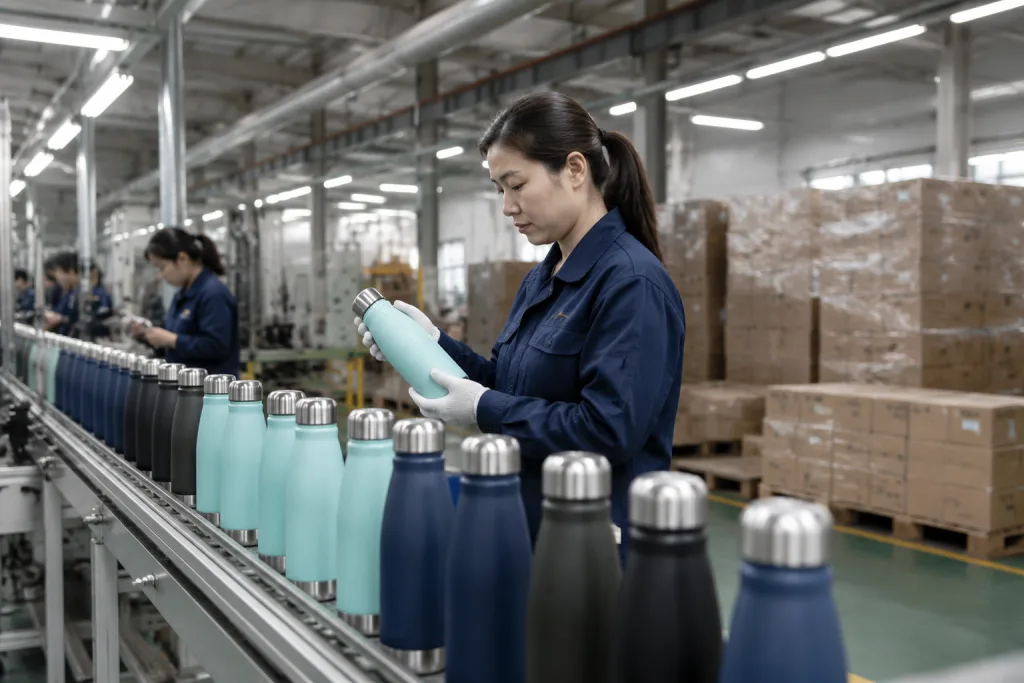
If you are choosing a 304 stainless steel double walled bottle manufacturer, finding a factory in China is the easy part. The hard part starts when two quotations look the same, then act nothing alike after 10,000 units have been welded, vacuum-tested, printed, carton-packed, and loaded. We run this line in Zhejiang; QC has pulled samples that looked fine on the desk but lost vacuum after the 95°C hot water test.
A 500 ml vacuum bottle at USD 2.80 FOB Ningbo and one at USD 3.45 FOB Ningbo may both say “304 stainless steel, double wall, powder coated.” That sentence hides the real cost drivers: 0.4 mm versus 0.5 mm steel, vacuum failure rate, lid tooling, coating thickness measured by film gauge, AQL discipline, and whether the canteen factory understands your sales channel. The buyer flagged it last month: the PO said matte black, the artwork file said gloss black. Small typo. Big argument. We manufacture in Zhejiang for B2B buyers who need straight answers before they commit to a custom drinkware program.
The head-to-head spec table
Buyers usually start with capacity: 350 ml, 500 ml, 750 ml, 1 L. Good for shelf layout. Bad for supplier comparison. For a canteen manufacturer, compare wall thickness, vacuum pass rate, coating method, logo tolerance, and packing risk. On our line in Hangzhou, QC pulled 32 pcs from a 500 ml trial run last month and found 3 lids with silicone rings sitting 0.8 mm proud, so the table below is the style we run with distributor drinkware buyers before we quote tooling, carton size, and lead time.
| Spec item | Budget promotional canteen | Retail-grade custom canteen | Outdoor/custom growler line |
|---|---|---|---|
| Inner steel | 304, 0.35-0.4 mm, usually enough for giveaways | 304, 0.4-0.5 mm, better dent resistance for retail returns | 304, 0.5 mm or heavier, built for rough handling |
| Outer steel | 201 or 304, 0.4-0.5 mm, cost-driven choice | 304, 0.5-0.6 mm, cleaner spec for chain-store buyers | 304, 0.6 mm with reinforced base, heavier in hand |
| Insulation | 6-8 hours warm claim, basic vacuum check | 12 hours hot, 24 hours cold typical, batch-tested before packing | 24-36 hours cold depending on volume, better fit for outdoor use |
| Finish | Spray paint or plain steel, faster but easier to scratch | Powder coat, metallic, rubber paint, checked with tape test | Powder coat, hammertone, stainless, thicker finish build |
| Logo | Silkscreen 1 color, lowest setup cost | Laser, pad print, UV print, matched to artwork size | Laser, emboss, sleeve, gift box, better for premium sets |
| Typical MOQ | 1,000 pcs/color, common promo order size | 2,000-3,000 pcs/color, smoother for coating yield | 1,000-2,000 pcs/model, depends on cap and box setup |
The key point is simple: a canteen customized for a bank promotion is not the same build as a customized growler for outdoor retail. We have seen this go sideways when a PO says “matte black bottle” but the buyer expects rubber paint, not standard powder coat; that one typo can add 12 days to approval against an 18-day production plan. If a canteen supplier gives one price without asking channel, target retail price, and packaging method, the math doesn't work. You are not getting engineering input. You are getting a number.
304 steel versus cheap substitutions
For B2B custom drinkware, 304 stainless steel is still the safe inner-wall choice because it holds up against water, tea, coffee, sports drinks, and daily washing. The common composition is roughly 18% chromium and 8% nickel, so retail packaging often calls it “18/8 stainless steel”. On our line, QC checks incoming coil with an XRF gun before drawing, then records the result against the order file. A proper 304 stainless steel double walled bottle manufacturer should provide material declarations and third-party food contact test reports when the buyer or market asks for them.
Some canteen suppliers cut the quote by using 201 stainless steel on the outer shell. That is not always a deal breaker if the inner wall is confirmed 304 and the buyer accepts the durability trade-off. For premium customized drinkware, 304/304 is the cleaner spec. We have seen rust complaints start around dented bases, laser-marked areas, and scratched powder coating after 3 months in use. For European and North American buyers, we normally recommend 304/304 for retail, corporate gifting above USD 10 retail value, and any distributor canteen line where returns eat the margin. A buyer once pushed back on USD 0.22 extra for full 304; the math did not work after the first return batch.
Here is the practical test: ask the canteen vendor to write the steel grade and wall thickness in the proforma invoice, not only in a chat message. Put “inner 304 / outer 304, wall 0.40 mm” or your agreed thickness on the PI so purchasing, QC, and the factory read the same spec. Also ask whether the factory runs incoming material checks with PMI or spot chemical testing. In Zhejiang, China, our production team records steel coil batch numbers and keeps retention samples by order. Boring paperwork. It matters when a container has 30,000 units and one distributor asks for proof six months later, or when QC pulled the sample and found the PO typo said “201 outer” by mistake.
Low steel cost can save USD 0.15 per bottle. One rust claim campaign can cost your brand ten times that, and we have seen this go sideways.
Which bottle fits which buyer
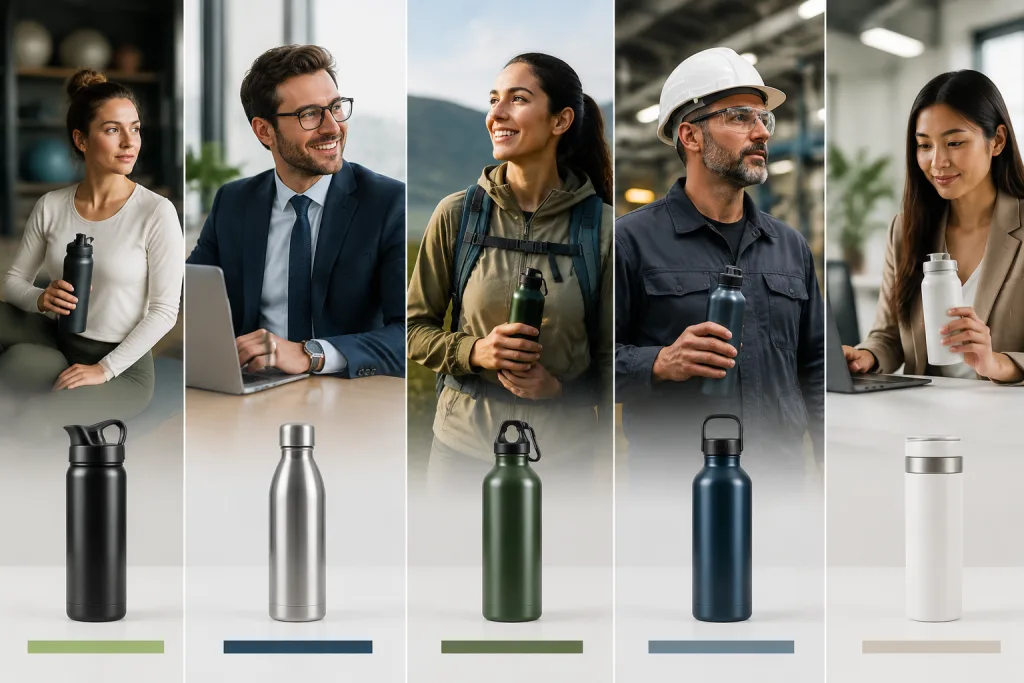
A canteen customizable program should be built around the sales channel, not the nicest catalog photo. Same 750 ml body, different result. We run this check at the sample table with a caliper, a filled bottle, and the buyer’s packing method before we talk about colors.
- Promotional buyer: For a conference giveaway, use a simple 500 ml or 600 ml model with one-color silkscreen logo and a standard white box. Stick to black, white, navy, or silver; QC can match those faster against our color chips, and the line loses less time during changeover. MOQ can start at 1,000 units per color. Skip premium lid tooling unless the campaign brief names it.
- Retail brand owner: For ecommerce or specialty retail, choose 304/304 steel with powder coating, then pick either laser engraving for a clean premium look or durable UV print for color artwork. Use a stronger box with foam or molded paper tray if the bottle is 750 ml or above; we have seen corner dents show up after a 1.2 m drop test. Expect MOQ of 2,000-3,000 units per color because color consistency and decoration setup matter.
- Canteen distributor: If you supply schools, clubs, gyms, or local businesses, choose a platform model with replaceable lids and repeat colorways. This is where the math is simple. A distributor drinkware line works best when spare lids share one thread size, cartons use one barcode label position, and the warehouse team does not need 8 different packing instructions.
- Outdoor or brewery buyer: For a custom growler or customized growler, check wall thickness, handle pull strength, and cap seal quality before chasing a low unit price. A 1.9 L vacuum growler is heavy; QC pulled one sample last season where the cap passed upright leak testing but dripped after 30 minutes on its side. Weak packaging will fail during courier delivery.
As a canteen manufacturer in China, we see about 6 out of 10 first-time buyers over-customize the first order. They ask for a new lid, new body shape, new paint, gift box artwork, and a non-standard carton size on the same PO; one buyer even typed “mat black” instead of “matte black,” and purchasing approved the wrong finish. That adds tooling cost, sampling days, and failure points. The smarter first order is a proven body with customized canteen color and decoration. After sell-through data is clear, invest in private tooling.
Logo methods compared without drama
Decoration is where 3 out of 10 custom canteen projects get messy on our line. A logo can look clean on the PDF and still fail on a tapered bottle, a rough powder coat, or a 9-day ship window; last month QC pulled the sample because the artwork sat 4 mm too close to the lower curve.
| Method | Best use | Approx. add cost | Watch point |
|---|---|---|---|
| Silkscreen | Simple 1-2 color logos on straight bodies | USD 0.08-0.18 | Weak choice on tapered bodies; screen edge can lift |
| Laser engraving | Permanent branding for corporate or retail gifts | USD 0.12-0.35 | Shows raw steel color under coating, so dark logos need planning |
| Pad printing | Small curved areas, lids, trigger parts | USD 0.10-0.25 | Artwork size is limited; 18 mm logos already feel tight |
| UV print | Full-color logos, gradients, wrap patterns | USD 0.35-0.90 | Needs abrasion testing before you promise retail durability |
| Emboss/deboss | Private tooling retail programs with repeat orders | Tooling often USD 800+ | Lead time is often 18 days vs 12 days for standard decoration |
For customizable drinkware, laser engraving is the safer call when the design allows it. It does not peel. It looks premium. It survives normal use better than ink on rough coating. For bright retail graphics, UV print works, but ask for 3M tape testing, alcohol rub testing, and a clear dishwasher statement. Be careful with “dishwasher safe” language; we have seen this go sideways when a buyer approved the bottle body but forgot the PP lid gasket and the printed logo. Around 70% of powder coated bottles survive casual dishwasher cycles, but lids, seals, and printed graphics are a different story. If you sell in Europe, keep the claim conservative unless you have test data.
Color matching needs discipline. Pantone on powder coating is not paper printing, and this is the wrong question to ask if the buyer expects a catalogue chip to match a sprayed metal bottle under every light box. A Delta E tolerance under 2 is tight and can raise cost; Delta E 3-4 is more realistic for industrial coatings on 304 stainless bodies. Good canteen vendors send pre-production color plaques or physical samples before mass coating; on our side, we run plaques at 180°C cure temperature and QC checks them under a D65 light booth before the coating line starts.
Factory capacity and lead time reality
A quotation without production timing is only half a quotation. BottleForge Industrial is based in Hangzhou, Zhejiang, with partner lines in Zhejiang and nearby China industrial clusters. For standard 304 double wall bottles, we run about 450,000-600,000 units per month, depending on season, coating mix, and inspection level. The bottleneck is usually not tube cutting; it is powder coating changeover, lid injection slots, or export carton supply. Last May, QC pulled 32 samples from a matte black run and found 3 with thin coating near the bottom radius, so the line lost half a shift for rework. That time has to be in the quotation.
For a normal customized canteen project, the working schedule is closer to this: 5-7 days for artwork and digital proof, 7-12 days for a physical sample when we use an existing mold, 25-35 days for mass production after deposit and sample approval, and 7-10 days for final inspection, balance payment, and China port handling. If the order needs new lid tooling or a new body mold, add 25-45 days before mass production. Short answer: no magic. We still need sample approval with the logo position measured in mm, and one PO typo in Pantone code can turn a 30-day job into a 42-day job.
MOQ depends on what you change. A plain stainless stock bottle with laser logo may be possible at 500-1,000 units. A powder coated canteen customized in a special Pantone color is usually 2,000-3,000 units per color because the spray booth and curing oven need a clean color run. A new shape for a private label distributor growler may need 5,000 units or tooling amortization. If another canteen supplier promises 300 units with custom color, new lid, retail box, and the lowest price, this is the wrong question to ask. Ask what they are skipping: coating adhesion test, lid fit check, or AQL inspection time.
FOB Ningbo or FOB Shanghai is typical for Zhejiang shipments. For North America, about 6 out of 10 buyers also ask for Amazon FBA preparation: FNSKU label, carton weight under 22 kg where possible, drop test packaging, and master carton barcode. We ship better when these rules are set before production. The buyer flagged this once after packing, and we had to reopen 186 cartons to add missing FNSKU labels; the math does not work when workers are relabeling cartons at 9 p.m. Those details should be priced before production, not negotiated when the goods are already packed.
Testing, inspections, and documents
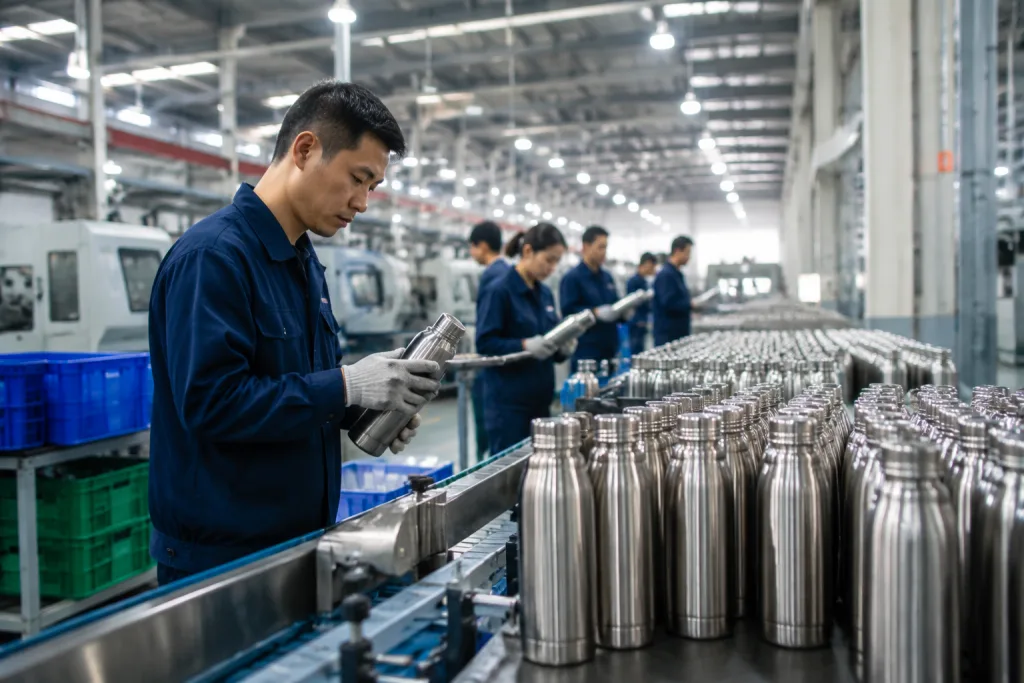
Quality control for double wall bottles is basic work, but the line has to run it the same way every order. For a 304 stainless bottle, we check vacuum hold after the copper brazing furnace, 100% leak test on the lid, cross-cut coating adhesion with 3M tape, logo rub test, lid thread fit on the go/no-go gauge, odor after hot water filling, and carton drop strength at 76 cm. Small faults cost money. A pinhole at the weld can turn into weak insulation. A soft silicone ring can soak a 12-bottle export carton. A coating edge under 18 microns can look fine today and come back as a scratch claim after 14 days in retail handling.
For B2B orders, put AQL inspection terms on the PO, not just in emails. We usually see AQL 2.5 for major defects and 4.0 for minor defects, with critical defects at 0. Critical defects include sharp edges, contamination, serious leakage, and wrong material. Major defects include poor vacuum insulation, severe dents, wrong logo placement, and non-functioning lids. Minor defects include small coating specks within agreed limits, light carton marks, or slight color variation. The buyer flagged this once after QC pulled 200 pcs from a 5,000 pcs lot and found the logo 3 mm lower than the signed sample; without AQL written on the PO, the argument took two days longer than the inspection.
Documents depend on the selling market, and this is where the wrong question gets asked. Do not ask, “Do you have certificates?” Ask which lab, which item code, which material contact surface, and which report date. For the EU, buyers commonly request LFGB or EU food contact test reports, REACH-related declarations, and packaging compliance. For the US, FDA food contact expectations and, for children’s items, CPSIA considerations may apply. If you sell kids bottles, ask about ASTM F963 where relevant. For factory social compliance, BSCI or SEDEX audit status may matter to larger retailers. We have seen this go sideways when a buyer’s PO said “black lid” but the test report covered only natural PP; the lab re-test added 9 working days before shipment.
One practical rule: approve a golden sample and keep two signed samples, one with the canteen manufacturer and one with you. During final inspection, compare mass production against that sample with calipers, a Pantone book, and the approved carton mark copy. Photos help, but a physical sample settles arguments faster. We ship smoother when the inspector can put the bottle beside the signed sample and say, “same logo height, same lid gap, same coating gloss.”
How to read the final quote
A usable quote from a 304 stainless steel double walled bottle manufacturer should let your buyer compare canteen vendors line by line. If it only says “vacuum bottle, 500 ml, logo, box,” push back. Too thin. We need the assumptions behind the number, because one buyer once flagged a 0.4 mm body on the quote while the approved sample we ran on the line measured 0.5 mm with a digital caliper.
Ask for capacity, dimensions, net weight, steel grade, wall thickness, lid material, seal material, coating type, logo method, packaging, carton quantity, carton size, gross weight, MOQ, sample cost, tooling cost if any, production lead time, payment term, Incoterm, and validity period. Ask whether the quote includes inner box, instruction sheet, barcode, polybag, desiccant, spare straw, brush, or hangtag. These small items can move the cost by USD 0.05-0.40 per unit; on a 5,000 pcs order, that is USD 250-2,000, not petty cash. QC pulled the sample last month and found the PO said “white box,” but the buyer expected a 350 gsm color box with EAN sticker.
For example, a retail-grade 750 ml customized drinkware bottle may quote around USD 3.20-4.60 FOB Ningbo depending on lid, coating, logo, and box. A 1.9 L customizable growler may sit around USD 8.50-14.00 FOB depending on handle, cap, and steel thickness. These are working ranges, not promises without drawings. If your target is USD 2.70 for a 750 ml powder-coated bottle with laser logo and color box, the math doesn't work; we would rather say that before the mold room cuts a lid insert and the sample takes 7 days.
The best canteen manufacturers are not the ones who say yes to every target price. They explain what changes when you cut USD 0.30 from the bottle: thinner steel, simpler lid, cheaper coating, lighter box, or less inspection time. We have seen this go sideways when a buyer saved USD 0.18 on coating and then got 23 pcs with rub marks in one AQL 2.5 pre-shipment check. Once the trade-off is clear, you can make a commercial decision instead of guessing.
Send your bottle spec for a practical quote
Share capacity, target price, logo, quantity, and destination. We will reply with realistic FOB options, MOQ, and lead time.
Frequently asked questions
What MOQ should I expect for a custom 304 double wall canteen?
For an existing bottle mold with laser logo, MOQ can sometimes start at 500-1,000 units. For powder coated custom canteen colors, a practical MOQ is 2,000-3,000 units per color because coating lines need setup time and stable color batches. If you need a new lid, new body shape, or private retail packaging, expect 5,000 units or tooling fees. For distributor canteen programs, we usually suggest starting with 2-3 core colors at 2,000 units each rather than six colors at low volume.
Is 304 stainless steel enough for European and North American sales?
304 stainless steel is the normal food-contact choice for stainless drinkware, but material grade alone is not the whole compliance package. You should request food contact test reports such as LFGB or EU food contact testing for Europe and suitable FDA-related documentation for the US. For coatings, inks, and silicone seals, ask what was actually tested, not only the steel body. If you sell children’s bottles, CPSIA and ASTM considerations may apply. A reliable canteen supplier should identify test scope before mass production.
How long does a customized drinkware order take from sample to shipment?
For an existing model, allow 7-12 days for a physical sample after artwork approval, then 25-35 days for mass production after deposit and signed sample approval. Final inspection, balance payment, and export handling normally add 7-10 days. In total, 40-60 days is realistic before vessel departure for many China FOB orders. New tooling can add 25-45 days. If your launch date is fixed, tell the manufacturer before quoting so coating, packaging, and inspection can be planned correctly.
Should I choose laser engraving or printing for my logo?
Laser engraving is best for a premium, permanent logo on powder coated or stainless surfaces. It usually adds about USD 0.12-0.35 per unit and has low failure risk. Silkscreen is cheaper, often USD 0.08-0.18, and works well for simple 1-color promotional logos. UV printing is better for full-color artwork but may cost USD 0.35-0.90 per unit and should be abrasion tested. For canteen promotional orders, choose silkscreen. For retail custom drinkware, laser is usually safer.
What should I check before paying the balance to a canteen vendor?
Book a final inspection using AQL 2.5 for major defects and 4.0 for minor defects, with critical defects at 0. Check quantity, carton marks, barcode, logo position, color, coating defects, dents, leakage, lid fit, odor, and vacuum performance. Ask the inspector to compare against the approved golden sample. Also confirm carton size, gross weight, and packing list match your freight booking. Do not rely only on factory photos for a first order, especially if it is a new canteen vendor.