Key Takeaways
- A serious 304 stainless steel double walled bottle factory should quote MOQ, lead time, and unit price together; a typical MOQ is 500-1,000 pcs.
- For 304 inner walls, specify 0.4-0.5 mm stainless steel, vacuum insulation, and an AQL 2.5 inspection plan before you pay.
- Samples usually cost USD 35-120 per style with 7-12 days lead time; bulk production commonly runs 30-45 days after approval.
- Your PO should list capacity, finish, logo method, packaging, carton marks, and test standards like REACH and LFGB when needed.
` tags intact, and make it read like a factory-side sales note with a few concrete shop-floor details.
If you are buying custom drinkware for retail, wholesale, or e-commerce, the hard part is not finding a supplier. The hard part is checking whether the factory can hold spec when the order moves from sample to 5,000 or 20,000 pieces. A 304 stainless steel double walled bottle factory should quote cleanly, show the wall thickness, confirm vacuum performance, and give the lead time in days, not in sales talk. We run this check on the line with a wall gauge and a vacuum test, because the buyer flagged one “same sample” order that came back with a 0.2 mm mismatch.
That matters even more when you buy in Zhejiang or anywhere else in China, because the spread is wide: some canteen makers are set up for 300-unit trial runs, others ship 300,000 units a month. If you want a canteen custom program that survives retail returns, distributor reorders, and Amazon pressure, start with the RFQ and end with a tight bulk PO. The math does not work any other way. QC pulled the sample against the PO twice after one buyer typoed the lid color code, and that saved a painful rework.
Start With A Clean RFQ
Your RFQ should do more than ask for a price. A 304 stainless steel double walled bottle factory needs enough detail to fix the body construction, decoration, and packing method before quoting a number you can trust. If you send “custom bottle, 5000 pcs,” you will get a soft quote back; we have seen that turn into a 6% margin hit after the buyer flagged the lid upgrade and color box after PI approval. Bad start.
Send one product per line item. State capacity in ml and oz, target market, inner and outer material, lid type, surface finish, logo method, and packaging. For example: 500 ml, 304 inner / 201 outer if allowed, or full 304 if you want a premium spec; powder coat matte black; laser logo 30 x 20 mm; brown box with one-color print. Our laser operator sets the logo jig from the artwork size, not from a screenshot pasted into email. If you want canteen customized for a distributor program, tell the factory if you need canteen promotional pricing, mixed colors, or a retail-ready master carton with barcode placement.
Good RFQs ask the factory to confirm hard numbers: MOQ, sample cost, lead time, monthly output, and repeat-order capacity. At BottleForge in Zhejiang, a normal production line for this category can run 120,000 units per month, but only if your spec stays stable and the packaging file is not changing every week. We run the line by BOM version; one PO typo on “matte” versus “glossy” can hold packing for 2 days. Asking “what is your best price?” is the wrong question to ask. Ask what spec the price is built on.
- State target price, preferably FOB Ningbo or FOB Shanghai.
- Ask for wall thickness, usually 0.4 mm to 0.5 mm for the inner cup.
- Request vacuum retention test data and leak test method.
- Specify whether you need canteen custom, custom canteen, or distributor drinkware packaging.
Check Factory Capability First
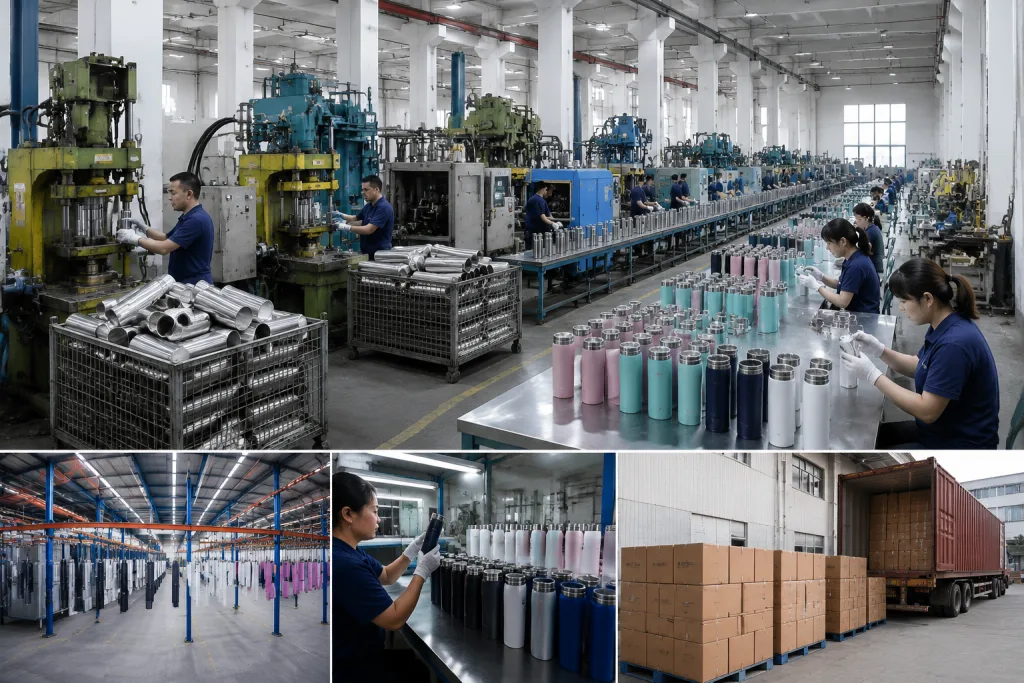
Before you talk decoration, confirm the supplier is a real canteen manufacturer, not a trading office asking a factory for answers after your call. We run into this often. A real plant can show which steps are in-house: tube cutting on the line, necking with the forming die, TIG welding at the bottle mouth, polishing wheels, vacuum sealing, powder coating, and final packing with carton drop-test records. Ask where the 304 stainless body is welded and what gauge they run, such as 0.4 mm or 0.5 mm. If they cannot explain the flow from raw tube to packed carton, they are the wrong canteen supplier for a repeat program.
Ask for business licenses, BSCI if you sell into mainstream retail, and test documents that match your market. For Europe, you may need REACH-related material declarations, and for food-contact compliance the factory should know what your importer or lab wants. In the US, you still need your own checks, but a solid factory should supply material specs, test reports, and batch traceability without drama. QC pulled a sample for one buyer last year and found the PO said “304 stainless,” while the supplier’s file only showed a lid gasket report. That order stopped. If they hesitate on documents, move on.
Capacity matters because a canteen distributor or canteen distributors team usually needs 3 to 8 SKU drops, not a one-off. A factory that turns 120,000 units per month can support a distributor canteen rollout; a smaller workshop may lose control on color consistency or vacuum leak rate once the order passes 20,000 pieces. Ask for defect history and what AQL they accept. For bulk drinkware, AQL 2.5 for major defects and 4.0 for minor defects is a normal starting point. Perfection is the wrong question to ask. You need a repeatable process, a line that records leak-test failures, and supervisors who know why 18 rejects in a 500-piece inspection lot matter.
“If the factory cannot show where the bottle is welded, how it is vacuumed, and how it is inspected, you are not sourcing. You are hoping.”
Approve The Sample Properly
I’ll rewrite the section in-place, keeping the HTML structure and tightening the sales-engineer tone with concrete factory details and fewer generic phrases.Sample approval is where a lot of canteen custom jobs slip. Buyers stare at the logo and miss the parts that drive returns: lid torque, seal compression, condensation on the sleeve, and whether the cap still threads cleanly after 50 open-close cycles. A sample should prove construction, not just show a pretty face.
We usually see sample pricing from USD 35 to USD 120 per style, depending on new tooling, custom lid parts, or a special coating. Standard sample lead time runs 7 to 12 days; if you need a new mold or a custom growler body, plan 15 to 25 days. For a customizable growler or customized growler for beer or cold brew, lock down mouth opening, carbonation tolerance, and gasket material before you sign off. The math does not work if those points are still open.
Test the sample like a buyer who expects pushback. Fill it with water at 95°C, close it, check for leaks after 10 minutes, then log the temperature at 6, 12, and 24 hours. If the factory claims 12-hour hot retention, ask for the test rig, the ambient temp, and the probe position. On our line, QC pulled a sample once because the lid sat 0.8 mm high and the seal showed a faint wet ring after the shake test. That is the kind of miss that turns into a claim later.
- Approve or reject against a written sample checklist.
- Confirm logo size, color code, and placement before bulk.
- Record actual weight and tolerance, not just nominal spec.
- Keep one sealed control sample for future disputes.
Lock The PO Line Items
I’ll rewrite the section in-place, keep the HTML exactly as-is, and tighten the sales-engineering tone with more factory-floor specificity.Your purchase order should read like a control sheet, not a polite email. If the PO is loose, the buyer flags it later and the factory starts arguing over what “same as sample” means. We’ve seen that go sideways on the line more than once. For a canteen factory, the PO is where we lock material, decoration, packaging, and test points.
Each line item should carry product name, size, construction, finish, logo method, accessory list, unit price, total quantity, approved sample reference, packaging spec, delivery term, and shipment split if any. Example: 500 ml 304 stainless steel double walled bottle, powder-coated matte white, laser logo, PP lid with silicone ring, 1 pc in color box, 50 pcs per carton, FOB Ningbo, 3,000 pcs. If you buy custom drinkware for several regions, add carton label text, barcode type, and whether the unit is FNSKU-ready for Amazon or retailer distribution. QC pulled the sample with a 0.3 mm finish mismatch once; the PO typo was the whole cause.
This is where you protect margin. If you want customizable drinkware across several SKUs, put the exact mold numbers or artwork codes in the PO. If you work with canteen vendors in different markets, give each market its own PO or at least its own line item. One line should not cover mixed construction and mixed packaging unless you want mixed results. The math doesn’t work.
Useful PO items:
- Material: 304 inner, 201 outer, or full 304 depending on your spec.
- Wall thickness: 0.4 mm or 0.5 mm.
- Surface: spray paint, powder coat, or polished steel.
- Packaging: color box, master carton, drop test requirement, barcode label.
Manage Bulk Production And QC
Start bulk only after the approved sample, final artwork, and signed PO match line by line. In China, one common mistake is thinking the factory will “remember” the sample details when the line opens. They remember the latest message in WeChat or the last marked PDF, and that is not always the approved one. We run a pre-production sample or golden sample before mass output, with the logo position measured by caliper in mm and the lid torque checked before QC signs the board.
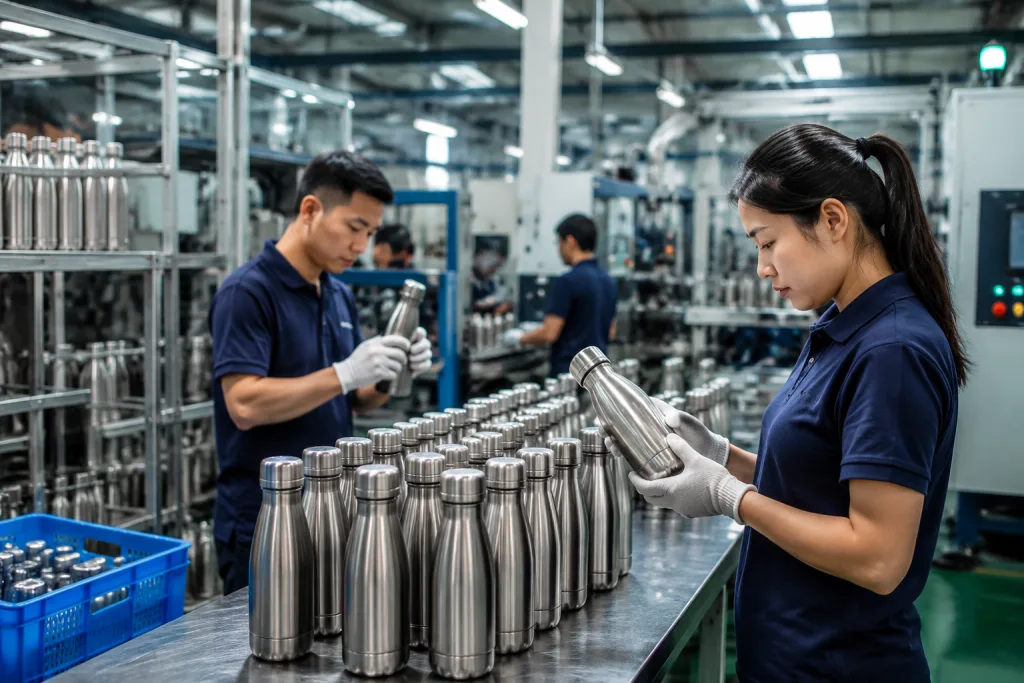
During bulk, check the control points that cause claims: raw tube incoming inspection, weld seam appearance, vacuum integrity, coating uniformity, and lid fit. For customized canteen orders, ask for in-line photos at welding and coating stages, not only packing photos with sealed cartons. QC should pull AQL sampling at final inspection, run leak test checks, and do carton drop tests if your channel is retail or distributor drinkware. Standard lead time is 30 to 45 days after sample approval, but powder coating rework or peak-season congestion in Zhejiang can change a 35-day plan into 48 days. We have seen this go sideways when a buyer approved matte black, then flagged gloss difference after 6,000 pcs were already sprayed.
Keep communication tight. Ask for production photos every 5 to 7 days. For a bulk order above 10,000 pcs, request a count by style and color before booking freight, and ask for carton numbers from the packing line, not a rough “ready soon” answer from sales. If the supplier says “everything ready” but cannot show carton marks and pallet count, they are not ready. Simple as that. For distributor canteen programs, mixed lots and split shipment logic should be fixed before production starts; changing it when the truck is at the dock costs time, and the math does not work if 120 cartons need to be reopened.
QC checkpoints worth writing into your order:
- Leak test on 100% of lids or a clearly defined sampling rate, with the test method written on the QC sheet.
- Vacuum performance verified on finished units, pulled from packed cartons instead of only the first table samples.
- Logo rub test for painted or printed decoration, including tape test or alcohol rub if your artwork uses fine lines.
- Carton compression and drop test for export packaging, especially when cartons are over 12 kg or going to distributor warehouses.
Price By Market And Channel
I’ll rewrite the section in place, keep the HTML untouched, and tighten the sales language so it sounds like a factory-side buyer note.Price is not just steel. The same 304 stainless steel double walled bottle factory can quote USD 2.10 on one spec and USD 5.80 on another when the lid, coating, or carton changes. We saw this on a 500 ml run last month: brushed body, plain lid, export carton, no drama. Once the buyer added a gradient finish and gift box, the math moved fast.
For North America and Europe, the channel sets the cost. E-commerce drinkware usually needs tighter packaging, barcode labels, and a lower defect limit, so the line runs more checks and the price goes up. Distributor canteen programs are different; mixed SKUs, spare parts, and extra outer cartons add labor and cube. If you are a canteen distributor, ask the factory to split product cost from packaging cost. Otherwise you are comparing apples to cartons.
As a working range, a 500 ml 304 stainless steel double walled bottle with a basic laser logo, simple lid, and export carton may sit around USD 2.20 to USD 3.60 FOB in 3,000 to 5,000 pcs. Add premium powder coating, a color box, or a custom lid and it can move to USD 4.50 to USD 6.50. A custom growler style with a heavier body and a more complex seal usually lands higher. QC pulled one sample at 0.35 mm wall thickness and the buyer flagged it, so we know where the cost pressure shows up.
If a canteen supplier sends a price that looks too good, ask three things: what is the inner steel grade, what is the wall thickness, and what packaging is included. One typo on a PO can hide a lot, and we have seen that go sideways. The right question is not “why so cheap?” It is “what did you leave out?”
Build Reorder Logic Early
Good buyers don’t treat the first order like a one-shot deal. They build the reorder plan while the first bulk run is still on the line. If you want to grow into a canteen distributor, lock the repeat points early: Pantone code on the powder coating card, logo position in mm from the bottom edge, and inner box layout with flute type marked. QC should pull the golden sample before mass packing, not after 20,000 pcs are already sealed. If the factory cannot repeat the same bottle six months later, the math doesn’t work. That supplier is a spot source, not a long-term vendor.
Keep the file system clean: approved sample photos, artwork files, carton specs, test reports, and the exact PO version. We’ve seen a repeat order delayed 12 days because the buyer sent “final logo.pdf” while the last approved file was “final logo-2.ai” with a 3 mm lower print position. When you place a repeat order, reference the previous order number and the golden sample. That saves time when a canteen manufacturers team changes the production manager or a coating batch comes out half a shade warm under the D65 light box. In Zhejiang, the stronger factories already work this way: fixed molds, signed SOP sheets, and QC records kept by order number. That is what you want from a canteen vendor.
For custom drinkware and customizable drinkware lines, plan for three reorder scenarios with real specs, not loose ideas. Same spec means same lid, same 304 stainless body, same carton weight limit, and the same barcode placement. Color refresh needs a new spray-out panel and buyer sign-off before we run bulk coating. Channel-specific packaging needs a separate packing instruction because retail buyers often ask for shelf-ready boxes, while wholesale customers usually want 24 pcs in a master carton. We’ve seen this go sideways when both channels used one PO and the warehouse mixed cartons. Handle it upfront, and the next purchase order is faster to approve.
Strong buyers also use the first order to measure supplier behavior. Sample lead time should be counted in days, artwork changes should be confirmed against the dieline, and document accuracy should include the small stuff like HS code, carton CBM, and company name spelling on the invoice. One buyer flagged a typo on the PO after the deposit was paid, and it took two emails plus a stamped revision to clean it up. Watch how the factory responds. In this business, a stable supplier is usually worth more than saving USD 0.08 per unit.
Send your RFQ and lock the sample
We quote MOQ, unit price, and lead time clearly, then turn your approved sample into a repeatable bulk order from China.
Frequently asked questions
What MOQ should I expect from a 304 stainless steel double walled bottle factory?
For a standard 500 ml bottle, a realistic MOQ is usually 500 to 1,000 pcs per color or per style. If you need a new lid or special mold, some factories will ask for 3,000 pcs or more. For canteen custom programs, MOQ rises when you add multiple colors, special packaging, or mixed logo methods. A factory in Zhejiang with stable lines can often support lower trial quantities, but the unit price will be higher. Always ask whether the MOQ is per SKU, per color, or per artwork version, because that changes the math fast.
How long does sample and bulk production usually take?
A standard sample usually takes 7 to 12 days. If you need new tooling, a custom growler style, or a special lid, allow 15 to 25 days. Bulk production is commonly 30 to 45 days after sample approval and artwork confirmation. During peak seasons in China, especially in Zhejiang, the timeline can stretch by another week or two. If a supplier promises 10-day bulk delivery on a custom drinkware order, be careful; that usually means they are pulling stock parts, not making a true customized canteen program.
What should I put in a PO for custom drinkware?
Your PO should list the exact product name, size, material, wall thickness, finish, logo method, packaging, quantity, unit price, Incoterms, and approved sample reference. Add barcode or FNSKU information if you sell through Amazon or retail channels. For canteen distributor orders, include carton pack count, master carton dimensions, and whether mixed SKUs are allowed. The PO should also state inspection standard, such as AQL 2.5 for major defects, and any compliance documents you require, such as REACH or food-contact declarations.
How do I know if the bottle is really 304 stainless steel?
Ask for a material declaration from the factory, then confirm whether the inner wall is 304 and whether the outer wall is 304 or 201. Many buyers only need 304 on the food-contact side, but you should write the spec clearly. If you want full 304, say so in the RFQ and PO. A trustworthy canteen manufacturer should also be able to show incoming material records and, if needed, third-party test reports. For export programs, that traceability matters more than a verbal claim.
What price range is normal for a custom canteen or customized growler?
A basic 500 ml 304 stainless steel double walled bottle with simple laser logo and export carton often lands around USD 2.20 to USD 3.60 FOB at 3,000 to 5,000 pcs. Better finishes, premium lids, and retail packaging can push the price to USD 4.50 to USD 6.50 or more. A customized growler usually costs more because of the heavier body, larger capacity, and sealing requirements. If a canteen supplier quotes far below that, ask what steel grade, thickness, and packaging are included before you compare it against another supplier.