Key Takeaways
- 304 stainless steel usually adds 8-15% cost versus lower-grade steel, but it reduces rust risk and complaint rate.
- Most export-ready MOQ starts at 500-1,000 pcs per SKU; custom colors can push it to 3,000 pcs.
- A typical 500ml double-walled bottle weighs 260-340g and holds temperature for 6-12 hours depending on lid design.
- A Zhejiang canteen factory with 300,000 units/month capacity can usually hold 35-45 day lead time on standard custom orders.
If you are buying a 304 stainless steel double walled bottle custom for retail, corporate gifting, or marketplace sales, the real decision is not “which bottle looks nice.” That is the wrong question to ask. The spec has to survive carton drop tests, logo approval, container loading, and a second PO without killing your margin. In Zhejiang and across China, the factories that win these programs are not the ones with the prettiest catalog. They are the ones that hold ±0.3 mm mouth tolerance, pass REACH, and ship 10,000 pcs at the same cost they quoted before the buyer flagged the lid fit.
A custom bottle is never just a bottle. You are locking steel grade, vacuum structure, powder coating, lid tooling, and logo method into one production plan. Miss one item and the math doesn’t work: MOQ moves from 1,000 pcs to 3,000 pcs, unit cost jumps by USD 0.18, or QC pulled the sample after the logo faded at 30 wash cycles. We run this on the line every week. If you want a practical buying path, start with four decisions that control most of the result: material choice, bottle structure, branding process, and whether the factory can repeat the same spec on the next order.
Start with the spec, not the logo
Buyers often start with the logo. Wrong order. For a 304 stainless steel double walled bottle custom order, the spec decides whether the bottle is safe to sell and stable on the shelf. Ask the canteen manufacturer for the exact steel grade, inner wall thickness, outer wall thickness, vacuum process, and coating system before artwork starts. On our line, QC checks cut-open samples with a digital caliper; one 0.08 mm short wall can turn a “premium” bottle into a return claim after 6 hot washes. Saving $0.40 on material is not a saving if the buyer flags rust spots in the first shipment.
For export orders, 304 stainless steel is the baseline we run because it gives a workable balance between corrosion resistance, food-contact acceptance, and price. Typical inner wall thickness sits around 0.35-0.45 mm, while the outer wall often runs 0.30-0.40 mm. If a supplier cannot state those figures, you are probably not talking to the real canteen factory; you are talking to a trading layer with no control over coil purchase or vacuum yield. We have seen this go sideways: the PO said “food grade steel,” the buyer expected 304, and the factory used 201 to hit the target price. In Zhejiang, stronger canteen suppliers will share steel coil certificates and salt-spray expectations, which helps when a retailer asks your team to defend the product spec.
- Ask for steel grade: 304, not vague “food grade” wording on the quotation.
- Confirm vacuum insulation time in hours, with test conditions such as starting water temperature and room temperature.
- Request wall thickness in mm and lid material by resin code, then match it against the pre-production sample.
- Check whether the item is meant as a custom canteen, custom growler, or everyday bottle, because body diameter, shoulder height, and capacity all change cost.
Choose the right wall structure
Double wall construction is not one spec. You are choosing heat hold, body weight, dent resistance, and how hard the tooling is to control on the line. A standard 500ml bottle with double vacuum walls can keep drinks hot for 6-8 hours and cold for 8-12 hours if the lid seal passes our 15-minute inverted leak test and the neck is not oversized. Small necks matter. If you stretch the body into a growler shape, the bottle looks stronger on the shelf, but thermal performance drops a little and freight cost often rises 10-20% because the carton gets taller. We saw this on a 40HQ load where the buyer flagged the pallet count after we changed the height by 12 mm.
For distributor drinkware programs, a simpler silhouette sells better than a fancy one. It packs tighter, prints cleaner, and takes more abuse in the export carton. A canteen distributor moving mixed SKUs will often choose a 250g-300g body with a matte powder coat instead of a heavier mirror-polished finish. Powder coating adds roughly $0.20-$0.45 per piece, but it gives better grip and hides handling marks from carton rub. QC pulled the sample after a 60 cm drop test once; the polished body showed every scuff, while the powder-coated one still looked sellable. For a canteen promotional program, the math works because the product stays presentable after warehouse handling.
Rule of thumb: if the bottle will be handled daily, pay for coating and lid sealing first; if it will sit on a shelf, pay for decoration first.
For a distributor canteen or distributor growler line, lock the dimensions early. Even 2-3 mm changes in diameter can change carton fit, pallet count, and landed cost in North America or Europe. This is where the wrong question gets asked. Buyers argue over $0.08 on unit price, then lose $0.22 per piece because the revised diameter cuts 96 bottles from a pallet. We run carton checks with a caliper before mass production for this reason, and we have seen 17 vendors lose money quietly here.
Pick branding that survives use
Match the logo method to the sales channel, not to what looks best in a mockup. Screen print keeps the unit cost down for promo buyers, laser engraving survives daily handling on brushed steel, and UV print is the right call only when the artwork needs gradients or 4-color detail and the coating has passed adhesion checks. On a 304 stainless steel double walled bottle custom order, the wrong decoration can be the difference between a 90-day complaint cycle and a 12-month repeat program. We have seen this go sideways: QC pulled the sample after 80 rubs with detergent, and the red UV layer started lifting near the shoulder radius.
For most B2B drinkware, laser engraving is the safest default when the buyer wants a premium look with low claim risk. It usually adds $0.10-$0.35 per location and works well on brushed or powder-coated surfaces. Screen printing fits canteen promotional item orders where brand color matters and the buyer is fighting for a lower unit price; expect a setup fee plus a unit cost that drops at 1,000 pcs and above. If you need a canteen customizable product line for retail, use one base body with two decoration routes: screen print for the entry SKU, laser engraving for the gift SKU. The line can run both, but separate the PO clearly. Last month a buyer typed “matte black laser” in one column and “white print” in the artwork file, and pre-production stopped for 2 days.
- Use laser for long-life branding and lower return risk.
- Use screen print for tight Pantone color matching and promo runs above 1,000 pcs.
- Use embossing or debossing only if your MOQ can support new tooling and a mold charge.
- Ask for rub testing: at least 50-100 cycles with a soft cloth and detergent.
For custom drinkware sold through Amazon or retail, clear logo placement beats fancy effects. If the marking sits within 3-5 mm of seams, curves, or the bottom taper, inspection failure goes up because the pad or laser head cannot hold a clean contact angle. Simple wins. A reliable canteen manufacturer in China will flag this before mass production, not after; if they approve every logo position without checking the bottle drawing, the math doesn't work.
Match MOQ to your channel
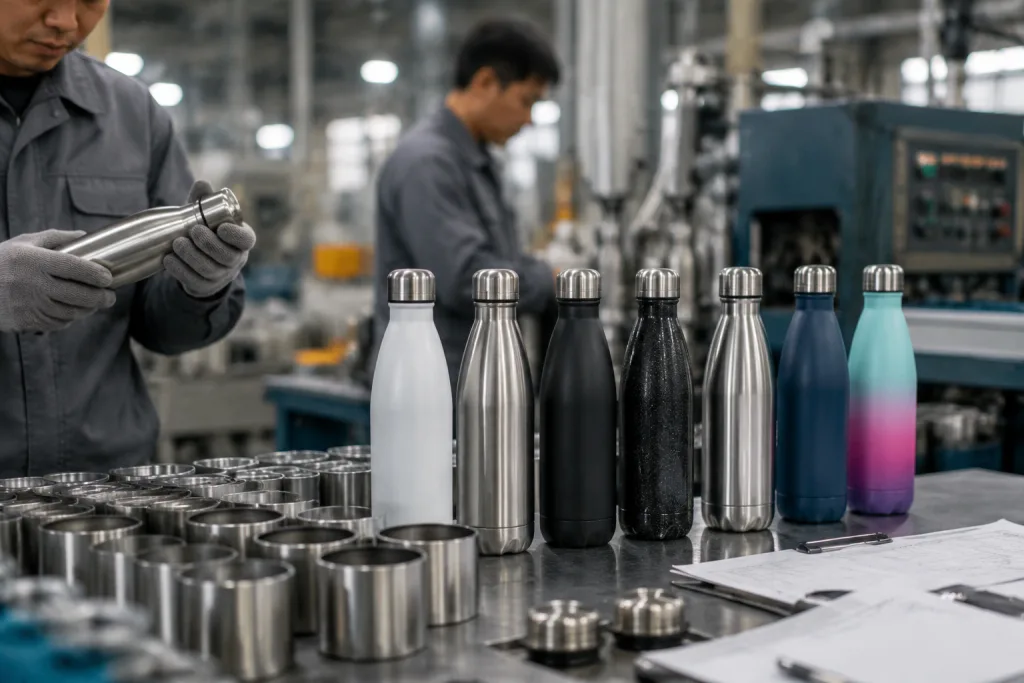
MOQ is not just a factory rule; it is a risk filter. A real canteen factory in Zhejiang might offer 500 pcs MOQ for standard stock-body customization, 1,000 pcs for mixed lid options, and 3,000 pcs for new color powder coating. Sounds flexible. The hidden cost shows up on the line: separate inner boxes, different barcode labels, extra sealing tests, and QC photos for each version. Last month QC pulled a 500ml sample because the color code on the carton mark was printed “BK” while the PO said “BLK”. If you are testing a new market, do not let the supplier push you into too many SKUs too soon.
For a canteen supplier handling export orders, the clean first order is simple: one body, one lid, one decoration method, one carton spec. If your buyer channel includes distributors, keep the line tight. A canteen distributors program with 6 colors and 4 lid types looks good in a catalog, but it creates 24 pick faces in the warehouse before you sell one bottle. We run into this during packing when workers need four lid bins beside one conveyor, and mistakes start at the 9th carton. You need items that reorder cleanly, not slow movers sitting under dust covers.
Pricing tracks MOQ hard. At 500 pcs, a 500ml 304 double wall bottle may land around $3.20-$4.60 FOB China depending on finish and print. At 3,000 pcs, the same bottle can drop by 12-18%. The reason is not magic; powder loss, screen setup, carton printing, and AQL sorting get spread across more units. A distributor canteen order is priced differently from a one-time corporate gift job because the math is different. The buyer flagged this once and asked for 3,000 pcs pricing on 600 pcs. The math does not work.
If you need to map quantity to budget, use your real sell-through, not your best-case forecast. China factories in Zhejiang can produce fast, and for a stock body we ship repeat orders faster than a new color run, but overbuying the wrong spec is still the cheap mistake that becomes expensive. Check 30-day sell-through, carton CBM, and cash tied up per SKU before you approve the PO. Ask this instead: can this item reorder in the same spec without another meeting?
Audit the factory before you quote
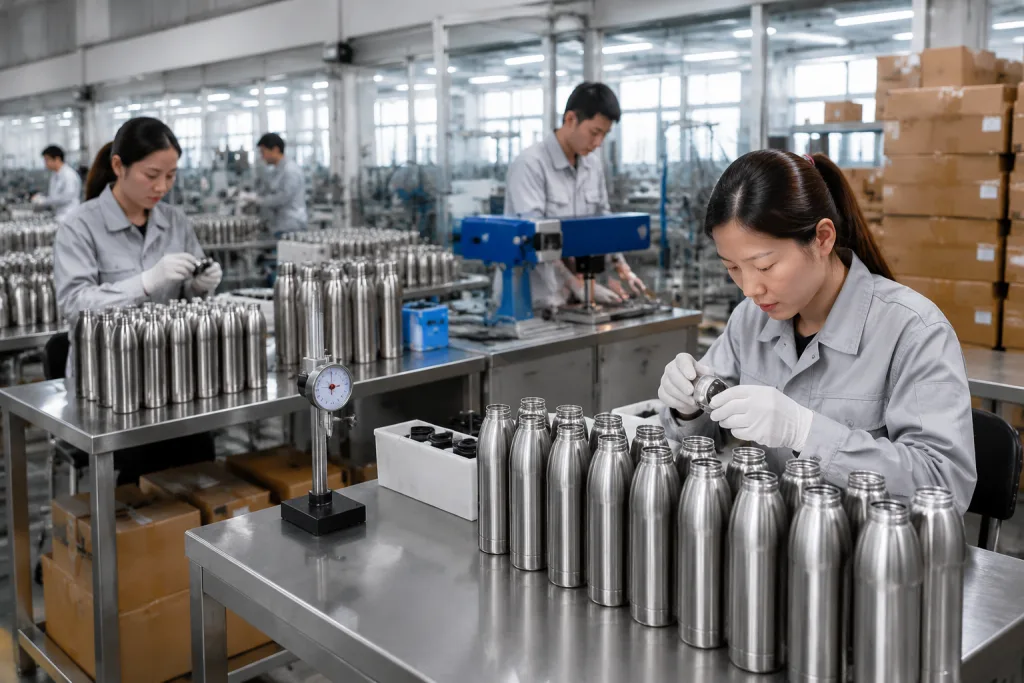
If you search for a canteen factory or canteen manufacturer, do not buy from photos alone. Ask for monthly output, line count, welding method, and incoming material checks. A serious canteen manufacturer should say something like “we run 6 vacuum lines, 280,000-320,000 pcs/month, 304 stainless coil checked by XRF gun before cutting.” That is a real answer. If they just send showroom pictures and say “quality is guaranteed,” move on. We have seen this go sideways when the buyer only checked a catalog, then QC pulled the sample
Use samples to kill hidden risk
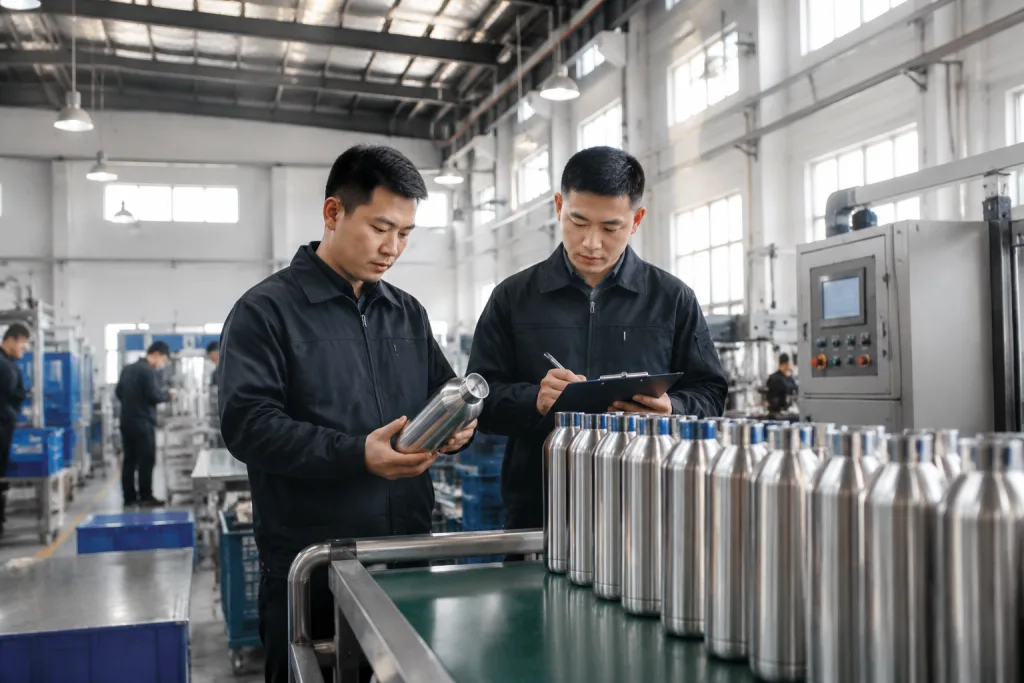
Sampling is where we save real money, because a PDF will not show a bad thread start or a weak vacuum weld. On a 304 stainless steel double walled bottle custom project, we run the sample through lid threading by hand, vacuum integrity on the leak tester, coating adhesion with a 3M tape pull, odor after a 30-minute hot rinse, and thermal performance. Fill it with hot water at 95°C and cold water at 4°C, then check condensation and temperature loss after 2, 4, 6, and 8 hours. QC pulled one 750 ml sample last month that looked clean on the desk but lost 11°C by hour 4. The mass order would have failed later, just in 3,000 pcs instead of 2 samples.
Do not approve a sample until the artwork is correct under the same lighting your buyer will use. We check logo color under a D65 light box and warehouse LED, because screen print can shift one Pantone shade and laser can look smoky on brushed steel but pale on powder coat. Returns start with small things. If your client sells through retail or e-commerce, a 1.5 mm logo drift or uneven print edge can turn into refund photos. For custom growler or customizable growler programs, check the handle weld, mouth diameter in mm with a caliper, and cap torque with a torque meter, because those affect the hand feel more than the body curve.
Sampling also tells you whether the bottle is a real canteen customizable platform or just a one-off shell with a new logo. The wrong question is, “Can you make 6 versions?” Ask whether one base body can hold steady across 2 lid molds and 3 finish options without changing packing size or carton weight. A strong canteen vendor will suggest one base body and multiple lids only after the first sample proves stable on the line. We have seen this go sideways when a buyer added a straw lid after approval, then the inner straw touched the vacuum base by 4 mm. For a canteen distributor covering different price points, that small miss eats inventory space and delays shipment by 12 days vs 18 days on a clean repeat order.
Do not approve based on photos. Approve based on a sample that has passed leakage, finish, and temperature checks.
Build the order for repeat sales
Build the program for the second PO, not just the first shipment. If the bottle needs to sit in a catalog for 18 months, pick a body and decoration spec we can run again without opening new tooling. We see 7 out of 10 distributors choose a custom canteen or custom growler with a standard 44 mm neck and modular lids for this reason. On the line, that means the same neck gauge, same lid torque check, same carton insert. Reorder simplicity protects margin.
Split the spec by channel. A corporate buyer wants a clean, customized canteen, logo placement within 0.5 mm, and a ship date that does not move. A retailer cares more about shelf face, barcode position, and color matching across 12 pcs per inner carton. A distributor needs a steady canteen suppliers relationship, price validity for 60 days, and support when mixed shipment schedules get messy. Same base bottle, different job. Forcing one spec across all channels is the wrong question to ask; we have seen it go sideways when QC pulled 42 scratched retail boxes from a corporate rush order.
For brands sourcing from Zhejiang or elsewhere in China, ask the supplier to quote three clear price levels with real specs, not loose names: entry powder coat, mid polished steel, premium laser engraving. Put them side by side. A canteen manufacturer who understands segmentation will show the tradeoff between finish cost, reject rate, and production time. One quote sheet should list FOB price, MOQ, lead time, sample cost, packaging detail, and spare lid policy. If the sheet misses carton size or gross weight, someone will chase it later; last month a buyer flagged a PO typo where 24 kg became 42 kg, and the booking almost used the wrong CBM.
After the first order ships, lock the spec. Change one thing per run: color, lid, packaging, or logo size, not all at once. That is how we keep the canteen vendor accountable and stop the bottle from drifting away from the approved sample. We keep a golden sample in the QC room with the Pantone card taped to the bag, and the line checks the next run against it before mass packing starts.
Request a custom quote from Zhejiang
Send your target MOQ, lid style, and decoration method. We’ll quote a production-ready spec with FOB pricing, lead time, and sample options.
Frequently asked questions
What is a normal MOQ for a 304 stainless steel double walled bottle custom order?
For standard shapes, 500-1,000 pcs per SKU is common. If you want a new color, new lid tooling, or special packaging, many canteen manufacturers will push MOQ to 3,000 pcs. A simple logo change is usually the easiest entry point. If you are testing demand, ask for one body, one lid, and one decoration method first so you do not trap cash in too many variants.
How much does a custom 304 double wall bottle cost FOB China?
A typical 500ml unit can range from $3.20-$4.60 FOB China for common custom work. Powder coating, laser engraving, and upgraded lids can push it higher. At 3,000 pcs, you may see a 12-18% drop versus a 500 pcs run. The final number depends on thickness, finish, lid material, and packaging. Zhejiang factories usually quote faster when those four items are fixed.
How long should lead time be for custom drinkware from China?
For a stable SKU with existing tooling, 35-45 days after sample approval and deposit is realistic. If you need new molds, a new color, or a special box, add time. A canteen factory with around 300,000 units/month capacity can still miss deadlines if you change artwork late. Ask for a dated production schedule, not a vague promise.
Which branding method is best for a canteen customized for retail?
Laser engraving is the most durable and usually the safest for repeat sales. Screen printing is cheaper and better for strong color branding, but it can wear faster. UV print works when you need more color complexity. For retail, many buyers choose laser on powder-coated bodies because it looks clean and handles handling better. Ask for rub testing before you approve the decoration.
What compliance documents should a canteen supplier provide?
For export drinkware, ask for food-contact declarations, REACH-related support where applicable, and a clear QC report with AQL levels. If you sell into Europe or North America, also confirm packaging, carton markings, and any retailer-specific barcode or FNSKU requirements. A serious canteen supplier should know whether your order is for distributor drinkware, custom canteen, or Amazon-ready stock and adjust the documents accordingly.