Key Takeaways
- A normal MOQ is 1,000-3,000 pcs per color for custom 304 bottles, depending on coating and logo process
- 304 stainless steel should be specified for inner wall, outer wall, or both, not assumed from a product title
- Vacuum failure rates under 1.5% after production testing are a realistic factory control target
- FOB Ningbo or Shanghai lead time is usually 30-45 days after artwork and deposit approval
A 304 stainless steel double wall bottle wholesale quote looks simple: capacity, color, logo, carton size, FOB price. Then two suppliers quote the same 500 ml bottle and one is USD 0.60 lower. We see this weekly. The gap is usually not “better sourcing”; it is 0.4 mm vs 0.5 mm steel, vacuum yield after the hot-water test, PP cap weight, powder coating thickness in microns, AQL 2.5 inspection scope, or whether the carton uses 5-layer K=A board. QC pulled one sample last month where the outer wall passed appearance, but the vacuum loss showed up after 6 hours in the 95°C test tank.
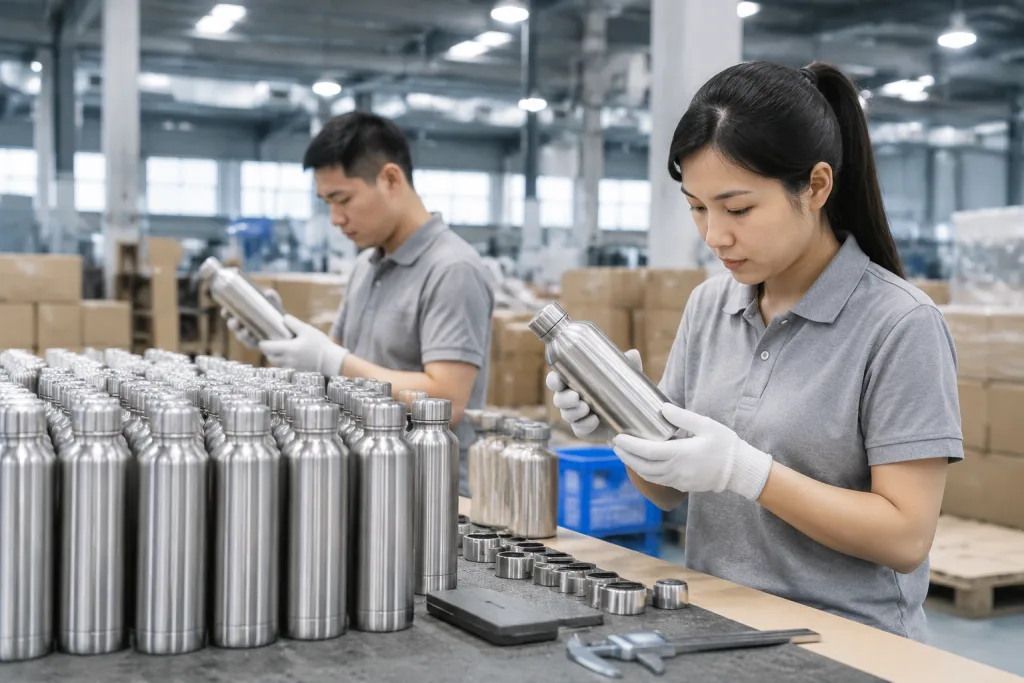
If you buy bulk drinkware for a retail brand, distributor program, corporate channel, or seasonal campaign, read the spec sheet like a cost map. The lowest FOB is the wrong question to ask if the bottle comes back with dented shoulders or a cap that leaks at 180° tilt. BottleForge Industrial in Hangzhou, Zhejiang works with export buyers who need straight answers before paying tooling or deposits in China; on the line, we run calipers, torque checks, salt-spray notes, and carton drop-test records before we call a quote safe to ship.
Material line: 304 is not enough
The first line of a 304 stainless steel double wall bottle wholesale spec should say exactly where 304 is used. I still see 3 out of 10 RFQs write “304 stainless steel bottle” and leave both walls unclear. Some factories quote 304 inner wall with 201 outer wall to cut RMB 1.2-1.8 per piece on a 500 ml bottle. That can work for a low-price promotion, but hiding it is where claims start. QC pulled one sample last May and the XRF gun showed 201 on the outer shell, while the buyer’s PO said “full 304.” Bad week.
For food-contact confidence, specify SUS304 / 18/8 stainless steel inner wall, with chemical composition test available on request. If the bottle is for salty drinks, beer, or acidic beverages, use 304 for both inner and outer walls. For a bulk growler or beer growler wholesale program, I would not use 201 outside if the bottle will sit wet in coolers, ice boxes, or outdoor racks. We have seen this go sideways: small rust spots around the bottom radius after 72 hours in a damp carton, then the buyer flagged the whole shipment.
Wall thickness also matters. A common range is 0.4-0.5 mm per wall for standard bottles. Light bottles can drop toward 0.35 mm, saving freight and steel cost, but they dent faster during carton drop testing. The math does not work for premium outdoor goods. For a premium wholesale canteen or outdoor canteen bulk order, ask for the finished weight tolerance, not only steel grade. A 750 ml bottle weighing 285 g and another weighing 340 g can both be “304 double wall,” but they do not feel the same in your customer’s hand. On the line, we check this with a 0.01 g scale and a wall-thickness gauge before polishing.
Ask your China supplier to state FDA/LFGB/REACH compliance by component: stainless body, PP cap, silicone gasket, coating, ink, and packaging print. Zhejiang factories exporting to Europe and North America should already have these files, but put the requirement into the proforma invoice or technical sheet. Small wording matters. We once received a PO with “silicon gasket” instead of “silicone gasket,” and the lab clerk stopped the file for half a day before we corrected it.
Capacity and shape affect tooling
Capacity looks like a marketing choice. It is not. It changes the body mold, carton count, shelf height, and sea freight math. The common wholesale drinkware sizes are 350 ml, 500 ml, 600 ml, 750 ml, 1,000 ml, and 1,900 ml for growlers. We see 500 ml work as the safest all-purpose SKU for office, promo, and retail gift orders. A 750 ml bottle sells better into outdoor and fitness channels because the buyer can price it above the small bottle without changing the line too much. For bulk canteen programs, 1,000 ml with a carry handle is usually the right call; QC pulled one 1,000 ml sample last month because the handle pin had 0.4 mm side play after the drop test.
Do not approve capacity from a catalog photo. Ask whether the stated size is brimful capacity or practical fill capacity. A “500 ml” vacuum bottle may hold 520 ml to the rim, but the recommended fill line sits lower once the stopper and gasket are fitted. For beer growler in bulk, this gets touchy because buyers expect usable volume, not a lab measurement. We had one PO where the buyer typed “64 oz usable” beside a 1,900 ml growler, then flagged the pre-shipment sample when foam space reduced the real pour volume. The math doesn’t work unless both sides define the fill line in mm from the mouth.
Shape changes cost faster than 6 out of 10 new buyers expect. A straight wall bottle is easier to polish, powder coat, print, and pack. The line likes it. A tapered shoulder or deep waist can raise scrap during forming and make silk screen registration drift by 1-2 mm, which looks bad on vertical logos. A wide mouth, usually 45-55 mm inner diameter, improves ice loading and cleaning, but it needs a larger cap and silicone gasket. A narrow mouth, around 32-38 mm, costs less and drinks more like a standard flask. We’ve seen this go sideways when a buyer picked a deep-waist shape for a wraparound logo; the screen frame passed the trial, then production rejected 73 pcs for print stretch near the curve.
If you are building drinkware wholesale assortments, keep one shared cap system across 2-3 capacities where possible. One cap mold used across 500 ml, 750 ml, and 1,000 ml bottles cuts spare-part risk and makes after-sales handling cleaner. At BottleForge Industrial, a typical private label bottle MOQ starts at 1,000 pcs per color, while new cap tooling may require 3,000-5,000 pcs to make commercial sense. We run cap fit checks with a torque meter and water leak test before packing, because one mixed thread spec can turn a reorder into a claims file.
Vacuum performance is a measurable risk
Double wall is not insulation by itself. The real work is done by the vacuum layer, weld consistency, copper lining if the spec calls for it, and the cap seal. For a normal 304 stainless steel double wall bottle wholesale order, buyers often request 12 hours hot and 24 hours cold. Fine, but this is the wrong question to ask unless the PO also states the test method; we once had a buyer flag a carton because the sales sheet said “24H cold” while the approved sample report used room-temperature water, not ice water.
We run a simple factory check: fill the bottle with 95°C water, close the cap with the standard torque setting, then measure water temperature after 6 hours at 20°C ambient temperature. A good 500 ml bottle may stay around 65-72°C, depending on mouth diameter and cap type. Wide mouth bottles usually lose heat faster than narrow mouth bottles. No surprise there. Large bulk growler products can perform well because volume is higher, but cap surface area still matters; QC pulled one 1.9 L growler sample last season where the body passed, but the PP lid gasket leaked heat through a 0.4 mm seating gap.
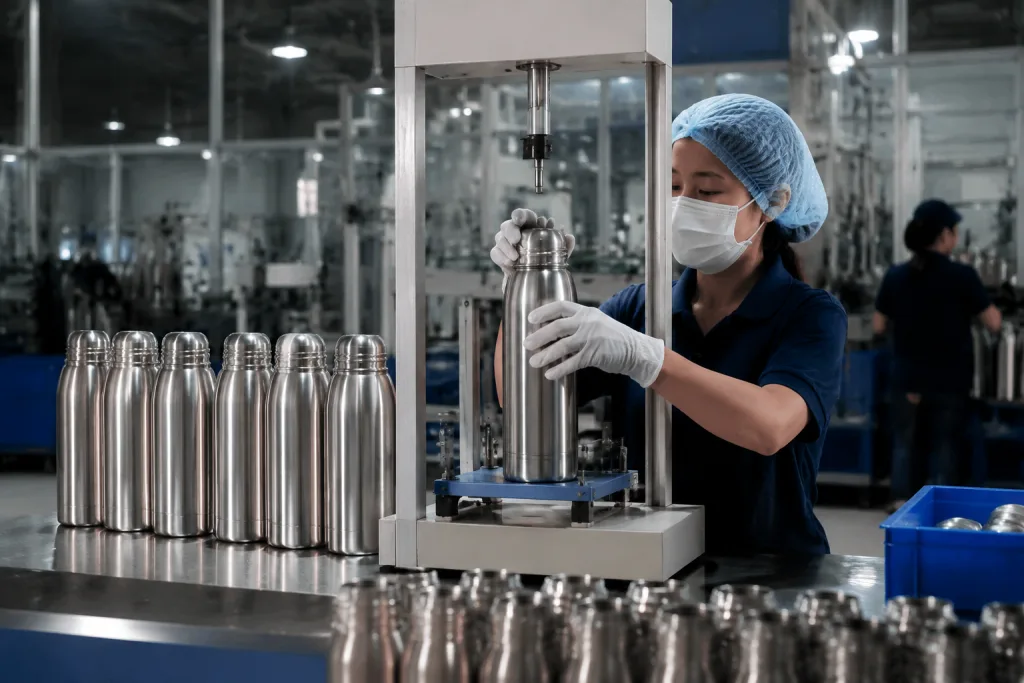
Vacuum failure is the quiet problem. If the inner and outer wall weld or vacuum seal is weak, the bottle may look fine in the master carton but perform like a single-wall cup. Serious factories test vacuum integrity after production. Some use hot water exposure and surface temperature checks; better lines use vacuum detection equipment. A realistic acceptable internal failure target is below 1.5% before final packing. If your supplier says zero defects, ask how many pieces they tested and by what method; the math doesn't work if they checked 20 pieces from a 30,000 pcs run and called it clean.
For alcohol flask wholesale or beer tumbler wholesale bulk, insulation is not always the main job. Odor control, gasket resistance, and leak prevention need their own checks, not just a nice temperature chart. If the product will hold beer, cocktails, or flavored drinks, require silicone gasket material to pass LFGB or FDA testing, and ask whether replacement gaskets can be packed at 1-2% of order quantity. We ship these spare gaskets in small PE bags taped inside the inner carton; otherwise the buyer’s warehouse team loses them before the first rework ticket is opened.
Finish, logo, and color tolerances
Surface finish is where 7 out of 10 delayed wholesale drink bottle projects get stuck on our line. Powder coating, spray painting, UV printing, laser engraving, silk screen printing, and water transfer each come with its own MOQ, jig setup, oven setting, and defect pattern. Powder coating holds up well for outdoor canteen wholesale lines; we usually check it after curing with a 60° gloss meter and a 3M tape pull. Spray painting gives more color options, but the math doesn't work if the buyer wants cheap paint, fast curing, and no scratches after carton vibration.
For brand color, skip the screen image. Send Pantone C or U code, then approve a physical color chip or pre-production sample under D65 light. For large drinkware bulk programs, set an acceptable Delta E tolerance if color consistency is critical; we often see buyers accept Delta E 1.5-2.0 for retail shelf programs, while promo orders can live with wider tolerance. Most buyers do not need laboratory-grade color control, but approve one golden sample and keep it sealed. QC pulled one sample last month because the PO said “navy blue” while the artwork file showed Pantone 2965 C.
Logo method should match how the bottle will be used. Laser engraving is clean and permanent, and it works well on powder coating or bare stainless when the fixture holds the body within about 0.5 mm. Silk screen printing is cost-effective for one or two colors on straight surfaces, especially when we run the same logo across 3,000 pcs. UV printing works for full-color artwork, but ask for abrasion testing with an alcohol rub or eraser rub before mass production. For corporate alcohol flask bulk, laser is usually safer. For retail beer tumbler in bulk with colorful branding, UV print can sell better, but we've seen this go sideways when the buyer approves artwork only by PDF and skips the printed sample.
Ask for a coating adhesion test, such as cross-hatch tape test, plus a simple rub test for printed logos. If your bottle will be sold in Europe, include REACH consideration for coating and inks. A Zhejiang export factory should be able to run these checks before shipment, but the buyer must specify the standard on the PI or PO. “Good quality painting” is not a spec. “Powder coating, 60-80 μm thickness, cross-hatch adhesion pass, no obvious dust at 30 cm viewing distance” is much more useful, and it gives QC a ruler, a tape test blade, and a pass line instead of an argument at final inspection.
Caps, gaskets, and leak claims
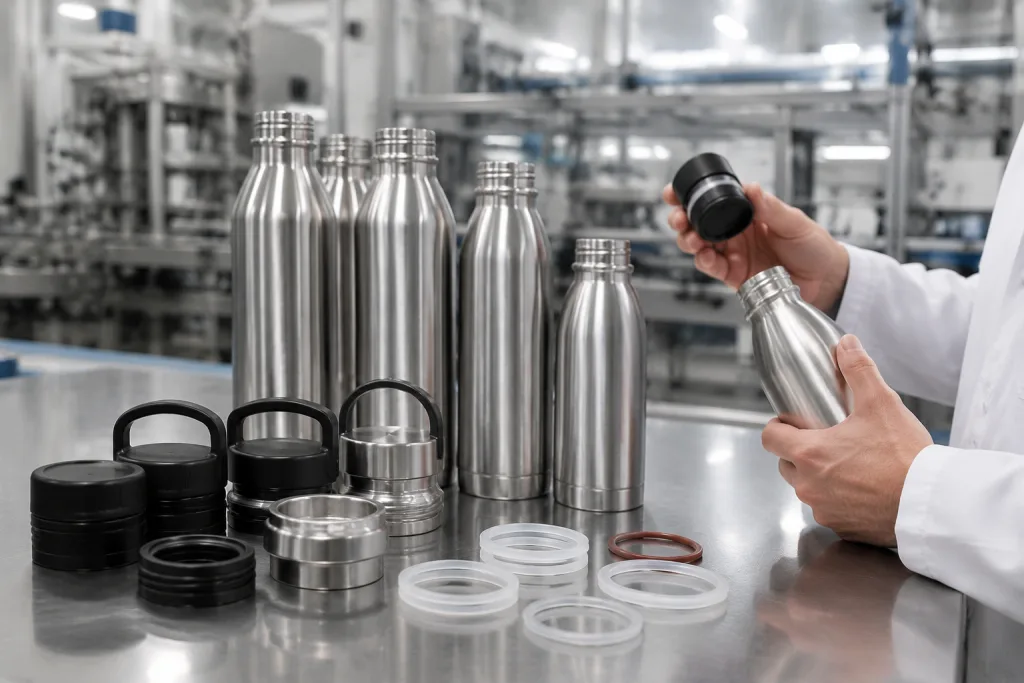
After coating, the cap is the next claim point we see. In our last 12 mixed-lid export orders, 7 complaints started at the gasket seat, hinge pin, or straw vent. A bottle body can pass vacuum and wall-thickness checks, then one loose silicone ring creates returns. For 304 stainless steel double wall bottle wholesale sourcing, write the cap spec on the PO: PP cap body, food-grade silicone gasket, 304 stainless insert, carry handle material, straw lid structure, flip-lid hinge size, screw-cap thread type. We check these at the QC bench with a 0.02 mm caliper because each part changes cost and risk.
A simple screw cap gives the best leak resistance. Fewer parts. A flip lid sells well for gym bottles, but the spring, hinge pin, and button all add failure points. A straw lid is popular in North America, though full leakproof performance is hard if the bottle sits upside down in a backpack; one buyer flagged 18 leaking straw lids from a 200 pc pre-shipment sample set after a bag test. For kids bottles, ASTM and choking hazard checks can apply, especially on small spout covers. For adult sports bottle bulk orders, buyers care more about one-hand opening and dishwasher claims. The math does not work if a buyer asks for a low-cost straw lid and “100% leakproof upside down” on the same SKU.
Write leak testing into inspection, not into a chat message. We run a simple method on the line: fill with 23°C water, close the cap to normal torque at about 0.8–1.0 N·m, invert for 30 minutes, then shake or roll the sample set on a rubber mat. QC pulled the sample if one drop appears at the thread or vent hole. For vacuum bottles, do not test with carbonated beverages unless the product is designed for pressure. Standard insulated bottles are not suitable for sealed carbonated beer unless the cap and body are engineered for it. For wholesale growler and beer growler wholesale bulk projects, confirm pressure expectations before using the word “growler” on retail packaging.
Check cap compatibility after storage, too. Silicone gaskets can deform if the Shore A is too soft, often below 50, or if the groove depth is off by 0.3 mm. We have seen this go sideways after cartons sat 21 days in a warm warehouse and the gasket took a set. A spare gasket program is cheap insurance. On a 5,000 pc wholesale drinkware order, adding 100 spare gaskets to the master carton costs little, and it lets your distributor fix complaints without opening a full replacement case.
Packaging, cartons, and landed cost
FOB unit price is just the first line on the quote sheet. Packaging adds USD 0.15-0.80 per piece: plain white box, printed kraft box, color retail box, insert card, hang tag, barcode label, gift sleeve, or a custom foam tray if the buyer insists. Last month QC pulled a 750 ml sample because the FNSKU label was 2 mm off the flat panel and the scanner missed it. For Amazon or retail distribution, FNSKU, warning labels, country of origin, and suffocation warnings are often mandatory.
Carton design decides breakage and freight. A 500 ml bottle may pack 24 pcs per export carton; a 1,000 ml canteen may pack 12 pcs; a 1,900 ml wholesale growler may pack 6 pcs. For ocean freight from China, we run 5-layer export cartons for normal bottles and add dividers when painted surfaces rub during the drop test. If you see scuffing inside cartons, do not blame the coating first; the line usually finds weak bagging, a loose inner box, or 8-10 mm of empty movement inside the carton.
When comparing drinkware wholesale quotes, ask for net weight, gross weight, carton dimensions, and CBM. This is where cheap quotes go sideways. A bottle that is USD 0.08 cheaper but packs inefficiently can lose the saving after ocean freight and inland delivery, especially when one carton jumps from 0.045 CBM to 0.058 CBM. The math does not work for beer growler bulk and large canteen bulk programs if nobody checks the carton cube before PO release.
At our Hangzhou, Zhejiang operation, a common lead time is 30-45 days after deposit and artwork approval, with monthly coordinated capacity around 300,000 stainless drinkware units across bottles, tumblers, and canteens. Peak season before summer and Q4 gifting can push the line from 32 days to 45 days, sometimes 52 days if powder coating is backed up. We ship faster when the buyer approves artwork, barcode, carton mark, and instruction sheet before the deposit, not two weeks later; we have seen one PO held for 6 days over a missing “Made in China” carton mark.
Inspection terms that protect margin
AQL inspection is not paperwork for big-box buyers only. It is how we stop 12,000 “mostly fine” bottles from eating the margin on one container. For most bulk drinkware orders, we run AQL Level II with critical defects 0, major defects 2.5, and minor defects 4.0. If the order is going into premium retail, tighten major defects to 1.5; last year a buyer flagged 7 scratched lids in a 200 pc draw, and the rework cost more than the inspection.
Define defects before QC opens the first carton. Critical defects include unsafe sharp edges at the mouth, wrong material, oil or dust contamination inside the body, severe leakage, and missing required compliance labels. Major defects include vacuum failure, dents visible at 50 cm, logo color outside the approved Pantone chip, cap threads that bind on the gauge, or barcode scanning failure. Minor defects include small dust points under the coating, slight color variation within approved tolerance, or light carton printing offset under 2 mm.
Pre-shipment inspection should cover quantity check, random carton selection, visual inspection, logo measurement with calipers, leak test, coating check, barcode scan, carton drop test if needed, and packing verification. For a best wholesale drink bottle program, I also ask QC to check finished weight on 20-32 pcs. Weight variance is a fast tell. If a 500 ml 304 stainless double wall bottle drops from 286 g to 271 g, the steel thickness or plastic cap parts changed somewhere on the line.
Payment terms should match risk. A common China export term is 30% deposit and 70% balance before shipment after inspection approval. FOB Ningbo or FOB Shanghai are typical for Zhejiang suppliers. If a supplier refuses reasonable inspection or will not send production photos before balance payment, the math does not work. We have seen this go sideways over small details, including one PO typo that changed “black lid” to “blank lid”; good factories prefer clear specifications because arguments after shipment cost more than discipline before production.
Send your bottle spec sheet for factory review
We will check material, MOQ, logo method, packaging, and FOB cost risks before you commit to production.
Frequently asked questions
What MOQ should I expect for 304 stainless steel double wall bottle wholesale?
For standard factory molds, expect 1,000-3,000 pcs per color for custom color and logo. If you choose stock color with laser engraving, some factories may accept 500 pcs, but the unit price is usually higher. New body tooling commonly needs 10,000 pcs or more to amortize mold cost. New cap tooling may start making sense at 3,000-5,000 pcs. For mixed wholesale drinkware programs, ask whether the supplier can combine 500 ml, 750 ml, and 1,000 ml under one order, but do not assume mixed colors count as one MOQ.
How much should a 304 double wall bottle cost from China?
A realistic FOB China range for a standard 500 ml 304 double wall bottle is roughly USD 2.20-4.20, depending on steel thickness, cap type, coating, logo, packaging, and inspection requirements. A basic screw-cap bottle with one-color logo is at the lower end. A powder-coated bottle with stainless cap insert, retail color box, and full compliance documents will cost more. Large items like a 1,900 ml beer growler wholesale order may range much higher because steel weight and carton volume increase sharply.
Is 304 stainless steel safe for beer, alcohol, and acidic drinks?
304 stainless steel is widely used for food-contact drinkware and is generally suitable for water, tea, coffee, beer, and many flavored drinks. The bigger question is the full construction: inner wall grade, weld quality, cap plastic, silicone gasket, and coating compliance. For alcohol flask wholesale bulk or beer tumbler wholesale projects, request FDA or LFGB test reports for food-contact components. Also confirm whether the product is intended for carbonated liquids. Many standard vacuum bottles are not designed to hold pressure from sealed beer or sparkling drinks.
What inspections should I require before paying the balance?
Use AQL Level II inspection, with critical defects 0, major 2.5, and minor 4.0 as a normal starting point. The inspection should cover quantity, appearance, logo position, color, capacity, weight, leak testing, vacuum performance sampling, cap function, barcode scanning, packaging, and carton marks. For a 5,000 pc order, the inspector will normally check a statistically selected sample, not every bottle. If the order is high value or time-sensitive, add during-production inspection at 20-30% completion to catch coating or logo errors early.
Can I combine bottles, canteens, tumblers, and growlers in one wholesale order?
Yes, but each SKU still has its own production reality. A factory may allow one purchase order covering bulk canteen, beer tumbler bulk, growler wholesale, and standard bottles, yet each color and decoration usually has a separate MOQ. Shared colors, shared caps, and shared packaging structures help reduce cost. For example, one black powder coating across 500 ml bottles, 750 ml canteens, and 20 oz tumblers is easier than six different Pantone colors. Ask for a line-by-line quotation showing MOQ, lead time, carton data, and logo setup per SKU.