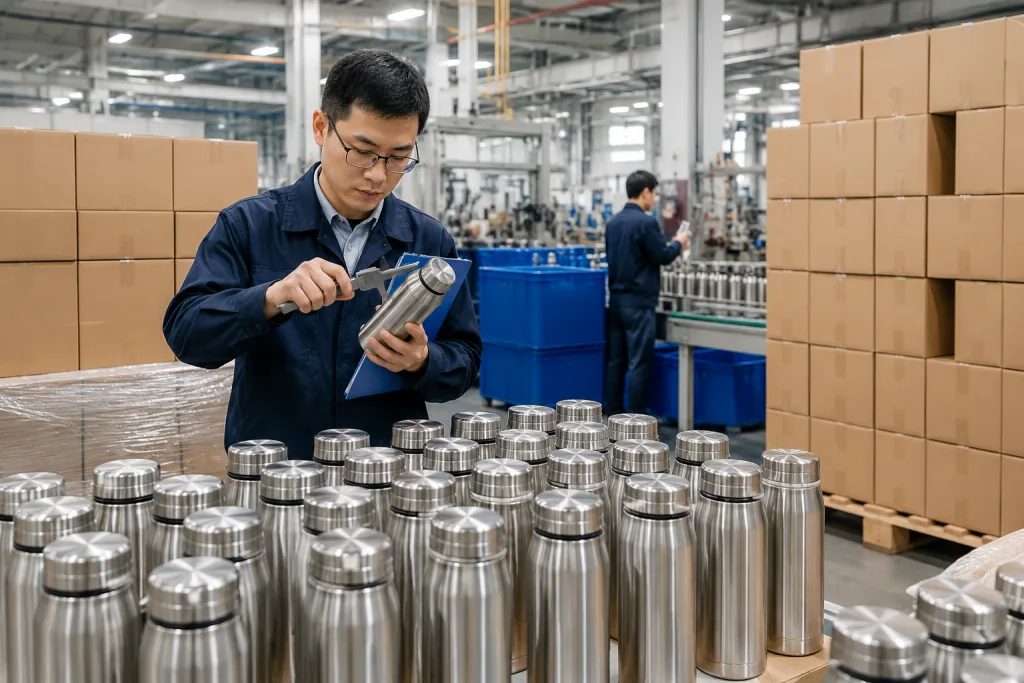
Key Takeaways
- Set the RFQ with 304 inner/outer steel, capacity, coating, lid type, carton spec, and AQL 2.5/4.0 before asking for price
- Typical MOQ for custom color bulk drinkware is 1,000-3,000 pcs per SKU, with 35-50 day production after approved sample
- A vacuum bottle should pass 6-12 hour heat retention, leak, drop, coating adhesion, and food-contact checks before shipment
- Your PO should separate bottle, lid, logo, packing, spare parts, inspection, FOB port, and payment terms line by line
Buying a 304 stainless steel double wall bottle bulk order is not hard because the bottle is complicated. It gets messy because a 0.2 mm steel change, a new lid mold, powder coating, laser logo, carton drop-test spec, and AQL 2.5 inspection can move your landed cost by 8-18% before your buyer notices. We see it on the line: the same 500 ml bottle can quote differently when the caliper reads 0.48 mm instead of 0.50 mm. The math doesn't work if the RFQ is loose.
If you are comparing wholesale drinkware offers from China, make every supplier quote the same spec sheet. At our Hangzhou, Zhejiang facility, we run up to 650,000 stainless drinkware units per month, but we still reject vague RFQs like “send best price for bottle.” Too risky. A clean buying file protects your margin, your launch date, and your customer reviews; last month QC pulled a pre-shipment sample because the PO said matte black, while the artwork file said PMS Black 6 C.
Start with the buying file
Your RFQ decides whether the order makes money or turns into rework. Don’t send one photo and ask for the “best wholesale drink bottle price.” We see this every week. A Zhejiang factory can quote lower by changing 0.5 mm to 0.4 mm, using 201 stainless on the outer shell, thinning the powder coat, or moving from K=K cartons to soft export cartons. QC pulled one sample last month where the buyer approved “same as photo,” but the outer wall measured 0.38 mm on the micrometer. The math doesn’t work after that.
For a standard 304 stainless steel double wall bottle bulk program, your buying file should state the capacity in ml, body shape with drawing or reference sample, lid style with seal material, color finish with Pantone or coating code, logo method with print size in mm, packaging, compliance market, target quantity, delivery port, and required test standards. If you are sourcing a bulk canteen, bulk growler, beer tumbler bulk order, or alcohol flask wholesale bulk line, don’t mix them into one loose request. Create separate SKU tables. The line needs this, because a 3,000 pcs MOQ bottle and a 1,000 pcs flask do not run on the same tooling schedule.
A practical RFQ line looks like this: 750 ml double wall vacuum bottle, SUS304 inner and outer, 0.5 mm inner wall, 0.45 mm outer wall, screw lid with silicone seal, powder coated black, 1-color silkscreen logo, individual white box, 24 pcs/master carton, FOB Ningbo, 3,000 pcs. Good line. It gives purchasing, engineering, and costing the same base. On our side, the sales desk can check it against the BOM, while the sample room checks the lid thread with a go/no-go gauge before we quote lead time.
Your first PO planning lines should include bottle SKU, lid SKU, decoration, packaging, barcode or FNSKU label, spare gasket percentage, inspection requirement, and incoterm. For North America, add FDA food-contact expectations. For Europe, add LFGB, REACH, and packaging waste requirements where needed. We once had a PO typo showing “FNSU” instead of “FNSKU,” and the buyer flagged it only after carton artwork was released. Small mistake, 2 days lost. A serious drinkware wholesale project starts with this level of detail, not with a spreadsheet of random prices.
Quote the real construction
“304 stainless steel” is too loose for a purchase order. Ask where the 304 sits. We still see cheap quotes using SUS304 on the inner liner, then 201 or 430 on the outer shell; QC caught one like this with an XRF gun after the buyer flagged rust spots near the bottom rim. That build can work for some promo drinkware bulk jobs, but it cannot be hidden in the spec. For a retail-grade canteen wholesale or wholesale growler order, write SUS304 inner and outer unless you choose a mixed-steel construction on purpose.
Wall thickness changes dent resistance and the hand feel. Common ranges are 0.38-0.50 mm for the inner wall and 0.40-0.55 mm for the outer wall. Thicker steel raises the cost and adds weight, but it also cuts down complaints on large growler bulk and beer growler wholesale items. The math doesn’t work if you save USD 0.08 on steel and then replace dented cartons after delivery. For 1.9 L beer growler in bulk, we run a stronger base and shoulder area because the filled weight is high; our line checks this with a digital thickness gauge before mass production.
Quote vacuum performance as a test number, not a slogan. A typical 500-750 ml bottle can keep hot water above 55°C after 6 hours when tested from 95°C water at 20°C room temperature. Premium builds can beat that, but “keeps hot all day” is not a specification. We test with a calibrated thermometer and a 6-hour log sheet, then QC pulls the sample if the reading drops below target. For beer tumbler wholesale bulk, cold retention and lid sealing usually matter more than heat, especially when the buyer’s complaint is a leaking PP lid in a 24 pcs carton.
Ask the supplier to quote by construction line: body material with steel grade and thickness; lid material with PP, Tritan, or stainless detail; seal material such as silicone ring hardness; finish and decoration with coating type, logo method, and artwork size; packaging with carton spec and drop-test level; test cost with AQL 2.5 or the buyer’s own checklist. This helps when comparing wholesale canteen, alcohol flask in bulk, and beer growler bulk pricing. If one offer is USD 0.35 lower, you can see whether the saving came from steel, coating, lid, carton, or inspection. We’ve seen this go sideways when a PO had one typo, “304 inner” instead of “304 inner/outer,” and the factory followed the cheaper version exactly.
Control MOQ and price breaks
MOQ is not just a factory rule. It comes from coating line setup, logo plate cost, lid inventory, carton printing, and the production slot we can hold on the line. For our China production, common MOQ is 1,000 pcs per color for stock molds with simple logo, 3,000 pcs per color for custom powder coating, and 5,000-10,000 pcs when you need private mold lids or exclusive shapes. On the floor, one powder booth color change costs about 45 minutes for cleaning, and QC still has to check color by Pantone card under a D65 light box. For alcohol flask wholesale or small canteen bulk items, MOQ can be lower if the finish is standard stainless.
Ask for price breaks at 1,000, 3,000, 5,000, and 10,000 pcs, then ask what changes at each level. This is where buyers catch real savings. Sometimes the 5,000 pc price is better because cartons, coating powder, and logo setup are spread across more units. Sometimes the math doesn't work because the lid is the cost driver. We had one buyer push for a lower price on a bulk growler with a complex swing cap; between 2,000 and 5,000 pcs, the cap supplier only cut USD 0.03, so the bottle price barely moved.
Your PO should not say only “3,000 pcs bottle.” Too vague. It should show each payable item. Example: 3,000 pcs 750 ml bottle at USD 4.20 FOB Ningbo; 3,000 pcs bamboo-pattern lid at USD 0.42; logo setup USD 60; printed color box USD 0.18/pc; 2% spare silicone gaskets free of charge; pre-shipment inspection by buyer. We once saw a PO typo list 30,000 pcs instead of 3,000 pcs, and our merchandiser caught it before the PI was issued. Small line-item errors become big arguments.
This line-item approach helps brand owners compare drinkware wholesale quotes honestly. If a supplier hides setup charges until the proforma invoice, your landed cost changes. For wholesale drinkware going to retail or Amazon FBA, include label application, carton drop-test requirement, and master carton weight limit, usually under 15 kg for easier handling. QC pulled one sample carton last month at 17.8 kg; the buyer flagged it because their warehouse team rejects cartons over their manual handling limit.
Approve samples before deposits
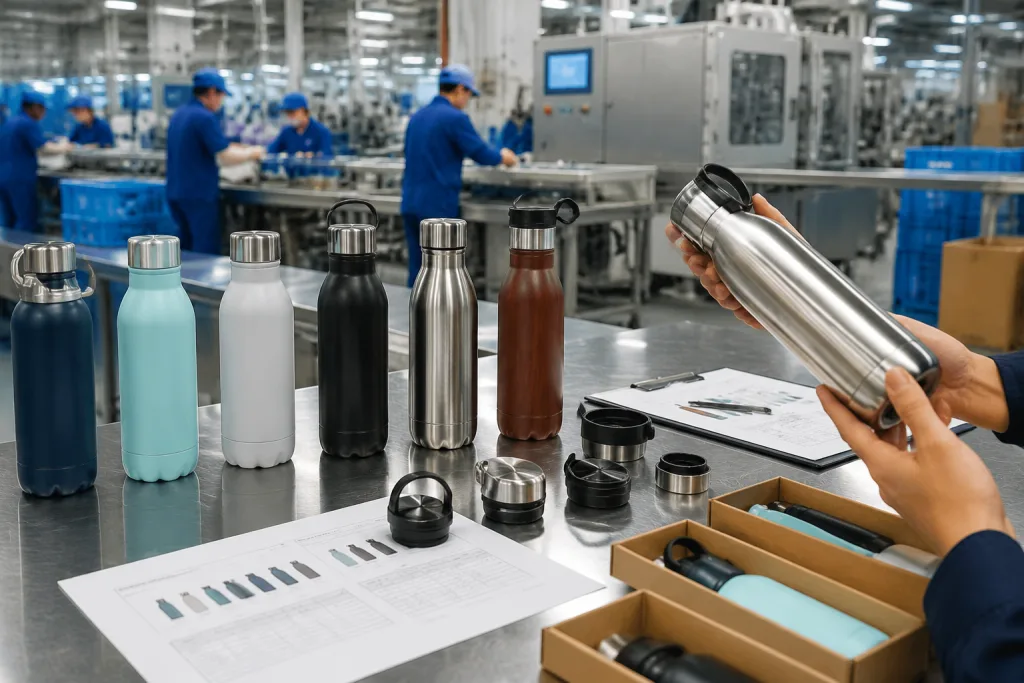
A sample is not a souvenir. It is the physical contract for your 304 stainless steel double wall bottle bulk order. We ask buyers to approve three checkpoints with different evidence: a blank construction sample for welding, vacuum body shape, and lid fit; a color and logo sample checked against Pantone and artwork size; a packed sample with box, polybag, barcode, and carton mark. For repeat wholesale drinkware, you can skip the blank sample if the mold passed the last run, but never skip color approval on powder coated or spray painted bottles. We have seen matte black pass in the office and fail under the QC light box because the coating showed 0.4 mm pinholes near the shoulder.
Typical sample timing is 3-7 days for stock blank bottles, 7-12 days for logo samples, and 12-18 days for custom color samples. Tooling or private mold lids can add 25-40 days. At BottleForge Industrial in Hangzhou, Zhejiang, we usually ask buyers to approve one “golden sample” kept by our line and one sealed sample kept by your team. Both should be signed or labeled with date, version, Pantone color, and logo file name. Simple rule. If the production bottle does not match the sealed sample, QC pulls the sample and stops arguing by email.
Sample PO lines should be clear. Example: 5 pcs 750 ml SUS304 double wall bottle, matte navy powder coating Pantone 2965C reference, laser engraved logo 45 x 28 mm, black PP screw lid with food-grade silicone ring, individual kraft box, sample fee USD 80, DHL freight collect. Do not write “blue bottle with logo” and expect the factory to guess the finish. We once received a PO with “Panton 2965” missing the “e”; the buyer flagged the color later, and the math did not work because the spray room had already mixed 18 kg of powder.
For beer growler wholesale bulk, test cap torque and carbonation suitability if the item is sold for beer transport. A lot of stainless growlers are built for short carry from taproom to home, not long-term pressurized storage, and this is the wrong question to ask after deposit. For alcohol flask bulk, check mouth welding, cap thread smoothness, and leakage after 24 hours inverted. The best sample review is boring: measure with calipers, fill to rated ml, shake for 30 seconds, drop from 1 m, scratch with a 3M tape cross-cut, wash, then write down what fails. QC pulled a flask sample last month because the thread felt gritty after five open-close cycles.
Put compliance into the PO
Compliance cannot be repaired after bulk production. If you sell in Europe, write LFGB or EU 1935/2004 into the PO where the product needs it, plus REACH for paint, powder coating, lids, straws, and spare parts. For the United States, ask for FDA food-contact compliant materials, and run a California Proposition 65 risk review if the bottles ship into that market. For children’s bottles, ASTM and CPSIA topics depend on cap design, straw length, and age grading. We have seen this go sideways when a buyer sent a PO with “food safe” only; QC pulled the sample 9 days before shipment, and the coating report did not match the Pantone black on the approved sample.
For a 304 stainless steel double wall bottle bulk order, material verification is simple, but buyers skip it to save 1 email. Ask for a stainless steel grade report or an XRF check on incoming sheet and tube material. For silicone seals, request food-grade test reports. For coatings, request adhesion and heavy metal compliance; we run a cross-cut adhesion test with 3M tape on the line before cartons close. BSCI or ISO 9001 factory documents help with factory review, but they do not replace product-specific testing. The math does not work if a USD 0.18 coating shortcut puts 3,000 bottles at risk.
Your PO compliance lines can read: Supplier to provide FDA food-contact declaration for stainless steel, PP, and silicone; LFGB test report required for EU shipment; coating to comply with REACH SVHC; production subject to AQL inspection; no material substitution without written approval. Add the exact SKU, color code, lid type, and test market beside that line. Small typo, big problem. We once received a PO that listed “SS201” in one cell and “304 stainless” in another, so the buyer flagged it during pre-shipment inspection and we had to issue a stamped correction letter before the forwarder would accept documents.
This matters across categories: wholesale canteen, beer tumbler in bulk, alcohol flask wholesale, and wholesale growler programs all touch lips, liquids, or both. If you are building a premium retail line, budget USD 250-800 for third-party lab tests depending on market and scope. That cost is minor beside a rejected container, platform takedown, or distributor claim. Written compliance terms give the factory a clear target. We ship tighter when the PO says “LFGB for silicone ring, REACH for coating, AQL 2.5 final inspection” instead of one loose sentence from sales chat.

Inspect production like an engineer
Run pre-shipment inspection when at least 80% of goods are packed and 100% are produced. Do not write “check carefully” on the PO. Use AQL. We usually see AQL 2.5 for major defects and 4.0 for minor defects, with critical defects not allowed. Critical means unsafe material, broken glass if any, sharp edges, severe leakage, wrong logo, or contamination inside the bottle. QC pulled one sample last month with steel dust inside the 304 stainless body after polishing; that is a shipment stop, not a discount discussion.
For double wall vacuum bottles, inspect capacity with a graduated cylinder, weight on a digital scale, lid fit by thread feel, and leakage by a timed test. Then check vacuum performance on 3 pcs per SKU, coating adhesion with 3M tape, barcode scan, carton marking, and export carton drop test. Simple leak test: fill the bottle, close the lid, shake for 30 seconds, then place it upside down for 10 minutes. For bulk drinkware going to retail shelves, judge visible coating defects under normal light at 30-45 cm distance, not with a microscope. We have seen buyers reject a whole color because a line inspector checked at 8 cm under a phone flashlight; the math does not work for mass production.
PO inspection lines should be specific: Inspection standard ANSI/ASQ Z1.4, general inspection level II, AQL critical 0, major 2.5, minor 4.0; carton drop test on export packaging; 3 pcs per SKU for heat retention test; buyer approval required before shipment. Add the SKU count, carton size, and logo position tolerance, for example +/-1.5 mm from the approved artwork. Small detail, big difference. We once had a PO typo that said “matte balck,” and the buyer flagged it after packing 126 cartons; clear inspection wording would have caught the color name before the line started.
If you are ordering beer tumbler wholesale, check the lid drinking slots with water, not only by sight, and shake for splash resistance. For beer growler bulk, check handle welding with a 10 kg pull and confirm cap sealing after the thread is fully tightened. For canteen bulk items with straps or carabiners, pull-test the attachment points and record the result on the QC sheet. Good factories in Zhejiang accept a clear checklist because it prevents emotional arguments later. Bad factories like vague standards because every scratch becomes “normal in mass production.” We ship better when the rules are written before the cartons are taped.
Ship with fewer surprises
The last step is not just booking space on a vessel. Packing and shipping decide whether your 304 stainless steel double wall bottle bulk order arrives sellable or comes in with dented cartons and warehouse refusals. Before the line closes, we check master carton L×W×H in mm, gross weight on the floor scale, inner dividers or foam bag, desiccant count, 5-layer carton burst strength, pallet plan, and shipping marks. For Amazon or distributor warehouses, carton labels often matter as much as the bottle. We have had a buyer flag one wrong digit in an FNSKU, and QC pulled 12 cartons back for relabeling before loading.
FOB Ningbo or FOB Shanghai is common for drinkware bulk from Zhejiang, China. For smaller trial orders under 2 CBM, courier or air freight can make sense, but the math often hurts: add USD 1.50-4.00 per bottle and your margin gets thin fast. Sea freight usually wins for full wholesale drinkware launches. A 750 ml bottle with individual box often packs 24 pcs per carton, with carton weight around 11-14 kg depending on lid and box. We run this through a carton drop test at 76 cm when the buyer asks for stronger retail packaging.
Your shipping PO lines should include: FOB Ningbo, 30% deposit and 70% after passed inspection before shipment, production lead time 40 days after sample approval, export carton with 5-layer corrugated board, FNSKU label applied to each unit, shipping mark on two carton sides, no mixed SKU cartons unless approved. Put these terms in the PO, not only in a WeChat message. Small detail, big pain. We once saw “matte black” typed as “matt black” on a PO, then the warehouse team questioned whether two SKUs were involved.
For growler wholesale and beer growler wholesale bulk, watch carton strength because large bottles dent when cartons collapse. A 64 oz growler has enough height to punish a weak corner after 18 days at sea, not just 12 days in a forwarder warehouse. For alcohol flask wholesale bulk, small units are easy to miscount, so require fixed carton quantity and random count checks with a handheld scanner. A clean final file includes commercial invoice, packing list, bill of lading, test reports, inspection report, and product photos. The paperwork is dull. Still, it keeps customs brokers and warehouse teams from chasing basic answers after the container has sailed, and we have seen this go sideways when the packing list says 200 cartons but the seal photo shows 198 loaded.
Send us your bottle RFQ for review
Share capacity, quantity, logo, packing, and market. We will return a practical FOB quote with MOQ, sample timing, and PO notes.
Frequently asked questions
What MOQ should I expect for 304 stainless steel double wall bottle bulk orders?
For existing bottle molds, a realistic MOQ is 1,000 pcs per SKU if you accept stock colors or plain stainless finish. Custom powder coating normally starts at 3,000 pcs per color because the coating line, powder purchase, and color cleaning take time. Private mold lids or exclusive body shapes usually require 5,000-10,000 pcs and tooling fees. For mixed bulk drinkware programs, do not assume you can combine a 500 ml bottle, 750 ml canteen, and 1.9 L growler to reach one MOQ. Factories usually calculate MOQ by mold, color, and decoration process.
How much does a stainless double wall bottle cost wholesale?
For a 500-750 ml 304 stainless steel double wall bottle, typical FOB China pricing may range from USD 3.20 to USD 6.50 depending on wall thickness, lid, finish, logo, and packaging. A basic silkscreen logo is often cheaper than laser engraving on large coverage areas, while a custom box may add USD 0.12-0.35 per unit. A bulk growler or beer growler in bulk can run higher because of capacity, handle construction, and cap design. Always ask for line-item pricing so you can see whether the quote includes packing, setup fees, spare parts, and inspection support.
Is 304 stainless steel enough for Europe and North America?
304 stainless steel is the normal choice for quality drinkware, but the steel grade alone is not a full compliance answer. You also need food-grade PP, silicone, coatings, inks, and any strap or accessory materials to meet your market requirements. For Europe, buyers often request LFGB or EU food-contact testing plus REACH review for coating and plastic parts. For North America, FDA food-contact material declarations are common, and some buyers review California Proposition 65 risk. Put the required reports in the PO before deposit, not after production is finished.
How long does the sourcing process take from RFQ to shipment?
A normal timeline is 2-4 days for RFQ clarification, 7-12 days for logo samples, 12-18 days for custom color samples, and 35-50 days for mass production after sample approval and deposit. Add 3-5 days for pre-shipment inspection and booking, then sea freight time depending on destination. Private tooling can add 25-40 days before samples. If you need wholesale drinkware for a fixed retail launch, work backward from your warehouse delivery date and add at least 14 days of buffer. Rush orders often cost more and reduce QC flexibility.
What defects should I check before accepting bulk drinkware?
Focus on defects that affect safety, function, and shelf appearance. Critical defects include leakage, sharp edges, contamination, wrong material, broken lids, and incorrect logo or barcode. Major defects include poor vacuum performance, obvious dents, coating peeling, wrong color, failed carton drop test, or lids that do not thread smoothly. Minor defects include small coating specks or light cosmetic marks within agreed limits. Use AQL critical 0, major 2.5, minor 4.0 for many wholesale drinkware orders. For beer tumbler bulk or wholesale canteen programs, add specific lid, handle, strap, or gasket checks.