Key Takeaways
- For custom 304 stainless bottles, plan MOQ from 1,000-3,000 units per color and 35-50 days mass production after sample approval
- Specify SUS304 contact surfaces, BPA-free PP or Tritan lids, LFGB or FDA food-contact testing, and AQL 2.5/4.0 inspection
- FOB China pricing for a 500 ml double-wall bottle usually lands around USD 3.20-5.80 depending on lid, coating, and packaging
- Do not approve bulk drinkware production until you have checked leak rate, coating adhesion, vacuum performance, carton drop strength, and barcode scanability
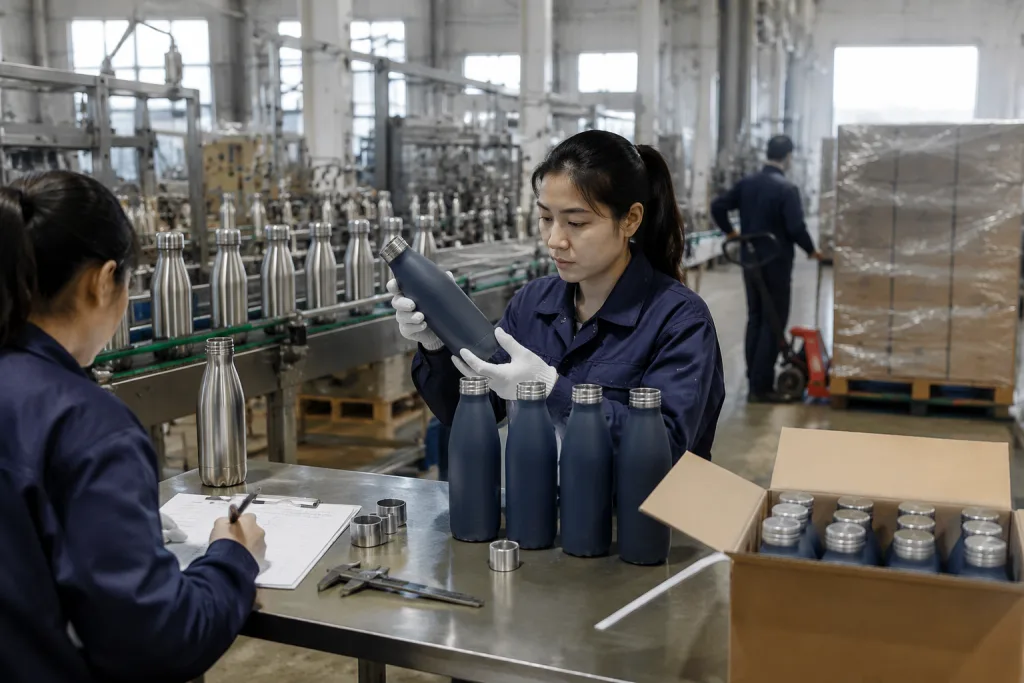
You are not just buying bottles. You are buying a repeatable supply chain: 304 stainless steel coil, BPA-free lid resin, powder-coat adhesion, 5-layer carton strength, EAN-13 barcode scans, and a factory merchandiser who replies before the vessel cut-off. For a 304 stainless steel bpa free water bottle wholesale order, the lowest quote is often where the spec is missing. We have seen this go sideways when a PO says “black lid” but the approved sample used a PP lid with a silicone carry loop, and QC pulled 32 mixed-lid cartons during final inspection.
Here is a realistic buyer scenario: you need 5,000 units for a North American outdoor brand, shipped FOB Ningbo from Zhejiang, China, with your logo, retail packaging, and third-party inspection. BottleForge Industrial in Hangzhou, Zhejiang runs stainless drinkware lines at up to 420,000 units/month, but the order only works if you lock the details before sampling: wall thickness in mm, logo position from the bottom seam, Pantone code, insert card size, and AQL 2.5 inspection points. Small stuff matters. One buyer flagged a 3 mm logo shift on a pre-production sample, and they were right to stop the line before we packed 278 cartons.
Start With The Actual Use Case
Your first decision is not the logo. It is what the bottle must survive. For this buyer scenario, assume you are sourcing 5,000 pieces of 500 ml double-wall bottles for an outdoor retail channel in the US and Canada. The target retail price is USD 24.99, so your landed cost ceiling is likely USD 7.00-8.50 after freight, duty, inspection, and domestic handling. That leaves an FOB China target of roughly USD 3.80-5.20 if the pack-out stays simple: kraft box, polybag, egg-crate divider, no color sleeve. We see buyers ask for gift-box foam inserts at this price, and the math does not work.
Write the use case in plain language on the RFQ: hot coffee for commuting, cold water for hiking, dishwasher not recommended, leakproof when closed, no straw, powder coating, individual kraft box, 24 units per export carton. Add the expected carton drop test if your retailer asks for it; we run 60 cm drop checks on export cartons before loading. This stops the supplier from quoting a thin promotional bottle when you need retail drinkware wholesale quality.
For 304 stainless steel bpa free water bottle wholesale orders, the common build is inner SUS304, outer SUS201 or SUS304, 0.4-0.5 mm wall thickness per shell, vacuum insulation, and a PP lid with silicone gasket. Say “full 304 inside and outside” if that is what your claim needs. Say it twice on the PO. QC pulled a sample last month where the buyer’s artwork said “all 304 stainless steel,” but the order sheet allowed SUS201 outer shell; that becomes a claims problem, not a production problem.
Decide early whether this program is only a water bottle or the start of a bulk drinkware range. If you plan to add a bulk canteen, bulk growler, beer tumbler bulk order, or alcohol flask bulk project later, keep the same powder code, logo method, kraft box layout, and barcode position. The line moves faster when the finish spec is stable, and your shelf looks like one brand family instead of 4 unrelated factory projects.
Lock The Specification Before Sampling
A usable quote starts with a locked spec sheet, not a mood board. For this order, write down capacity, diameter, height, mouth opening, lid material, coating, logo size, packaging, test requirements, and shipping terms. A 500 ml bottle at 73 mm diameter usually clears standard car cup holders; an 85 mm body often gets flagged by retail buyers after the first fit check. QC pulled this once with a digital caliper on the packing table. Small dimension. Big headache.
For material, write it cleanly: inner wall SUS304, food contact grade; lid PP or Tritan, BPA free; gasket food-grade silicone; coating food-contact safe where applicable; no recycled plastic in food-contact parts unless certified. For Europe, ask for LFGB or EU 10/2011 where plastic parts touch liquid. For North America, FDA food-contact compliance is the usual baseline. If the bottle will be sold for children, discuss ASTM and CPSIA requirements before tooling, because the math does not work if testing fails after 5,000 pcs are already packed in export cartons.
Logo method matters. Laser engraving lasts, but it will not give you Pantone gradients. Silk screen is cheaper for one or two colors, usually USD 0.08-0.18 per position at volume, but curved bottles can stretch artwork by 1-2 mm near the shoulder. Heat transfer or UV printing can handle gradients, though we run 3M tape adhesion and hot-water rub checks before approving mass production. For a 5,000-unit order, we normally sample laser engraving and silk screen side by side before confirming the PO.
Do not load the first run with too many moving parts. Two colors are fine. Five colors, three lids, and two box artworks turn a clean wholesale drinkware order into a sorting job on the line, and we have seen this go sideways when the PO had “mat black” typed in one row and “matt black” in another. If you also need canteen wholesale or wholesale growler products, quote them as a separate phase unless the launch date gives the factory at least 12 extra days for sampling and carton drop-test checks.
Read The Quote Like An Engineer
A low unit price is not a landed cost. Ask for the quote in a table with model number, capacity, material, coating, logo method, individual packaging, export carton quantity, carton size, gross weight, MOQ, sample cost, tooling if any, lead time, payment terms, FOB port, and validity period. We run into this on real POs: one buyer sent “500ML black bottle” but missed the lid code, and QC pulled the sample against the wrong screw lid. If one supplier quotes FOB Ningbo and another quotes EXW Zhejiang, the math does not work.
For a practical China factory quote, expect MOQ around 1,000 pieces for an existing mold and 3,000 pieces per custom color if powder coating is involved. BottleForge’s normal lead time is 7-10 days for pre-production samples and 35-50 days for mass production after deposit and sample approval. Peak season before Q4 can add 10-15 days, especially for custom boxes and coated parts. On the line, a color change is not just “paint it blue”; we clean the spray booth, check the Pantone chip under a D65 light box, then run adhesion testing with 3M tape.
Typical FOB Ningbo pricing for a 500 ml double-wall 304 bottle may be USD 3.20-4.20 with a basic screw lid and plain box. With powder coating, custom logo, upgraded lid, and retail carton, the same bottle may land at USD 4.30-5.80. A bulk growler or beer growler in bulk is a different cost structure because 1.9 L and 2 L bodies use more steel, larger cartons, and slower polishing. A wholesale growler can easily run USD 8.50-16.00 FOB depending on cap system and handle. We ship fewer growlers per export carton too, often 12 pieces instead of 24, so the freight per piece jumps fast.
When buyers ask for the best wholesale drink bottle, I usually push back. This is the wrong question to ask. “Best” means one thing for Amazon FBA and another for retail stores, corporate gifting, or outdoor specialty shops. We have seen this go sideways when a buyer chose a matte coating for a gym promo, then flagged scratches after the first carton rub test. Your best option is the bottle that passes the test plan, protects the margin target, and ships before the delivery date without after-sales noise.
Approve Samples Without Being Polite
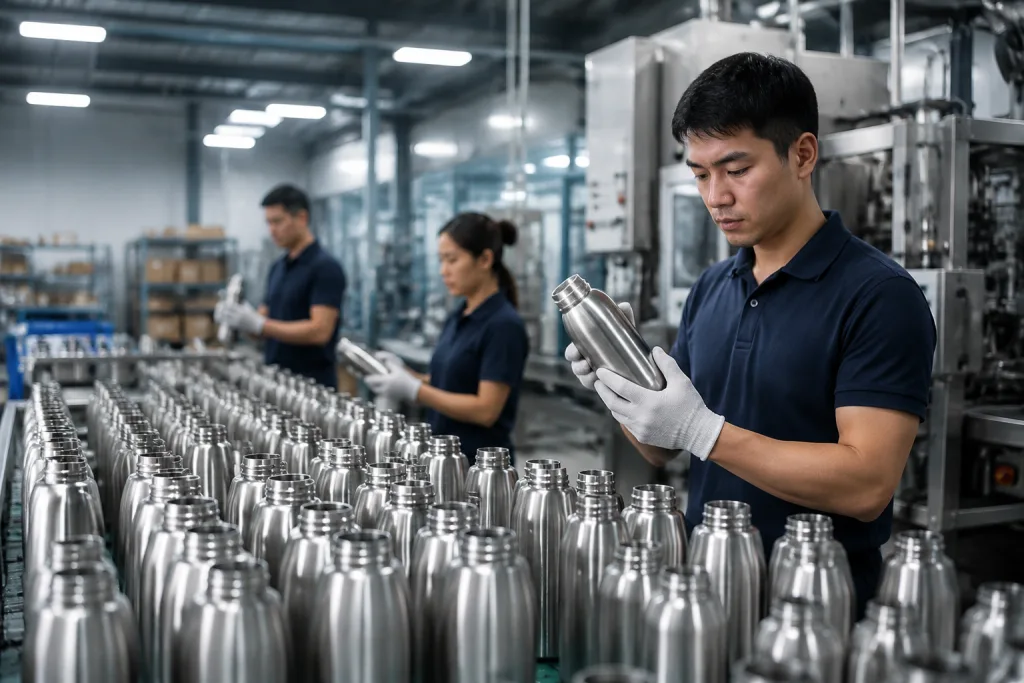
I’ll keep the HTML structure intact and rewrite the prose with a sharper, field-tested tone. Next I’m tightening the sample checks, adding concrete factory-floor details, and stripping the AI filler.Sample approval is where you stop being nice. Do not sign off because the color is close or the logo passes under office light. Check it the way incoming QC would. Fill with 95°C water, close the lid, invert for 10 minutes, and look for gasket seepage. Then fill with cold water and ice, leave it for 12 hours, and check condensation. Measure capacity to the marked fill line, not brim capacity. That is the standard.
For surface checks, run a cross-hatch tape test on printed or coated areas. On powder coating, a basic 3M tape pull after cross-cutting should leave the coating in place in normal adhesion zones. Rub printed logos with a wet cloth, then with 70% alcohol for 30-50 cycles if your channel sees hard use. We’ve seen this go sideways fast. It is cheaper to reject a sample in Hangzhou than explain peeling logos to 5,000 customers later.
Dimension checks are basic, and buyers still skip them. Measure height, diameter, mouth opening, thread fit, and lid alignment on at least 3-5 samples with a caliper; we use a 0.01 mm gauge on the line for this. Weigh each bottle too. A 6 g spread usually means wall thickness drift or a part swap. For drinkware bulk programs, that matters because customers line units up side by side and spot mismatch fast.
Also inspect packaging. Scan the UPC or FNSKU if the order is going to Amazon FBA. Drop one packed export carton from 76 cm on the corner, edge, and face if the shipment will move by courier or mixed handling. The buyer flagged a carton typo on one PO last month, and that sort of small miss turns into a warehouse headache. For alcohol flask wholesale, beer tumbler wholesale bulk, or canteen bulk orders, packaging needs more care because those shapes dent easier than straight bottles.
Set A QC Plan In The PO
I’ll rewrite the section in-place, keeping the HTML tags and all specific QC numbers intact, while making the prose sound like a factory-side sales engineer wrote it.Put the QC plan in the purchase order. Don’t leave it as a side note behind price and delivery date. Use AQL language both sides can read without argument. We normally see AQL 2.5 for major defects and 4.0 for minor defects, with critical defects not allowed. For food-contact drinkware, critical defects mean wrong material, sharp edges, contamination, leakage, unsafe odor, blocked drinking path, and bad compliance labels.
For a 5,000-piece order, a third-party inspection under ANSI/ASQ Z1.4 general inspection level II may pull around 200 units, depending on lot size and the sampling plan. Ask the inspector to check appearance, function, dimensions, logo position, color, barcode, carton marks, packing quantity, gross weight, and the drop test. We run this on the line with a simple gauge and a tape measure; one buyer once left out barcode and carton marks, then blamed us when the shipment hit the warehouse and the labels were off. If vacuum performance matters, spell out the test: fill with 95°C water, record temperature after 6 or 12 hours, and compare it with the approved sample or agreed standard.
Pre-shipment inspection should happen when 100% of goods are finished and at least 80% packed. Earlier checks are fine for catching process trouble, but they cannot confirm final carton marks, accessories, or packing ratios. If the order mixes SKUs such as wholesale canteen, growler wholesale, beer tumbler in bulk, and alcohol flask in bulk, insist on SKU-by-SKU sampling. Mixed cartons hide mistakes. QC pulled the sample, found one PO typo on the carton code, and that saved a rework before loading.
Factories in China that do export every day will accept a clear QC appendix. “Good quality” is not a spec. Write hard limits: logo position tolerance ±2 mm, color within approved sample range, no visible dents at 50 cm viewing distance, leak test pass rate 100% in sampled units, carton quantity exactly 24 pieces. The math works only when the limit is written down. Otherwise, you end up arguing over a gray area after the goods are already on the truck.
Manage Compliance And Paperwork Early
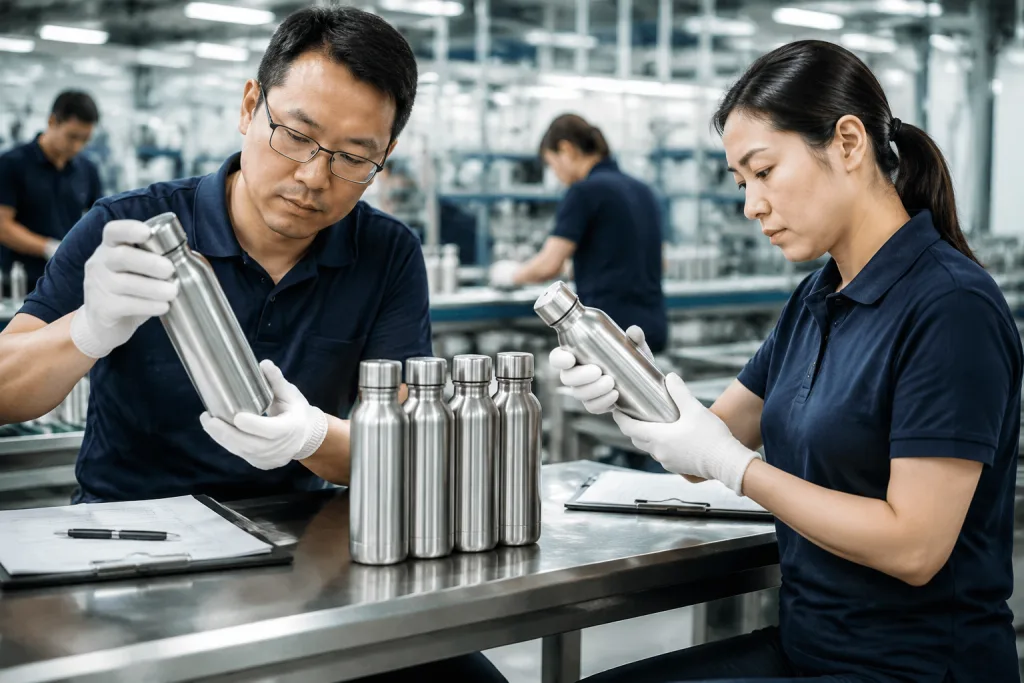
Do not collect compliance after the vessel sails. For 304 stainless steel bpa free water bottle wholesale orders, ask at quotation stage which reports are on file, who issued them, and whether they cover the exact steel, silicone ring, PP lid, straw, coating, and color in your PO. We had QC pull a sample from line 3 last April: the bottle body had a valid 304 stainless report, but the new flip lid had no BPA-free test at all. A 3-year-old stainless steel report does not prove today’s PP lid is BPA free.
For North America, buyers usually ask for FDA food-contact declarations, BPA-free documentation for plastic parts, California Proposition 65 review where relevant, and CPSIA tracking when the bottle is for children. For Europe, check REACH, LFGB, EU 10/2011 for plastic components, and food-contact migration testing against the actual contact parts. If your distributor asks for BSCI or Sedex, verify the audit status before the 30% deposit; waiting until final inspection is the wrong question to ask because the line may already be packed in 12 kg export cartons.
Paperwork has to match the shipment sitting on the pallet: product name, material, factory name, importer details, HS code, country of origin, carton marks, and invoice description. Stainless steel vacuum bottles often move under HS code 9617, but confirm with your broker before we print carton marks. We have seen this go sideways over one PO typo, “tumbler” entered as “tumblr,” which held 86 cartons while the buyer’s forwarder corrected the CI and PL. If your shipment includes beer growler wholesale bulk or beer tumbler wholesale items, write the descriptions clearly enough for customs and insurance.
For Amazon FBA, put the label rules directly on the PO: FNSKU label size, placement, suffocation warning if polybags are used, carton weight under the required threshold, and no mixed SKU carton unless approved. We run a 40 mm label gap from the carton seam because FBA scanners miss labels that wrinkle over the fold. A Zhejiang supplier can pack cleanly for a distributor warehouse and still fail FBA receiving if the FNSKU sits across tape or the buyer changes the carton mark file after pre-shipment QC.
Plan Reorders Before The First Shipment
I’ll rewrite the section in place, keep the HTML untouched, and tighten the prose so it reads like a buyer-facing factory note.The first order proves the product. The reorder proves the supplier. Before the 5,000 units leave Ningbo, lock down how the second run will be controlled: one golden sample kept at the factory, one with your team, one color chip with the Pantone code, one artwork file version, one lid component code, one packaging dieline, and one QC checklist. Photos do not show coating texture or lid fit. QC pulled the sample on the line with a caliper, and that check saves arguments later.
Reorder risk usually comes from silent substitution. We’ve seen a gasket supplier change, a powder coat shift, or a weaker box board swap in because the original vendor is busy. Sometimes nothing breaks. Sometimes the buyer flags leaks, odor, scuffed cartons, or a shelf color mismatch. Your PO should say material, component, packaging, and process changes need written approval first. That is the right question to ask, not whether the factory is “flexible.”
If your roadmap includes canteen wholesale, wholesale drinkware sets, growler bulk, beer growler bulk, beer tumbler wholesale, or alcohol flask wholesale bulk, build one shared component plan. One lid family, one black coating standard, one carton strength spec, and one inspection checklist cut errors fast. We run the math on this every season, and the savings beat one-off pricing games. It also gives you better leverage when negotiating drinkware wholesale pricing across several SKUs.
For steady programs, forecast 90 days out. A factory in Zhejiang, China can reserve line time and coating capacity if you give real numbers, not “maybe 3,000.” If you only send urgent POs, you will pay more, accept fewer color choices, or ship late. We’ve seen that go sideways on a 12-day line slot versus an 18-day slot, and the buyer usually loses. The practical buyer does not squeeze every cent from the first order; they remove uncertainty from every order after it.
Send Your Bottle Spec For Factory Review
Share capacity, quantity, logo, market, and target price. We will check feasibility, MOQ, lead time, and practical QC points before quoting.
Frequently asked questions
What MOQ should I expect for custom 304 stainless steel bottles?
For an existing mold, the workable MOQ is usually 1,000 pieces per order, but custom powder coating often starts at 3,000 pieces per color. If you need a private mold, expect 5,000-10,000 pieces depending on size and tooling cost. For mixed bulk drinkware orders, some factories can combine bottle, canteen, and tumbler quantities, but color and packaging still create separate production lots. At BottleForge in Zhejiang, sample lead time is normally 7-10 days, and mass production is usually 35-50 days after deposit and approved sample.
Is 304 stainless steel always required for wholesale drinkware?
For the liquid-contact inner wall, SUS304 is the safest standard choice for water, tea, coffee, and most daily beverages. Some factories use SUS201 on the outer wall to reduce cost, which can be acceptable if it is clearly disclosed and not exposed to liquid. For a premium 304 stainless steel bpa free water bottle wholesale program, specify inner SUS304 at minimum and request material test reports. If you sell in Europe or North America, pair the steel requirement with BPA-free PP or Tritan lids and food-grade silicone gaskets.
How do I compare FOB prices from different China suppliers?
Put every quote into the same format: capacity, construction, steel grade, wall thickness, lid type, coating, logo method, packaging, carton quantity, MOQ, lead time, and FOB port. A USD 3.60 bottle with a plain box is not cheaper than a USD 4.40 bottle with powder coating, laser logo, retail carton, and stronger export packaging. Also check carton volume because ocean freight can add USD 0.25-0.80 per unit depending on route and bottle size. FOB Ningbo or Shanghai quotes from Zhejiang factories are easiest to compare.
What QC tests should I require before shipment?
Use AQL 2.5 for major defects and 4.0 for minor defects, with zero tolerance for critical safety issues. The inspection should include leak testing, odor check, sharp-edge check, coating adhesion, logo rub test, barcode scan, capacity measurement, carton drop test, and packaging count. For insulated bottles, add a heat retention test using 95°C water over 6 or 12 hours. For a 5,000-piece order, third-party inspection may sample about 200 units under general inspection level II, but the exact sample size depends on the selected standard.
Can one supplier handle bottles, canteens, growlers, and flasks?
Yes, but do not assume every category runs on the same line. Water bottles, wholesale canteen items, beer growler wholesale products, and alcohol flask wholesale orders may use different molds, welding fixtures, polishing processes, and leak tests. A good supplier can coordinate them under one project manager and one QC system, but each SKU still needs its own approved sample and specification sheet. If you are launching several SKUs, start with 2-3 core models, validate sell-through, then expand into growler wholesale or beer tumbler bulk programs.