Key Takeaways
- A realistic MOQ for private label stainless bottles is 1,000-3,000 pcs per color, depending on coating and lid tooling
- 304 stainless steel should be specified as 18/8 food-contact grade with material certificates, not just written on a sales sheet
- Expect 35-45 days mass production after sample approval for a 5,000 pc export order
- Use AQL 2.5/4.0 inspection with leak, coating adhesion, vacuum, barcode, and carton drop checks before shipment
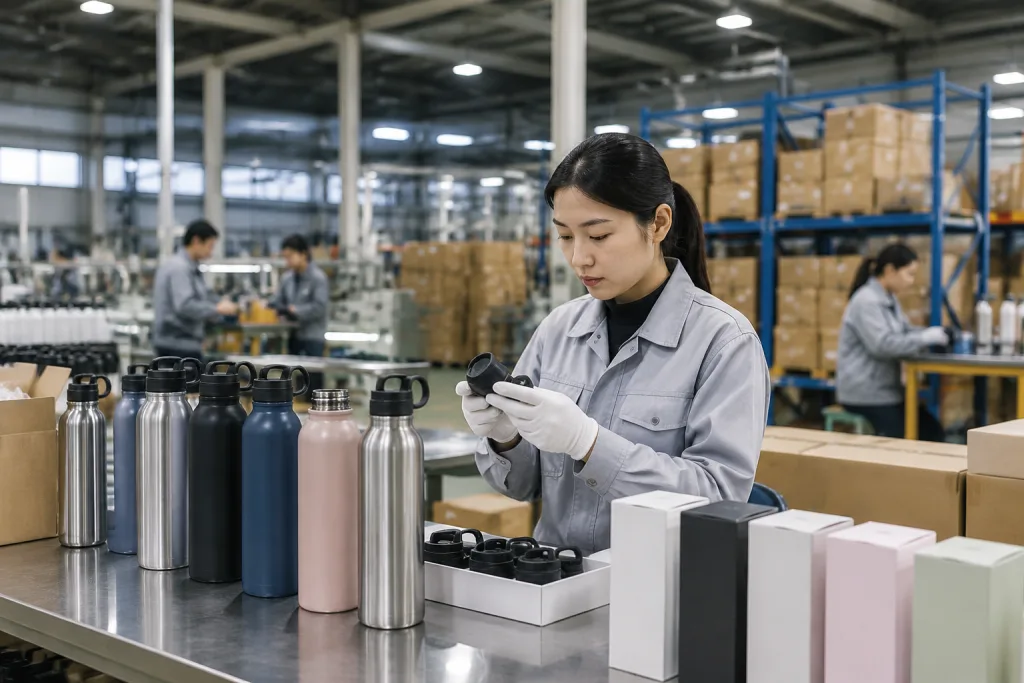
You are not buying a bottle. You are buying 5,000 leak tests, 5,000 logos that must pass a 3M tape pull, 5,000 cartons that need to reach Rotterdam without crushed corners, and 5,000 product claims that cannot create a compliance problem for your website. This is the right way to look at a 304 stainless steel bpa free water bottle private label order. We run the cap on a torque tester before bulk approval because one loose silicone ring can turn into a 3% complaint rate.
A typical case: a European distributor asks for a 750 ml double-wall bottle for retail shelves, corporate gift packs, and canteen promotional programs. Our Hangzhou, Zhejiang team gets 6 to 8 RFQs like this most weeks from canteen distributors, drinkware buyers, and brand owners who understand their market but need tighter factory-side control in China. The buyer usually flags the same issues: barcode position, Pantone logo match, carton drop-test strength, and whether the PO says “304 stainless” while the artwork file still says “18/8 steel.” That typo looks small. We have seen it go sideways.
Start With The Selling Channel
The first mistake is asking a canteen supplier for “your best bottle” before you tell us where it will sell. Wrong question. A bottle for a distributor canteen program is built different from a retail bottle for outdoor shops, and an e-commerce set needs FNSKU labeling, drop-test cartons, and barcode position checked with a scanner on the packing table. The factory specification should start from the channel.
For this buyer scenario, the order is 5,000 pcs of 750 ml bottles, split into matte black and stone grey. The buyer sells to corporate gift companies and regional outdoor stores in Germany, France, and the Netherlands. They need a clean private label look, not a cheap giveaway. We run this as double-wall vacuum insulation, 304 stainless steel inner and outer body, BPA free PP lid, silicone sealing ring, individual kraft box, and EU-ready labeling. QC pulled the sample after laser marking because the logo sat 3 mm too low on the matte black body.
If you are a canteen distributor or distributor growler buyer, define the end use early. Will the product sit in a warehouse for three months? Will it be washed daily in offices? Will it carry hot tea, carbonated drinks, or only water? A custom canteen for school campaigns may need a different mouth diameter and easier cleaning; we usually check this with a simple 45 mm bottle brush test on the line. A custom growler may need 64 oz capacity, stronger handle hardware, and more aggressive pressure testing. We have seen this go sideways when the buyer asks for a slim mouth, then their client complains the bottle cannot take ice cubes.
Good China sourcing is not about collecting 12 random FOB prices. It is about turning your sales channel into a product file the canteen factory can build, cost, and inspect. We ship fewer surprises when the PO says the carton mark, lid color, barcode size, and AQL 2.5 level before the first steel sheet is cut.
Lock The Material Specification
“304 stainless steel” gets the discussion started, but it will not protect your order. Write the PO as SUS304 / 18/8 food-contact stainless steel for internal food-contact surfaces. For a higher-grade retail bottle, we see about 4 out of 10 buyers ask for 304 on the outer wall instead of 201. It costs more. The math still works if your label claim says “304 stainless steel bottle,” because a 201 outer shell creates arguments during incoming inspection. Last month QC pulled the sample and checked the wall with a handheld XRF gun; the inside passed, the outside did not.
For the 750 ml scenario, a typical body wall thickness is 0.40-0.50 mm per layer before forming. Go too thin and the bottle still looks good in a catalog photo, then picks up dents before the second refill. We’ve seen this go sideways on corporate gift orders: one dropped carton, 37 dented units, and the buyer flagged it as a packaging issue when the real problem was weak steel. Powder coating should be checked by cross-hatch adhesion, usually ASTM D3359 as a reference. Run the 3M tape test on the line. The coating also needs practical abrasion resistance; a matte finish that scratches after one week in a backpack is not a premium product.
BPA free is not about the stainless body. It points to plastic contact parts: PP lid parts, Tritan straw or spout parts, silicone inner plug and sealing ring. Ask your canteen manufacturer for the exact material grade, then match it with LFGB, FDA, or REACH-related test reports for your sales market. In Zhejiang, China, we often get POs saying “BPA free” while the silicone ring is not listed anywhere; one buyer even typed “silicon ring” on the PO, which delayed the test request by 2 days. That small ring is where leakage complaints and compliance questions usually start.
For private label custom drinkware, write the product file like an engineer: capacity tolerance ±5%, empty weight target, finish code, lid material, gasket material, insulation target and packing method. Short spec sheets cause expensive phone calls. If the canteen vendors you contact cannot confirm these points clearly, they are quoting a picture, not a controlled product. We ask for a signed golden sample, caliper readings in mm, and carton drop-test photos before we ship production.
Choose Branding Before Sampling
Logo method sets price, lead time, and defect risk, so lock it before sampling. This is the wrong question to ask after the sample is already on the courier truck. For the 5,000 pc order, the buyer wants a 45 mm logo on the front and a small legal line on the base. On powder-coated stainless bottles, laser engraving is the safest choice for wear. It burns through the coating and shows the 304 stainless below. Clean result. Low scratch risk. On our line, QC pulled the sample after a 3M tape test and checked the logo edge under a 10x loupe.
Silkscreen printing fits larger graphic areas and lower-cost canteen promotional orders, but we run ink adhesion testing and Pantone matching before we quote it as final. Heat transfer handles multi-color art, yet the edge needs checking after dishwasher exposure if you plan to print any cleaning claim on the insert. For a canteen customized with individual names, laser personalization works, but it slows packing because the operator scans each name file at the fiber laser station. Do not expect the same unit price for 500 unique names as for one repeated logo. We have seen this go sideways when a PO had “Mathew” in Excel and the buyer flagged “Matthew” only after cartons were sealed.
Packaging is branding too. A private label buyer usually needs a dieline for the color box, barcode placement, country-of-origin wording, warning text, and recycling marks. If you sell through e-commerce, put FNSKU labels and master carton labels into the factory packing instruction, not into a late email. If you sell through retail, check whether the retailer wants hanger holes or shelf-ready trays, then confirm carton gross weight under 15 kg. Our packing team measures the color box with a caliper in mm before cutting the sample carton, because a 2 mm tight fit can scuff the bottle shoulder during transit.
Our Zhejiang factory line can produce about 300,000 stainless bottles per month, but artwork approval still controls the clock. Normal pre-production sample time is 7-10 days after artwork confirmation. Mass production is usually 35-45 days after sample approval and deposit. The math does not work if the bottle is approved and the barcode file arrives 6 days later. A serious canteen vendor will push you to approve packaging details early because cartons, inserts, and barcode files can hold a finished bottle in the warehouse; we ship only after the carton mark, PO number, and AQL 2.5 inspection record match.
Build The Cost Sheet Honestly
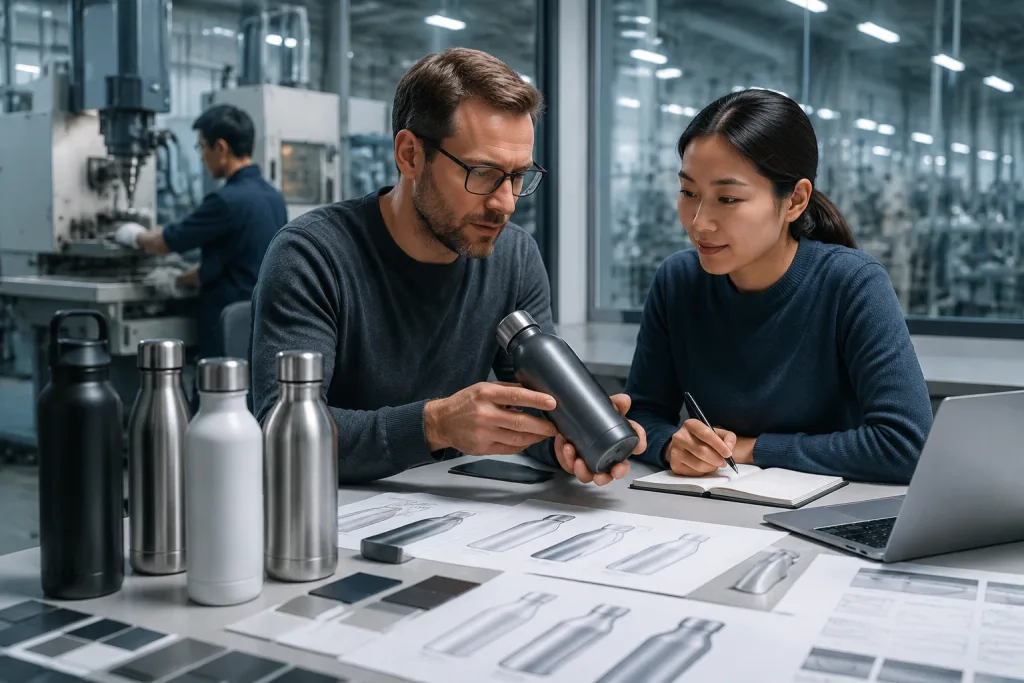
A private label bottle price is not one number. It is a stack of choices, and the stack changes fast on the line. For a 750 ml double-wall 304 stainless steel bpa free water bottle private label order, we usually see FOB China at USD 3.20-5.80 per pc at 5,000 pcs, based on outer wall steel grade, lid design, coating yield, logo process, box quality, and inspection requirements. QC pulled one 750 ml sample last month and found the powder coat 0.18 mm thicker near the base; that alone changed the rework rate. A custom mold lid, carry loop, or special handle pushes the price higher because the math includes tooling, trial shots, fitting tests, and extra assembly time.
MOQ is not magic. For standard bodies and existing lids, 1,000 pcs per color is possible on some models. For custom colors, private label packaging, and stable coating yield, 3,000 pcs per color is healthier; below that, the coating line wastes too much paint during color change and oven setup. We run color cards against a D65 light box, not a phone photo. For a fully customized growler or canteen customizable with new cap tooling, expect tooling fees from USD 800-3,000 for simple plastic components and more for complex assemblies.
Ask canteen manufacturers to separate the quotation into bottle, logo, packaging, testing, spare parts, and shipping terms, with each line shown clearly. If everything is buried inside one unit price, you are not comparing vendors; you are comparing fog. A canteen supplier offering USD 0.40 less might be using a thinner body, 201 outer steel, 5-layer carton changed to 3-layer carton, or no third-party testing. We have seen this go sideways. The buyer flagged crushed master cartons at AQL 2.5 inspection, and the “saving” disappeared before the container left Ningbo.
For distributors, landed cost matters more than FOB. Add ocean freight, duty, customs clearance, inland trucking, palletization, inspection, and a replacement buffer you can defend to your finance team. If you are a distributor drinkware buyer selling seasonal campaigns, price the risk of late delivery too. Cheap freight is the wrong question to ask if the promo date is fixed. A shipment arriving 18 days after the event is not cheap, even if the PO had a clean USD 3.20 unit price and the buyer only spotted the wrong SKU typo after booking.
Approve Samples Like A QC File
A sample is not a souvenir from the canteen factory. It is the control standard for mass production. For this order, we approve three golden samples: one for the buyer, one for the factory QC room, and one sealed for the inspection company. Each sample is signed and dated, with front, side, bottom, lid, and logo photos saved in the order folder. Simple rule. If QC pulled the sample from the cabinet and the line cannot match it, production stops.
The sample approval sheet should cover points we can measure with a caliper and scale. Check total height, diameter, mouth opening, net weight, capacity, logo position, color, lid fit, gasket compression, and smell. Fill the bottle with hot water at 95°C for vacuum testing and check outside temperature rise after 6 hours. We run a common target: hot water stays above 60°C after 6 hours at 20°C room temperature; premium products should be agreed at a stricter figure before the PO is released. We once caught a 3 mm mouth-opening difference at sample stage, and that small miss made the buyer's ice-cube test fail.
Leak testing should be unpleasant. Fill the bottle, close the cap, invert it for 30 minutes, shake it 20 times, and place it sideways on tissue. If the lid has a straw or flip spout, test it in open, closed, and half-closed positions. A customizable canteen with a complicated lid looks good on a sales sheet, but every hinge and gasket adds one more place to fail. The math does not work if a 5,000 pcs order saves USD 0.08 on the lid and then gets a 2% leak claim after delivery.
For customized drinkware, color approval should use Pantone references where possible, but powder coating on metal will not match paper perfectly. Agree on a realistic tolerance before production, such as one approved limit sample for light shade and one for dark shade under the same light box setting. For logo approval, request a close-up photo, rubbing test, and placement measurement. We ship what the signed sample says, not what looks nice in a chat screenshot. The approved sample should become the contract, not just a nice photo in a thread with canteen suppliers.
Inspect Before The Balance Payment
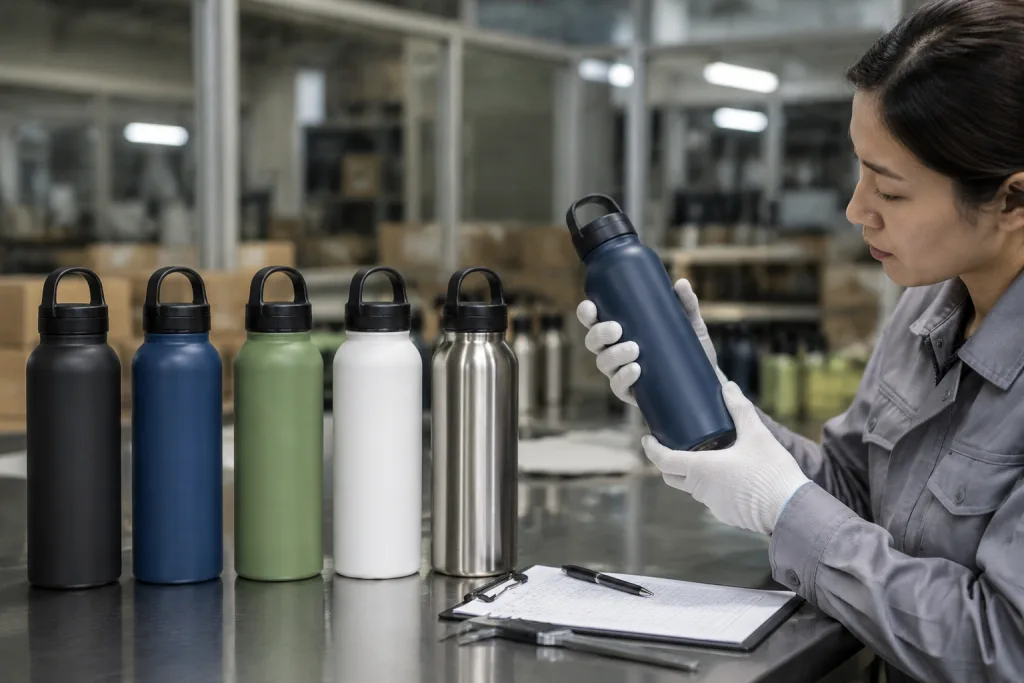
Final inspection is where you protect margin. For a 5,000 pc order, we run ANSI/ASQ Z1.4 sampling with AQL 2.5 for major defects and 4.0 for minor defects. Critical defects, such as sharp metal edges, foreign matter inside the bottle, serious leakage, or unsafe plastic smell, should be zero tolerance. QC pulled the sample last month and found 3 lids with flashing on the PP thread; small issue at the line, expensive issue after the container lands in Rotterdam, Los Angeles, or Toronto.
The inspection checklist should cover appearance, coating defects under a 60 cm light check, dents over 1 mm, welding marks, logo position, lid assembly torque, gasket presence, odor, actual capacity by scale, leak test, vacuum performance sample test, barcode scan, carton marks, carton weight, and drop test. For export cartons, 5-ply corrugated is common. If each bottle is in an individual box, dividers or tight packing may still be needed to prevent abrasion; we have seen matte powder coating rub through after 18 days at sea when the carton had 6 mm of empty space. A carton drop test from 60-80 cm on edges and corners gives a clearer read on transport risk.
Collect compliance documents before shipment: material declaration, BPA free statement for plastic parts, stainless steel food-contact test reports, packaging information, and BSCI or ISO-related factory documents if your customer requires them. For EU buyers, REACH and LFGB requests are common. For North America, FDA food-contact expectations and ASTM references may appear in customer manuals. Ask before the balance payment. We once had a buyer flag a PO typo, “304 stainess,” after the test report was issued, and the lab needed 2 working days to revise the file name.
About 7 out of 10 canteen vendors will say inspection is not needed because “we checked already.” That is the wrong answer for private label. The factory QC team protects the factory process; your inspection protects your purchase order. In China, good factories do not fear inspection. They book a table, open cartons, charge the leak tester, and prepare for it.
Plan Reorders And Variants Early
The first order should set up the second order. If the 750 ml bottle sells through, the next PO usually asks for a 500 ml kids version or a 1,000 ml sports version; outdoor buyers sometimes ask us to turn the same body language into a growler. Keep the structure consistent: logo position measured from the bottom in mm, one lid family where the neck thread allows it, packaging copy from the same file, and cartons that stay close enough for the same pallet plan. We check this on the line with a thread gauge and a printed logo ruler. Small detail. Big saving. It makes distributor canteen programs easier to repeat without rebuilding the whole item master.
Ask the canteen manufacturer to keep production records for the steel batch and coating batch, then tie the lid material batch, packing lot, and inspection report to the same PO. If a customer reports leakage after two months, you need traceability down to the carton label. Without lot control, every complaint becomes a debate. With lot control, QC can pull the retained sample, check the silicone gasket hardness at 55±5 Shore A, and decide whether the issue came from misuse, a gasket batch, or assembly pressure on the line.
Spare parts matter. For a 5,000 pc order, ordering 1-2% extra lids and gaskets is cheap insurance, usually one small carton under 12 kg. Distributors often push back here because the line item looks unnecessary on the PI. We disagree. A lost lid can turn a satisfied customer into a replacement request, even when the bottle body passes the 24-hour upside-down leak test. For custom canteen and distributor growler programs, spare caps let you support retailers without paying air freight for 30 tiny parts later.
At BottleForge Industrial in Hangzhou, Zhejiang, we prefer buyers who build a specification library instead of restarting every RFQ from zero. We keep files for logo size, Pantone code, lid BOM, carton marks, and the last inspection photos; one buyer once sent a reorder PO with “matte balck” copied from an old email, and the buyer flagged it only after the carton artwork was ready. The math doesn't work when every reorder starts as a fresh project. A clean spec library reduces mistakes, keeps prices steadier, and gives your brand a recognizable product line. Private label drinkware is not complicated, but it punishes vague instructions.
Send your bottle spec and target landed cost
We will review material, MOQ, branding, packaging, and QC risks before you commit to a private label stainless bottle order.
Frequently asked questions
What is a realistic MOQ for a private label stainless bottle?
For an existing 304 stainless steel bottle shape, a realistic MOQ is usually 1,000 pcs per color for simple logo work and 3,000 pcs per color for custom powder coating, retail packaging, and stable production scheduling. If you need a new lid mold, special handle, or unique body shape, the MOQ can move to 5,000-10,000 pcs because tooling and line setup become more expensive. For mixed colors, ask whether the canteen factory charges a color change fee. Small runs often look attractive, but coating loss, packaging setup, and QC time make very low quantities inefficient.
How do I verify the bottle is really 304 stainless steel?
Ask for material certificates and food-contact test reports that identify SUS304 or 18/8 stainless steel. For critical orders, you can add a third-party lab test or PMI material check on random production samples. A magnet test is not enough; some stainless steels show weak magnetic response after forming, and some non-304 materials may pass a casual check. Put the 304 requirement in the purchase order, including whether both inner and outer walls must be 304. During inspection, the inspector should record production lot numbers, sample photos, and any factory material documents.
Is BPA free enough for Europe and North America?
BPA free is only one claim, mainly related to plastic parts such as the lid, straw, or inner plug. For Europe, buyers often request LFGB food-contact testing, REACH-related compliance, and a declaration for plastic and silicone components. For North America, FDA food-contact expectations are common. If the bottle is for children, requirements can be stricter, including CPSIA-related checks in the United States. Do not print “BPA free” on packaging unless the supplier can support it with material declarations or test reports for the actual parts used in your order.
What defects should I reject during final inspection?
Reject sharp edges, foreign matter inside the bottle, serious leakage, missing gaskets, unsafe odor, wrong logo, wrong barcode, major dents, exposed rust marks, and severe coating failure. Use AQL 2.5 for major defects and 4.0 for minor defects on normal export orders. Minor issues may include tiny dust points in coating or slight carton scuffs within agreed limits. The inspection should include leak testing, capacity checks, logo rub testing, barcode scanning, carton drop testing, and packaging count verification. Critical safety or hygiene defects should be zero tolerance, not averaged into AQL.
How long does a 5,000 pc private label order take?
A normal timeline is 7-10 days for pre-production samples after artwork confirmation, then 35-45 days for mass production after sample approval and deposit. Add 3-5 days for final inspection, booking, and export paperwork. Ocean freight to Europe or North America may add 25-45 days depending on port and season. If you need custom packaging, new lid tooling, or third-party lab testing, build in extra time. The most common delay is not welding the bottle body; it is late approval of artwork, barcode files, color standards, and compliance wording.