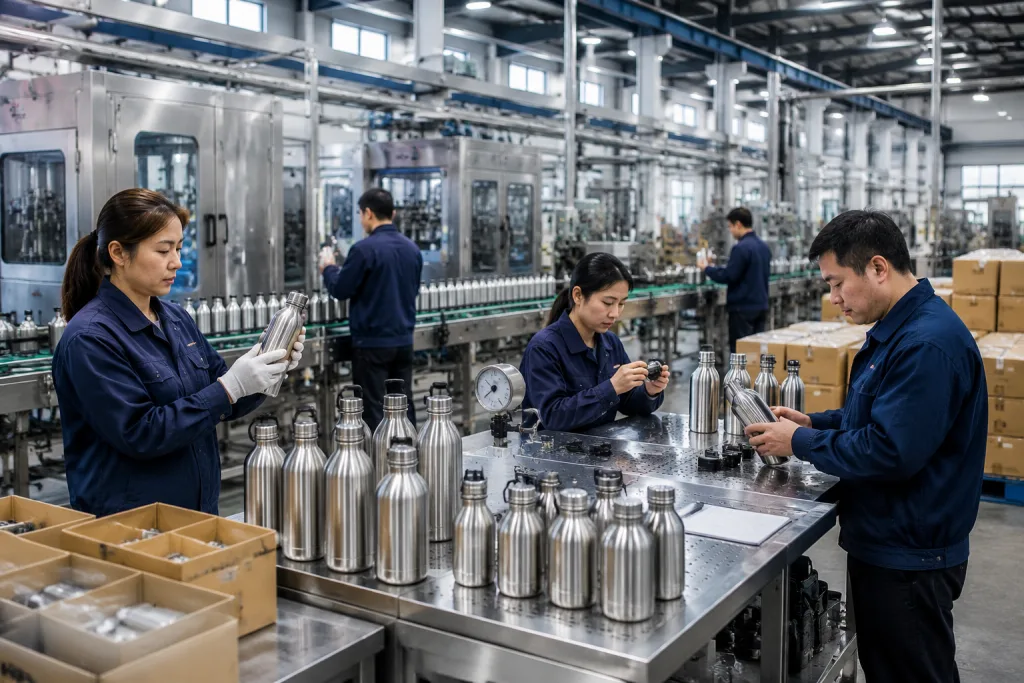
Key Takeaways
- 304 stainless steel should be confirmed as 18/8, typically 0.4-0.6 mm wall thickness for most bottles
- BPA-free applies to lids, straws, gaskets, and coatings, not the stainless body itself
- A practical custom drinkware MOQ is 1,000-3,000 pcs per color for powder coating
- AQL 2.5/4.0 inspection and 30-45 day lead time should be written into the PO
A bottle quotation only means something when the spec behind it is nailed down. We see two factories quote the same 750 ml bottle with a USD 0.40 gap: one runs 0.4 mm body steel instead of 0.5 mm, swaps in a cheaper PP cap, skips inner polishing, and packs 24 pcs into a soft carton without corner protection. Looks fine on a PDF. QC pulled the sample, and the difference showed up in the wall thickness gauge.
If you buy custom drinkware for retail, promotion, Amazon, or distributor channels, read the spec sheet like a PO, not sales copy. BottleForge Industrial is based in Hangzhou, Zhejiang, and this guide is built around the lines we ask buyers to confirm before they place a canteen customized order in China: steel grade, lid material, coating, logo method, carton drop test, and the MOQ the line can actually run without price games. The wrong question is “what is your best price?” The better one is “what exactly are you quoting?”
Material line: 304 stainless steel
The first line on your spec sheet should not say only “stainless steel.” Write SUS304, 18/8 food-grade stainless steel for every liquid-contact part: inner wall, mouth ring, tea infuser, and cap insert if metal touches the drink. In China, 304 is the export workhorse for reusable water bottles, tumblers, canteens, and growlers because it forms cleanly on the hydraulic press and holds up better than 201 against tea, coffee, lemon water, and light salt content. We run 201 only when a buyer asks for a promo item with a short use cycle. For a retail bottle, the math doesn’t work.
For a normal double-wall bottle, we usually see an outer wall of 0.45-0.55 mm and an inner wall of 0.4-0.5 mm before forming. Low quotes often hide 0.35 mm coil on the outer shell; QC pulled one 750 ml sample last month that looked fine on the desk but dented after a 1.2 m carton drop test. It feels cheap, too. If you are building a retail line, that small coil saving turns into returns, photo complaints, and buyer pushback about “thin body” after the first shipment lands.
Ask the canteen manufacturer for a material test report showing nickel and chromium content, or request a third-party test under LFGB, FDA food-contact, or equivalent migration testing. For a custom growler or customized growler used with beer, check the inner weld bead under a borescope and ask whether the factory passivates after welding. We’ve seen this go sideways when a PO said “304 body” but the approval sheet forgot the lid insert; the buyer flagged rust marks after 18 days of acidic drink storage, not 12. Spell it out before tooling starts.
Buyer impact: if the steel grade is vague, your price comparison is not real. Lock SUS304 for liquid-contact parts in the PO and artwork approval sheet.
Capacity, shape, and real fill volume
Capacity looks simple until QC pulls the sample and fills it on the bench. A “750 ml bottle” can be brimful capacity, usable capacity, or the number printed on the hangtag. Brimful means filled to the top edge with no lid. Usable fill sits lower, often by 20-40 ml, because the cap thread, straw, ice, and a little shake room all take space. We run this check with a 1,000 ml graduated cylinder, not by eye. If you sell in Europe or North America, lock this wording before label artwork goes to print.
Common export sizes are 350 ml, 500 ml, 750 ml, 1,000 ml, 1.2 L, and 1.9 L for growlers. For a distributor drinkware program, 500 ml and 750 ml usually move fastest because they fit a school bag side pocket, most car cup holders, and a normal office desk setup. For outdoor or canteen promotional projects, 1,000 ml and 1.2 L give the buyer a stronger hand-feel, but the math can turn ugly. We ship these by carton cube first; one recent 1.2 L order hit volume weight at 13.5 kg per carton while the actual weight was only 9.8 kg.
Shape changes factory risk. A straight-wall canteen custom design is easier for the line to powder coat and screen print because the jig holds the body steady. A canteen customizable body with shoulders, grip grooves, or a narrow waist needs tighter tooling control, and we have seen reject rate move up by 1-3% after the first 300 pcs trial run. Wide mouth sounds better on paper. It is easier to clean and takes ice, but the sealing diameter is larger, so cap leakage testing matters more; QC uses an inverted 30-minute leak test before we approve the pre-production sample.
If you are a canteen distributor or distributor growler buyer, ask for a drawing that calls out height in mm, body diameter, mouth opening, capacity tolerance, and carton quantity. One millimeter can decide whether the bottle fits a retail shelf tray or breaks an Amazon FBA carton plan. We have seen this go sideways from a PO typo: 750m1 instead of 750 ml, then the buyer flagged the label claim after the sample was already packed.
BPA-free parts buyers forget
Stainless steel has no BPA. The BPA-free claim sits on the non-steel parts: PP lids, Tritan straws, silicone gaskets, plastic handles, paint systems, plus printed inks on some orders. We run a material matrix for each SKU, down to the gasket ID in mm, because QC once pulled a lid sample where the PO said “PP” but the supplier packing label said “PC.” A responsible 304 stainless steel bpa free water bottle manufacturer should list every food-contact material instead of hiding them under “eco-friendly.”
Common builds use PP #5 for basic lids, Tritan for clear flip tops or straws, and food-grade silicone for seals. If you sell into kids, fitness, or school channels, ask for BPA-free, phthalate-free, and lead/cadmium compliance on painted surfaces; 2 test reports are better than one vague certificate. For the EU, REACH and LFGB are often requested. For the United States, FDA food-contact material declarations and California Proposition 65 screening may be needed depending on your retail channel. On the line, we check lid resin markings with a 10x loupe because one buyer flagged a missing “PP” mark after 18,000 pcs had already been packed.
A canteen supplier may offer three lid prices for the same bottle body. The cheapest lid may save USD 0.08-0.15 per unit, but the math does not work if leakage claims hit even 1% of a retail order. Look at the hinge pin, gasket thickness, thread fit, and drop resistance; our QC team measures silicone rings at 1.8 mm or 2.0 mm with a digital caliper before assembly. For straw lids, test suction, backflow, and cleaning access. For a customizable growler, cap lining and thread engagement are critical because users expect 18 days of storage, not 12 days, and some will still pour in carbonated drinks even if the manual says not to.
Do not accept “BPA free” printed on packaging unless the canteen factory can support it with material declarations or test reports. This is the wrong question to ask: the issue is not whether the bottle body is BPA-free, but whether every plastic, coating, ink, and gasket has paperwork. We ship cartons with a document pouch on the master box, and we have seen a marketplace request the FDA file because one barcode digit on the PO was typed wrong. Your importer of record is the one exposed if customs, a retailer, or a marketplace asks for documentation.
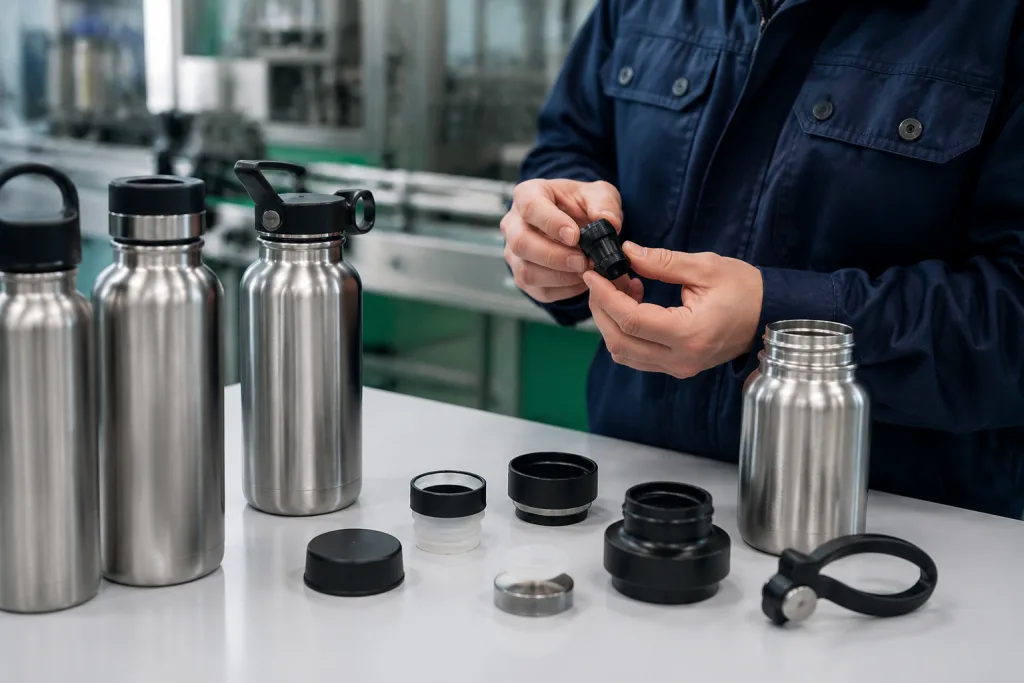
Insulation, sealing, and performance claims
For double-wall vacuum bottles, the insulation claim needs a test sheet, not a nice sentence. We fill with 95°C water, close the lid to the normal torque by hand, then record the temperature after 6, 12, and 24 hours at room temperature with a calibrated probe. A solid 500-750 ml bottle may stay above 55°C after 12 hours and above 40°C after 24 hours, depending on body shape, mouth size, stopper structure, and lid seal depth in mm. Cold tests pass more easily if ice is allowed, so write the method clearly on the spec. Otherwise the buyer will compare two different tests and blame the factory.
Vacuum failure is sneaky. The bottle can look clean on the inspection table and still dump heat fast. Good factories run vacuum testing during production, usually by temperature decay checks or surface heat detection after the line pulls samples. At BottleForge in Zhejiang, our drinkware lines can support about 480,000 units/month across bottles and tumblers, including canteen-style shapes, but we keep insulation checks separate from appearance checks because a bright powder coat hides nothing about vacuum strength. QC pulled a sample last month that looked perfect, but the shell warmed too fast in 8 minutes. That one stopped the carton packing.
Leakage testing should be written by position and time. Use plain wording: fill to 90%, close cap, invert for 30 minutes, then shake 20 cycles. For sports lids, add side-position testing because the push button and straw vent are common leak points. We have seen this go sideways on a canteen promotional order when the buyer wrote “leakproof” on the PO but approved a flip lid meant for upright use. Your end user may throw the bottle into a bag with electronics; “mostly leakproof” is not good enough copy.
For customized drinkware with powder coating, insulation also protects the outside finish from condensation on cold drinks. A single-wall customized canteen is cheaper and lighter, but it will sweat with ice water, and the carton liner may show damp marks during a 12-day domestic warehouse hold versus an 18-day export sailing. That is fine for outdoor giveaways and price-driven programs. It should not be sold as equal to vacuum insulation. The math does not work.
Decoration line: logo and finish
Decoration is where 6 out of 10 B2B drinkware projects start slipping. The spec sheet must split surface finish, logo method, logo size, Pantone color, placement tolerance, and packaging artwork. “Black bottle with logo” is not a production instruction. We had one PO last month that said “logo as sample” but attached the old AI file; QC pulled the sample at line start because the print was 8 mm too low.
Common finishes include powder coating, spray painting, mirror polish, brushed steel, and electroplating-style effects. Powder coating is the standard choice for retail and distributor canteen programs because the grip feels better and the coating survives carton rub testing better than basic spray paint. For powder coating, MOQ is usually 1,000-3,000 pcs per color because the coating line setup, powder purge, and color change waste are real. We run a 2.5 kg powder test before bulk when the buyer asks for a special Pantone. If a canteen vendor promises 200 pcs per Pantone color at the same price, ask whether they are using stock bottles or switching to a cheaper spray process. The math doesn't work otherwise.
Logo methods include laser engraving, silk screen printing, heat transfer, water transfer, embossing, and full-wrap printing. Laser engraving is durable and clean on powder coating or bare steel, but it is limited to one color. Silk screen works well for simple logos, usually with a placement tolerance of ±1.5-2 mm on cylindrical bodies; our jig still needs a flat reference point, so tapered bottles take more checking. Full-wrap artwork needs a seam allowance and may distort near curves. The buyer flagged this once on a 750 ml bottle because the mountain graphic looked bent at the shoulder.
For canteen customizable projects, approve a digital proof and a physical pre-production sample before mass production. No shortcut here. A pre-production sample normally takes 7-10 days after artwork confirmation, and that clock starts only after we receive editable AI or PDF artwork, not a low-resolution JPG pasted into email. If you are building customizable drinkware for several SKUs, standardize the logo height and print zone to cut approval errors; we usually set one 55 mm high print window across 500 ml and 750 ml bodies when the shape allows it.
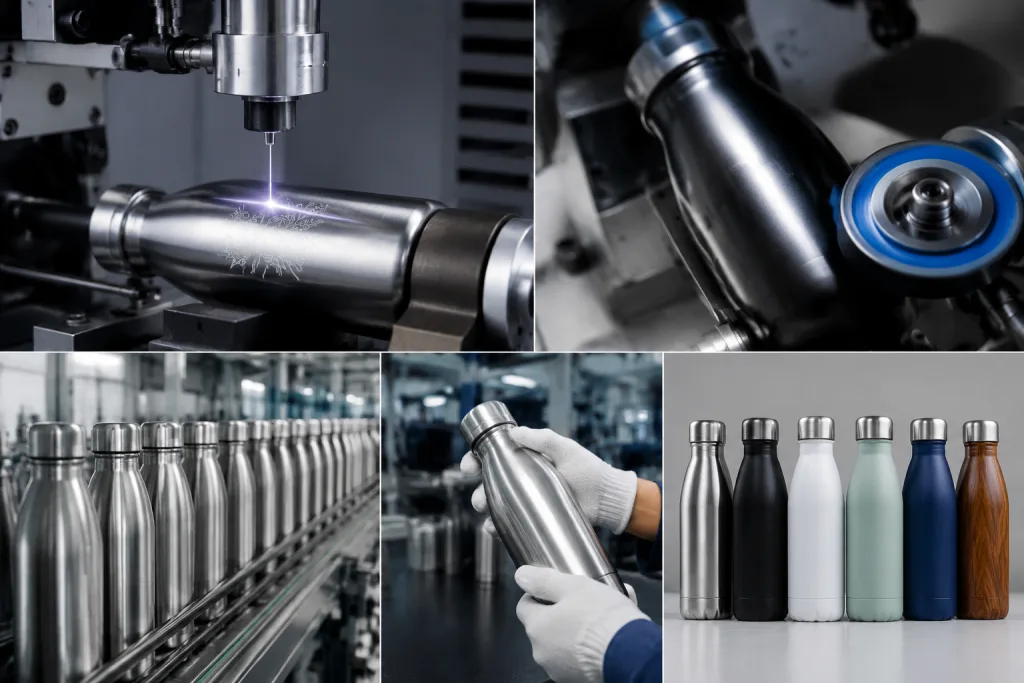
MOQ, price, and export terms
MOQ is not a punishment. It pays for setup cost, material purchasing, coating line changeover, carton printing plates, and QC time. At BottleForge Industrial in Hangzhou, Zhejiang, we usually run 1,000 pcs for simple laser logo on available models, 3,000 pcs per color for custom powder coating, and 5,000-10,000 pcs when new tooling, special lids, or exclusive shapes are involved. Last month QC pulled the first 12 coated samples because the Pantone chip looked fine in the office but shifted under the D65 light box on the line.
As a rough FOB China range, a 500 ml double-wall 304 bottle with a standard screw lid may be USD 2.20-3.20 depending on steel thickness, finish, and packing. A 750 ml bottle may be USD 2.70-4.20. A larger custom growler can run USD 5.50-9.50 depending on capacity and cap construction. Not a fixed quote. These numbers give buyers a quick filter when a canteen supplier sends a price that is USD 0.35 lower but quietly changes 0.5 mm steel to 0.4 mm or swaps the lid gasket material.
Price lines should state FOB Ningbo or FOB Shanghai, inner box or bulk pack, carton size, gross weight, test requirements, and spare parts. If you need DDP, Amazon FBA labeling, FNSKU stickers, carton drop test, or retail color boxes, quote them separately. A distributor drinkware buyer often compares unit price only, then finds later that color box, barcode, and palletization add USD 0.20-0.60 per unit. We've seen this go sideways: the PO said “bulk pack,” the buyer expected 1 pc gift boxes, and the carton artwork file arrived with a barcode digit typo.
Payment terms for new buyers are commonly 30% deposit and 70% before shipment after inspection. Production lead time is usually 30-45 days after deposit and sample approval. During peak season in China, especially before Chinese New Year, add at least 10-20 days of buffer. The wrong question is “How fast can you ship?” Ask whether steel is booked, lids are in warehouse, and powder coating has a slot; 30 days vs 45 days depends on those three checks, not on a sales promise.
Inspection, compliance, and shipment risk
Write the inspection standard into the PO before we cut steel or print artwork. For custom drinkware, we usually run AQL 2.5 for major defects and AQL 4.0 for minor defects, with critical defects rejected at once. Major defects include leakage at the lid thread, wrong material instead of 304 stainless, poor vacuum after the hot-water hold test, sharp mouth edges over 0.2 mm, wrong logo position by more than 1.5 mm, broken lids, or coating failure after tape pull. Minor defects include 1 to 2 small dust points inside the approved limit sample, slight color variation within tolerance, or light carton scuffs found during packing. QC pulled the sample last month because the PO said “matte balck,” but the approved sample was gloss black. Small typo. Big argument.
Ask your canteen manufacturer for an inline inspection report and a final inspection report with photos, not just a stamped checklist. For larger orders, book a third-party inspection agency in China when production is 100% finished and at least 80% packed; for a 10,000 pcs order, that usually means cartons are already sealed and waiting near the loading bay. We ship after the report is clear. If you skip inspection on a canteen customized order, you are doing quality control after the goods reach your warehouse, when a $0.18 lid gasket issue becomes repacking labor, air freight, and buyer chargebacks. The math does not work.
Compliance depends on destination and sales channel. EU buyers often request LFGB, REACH, packaging waste documentation, plus BSCI factory audit records if the order goes into retail. North American buyers may ask for FDA food-contact documentation, CPSIA for kids products, ASTM testing for certain children’s items, and Prop 65 risk review. If your custom canteen is for children under 12, do not treat it like an adult sports bottle. The line checks small-part risk with a torque tester and a 30 lb pull test, because one loose straw cap can fail the whole shipment.
Packaging also needs engineering, not guesswork. Use 5-ply export cartons for heavier growlers, add dividers for powder-coated bottles, and run a carton drop test such as ISTA-style corner, edge, and face drops from 76 cm when carton weight allows. We have seen this go sideways: one buyer asked to remove egg-crate protection to save $0.11 per unit, then QC found 7 dented bottles in 125 pcs after the drop test. Reliable canteen vendors will discuss failure points openly. The best supplier relationship is not the one with the prettiest catalog; it is the one where problems are found in Zhejiang before they become claims in your market.
Send your bottle spec sheet for factory review
We will check material, MOQ, decoration, compliance, packing, and FOB cost before you commit to mass production.
Frequently asked questions
What is a realistic MOQ for a 304 stainless steel BPA-free bottle?
For standard shapes, expect 1,000 pcs for a simple laser logo on stock colors and 3,000 pcs per color for custom powder coating. If you need a new lid mold, exclusive body shape, or a canteen customized retail pack, MOQ usually moves to 5,000-10,000 pcs. Some canteen vendors offer 300-500 pcs, but they are often using existing inventory, limited colors, or digital decoration. That can work for sampling a market, but the unit price and color control will not match mass production.
How do I verify that the bottle is really 304 stainless steel?
Ask for the material grade in writing as SUS304 or 18/8 stainless steel for all liquid-contact steel parts. Request a material test report showing chromium and nickel content, or arrange third-party testing before shipment. A simple magnet test is not enough because some formed 304 parts may show slight magnetism after deep drawing. For a serious distributor canteen program, include material verification in the inspection checklist and keep the supplier’s food-contact declaration with your import documents.
Does BPA-free mean the whole bottle has been tested?
Not necessarily. BPA-free mainly concerns plastic and coating components: PP lids, Tritan straws, silicone gaskets, printed inks, and painted surfaces. The stainless body itself is not the BPA concern. For EU sales, ask for LFGB and REACH documents when relevant. For the US, FDA food-contact declarations and Prop 65 screening may be required by retailers. If your customized canteen has multiple lids, each lid material should be covered, not just the main bottle body.
What lead time should I plan for customized drinkware?
A normal schedule is 7-10 days for a pre-production sample after artwork approval, then 30-45 days for mass production after deposit and sample sign-off. Add 3-7 days for final inspection, corrections, and export paperwork. If you need color boxes, FNSKU labels, palletization, or multiple SKU sorting, allow extra time. Before Chinese New Year, many China factories close or run reduced capacity, so you should place confirmed POs 60-75 days before your required ship date.
Which decoration method is best for a canteen promotional order?
For durable one-color branding, laser engraving is usually the safest choice because it will not peel and works well on powder-coated bottles. For multi-color logos, silk screen printing is cost-effective, but keep the artwork simple and avoid tiny text under 1 mm stroke width. Heat transfer or full-wrap printing is better for retail graphics, but sample approval is essential because seams and curves can distort artwork. For 1,000-3,000 pcs, decoration choice can change unit price by USD 0.10-0.80.