Key Takeaways
- 304 stainless body material should be confirmed with XRF or lab test, not only a quotation line
- A practical MOQ is 1,000 pcs per color for stock shapes and 5,000-10,000 pcs for new molds
- Powder coating normally needs 180-200°C curing and 60-80 μm film thickness for durable color
- Use AQL 2.5/4.0 inspection plus REACH, LFGB, or FDA food-contact testing for EU and North America
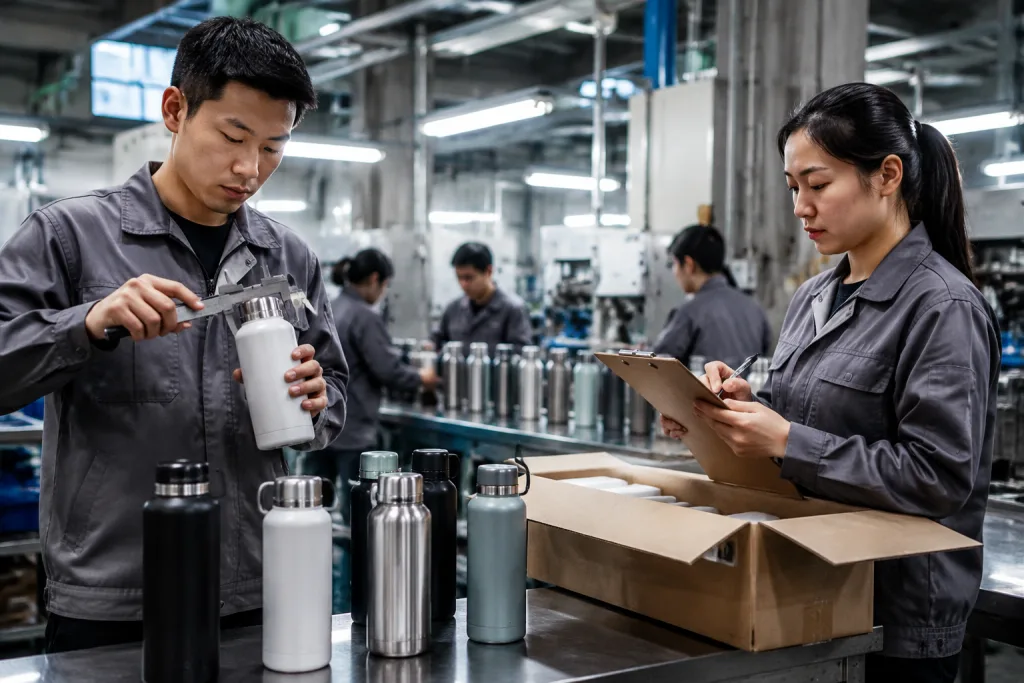
A spec sheet looks simple until you place 20,000 bottles and QC pulls 125 pcs from the line with chipped powder coating, a PP lid that cannot prove BPA free status, or a 5-layer K=K carton that fails the Amazon FBA drop test from 76 cm. Returns start there. If you are sourcing from a 304 stainless steel bpa free water bottle factory, the small lines on the quotation decide whether your complaint rate stays under 1.5% or eats the margin.
Our Hangzhou, Zhejiang team sees this problem in about 8 buyer projects each season: buyers compare unit prices before they check steel grade, 0.5 mm vs 0.6 mm wall thickness, vacuum loss rate after 24 hours, logo process, and inspection terms. China can ship solid custom drinkware. The wrong question is “who is 3 cents cheaper”; the better question is whether the factory spec reads like something the production line can actually hold after tooling, polishing, spraying, and AQL 2.5 inspection.
Start With Steel Grade
The first line on the spec sheet usually says 304 stainless steel. Don’t treat it as decoration. For a bottle body, 304 is the usual choice because it contains roughly 18% chromium and 8% nickel, so it resists corrosion better than 201 steel. If you are buying for schools, outdoor retail, workplace gifting, or a canteen promotional program, this line affects odor complaints and rust claims. We have seen a 0.4 mm inner wall pass salt-spray clean while a cheaper 201 sample showed spots after the buyer’s desk test.
Ask the canteen manufacturer to state which parts are 304. A good spec separates inner wall, outer wall, rim, tea filter, straw, and lid hardware. In price-driven projects, we often see 304 used for the inner liner and 201 used for the outer shell; on premium runs, buyers usually ask for 304 on both walls. That mix is not automatically wrong, but it must be written down. If your product is marketed as premium custom canteen or customized drinkware, 304 inner and outer walls are easier to defend when the buyer flagged it in retail QA.
For serious B2B orders, request one of three checks: an XRF material scan on random finished bottles, a third-party composition report tied to the PO, or an incoming coil certificate with heat number. XRF is fast. QC pulled the sample, shot the inner wall with the handheld XRF gun, and caught the wrong shell material before packing on a 12,000-piece order last year. It will not settle every dispute, but it blocks the worst substitution problems. At BottleForge Industrial in Zhejiang, our standard stainless bottle line runs about 450,000 units/month, and we keep coil batch records for export orders so a canteen distributor can trace complaints back to a steel batch instead of guessing.
Wall Thickness And Vacuum Build
The next spec line buyers skip is wall thickness. For double-wall vacuum bottles, common body thickness is 0.4 mm to 0.5 mm per wall. We check it with a digital thickness gauge before polishing, because a cheap 0.32 mm shell can look fine in a photo and still dent during China domestic trucking or one rough pallet move at the Ningbo warehouse. Dents are not cosmetic for a distributor drinkware order. The buyer sees chargebacks, replacement claims, and CS tickets.
Vacuum performance is not decided by thickness alone. The line needs a stable laser-welded seam, an inner wall with no oil residue after cleaning, correct vacuum pumping time, and a tight seal at the tail point. Ask for the heat retention test condition, not a loose claim like keeps hot 12 hours. A usable factory line reads: 95°C water, 20°C ambient room, filled to rated capacity, measured after 6 hours. For a 500 ml bottle, a 0.45 mm build should hold above 60°C after 6 hours if the vacuum is right; QC pulled samples last month where 3 pcs failed because the bottom seal color changed after pumping. Larger custom growler or customized growler items perform better because the volume-to-surface ratio is higher.
Check the base design too. A thin concave base can wobble after forming, and buyers flag this fast when they test the sample on a glass desk. A thicker base gives better stability, but the math does not always work because it adds grams and raises freight cost. If you are planning customizable growler production, decide whether the buyer wants a rugged hand feel or a lighter carton. A 64 oz stainless growler can vary by 80-120 g depending on wall gauge and base structure. On a 10,000 pc order, that changes carton weight, container loading, and landed cost.
Do not approve a vacuum bottle sample until the same sample set passes heat retention, leak resistance, and a real drop denting check.
BPA Free Means Every Contact Part
BPA free cannot sit only on the stainless body. 304 stainless has no BPA issue; the risk sits in the parts that touch the drink or the mouth, such as PP flip lids, Tritan straws, silicone gaskets, spouts, carry handles, and coated inner parts if the design uses them. A reliable 304 stainless steel bpa free water bottle factory should list the resin for every contact part. On our line, QC pulled 12 random lids last month because the cap BOM said PP, but the injection tray label showed AS.
For Europe, ask for LFGB or EU 10/2011 test coverage when plastic touches water. For North America, FDA food-contact compliance and California Proposition 65 review depend on your sales channel and retailer manual. REACH is still common for coatings and restricted substances. If the bottle is for children, ASTM F963 and CPSIA lead and phthalate checks can decide whether the shipment passes buyer review. A kids bottle is not a smaller sports bottle with a cartoon logo. We have seen this go sideways when a buyer approved the bottle body, then flagged the straw tip during carton inspection.
For canteen suppliers and canteen vendors, the common mistake is testing one standard lid and then switching to a cheaper lid for production. Lock the lid code in the purchase order. If you run three cap options, put material confirmation beside each cap code, not in a separate email thread. Small detail. Big headache. Silicone gasket hardness is usually around Shore A 50-60 for a reliable seal; too soft can deform, too hard can leak when the user cross-threads the lid. We once had a PO with “LID-21B” typed as “LID-12B,” and QC caught it only after the first 500 pcs were packed.
If your customer asks for canteen customizable lid colors, be careful with pigments. Bright red, orange, and black plastics should go into chemical testing when the colorant changes, especially if the Pantone chip is new for that order. A good canteen factory will not complain about this. Testing costs less than pulling 30,000 units back from a retail chain, and the math does not work once warehouse handling, relabeling, and buyer chargebacks start.
Capacity, Threads, And Leak Control
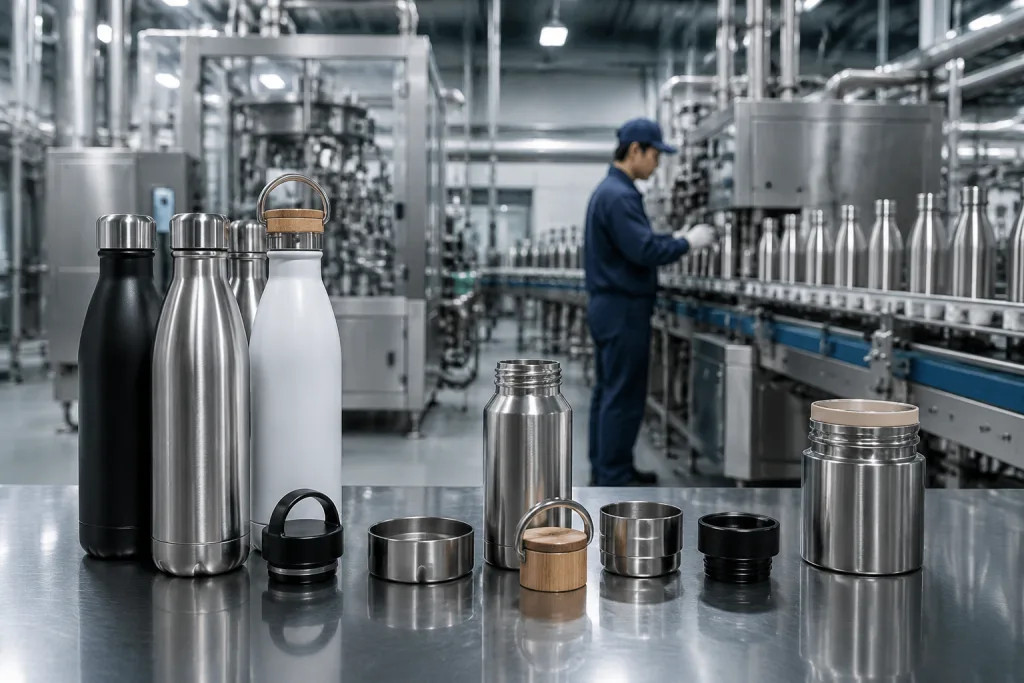
Capacity sounds simple. It is still one of the top 3 reasons QC pulled a sample from our line last year. A 750 ml bottle can mean brimful capacity or usable capacity. Brimful is measured to the top edge with a graduated cylinder; usable capacity leaves headspace so the cap closes without water pushing into the thread. Put both on the drawing if you sell to a strict distributor canteen customer. A 3-5% capacity tolerance is common, but your label claim needs to stay honest. We once had a buyer flag a “750ml” carton mark because the usable fill was 718 ml. The math doesn’t work if retail compliance checks the bottle.
Thread design matters more than first-time buyers expect. Wide-mouth bottles are easier to clean and fill with ice, but the lid needs enough thread engagement to prevent leaks. A typical reliable design uses 2.5-3.5 turns from first bite to seal. Too few turns feels fast but raises leakage risk. Too many turns annoys users. For sports lids, check one-hand opening force, hinge life, and straw fit with the actual silicone parts, not a loose lab sample. We run leak control by filling to rated capacity, closing the lid with the production gasket, placing the bottle upside down for 30 minutes, then shaking 10 times. QC also checks the first-shot caps with a torque meter because a 0.3 mm thread mismatch can show up as slow seepage. For travel tumblers, angle leakage is the better test because the product sits in cars and backpacks, not upside down on a perfect table.
Custom canteen projects often require car cup compatibility. Ask for bottom diameter in millimeters. About 70-75 mm lower diameter works for 8 out of 10 North American cup holders we see in buyer spec sheets. A 1 L bottle may need a stepped base or it will not fit. For a canteen distributor, this is a sales feature; for an end user, it is the difference between daily use and a return. We have seen this go sideways when a PO only said “fits car cup holder” and the final base came out at 82 mm.
On customized canteen shapes, do not skip tooling review. A new mold in China normally adds 20-35 days before production samples, and the mold cost must be separated from the FOB unit price. Send us the 2D drawing, cap stack height, and target bottom diameter before artwork approval. One typo on a PO, such as “78 mm” typed as “87 mm,” can delay the line longer than the mold cutting itself.
Coating, Logo, And Color Tolerance
Surface finish is where custom drinkware looks shelf-ready or looks cheap. We run powder coating on about 7 out of 10 stainless bottle orders because it gives better grip, deeper color, and fair abrasion resistance for daily use. A practical production spec is 60-80 μm coating thickness with curing around 180-200°C, depending on powder supplier. QC checks the neck and bottom edge with a coating thickness gauge, not by eye. Too thin, and the steel ghosts through on rolled edges. Too thick, and the threads start fighting the lid fit.
For logo work, match the process to where the bottle will be sold. Silk screen is economical for simple one- or two-color logos and can work at 1,000 pcs MOQ per color, but small text under 1.2 mm often fills in after coating. Laser engraving suits premium corporate gifting and will not peel, but it exposes the stainless underneath, so the buyer must accept that silver mark. Heat transfer and water transfer handle full-wrap artwork, with more proofing time and scrap allowance; we usually hold back 3-5% extra bodies for complex wraps. For a canteen custom campaign with a large brand mark, ask for a pre-production sample after mass-production coating, not a hand-finished sample from the sample room. We’ve seen this go sideways when the sample-room logo looked sharp, then the line sample showed a 0.6 mm registration shift.
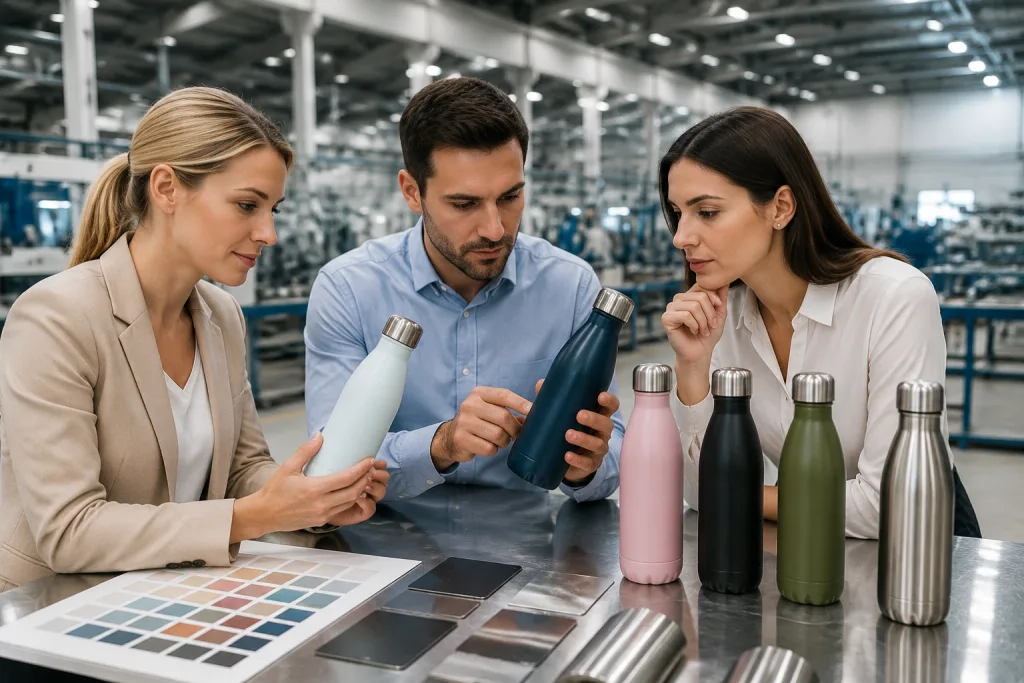
Color tolerance should be written on the PO. Pantone matching on powder coating is not paper printing, and asking for a “perfect Pantone” is the wrong question to ask. A reasonable tolerance is often Delta E under 1.5-2.0 for controlled batches, but metallic and matte finishes are harder because gloss level changes how the color reads under a D65 light box. If you are a canteen vendor handling two or three annual reorders, keep a signed color panel. Zhejiang factories can match previous runs, but only if the original powder code, curing settings, and approved panel are still available. Last year a buyer flagged a reorder as “too warm”; the approved panel had been lost, and the old PO listed only “navy blue,” with no powder code.
For customizable drinkware and canteen customized programs, check dishwasher claims before artwork is locked. Several powder-coated bottles are hand-wash recommended, even when the coating passes a basic cross-hatch tape test. If your retail packaging says dishwasher safe, you need cycle testing, not optimism. We normally ask for 30-50 dishwasher cycles on coated samples and then check logo peel, whitening near the weld line, and lid thread roughness.
MOQ, Inspection, And Shipment Terms
The commercial lines on the spec sheet are not paperwork; they decide whether your order is easy to run or painful from day one. For stock bottle shapes from our Zhejiang production network, a realistic MOQ is 1,000 pcs per color for standard powder coating and logo. For new molds, expect 5,000-10,000 pcs depending on shape, lid complexity, and annual forecast. A fully customized growler with special cap tooling may need a higher first order because the mold room, laser fixture, and coating line changeover all have real costs. We had one buyer ask for 6 colors at 500 pcs each; the math did not work after we counted powder loss and two extra cleaning cycles on the line.
Lead time should be split into sample, pre-production, and mass production. A normal custom drinkware timeline is 7-10 days for logo sample, 3-5 days for approval after comments, and 30-45 days for mass production after deposit and artwork confirmation. Peak season before summer and Q4 gifting can add 10-15 days. Check capacity first. If a canteen supplier promises 15 days for a coated, logoed 20,000 pc order without checking coating slots, lid inventory, and carton booking, be skeptical. We usually confirm the schedule against the laser room queue and the powder coating oven plan before we write the ship date on the PI.
Inspection terms should be on the purchase order. For B2B orders, AQL 2.5 major and 4.0 minor is a common starting point. Define critical defects as leakage, rust, wrong material, sharp edges, failed barcode, and unsafe contamination. QC pulled one sample last season with a 0.6 mm burr inside the lid thread; small defect, big complaint risk. If shipping to Amazon FBA, confirm carton size, gross weight, FNSKU labeling, suffocation warnings for polybags, and drop test condition before production packing begins. Do not leave packing to “standard export carton” wording. That phrase causes arguments.
FOB Ningbo or FOB Shanghai are common for Zhejiang and broader China shipments. Ask whether the quoted price includes export carton, inner box, desiccant, barcode sticker, and palletizing. Canteen distributors and distributor growler buyers should model landed cost using real carton dimensions, not only FOB price. This is the wrong place to save blind. A bottle that is USD 0.08 cheaper can lose money if it loads 12% fewer units per container. We check carton CBM with a tape measure on the packed master carton, not only the size typed on the packing list, because a 15 mm carton bulge can change the container count.
Send Us Your Bottle Spec Sheet
We will review steel grade, MOQ, logo process, packaging, testing, and FOB terms before you commit to production.
Frequently asked questions
What MOQ should I expect from a 304 stainless steel bpa free water bottle factory?
For existing bottle molds, expect about 1,000 pcs per color for powder coating and one logo position. Some factories in China accept 500 pcs, but the unit price usually rises because coating line setup, screen plates, and packing changes are fixed costs. For a new body shape, 5,000-10,000 pcs is more realistic. For a custom growler or complex lid, tooling cost and MOQ can be higher. If you are testing a distributor drinkware program, use a stock mold first, then invest in tooling after sell-through data.
How do I verify the bottle is really 304 stainless steel?
Ask for material confirmation at three points: coil certificate before production, XRF scan during production, and third-party lab testing if the order is high risk. XRF is useful because it can check chromium and nickel content quickly on random units. For 304 stainless, you generally expect about 18% chromium and 8% nickel, although exact ranges follow the steel standard. Do not rely only on a product photo or supplier promise. A canteen manufacturer should be willing to add material grade to the purchase order and inspection checklist.
Which logo process is best for a customized canteen order?
For simple promotional jobs, silk screen is usually the best cost option at 1,000-5,000 pcs, especially for one-color artwork. Laser engraving is better when you want a durable premium look and no risk of ink peeling. Heat transfer works for complex full-color designs but needs more sampling time and tighter QC. For canteen promotional orders, I usually recommend approving a real coated production sample, then using AQL inspection to check logo position, color, adhesion, and scratches. Do not approve only a digital mockup.
What tests should I request for BPA free and food-contact compliance?
For Europe, request LFGB or EU 10/2011 for plastic food-contact parts, plus REACH review for coatings and restricted substances. For North America, FDA food-contact compliance is common, and Proposition 65 may be needed for California sales. If the bottle is for children, add CPSIA and ASTM F963 where applicable. Test the actual lid, gasket, straw, and color used in production. A canteen supplier may have old reports, but reports older than 12-24 months or for different materials should be treated carefully.
How long does production take after sample approval?
For a normal customized drinkware order using an existing mold, plan 30-45 days after deposit, artwork approval, and sample sign-off. Add 7-10 days for logo sample preparation before that. New mold projects can add 20-35 days for tooling and trial samples. During peak seasons in China, add another 10-15 days if you need powder coating, gift boxes, or retail-ready packaging. A canteen vendor that quotes very short delivery should show line capacity, material availability, and a written production schedule.