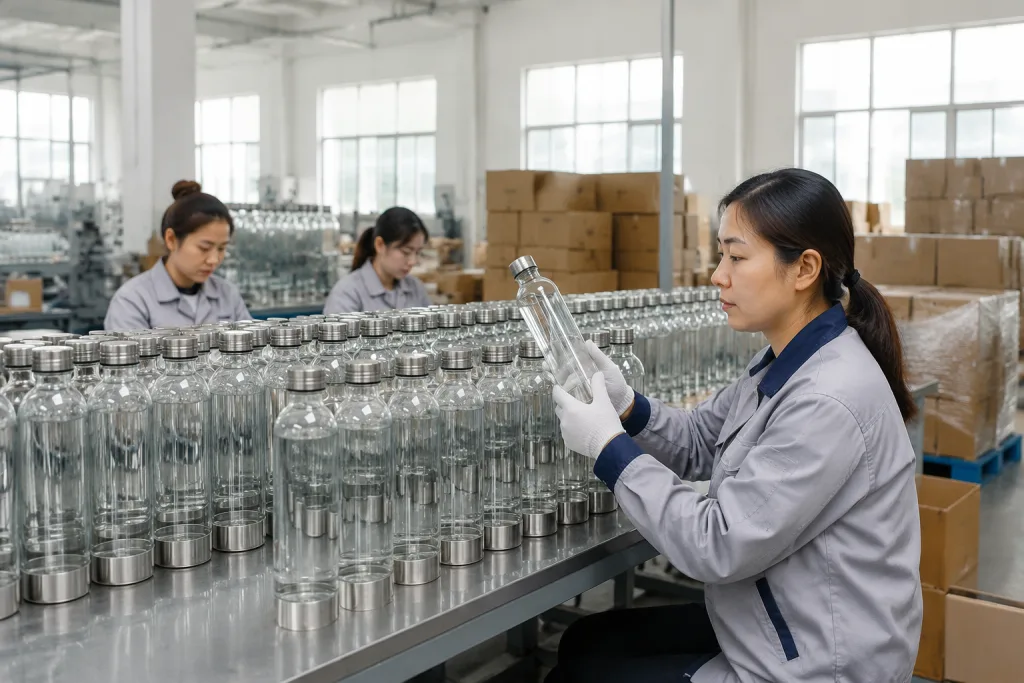
Key Takeaways
- A 500-750 ml borosilicate bottle with 304 stainless steel cap usually lands at USD 1.85-4.20 FOB China depending on volume and decoration
- Practical MOQ starts at 3,000 units for standard molds and 10,000-20,000 units for private molds or complex packaging
- Normal lead time is 7-12 days for samples plus 30-45 days for mass production after deposit and artwork approval
- Logo, sleeve, gift box, inner tray, and drop-test requirements can add USD 0.15-1.10 per unit
A glass bottle looks simple until you buy 5,000 units and find the cap liner, silicone sleeve thickness, logo process, inner carton, test report, and packing method all move the quote. Small parts bite. For wellness brands and sustainable retailers, “how much per bottle?” is the wrong question to ask. The real question is whether the bottle survives a 1.2 m carton drop test, passes REACH or LFGB checks, keeps the logo clean after tape testing, and lands before the launch window the buyer already sold to retail.
BottleForge Industrial runs custom glass water bottle projects from Hangzhou, Zhejiang, for buyers in Europe and North America. A normal borosilicate glass bottle bulk order in China runs 3,000-20,000 units, with 30-45 days production after sample approval. Before a PO is issued, we check the cap drawing in mm, confirm 304 stainless steel contact parts, and quote the packing by actual carton weight, not guesswork. We have seen this go sideways when a PO says “bamboo lid” but the approved sample used stainless steel trim, so below is the cost and lead-time breakdown we use before the line starts.
Where the unit price really moves
For 304 stainless steel borosilicate glass bottle wholesale projects, the glass body is only one line on the quotation sheet. A 500 ml clear borosilicate body can hold steady in cost for 30 days, while the lid structure, silicone sealing ring, sleeve, and packaging move the final FOB price by 30-60%. We see this every week. If a supplier sends one neat unit price without splitting cap, gasket, carton, and logo costs, push back and ask for the BOM breakdown; our costing table uses 0.01 kg increments for glass weight and separate rows for each packing step.
Typical FOB China pricing for a standard clear 500-750 ml bottle with a 304 stainless steel outer cap and food-grade silicone seal looks like this: USD 1.85-2.35 at 10,000 units for a plain bottle, USD 2.25-3.10 with one-color logo and kraft box, and USD 3.20-4.20 with silicone sleeve, custom color cap, retail gift box, and barcode labeling. Smaller 3,000-unit runs usually sit 12-25% higher because setup costs and packing labor are spread across fewer pieces. The math is simple. On one 3,000 pcs PO last season, the buyer flagged a USD 0.19 jump, and it came from 6 workers hand-applying barcode labels at 1,200 pcs per shift, not from the glass furnace.
The cap matters. Some buyers write “stainless cap” but mean a thin decorative stainless shell over PP plastic. For wellness and sustainable retail channels, specify 304 stainless steel contact or outer surface, a BPA-free inner insert, and a removable silicone gasket with shore hardness around 50-60A. QC pulled the sample on a recent order because the gasket sat 0.4 mm proud and caused a slow leak after the 24-hour inverted test. If you want a tea infuser, handle loop, bamboo-stainless hybrid lid, or leakproof flip lid, cost it as a separate part. Calling it a small option is the wrong question to ask.
Borosilicate glass bottle manufacturers in Zhejiang and other parts of China usually quote from glass thickness, bottle weight, cap type, surface finish, and packaging. A 2.0-2.2 mm wall bottle is cheaper and lighter, but 2.5-3.0 mm is safer for premium retail. We run calipers on the shoulder and base, not just the straight wall, because that is where AQL inspection often finds weak spots. For a bulk glass water bottle program, saving USD 0.12 on thin glass does not work if breakage claims rise by 1-2% and your importer starts asking for credit notes.
MOQ tiers that actually make sense
MOQ is not a moral test. It is a setup-cost problem. For a borosilicate glass bottle order, we run glass forming, cap assembly, logo printing, inspection, and packing as separate steps, not one magic button. If the order is too small, the line spends 3 hours changing jigs and screen frames to make 600 bottles. The math does not work. At BottleForge Industrial in Hangzhou, Zhejiang, our standard capacity for glass and mixed-material drinkware projects is about 450,000 units/month, but efficient scheduling still depends on MOQ tiers that match real line time.
For standard models, 3,000 units is a realistic starting MOQ for a borosilicate glass bottle custom order with one logo position and stock cap color. QC still checks logo position with a 0.5 mm tolerance gauge, so even a “small” order has fixed setup work. At 5,000 units, you get better unit pricing and room for custom carton marks, FNSKU labels, or 2 sleeve colors. At 10,000 units, most buyers can push for better cap finish, PMS-matched sleeve colors, and steadier production priority. For 20,000 units and above, private packaging and partial mold adjustments are easier to justify because the tooling cost is spread across enough pieces.
Private mold projects are different. A customized borosilicate glass bottle with a unique body shape normally needs 10,000-20,000 units MOQ, plus mold cost. A simple glass mold may cost USD 1,200-3,500. A more complex bottle with special shoulder shape, threaded neck changes, or matched sleeve tooling can reach USD 5,000-9,000. Mold sampling adds 15-25 days before normal sample approval, and we have seen first shots rejected because the threaded neck was 0.3 mm tight against the cap insert.
If you are a borosilicate glass bottle distributor or sustainable retailer testing a new line, do not start with a private mold unless your sell-through data is strong. Start with a standard bottle. Customize the cap, sleeve, logo, and box, then move to private tooling after the second or third reorder. One buyer once flagged this late after their PO said matte black cap, but their artwork file named it “gloss black cap”; that kind of small mismatch is cheaper to fix on a standard SKU. This lowers launch risk and keeps cash out of tooling until the SKU proves itself.
Decoration costs buyers often miss
A custom borosilicate glass bottle is not just “add a logo.” Decoration changes unit cost, lead time, scrap risk, and MOQ. For clean wellness branding, one-color silkscreen on the glass is still the safest choice. We run this on a curved screen printer with a 0.3 mm registration tolerance, and QC checks the first 20 pcs before the line continues. It usually adds USD 0.08-0.18 per unit, with a screen setup fee of USD 30-60 per color. Two-color printing can look better on retail designs, but curved glass moves. Tiny text below 6 pt is a bad idea; we had one buyer flag a nutrition-claim line that turned into gray dust after firing.
Laser engraving works well on 304 stainless steel caps, especially for brands that want a permanent logo without ink. Expect USD 0.10-0.25 per cap depending on logo size and output speed. On our fiber laser, a 25 mm logo is different from a 45 mm wrap mark; the cycle time changes, and the math changes. Pad printing on caps can be cheaper for simple marks, but abrasion resistance is weaker unless coated. For borosilicate glass bottle promotional orders, buyers often choose one-color glass logo plus cap engraving because it looks premium without adding a sleeve that slows packing by 2-3 seconds per unit.
Sleeves are a bigger decision, and asking only for the sleeve price is the wrong question to ask. A silicone sleeve protects the glass and creates color blocking for retail shelves, but it adds tooling, color matching, and labor. A stock sleeve can add USD 0.35-0.60 per unit. A custom sleeve with embossed logo, PMS color, and matched fit can add USD 0.60-1.20, plus mold cost of USD 400-1,500. Neoprene sleeves are cheaper for some programs, usually USD 0.25-0.55, but they feel less premium and may not match plastic-free claims. We once pulled 80 pcs during incoming QC because the sleeve mouth was 1.5 mm too tight, and workers had to use both thumbs to force it over the glass.
For a borosilicate glass bottle customizable program, artwork approval should be treated as a production gate. Send vector AI or PDF files, confirm Pantone references, and approve a printed sample under daylight and indoor lighting. Simple step. We check the file at 1:1 size, not just on a laptop screen, because a 0.2 mm line can disappear after screen exposure. A good borosilicate glass bottle supplier will warn you if your logo is too close to the curve, too low near the base, or too fine for stable printing. We have seen this go sideways when the PO said “black logo” but the artwork showed Cool Gray 11C.
Packaging and freight cost traps
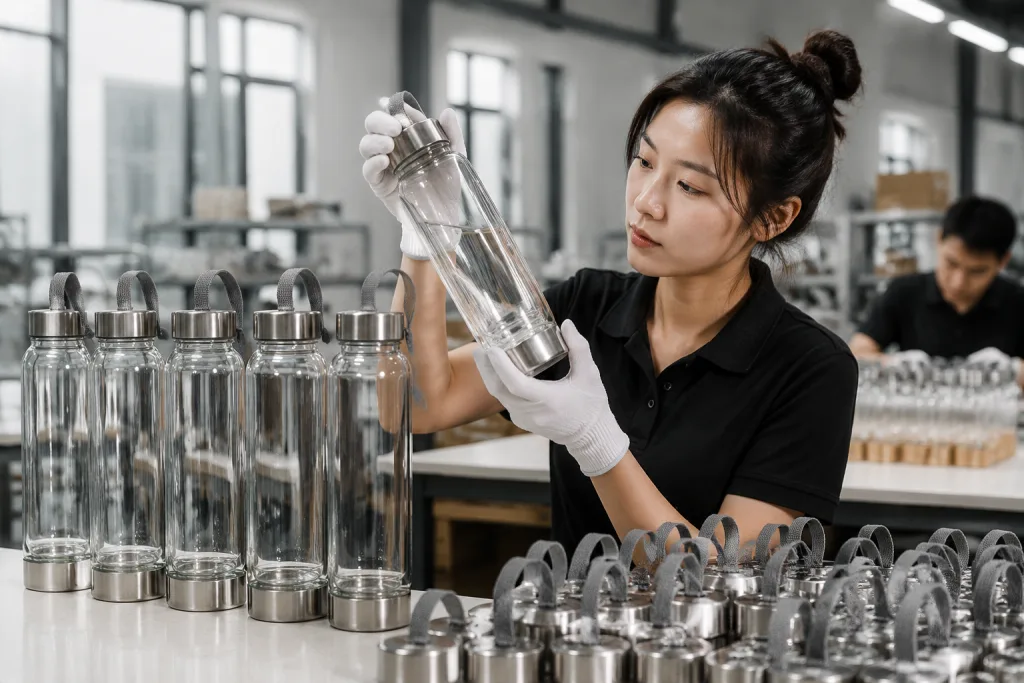
Glass does not forgive weak packaging. If you sell through sustainable retailers, subscription boxes, corporate wellness programs, or Amazon FBA, the export carton design matters as much as the bottle. We have seen 9 bottles break in one 120-piece trial because the buyer chose a thin bulk carton, each bottle only in a polybag with an egg-crate divider. Fine for distributor glass water bottle inventory on pallets. Wrong for premium retail and parcel shipping. QC pulled the sample after the second corner drop and the cap had already punched through the tuck box.
Packaging costs usually start at USD 0.12-0.25 per unit for a plain white or kraft tuck box. A printed retail box with 350 gsm paperboard, matte lamination, and instruction insert may add USD 0.35-0.75. Molded pulp trays are popular with sustainable brands and can cost USD 0.18-0.45 depending on shape and thickness. Plastic-free packaging needs a stricter check than most buyers expect: BOPP tape, PET window, PE inner bag, and silica gel pouch all get questioned. Last month the buyer flagged a PO that said “no plastic,” but the artwork still called for a clear window.
For North America and Europe, we normally recommend a 5-ply export carton for glass bottles, with carton gross weight kept under 15 kg where possible. Agree on the drop test before production, not after the line has packed 80 cartons. A realistic retail carton test is a 76 cm drop on corners, edges, and faces, but the exact method depends on your channel. Amazon-style parcel requirements are stricter than palletized wholesale delivery. We run the first packed carton across a 30 kg floor scale and check the edge-crush feel by hand before sending photos.
Freight also changes the landed cost. A 500 ml bottle with box may pack around 24 pieces per carton, with carton dimensions near 45 x 35 x 32 cm depending on sleeve and box design. Sea freight is the default for borosilicate glass bottle wholesale because air freight can cost more than the product. FOB Ningbo or FOB Shanghai are common from Zhejiang, China. For urgent launches, some buyers air ship 300-500 samples or first cartons, then send the balance by sea. The math gets ugly fast: one client paid 12 days air transit instead of 18 days sea plus local trucking, and freight added USD 1.40 per bottle on a mid-range order.
A realistic sourcing timeline
A custom glass water bottle project should not be scheduled like a blank T-shirt order. Glass forming, cap fit, silicone sealing, logo curing, and packing drop tests all take real line time. We check mouth ID with a digital caliper, usually to ±0.2 mm, because a nice logo means nothing if the cap leaks. If your retail launch date is fixed, work backward from the warehouse delivery date, not from the day the PO is typed.
For a standard customizable glass water bottle, allow 2-3 days for model selection and quotation, 3-5 days for artwork adjustment and proforma invoice, and 7-12 days for pre-production samples. If you need custom sleeve color, cap finish, or box printing, sampling may take 12-18 days. That difference matters. We once had a buyer push back on a 5-day sample delay, but their PO listed “matte black cap” while the artwork showed brushed steel; QC pulled the sample before it went out. After sample approval and 30% deposit, mass production normally takes 30-45 days for 3,000-20,000 units. Peak season before summer campaigns or Q4 gift orders can add 7-15 days.
Inspection should happen before final payment and shipment. For glass drinkware, we usually suggest AQL Level II with critical defects at 0, major defects at 2.5, and minor defects at 4.0. Critical defects include broken glass, sharp edges, serious leakage, and contaminated interiors. Major defects include logo misplacement, cap thread problems, loose gasket, and visible bubbles beyond the agreed limit. Minor defects include small cosmetic marks that do not affect use. On one 10,000-unit run, the inspector found 14 loose gaskets in the first cartons opened; the line stopped, and we re-checked every cap with a torque test.
Private mold timelines take more patience. Add 15-25 days for mold development, 7-10 days for trial correction, and another 7-12 days for approved samples. If you are working with borosilicate glass bottle manufacturers for a new body shape, budget 70-95 days from confirmed drawing to ex-factory shipment. Rushing glass tooling is the wrong question to ask; the math does not work when a 0.5 mm wall-thickness drift creates poor cap fit, unstable weight, and cartons that fail the 80 cm drop test.
Compliance checks before deposit
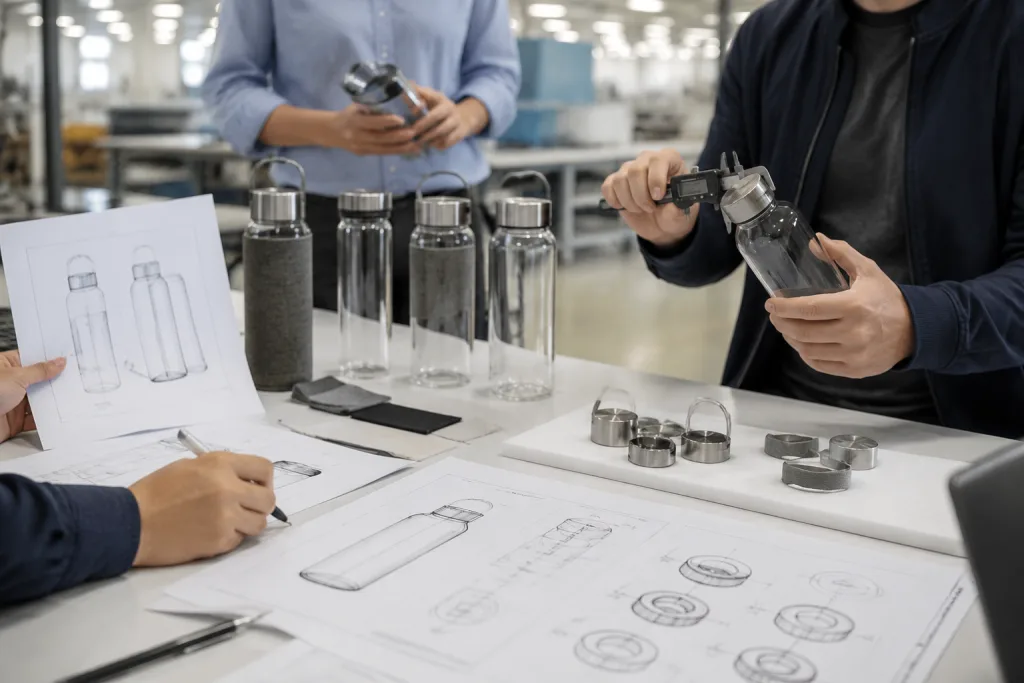
I’ll rewrite the four paragraphs in-place, keep every tag intact, and tighten the compliance language so it sounds like a factory-side sales engineer.Wellness brands and sustainable retailers should not accept “food grade” as a sales line. Before you pay the deposit, ask the borosilicate glass bottle supplier for the exact build: high borosilicate glass body, 304 stainless steel cap parts, food-contact silicone gasket, and any PP or Tritan inner parts if they are in the BOM. We run into PO sheets that say “stainless lid” with no grade, and that is where the headache starts. Match the test file to the market you ship into.
For the EU, buyers usually ask for LFGB or EU food-contact testing, plus REACH screening for coatings, silicone, and printed inks. For the United States, FDA food-contact compliance and California Proposition 65 screening come up fast, especially if the buyer flags California as a sales state. ASTM and CPSIA matter more for children’s drinkware; most adult wellness bottles are not sold that way. This is the wrong question to ask if the bottle is for adults.
Factory audits matter too. BSCI, ISO 9001, and a current social compliance report help distributor buyers cut risk when their customer sends a vendor manual with a 48-hour deadline. QC pulled the sample and found a mismatch once: the report named one plant, the cartons came from another site. That sort of paper gap can kill a deal. Ask for the latest report and check the factory address line by line.
Ask for leak testing and thermal shock limits in writing. Borosilicate handles temperature swings better than soda-lime glass, but it is not indestructible. We have seen it go sideways when a buyer poured boiling water into a cold bottle, then capped it tight and expected no issue. A solid borosilicate glass bottle maker will give clear use notes, not promise the bottle is unbreakable.
How to compare supplier quotes
I’ll rewrite this section in place, keeping the HTML tags and structure unchanged while making the prose sound like a factory-side sales engineer wrote it.When you compare borosilicate glass bottle suppliers, do not line up unit price only. Build one quote sheet with the same bottle capacity, glass thickness, cap structure, gasket material, logo method, sleeve type, box specification, carton packing, test reports, incoterm, and lead time. If one borosilicate glass bottle vendor is USD 0.35 cheaper, ask what changed: thinner glass, no sleeve, 201 instead of 304 stainless steel, or cartons that fail a 1.2 m drop test.
For borosilicate glass bottle distributors, repeatability beats the lowest first-order number. Your reorder should match the first shipment in cap color, box size, barcode position, and logo placement. Keep a golden sample and a locked production file. We run this by SKU at BottleForge Industrial in Zhejiang, China, with approved samples, artwork files, carton marks, and QC notes in the same folder, because reorders go sideways when the buyer flags a tiny label shift after the PO is already booked.
A solid RFQ for a bulk borosilicate glass bottle order should state target capacity, quantity by color, expected retail channel, logo artwork, packaging reference, destination port, compliance needs, and launch deadline. If you need FNSKU labeling, pallet height limits, master carton barcodes, or mixed-SKU cartons, put it in the first email. That is not a problem, but it adds labor on the line and changes the packing plan. We have seen buyers send a clean spec on Monday and a corrected PO with a barcode typo on Wednesday; the math does not work if the scope keeps moving.
The best wholesale result usually comes from a standard bottle platform with controlled customization: proven glass body, reliable 304 stainless steel cap, your own logo, your own sleeve color, and packaging that survives the channel’s handling. That gives you a customized glass water bottle that looks branded without paying private-mold money too early. In practice, a 500 ml bottle with a 1.8 mm wall and a standard cap beats a fancy quote that saves USD 0.12 and costs you a broken carton claim later.
Price your glass bottle project before tooling
Send capacity, quantity, logo files, packaging target, and destination port. We will return a practical MOQ, FOB quote, and timeline.
Frequently asked questions
What is the normal MOQ for 304 stainless steel borosilicate glass bottle wholesale?
For a standard model, a practical MOQ is 3,000 units with one logo and stock cap options. At 5,000 units, pricing improves and you can usually add more packaging customization. At 10,000 units, PMS sleeve colors, better cap finishes, and stronger production priority become easier. For a private glass mold, expect 10,000-20,000 units and tooling charges from about USD 1,200 to USD 9,000 depending on shape and complexity.
How much does a custom borosilicate glass bottle cost?
A standard 500-750 ml borosilicate bottle with 304 stainless steel cap usually quotes around USD 1.85-2.35 FOB China at 10,000 units without complicated decoration. Add USD 0.08-0.18 for one-color silkscreen, USD 0.10-0.25 for cap laser engraving, USD 0.35-0.75 for a printed box, and USD 0.35-1.20 for a silicone sleeve. Small 3,000-unit orders are commonly 12-25% higher because setup and inspection costs are spread across fewer bottles.
How long does production take after sample approval?
For standard borosilicate glass bottle bulk orders, mass production normally takes 30-45 days after sample approval and deposit. Samples take 7-12 days for simple logo work, or 12-18 days if you need sleeve color matching, cap finish changes, or printed packaging. Private mold projects add 15-25 days for tooling and trial correction. If your launch is seasonal, add a 7-15 day buffer before summer and Q4 peak production periods in China.
Can borosilicate glass bottles be used for hot water?
High borosilicate glass handles temperature change better than ordinary soda-lime glass, but you still need responsible instructions. Many bottles can accept hot water, but users should avoid pouring boiling water into a very cold bottle, closing the cap immediately on very hot liquid, or adding carbonated drinks. For retail packaging, we suggest a clear care card with temperature warnings, cleaning instructions, and a note that glass can break if dropped or thermally shocked.
What tests should a sustainable retailer request?
For EU sales, request LFGB or EU food contact testing and REACH screening for silicone, coatings, and inks. For the US, ask for FDA food contact support and consider California Proposition 65 screening. For quality control, use AQL Level II inspection with critical defects at 0, major defects at 2.5, and minor defects at 4.0. Also request leak testing, carton drop testing, and material confirmation for 304 stainless steel, silicone gasket, and borosilicate glass.