Key Takeaways
- For a 500 ml bottle, ask for 1.8-2.2 mm wall thickness and 3.2-4.0 mm base thickness.
- Use AQL 0 for critical defects, 2.5 for major, and 4.0 for minor on a 3,000 pcs lot.
- A Zhejiang factory with 600,000 units/month should still quote 35-45 days after sample approval.
- 304 lids need mill certs, 2.0 mm silicone gaskets, and 24-hour leak testing.
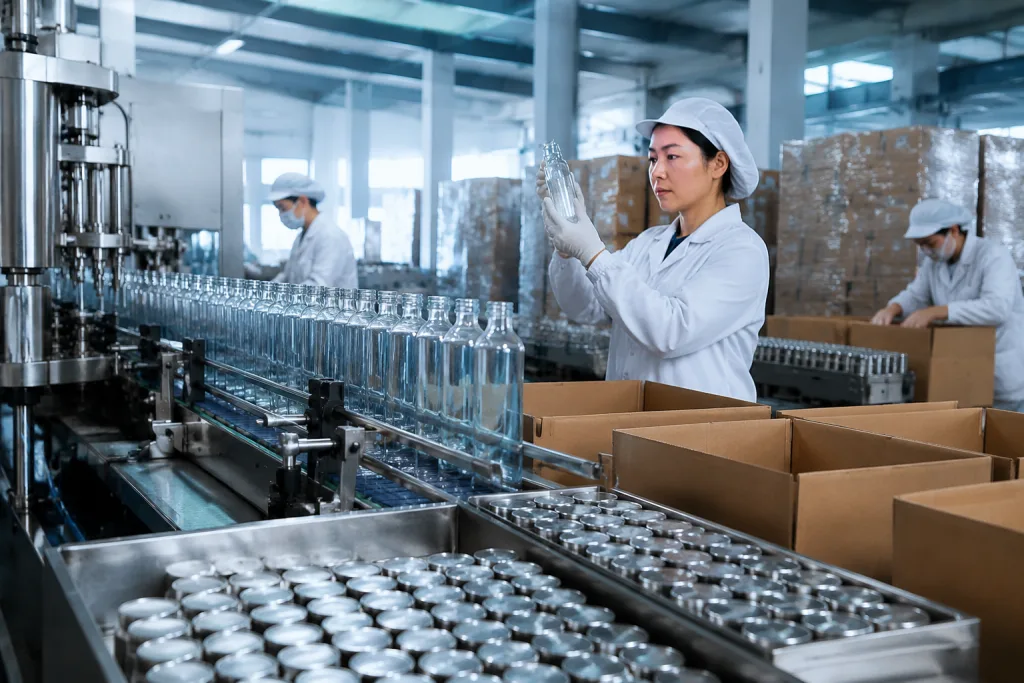
Too many buyers still brief a custom glass water bottle like it is a logo print job with a lid screwed on. That is the wrong question to ask. We have seen 3,000 pcs pass the desk sample, then fail on the line because the rim had 0.4 mm chips, the silicone gasket sat 0.6 mm off center, and the 304 stainless steel cap started leaking after a 1.2 m drop test. The glass body, steel parts, gasket, print, and pack-out do not fail in the same way.
If you are sourcing from a 304 stainless steel borosilicate glass bottle supplier in Zhejiang or another China production base, think like the engineer who has to ship the order, not the buyer flipping through a catalog. A serious borosilicate glass bottle factory should talk about annealing temperature, wall thickness tolerance, AQL, and carton compression before shaving USD 0.03 off the quote. QC pulled the sample for one EU buyer last month because the PO said “matte black lid” but the approved sample tag said “satin black”; small typo, 18 days lost. That is where margin disappears.
Glass That Looks Fine Until Heat Hits It
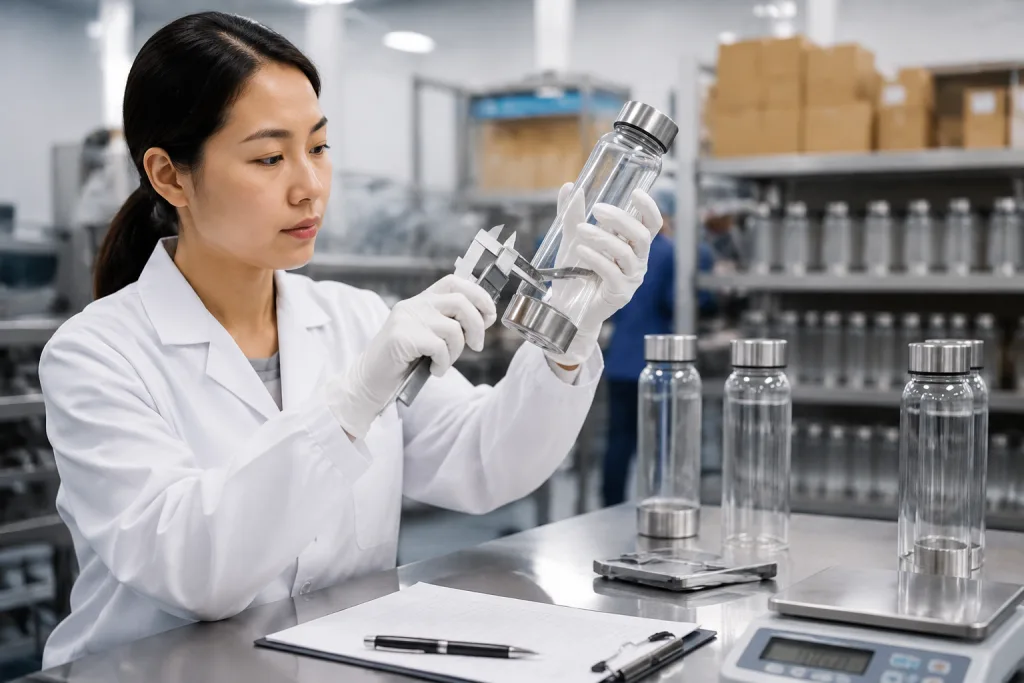
Borosilicate glass gives you some room, but it does not save bad forming. The failure we see first on the line is uneven wall thickness. A 500 ml bottle can read 1.6 mm on one side and 2.4 mm on the other; it will pass a quick visual check, then crack when hot tea hits a cold stainless sink. QC checks this with a Mitutoyo digital caliper at 4 points around the body. For a custom borosilicate glass bottle, we spec wall thickness within ±0.2 mm and a 3.2-4.0 mm base, depending on height and fill volume.
The next failure is poor annealing. That is on the furnace, not the drawing. Nice photos do not prove the annealing curve was held. Ask your borosilicate glass bottle manufacturer for thermal shock testing at a 100-120°C delta, then ask how many pieces cracked out of 50. We once had a buyer accept “no obvious cracks” in an email; the math did not work when 7 cartons came back from their warehouse. A proper borosilicate glass bottle supplier in Zhejiang should show batch records from the annealing oven, not excuses.
What to spec around:
- Wall thickness: 1.8-2.2 mm for 450-550 ml formats, checked at body shoulder and lower belly
- Roundness and neck concentricity: keep visible wobble below 1.0 mm on a flat glass plate
- Bubbles in the viewing zone: zero on premium retail SKUs; QC pulled the sample if bubbles sit near the logo area
- Hot-cold cycling: 0°C to 95°C at least 20 cycles, with cracked pieces counted by batch number
If you are buying borosilicate glass bottle bulk, do not let anyone call a crack problem a cosmetic issue. We have seen this go sideways after AQL sorting, because cracks repeat when the forming mold and annealing curve stay the same. It is a process issue.
Lids, Gaskets, and Leaks
Leak complaints rarely start with the glass body. In our claim log, about 8 of 10 come from the 304 stainless steel cap, thread pitch, or gasket. A lid can look premium and still fail when the gasket is too hard, the closing torque jumps between operators, or molding flash cuts the seal. QC pulled one sample last month with a 0.3 mm flash line across the silicone seat. If you are buying from a borosilicate glass bottle factory, ask for the lid drawing and gasket spec before you approve the render.
For a food-contact closure, I want 304 stainless steel with a mill certificate on file, not a supplier's verbal promise. The shell thickness should usually sit around 0.4-0.5 mm, and the silicone gasket should be around 2.0 mm cross-section with 50-60 Shore A hardness. That gives enough compression without crushing the seal. We run a digital torque tester on the cap, typically in the 0.8-1.2 N·m range for smaller caps, then test bottles upside down for 24 hours at room temperature and again after a 40°C hold.
Do not ignore the fit between the glass neck finish and the lid. This is where we've seen orders go sideways. A 38 mm neck on a custom glass water bottle is common, but the thread profile still decides whether the cap seals or walks loose in a carton. One degree of mismatch can make a whole borosilicate glass bottle wholesale order fail in transit; we once had a buyer flag wet inner cartons after a 12-day sea leg because the PO said “38 mm” but missed the thread drawing. A good borosilicate glass bottle vendor sends the closure sample before mass production, not after.
Leak prevention is cheap in tooling and expensive in returns. Build the seal into the spec, not into the apology.
Branding That Survives Dishwashers
Decoration is where 7 out of 10 borosilicate glass bottle custom projects get risky after the sample stage. A logo can look clean under the light box, then start rubbing off after 10 dishwasher cycles because the ink system was chosen for price, not curing temperature. We have seen this go sideways on a wellness bottle order when QC pulled the sample after wash testing and found logo edge lift near the 18 mm radius curve. For a wellness brand or sustainable retailer, that is a reputation problem, not a print problem. Pick the decoration method by heat, abrasion, and order quantity. Not by the prettiest sample photo.
Silkscreen printing is the safer choice for 1-3 colors when the ink is fired properly, usually in the 560-620°C range. We run a kiln temperature chart for every batch, and a 25°C drift is enough to make the math fail on dishwasher claims. That finish suits a customized glass water bottle needing a durable retail look. UV print is faster and cheaper, so I would keep it for 500-1,000 pcs short-run borosilicate glass bottle promotional campaigns or low-abrasion SKUs. For metal parts, laser engraving on the 304 lid usually beats pad print, especially where buyers keep asking if the logo will scratch under a key test. If color accuracy matters, set a Pantone target and define an acceptable Delta E, ideally under 2.0 for the first production run.
Do not let a borosilicate glass bottle manufacturer hand-wave dishwasher resistance. Ask for a 50-cycle wash test at 65°C, then inspect for edge lift, gloss loss, and fading with the same 3M tape pull we use at final QC. If you are building a customizable borosilicate glass bottle line for multiple retailers, lock the artwork file, logo position, and print tolerance before tooling. We normally set logo position tolerance at ±1.5 mm on straight-wall bottles; tighter than that needs a fixture check before mass production. Small artwork moves become big problems once the line starts moving.
If you need a custom logo system, compare your options through custom logo decoration options and keep the decoration spec in the same folder as the bottle drawing. Sounds basic, but we had one PO typo where “matte black lid” became “matte back lid,” and the buyer flagged it only after the pre-production sample photos were sent.
Packing For The Real World
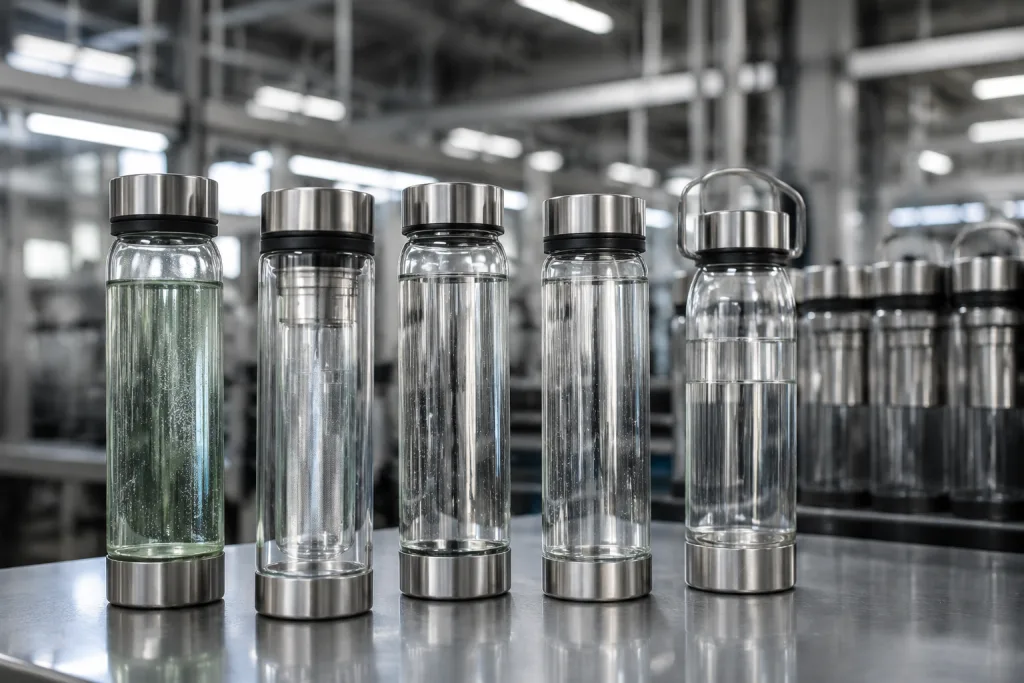
A bulk glass water bottle can pass thermal shock, leak testing, and the 24-hour standing check, then still reach the buyer with cracked bodies because the pack-out was designed for a sample room shelf, not a 40HQ container. We see this often. Some borosilicate glass bottle suppliers save RMB 0.35 per inner box with 250 g paper, loose dividers, and a master carton that collapses after the first 2 pallet layers. In Zhejiang, a serious borosilicate glass bottle factory treats packaging as part of the SKU. QC pulled one 500 ml sample last month where the bottle was fine, but the white inner box had 3 mm side play; that is where damage claims start eating margin faster than a bad logo print.
For retail-ready shipping, we run individual boxes, a 3-ply inner partition, and a 5-ply master carton with an edge crush test matched to the route. For e-commerce or distributor borosilicate glass bottle shipments, test 1 m drops on flat, edge, and corner positions, then run vibration for at least 60 minutes. The line should not skip this. If you sell through a borosilicate glass bottle distributor network, the carton may see cross-docking in Hamburg, pallet rework by a 3PL, and another truck ride before delivery. Your packaging has to survive that handling, not just look neat in a pre-shipment photo.
One practical number: a 24-piece carton for a 500 ml bottle often lands around 8-10 kg gross weight. If the carton is 12 kg, ask whether the glass is overweight or the carton size is wasting space; if it is 6.5 kg, the math does not work and the bottle is probably under-packed. For a borosilicate glass bottle wholesale order, ask for carton dimensions, pallet pattern, gross weight, and a photo of the loaded pallet before shipment. We also check the shipping mark against the PO, because one buyer flagged a “borosilcate” typo after cartons were already sealed with 48 mm tape. Reject the bad pack-out on paper. Rotterdam and Ohio warehouses are expensive places to find it.
QC Numbers You Should Ask For
QC is where a borosilicate glass bottle manufacturer proves it can run the order, not just quote it. Do not ask for a generic inspection report. Ask for numbers. On a 3,000-piece lot, I would use General Inspection Level II with AQL 0 for critical defects, 2.5 for major, and 4.0 for minor. Critical means no-pass items: a leak found on the 24-hour inverted test, a rim crack visible under the inspection lamp, or a cap that fails the torque check. Major means logo shift over 1.5 mm from the approved artwork, wrong Pantone color, or visible body deformation on the line. Minor means tiny bubbles outside the viewing zone, or a label that is off-center but still within the signed sample limit.
Ask for dimensional checkpoints by line item: bottle height, max diameter, neck finish, lid fit, net weight. A tolerance of ±1.0 mm on overall height is reasonable for a 3,000 to 10,000 pcs custom glass water bottle program, but the neck and sealing surfaces need tighter control. We run a digital caliper, thread go/no-go gauge, and sample-fit the 304 stainless lid every 2 hours during packing. If the factory cannot tell you how they inspect those points, they are not controlling the process. The better factories in China keep retention samples, heat-test records, and incoming material checks for both glass and 304 stainless steel parts.
For documentation, I would ask for LFGB or FDA food-contact declarations based on your sales market, plus REACH confirmation for the spray coating, printed ink, and silicone gasket material. If a borosilicate glass bottle supplier cannot trace the lid and gasket back to a material batch, your compliance file has a hole. We have seen this go sideways when a wellness buyer flagged a missing silicone test report 6 days before PO release. That matters for retailer audits, and it matters if you sell through borosilicate glass bottle vendors who will not release a PO until the paperwork matches the spec sheet.
Need a quick factory review? Start with quality control standards and compare them against your spec sheet, not against your hope. Small detail, big clue: if the PO says “304 stainess” and nobody catches the typo before artwork approval, QC is probably checking boxes instead of the order.
The Spec Sheet That Prevents Reorders
The safest way to stop repeat failures is a spec sheet the borosilicate glass bottle supplier can build from, not guess from. Start with capacity in ml, body shape, neck finish, lid type, gasket material, and finish method; we usually add neck OD in mm because one 0.3 mm miss can make the cap feel loose. Then set the pass rules: wall thickness, color tolerance, decoration method, leak standard, thermal shock limit, drop-test method, and carton performance. A brief that only says custom glass water bottle or customizable glass water bottle is a sales note, not a production spec once tooling starts.
If you are sourcing borosilicate glass bottle custom programs at scale, ask the factory to quote the mold, lid tooling, packaging, and inspection cost as separate lines. That shows where the money is going. A serious borosilicate glass bottle manufacturer in Zhejiang or elsewhere in China should handle 3,000 pcs MOQ for a pilot run, then move to 10,000 pcs or more after artwork and lid fit are frozen. On our line, 35-45 days after sample approval is normal; one buyer once pushed for 28 days with a new bamboo lid and the math did not work. A factory with 600,000 units/month capacity should not be making up your lead time during PO review.
If you are comparing a borosilicate glass bottle vendor against a full factory, ask who controls the furnace curve, tooling room, and QC bench. This is where orders go sideways. A vendor can resell a clean sample, but the factory sees the annealing record and the leak-test tray before shipment. That matters for a customized borosilicate glass bottle, a custom borosilicate glass bottle for retail, or a borosilicate glass bottle promotional run with a tight deadline. Write the spec once, then use it on every PO.
For sourcing context, see borosilicate glass bottle MOQ guide and sourcing custom drinkware from China before you place the next order; we have seen a single wrong lid code on a PO hold cartons at final inspection.
Send your spec and get a factory quote
Share your capacity, lid type, logo, and target market. We can quote a borosilicate glass bottle bulk program with practical QC and lead times.
Frequently asked questions
What MOQ should I expect from a 304 stainless steel borosilicate glass bottle supplier?
For a standard 450-550 ml custom glass water bottle, 3,000 pcs is a realistic MOQ if the mold already exists. If you need a new shape, custom lid, or multiple Pantone colors, 5,000 pcs is more common. A serious borosilicate glass bottle factory in China will usually quote samples in 7-10 days and mass production in 35-45 days after sample approval. If someone offers 500 pcs with full customization, check whether they are a factory or a trading layer. Small volume is fine for testing, but it usually comes with higher unit cost and looser control over lid fit, print consistency, and carton strength.
Can a borosilicate glass bottle go in the dishwasher with a 304 stainless steel lid?
Yes, but only if the closure and decoration are built for it. Borosilicate glass itself handles dishwasher heat well, but the weak points are the ink, gasket, and lid finish. I would ask for a 50-cycle wash test at about 65°C and check for fading, edge lift, or seal shrinkage. A 304 lid with a 2.0 mm silicone gasket and a proper compressive fit usually performs well. If the bottle uses a low-temperature decal or a soft adhesive label, it may fail after 10-20 cycles. That is why a borosilicate glass bottle manufacturer should specify the printing method and seal material, not just the bottle shape.
What documents should I request from a borosilicate glass bottle manufacturer?
For EU and North American buyers, ask for a food-contact declaration, REACH confirmation for inks and silicone, and either LFGB or FDA-related compliance support depending on your market. For the 304 stainless steel lid, request a mill certificate and material traceability. You should also ask for the factory inspection report, dimensional measurements, retention sample photos, and packing specification. If the supplier is a true borosilicate glass bottle supplier rather than a reseller, they should also show process evidence like annealing records, leak-test results, and AQL records. For a wellness brand or sustainable retailer, that paperwork is not optional; it is what protects your import file and your retailer approval.
How do I reduce breakage in borosilicate glass bottle bulk shipments?
Start with the carton. Use individual boxes, internal dividers, and a 5-ply master carton tested for compression. For a 24-piece carton, aim for a gross weight around 8-10 kg; if it is much lighter, the pack-out may be under-protected. Ask for a 1 m drop test on flat, edge, and corner positions, then vibration testing before mass shipment. Palletizing matters too: stack height should stay reasonable, often under 1.6 m including the pallet. A borosilicate glass bottle factory in Zhejiang or elsewhere in China should be able to show you how they packed the same SKU for export, not just how they packed a sample box for photography.
Should I buy from a borosilicate glass bottle distributor or a factory?
If you need a few cartons quickly, a distributor or vendor can be fine. If you need a custom borosilicate glass bottle, consistent 304 lid fit, and repeatable print quality, go to the factory. A distributor borosilicate glass bottle quote can hide the real tooling owner, which makes revisions slower and QC less transparent. A factory can confirm furnace data, mold history, and closure specs directly. That matters when you are ordering 3,000-10,000 pcs and need repeatability. For a retailer program, I would always ask who controls the mold, who buys the 304 steel, and who signs off on AQL. Those answers tell you whether the supplier can scale with you.