Key Takeaways
- A practical MOQ for borosilicate glass bottle custom orders is 1,000-3,000 pieces per size, depending on logo and packaging
- 304 stainless steel lids cost more than PP lids but help premium positioning and reduce odor complaints
- Borosilicate bodies should be checked for thermal shock, rim thickness, annealing stress, and carton drop performance
- Expect 35-50 days for mass production after sample approval from a Zhejiang glass bottle factory
A glass bottle looks simple until you buy 5,000 pcs, add a logo, pass retailer testing, and still need cartons to arrive without cracked sleeves. Brand teams talk about the clean material story. Procurement gets stuck with lid torque, silicone ring fit, breakage rate, MOQ, and whether the second production run matches the golden sample. We’ve had QC pull 24 bottles from a pre-shipment carton and find 3 sleeves split at the bottom seam after a 76 cm drop test. That kills the margin fast.
For a 304 stainless steel borosilicate glass bottle private label program, “glass or plastic” is the wrong question to ask. Decide the borosilicate wall thickness, 304 stainless cap structure, gasket material, logo process, inner box protection, and FDA or LFGB test route before asking a borosilicate glass bottle supplier in China for a quote. On the line, a 0.3 mm difference in cap thread height can turn into buyer pushback: “the lid feels loose,” even when the bottle does not leak.
Start With Four Buying Decisions
I’ll rewrite the section in place, keep the HTML structure intact, and tune the voice toward a real factory-side sales engineer.Before you ask for a borosilicate glass bottle bulk quotation, lock four decisions first. If you skip them, every borosilicate glass bottle manufacturer will quote a different spec, and the price sheet is dead on arrival.
First, choose the bottle body. Most wellness retail lines run borosilicate glass because it takes hot tea and ice water without drama, unlike soda-lime glass. For private label, 350 ml, 500 ml, 650 ml, and 750 ml are the usual sizes. On our line, 1.8-2.2 mm wall thickness is the normal range. Go thinner and the bottle looks cleaner, but breakage climbs in transit; go thicker and your FOB price plus freight both go up.
Second, choose the cap system. The standard build is a 304 stainless steel outer lid with food-grade PP or silicone on the drinking side. Full metal contact sounds premium, but the thread gives you less room to breathe and the feel against glass can be rough. Ask for 304 stainless steel at 0.4-0.6 mm gauge, not a vague “stainless look” note on the PO. We’ve seen that typo turn into a bad sample.
Third, decide decoration. A custom borosilicate glass bottle can take silk screen, heat transfer, decal, laser on stainless steel, or a paper sleeve. For wellness brands, one-color silk screen at 50 x 80 mm is usually the clean first move. It keeps setup cost under control and lets QC pull the sample fast. This is the wrong question to overthink at the start.
Fourth, choose retail packaging. A nice box that fails a drop test is waste. For North America and Europe, we usually run an inner kraft box with molded paper pulp or EPE protection, then a 5-ply export carton. It is less flashy than a thin gift box, but the math works better when you ship 10,000 pcs and the buyer flags carton damage at arrival.
Pick Glass Specs Before Price
About 7 out of 10 new buyers ask for a bulk glass water bottle quote, then sort the sheet by the lowest FOB price. Wrong order. Photos do not show glass stress, wall thickness drift, or a bad annealing curve. Before comparing prices, make the borosilicate glass bottle factory confirm material, forming process, annealing lehr settings, and inspection points. On our line, QC checks wall thickness with a digital caliper before the bottle ever reaches packing.
Borosilicate glass has a lower coefficient of thermal expansion than common soda-lime glass, so it handles temperature change better. That matters when a consumer pours warm tea into a cold bottle or washes it in hot water. Still, do not sell it as unbreakable. Glass breaks. We have seen this go sideways when a buyer printed “shatterproof” on the color box and then got complaints after drop damage from a 1.2 m kitchen counter. Good sourcing cuts random failures. It does not cancel physics.
Ask for the body weight tolerance. For example, a 500 ml bottle might be 230-270 g depending on wall design. If one borosilicate glass bottle vendor quotes 210 g and another quotes 280 g, they are not quoting the same item. The math does not work. We weigh 20 pcs from the trial run on a bench scale and record the spread before confirming bulk packing. Check rim finishing too. A smooth fire-polished rim cuts chipping complaints, especially on bottles where users drink directly from the mouth.
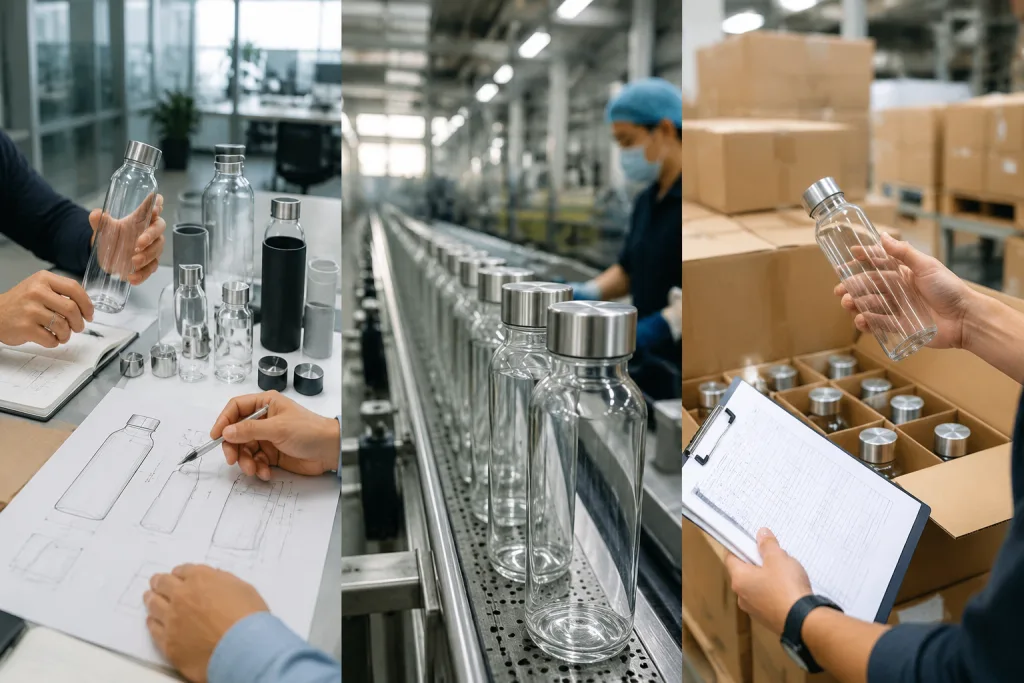
For private label, request pre-production samples from actual mass-production tooling, not only showroom samples. A borosilicate glass bottle manufacturer in Zhejiang or other China production clusters may have 30 or 50 stock molds, but your 304 stainless lid, logo, sleeve, and box create a new finished item. We run incoming glass inspection, lid fit checks, 100% visual screening for obvious cracks, and AQL sampling before carton sealing. QC pulled one sample last month because the silicone ring sat 0.6 mm proud and the cap felt loose after three open-close cycles. For mixed-size programs, keep one shared neck finish if possible. Shared caps simplify spare parts, cut MOQ pressure, and make reorders cleaner.
304 Stainless Lid Trade-Offs
The lid is where a “simple” customizable glass water bottle turns premium or starts complaints. For a 304 stainless steel borosilicate glass bottle private label project, the cap has to seal after washing and still match the logo finish you approved on the golden sample. No shortcuts here. Last month QC pulled 32 lids from the line and found 3 with gasket flash over 0.4 mm; those 3 would have leaked before the carton reached a reviewer. A shiny cap that leaks after two weeks will hurt reviews more than a slightly higher FOB cost.
304 stainless steel is widely used for food-contact drinkware because it resists corrosion and is accepted by most retailers when the paperwork is clean. But caps are rarely one material. A standard lid often has a 304 stainless outer shell, PP inner core, silicone gasket, plus a carry loop or TPE grip depending on the design. Ask for a component breakdown, not just “304 lid” on the PI; we once had a buyer flag a PO because the supplier wrote “SS cap” and their compliance team rejected it. For EU programs, request LFGB or relevant food-contact documentation. For US programs, ask about FDA food-contact material declarations. If children may use it, discuss CPSIA and ASTM considerations early.
There is a cost trade-off, and this is where the math gets misread. On a 500 ml borosilicate glass bottle wholesale order, a basic PP lid might reduce FOB cost by USD 0.18-0.35 per unit compared with a stainless lid. A bamboo lid may look natural, but 6 out of 10 bamboo cap samples we run show visible grain mismatch, and poor sealing can bring moisture smell after a 48-hour humidity check. A 304 stainless lid is less “eco-looking” than bamboo but usually gives steadier color, weight, and assembly results for distributor glass water bottle programs.
Thread design also matters. Glass threads need tolerance control, and the gasket must compress without making the user crank the cap hard. We normally test filled bottles inverted for at least 30 minutes, then run 50 open-close cycles on samples with a torque meter before packing approval. The wrong question is “which lid is cheapest?” If you plan a borosilicate glass bottle promotional campaign, do not use the cheapest lid just because the item is a giveaway. Promotional products still become public reviews.
Branding Choices That Actually Scale
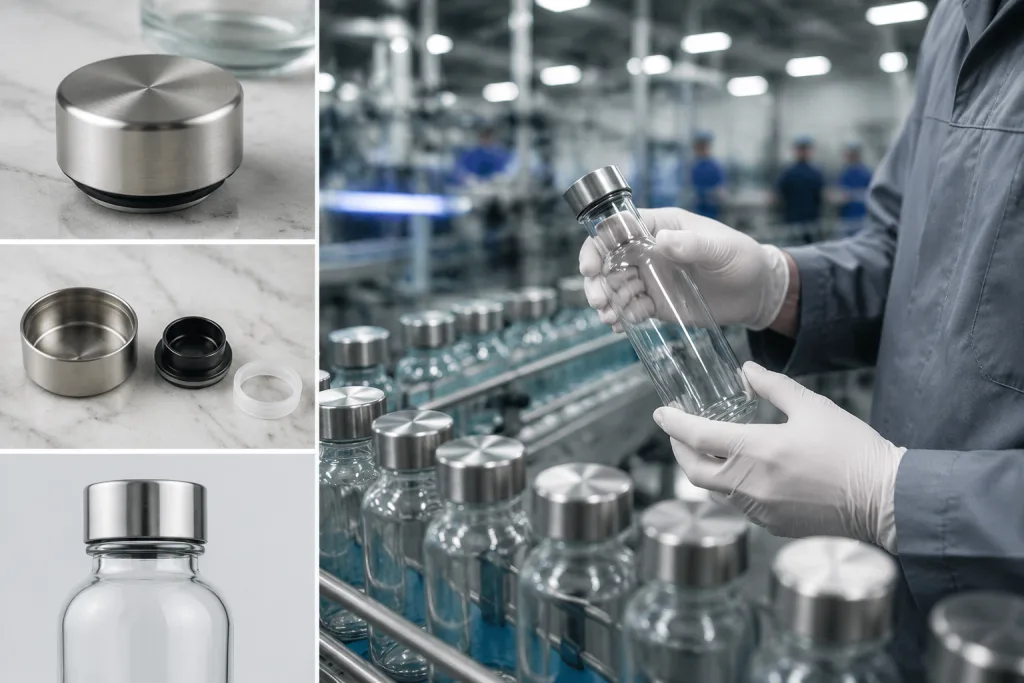
A borosilicate glass bottle customized for a wellness brand should not need babysitting every reorder. Decoration has to repeat on the line, hold the same shade after curing, and pass a simple 3M tape test at QC. The right branding method comes down to artwork detail, target FOB, and whether the bottle is going to Amazon, boutique retail, or a refill program.
Silk screen printing is the practical default for a custom glass water bottle. One-color printing is the safest and lowest-cost choice; two to three colors need tighter registration, usually within ±0.5 mm, and the setup charge climbs fast. For a 500 ml customized glass water bottle with one-color silk screen, the decoration MOQ is around 1,000 pieces, while full custom packaging may push the useful MOQ to 2,000-3,000 pieces. QC pulled one sample last month because the white logo shifted 1.2 mm after the second pass. Laser engraving works well on 304 stainless steel caps, not on clear glass unless you accept a frosted, quiet mark.
Decals handle complex artwork, but they add process time and fail when firing temperature or adhesion is off. We run decal orders 12 days vs 7 days for basic silk screen, so the math doesn't work for every launch. Heat transfer looks strong on sleeves or coated surfaces; on bare glass, we rarely suggest it for long-life retail products. If you sell through sustainable retailers, small branding often sells better than a huge logo. Buyers want a bottle that looks right on a kitchen counter, yoga studio shelf, or refill station, and one buyer flagged a 42 mm front logo as “too merch-heavy” for their shelf.
For a customizable borosilicate glass bottle line, lock a brand standard sheet: Pantone color with tolerance, logo size in mm, print position from base, cap finish sample, gasket color chip, box dimensions, barcode placement, and carton mark layout. Boring work. It prevents expensive drift. A borosilicate glass bottle distributor with 6 retail accounts will catch batch two if the logo sits 8 mm higher than batch one. Retailers notice too, especially when the carton mark on the PO says “matte black cap” and the supplier prints “mate black cap.”
MOQ, Pricing, And Lead Time
Price is not just the bottle. We quote from the drawing and BOM: glass weight in grams, cap material, logo size in mm, box paper weight, AQL 2.5 inspection, and how often you reorder. From our Zhejiang, China supply base, a 500 ml borosilicate glass bottle with 304 stainless steel lid, one-color logo, and kraft retail box often lands around USD 1.35-2.20 FOB Ningbo or Shanghai at 3,000-5,000 pieces. At 1,000 pieces, the math gets ugly because the silk-screen screen, sample run, carton knife line, and export carton labels still take the same setup time. The line does not care that the PO is small.
For a borosilicate glass bottle custom project, realistic MOQ is usually 1,000 pieces for stock bottle plus simple logo, 2,000-3,000 pieces for custom color gasket or retail box, and 5,000 pieces or more for a new mold or unusual shape. A borosilicate glass bottle factory can sometimes accept 500 pieces for a trial, but the unit price will be poor and packaging choices will be limited. We have seen buyers ask for 500 pieces with Pantone gasket, printed sleeve, and drop-test carton; the math doesn't work. If a quote looks too good at 500 pieces, check whether it excludes logo, inner box, testing, or export packing. QC pulled one trial sample last year where the quote included a “gift box,” but the supplier meant a 250 gsm white tuck box, not the 350 gsm kraft retail box on the buyer’s PO.
Lead time is predictable when decisions are clean. Digital artwork review takes 1-2 days, assuming the logo file is AI or PDF and the print size is marked, for example 38 mm wide on the front face. Physical samples take 7-12 days if stock components are available. Mass production normally takes 35-50 days after sample approval and deposit. Our Hangzhou coordination team works with partner lines that can handle about 180,000 glass drinkware units per month across standard shapes, but your confirmed cap and carton materials still need scheduling. One late carton change can move shipment from 42 days to 49 days. We ship better when the buyer freezes the BOM before deposit.
For borosilicate glass bottle wholesale and distributor borosilicate glass bottle programs, repeatability beats squeezing the last USD 0.03. Keep the same mold, keep the same retail box structure, and send a 90-day reorder forecast. You will get better production slots and fewer surprises. We have seen this go sideways when a distributor changes the lid finish every order; the buyer flagged color drift, and the line had to sort caps by hand under a D65 light box.
Compliance And Inspection Plan
8Choose The Right Supply Partner
The best borosilicate glass bottle manufacturers are not always the ones with the cleanest catalog. You need a partner who pushes back when a design will leak in a 45°C hot-fill test or crack after the drop tester hits 80 cm. We have seen this go sideways: a buyer wanted a slim 18 mm mouth with a heavy 304 stainless lid, and QC pulled the sample after the gasket rolled during torque testing. Nice rendering. Bad bottle. For wellness brands, one leaking carton can cost more than the mold fee.
Ask who is quoting you: a borosilicate glass bottle vendor, a trading company, or a factory-direct team running the line. Capable borosilicate glass bottle vendors are fine if they control QA, but the chain must be clear. A real partner should spell out mold ownership in writing, sample fees before tooling, tolerance such as ±1.5 mm on height, inspection method, carton spec with 5-ply K=A board if needed, and the action plan if defects exceed AQL. If you sell in 3 or more countries, ask for cases serving borosilicate glass bottle distributors, not only 500-piece gift orders with a logo sticker.
At BottleForge Industrial in Hangzhou, Zhejiang, we are close to China glass plants, 304 stainless lid workshops, printing lines, and Ningbo/Shanghai export lanes, so we manage the finished item, not just the bottle body. That matters when your customized borosilicate glass bottle includes a silicone gasket, kraft box, barcode label, and retailer carton mark with a 12-digit SKU. Each part can pass alone and still fail after assembly; we once rejected 1,200 lids because the gasket groove was 0.3 mm shallow and the buyer flagged seepage in the first pre-shipment sample.
When you shortlist borosilicate glass bottle suppliers, send one clean RFQ with target capacity, cap material, logo process, packaging, destination port, compliance market, expected annual volume, and launch date. Better: attach a reference photo and tell us if the MOQ target is 3,000 or 10,000 pieces. Good suppliers ask about carton drop height, barcode placement, and whether the PO says “matte black” or “matt black” because that typo has stopped artwork approval before. Weak suppliers send a price list and hope nobody notices the missing details.
Send Your Glass Bottle RFQ For Review
Share size, cap, logo, packaging, MOQ, and destination. We will return a practical Zhejiang factory quote with risks clearly marked.
Frequently asked questions
What is the best MOQ for a first private label glass bottle order?
For a first 304 stainless steel borosilicate glass bottle private label order, 2,000-3,000 pieces per size is the cleanest starting point. At 1,000 pieces, a borosilicate glass bottle supplier can usually print a logo on a stock bottle, but packaging choices and price flexibility are limited. At 3,000 pieces, you can usually justify one-color silk screen, a custom kraft box, carton marks, and better production scheduling. If you need several colors or capacities, do not split too aggressively. Three sizes at 1,000 pieces each are often harder to control than one strong 3,000-piece launch size.
Is borosilicate glass safe for hot drinks?
Borosilicate glass is better for temperature change than common soda-lime glass because it expands less when heated. That makes it suitable for warm water, tea, and daily washing when designed correctly. Still, you should avoid extreme claims. A bottle taken from a freezer and filled with boiling water can still crack. For retail claims, ask your borosilicate glass bottle manufacturer for thermal shock test data, wall thickness, and usage instructions. We normally recommend clear care wording on the box: avoid sudden extreme temperature change, do not microwave with the 304 stainless steel lid, and inspect after impact.
Can I customize the bottle shape, or only the logo?
You can do both, but the economics are very different. A borosilicate glass bottle custom logo on an existing mold may start at 1,000-3,000 pieces. A new bottle shape usually needs tooling, engineering review, and a higher MOQ, often 5,000-10,000 pieces depending on complexity. New molds are useful if you have strong annual volume or need a protected brand silhouette. For most wellness brands, start with a proven stock body, then customize the lid finish, logo, sleeve, and packaging. That gets you a customized glass water bottle without taking mold risk too early.
What should I ask a glass bottle supplier before paying a deposit?
Ask for a written specification sheet, not only photos. It should list capacity, glass type, body weight tolerance, wall thickness range, lid material breakdown, silicone gasket type, logo method, packaging structure, carton quantity, FOB port, MOQ, sample time, mass production lead time, and inspection standard. For Europe, ask about food-contact and REACH-related documents. For the US, ask about FDA food-contact declarations and any retailer-specific testing. Also confirm whether the sample will use the same cap, print, and box as mass production. A showroom sample is not enough for a bulk borosilicate glass bottle order.
How do I reduce breakage during shipping?
Start with the product and packaging together. A 500 ml glass bottle in a thin retail box may look fine on a desk but fail in courier handling. Use a snug inner box, molded paper pulp or EPE support, and a 5-ply export carton. Run a carton drop test before mass shipment, especially if you sell online or supply multiple retailers. Keep master cartons at a manageable weight, often under 15 kg gross for glass drinkware. For distributor orders, ask the warehouse not to repack loose bottles without equivalent protection. Saving USD 0.08 on packaging can create USD 0.80 in replacements.