Key Takeaways
- Ask for 304 stainless steel grade confirmation, 3.3 borosilicate glass, and wall thickness of 2.0-2.5 mm before pricing
- A realistic MOQ for custom glass water bottle orders is 1,000-3,000 units per color or logo version
- Plan 7-12 days for samples and 30-45 days for bulk production after artwork approval
- Use AQL 2.5 for major defects and AQL 4.0 for minor defects on retail-ready shipments
A glass bottle looks simple until the buyer asks three hard questions: is the lid real 304 stainless steel, will the silicone sleeve match the Pantone chip under store lighting, and can the master carton survive a 1.2 m drop test. We had QC pull 32 pcs from a pre-shipment lot last month because two caps showed rust marks after a 24-hour salt spray check. For wellness brands and sustainable retailers, one cracked bottle or rusty cap is not “minor.” It becomes a return, a bad review, and lost shelf space.
If you are sourcing from a 304 stainless steel borosilicate glass bottle manufacturer in China, “send me your best price” is the wrong question to ask. We run cleaner orders when the RFQ lists capacity in ml, glass thickness in mm, lid material, sleeve color, carton strength, barcode position, MOQ, and the exact PO wording before the line starts. Our Hangzhou, Zhejiang team sees this every week with borosilicate glass bottle bulk orders; one buyer once typed “matte black lid” on the PO after approving a brushed steel sample, and the math did not work once 6,000 lids were already in the warehouse.
Start With A Proper RFQ
Your RFQ decides whether you get a usable quote or a nice-looking guess. We run glass bottle quotes every week, and a serious borosilicate glass bottle manufacturer will ask for capacity, lid structure, packing layout, logo process, and destination port before giving a FOB price. If a borosilicate glass bottle vendor quotes in 10 minutes with no questions, something is missing. Last month QC pulled a 750 ml sample from the line and found the carton drawing showed 23 pcs, while the buyer’s PO said 24 pcs master carton.
For a 304 stainless steel borosilicate glass bottle manufacturer, the first PO line item is not a purchase order yet. It is a spec check. State the bottle size clearly: 500 ml, 550 ml, 750 ml, or 1,000 ml. Ask for high borosilicate glass, normally 3.3 expansion coefficient material, not soda-lime glass. For drinkware, we usually recommend 2.0-2.5 mm wall thickness depending on bottle diameter; on a 70 mm body, the math does not work if the buyer wants a light bottle, low breakage, and cheap courier handling at the same time. Thinner glass looks elegant, but we have seen it go sideways when a distributor stacks 9 kg cartons too high.
Your RFQ should price the glass body, 304 stainless steel lid, silicone sealing ring, sleeve, logo, and packaging as separate items. A borosilicate glass bottle supplier may use 304 stainless steel on the outer lid shell but PP plastic inside. That is fine if food-contact materials pass LFGB or FDA, but write it into the spec sheet. For EU retailers, ask about REACH, LFGB, and packaging recycling marks. For North America, ask about FDA food-contact compliance and ASTM-related packaging tests if you sell through larger retail channels. We once had a buyer flag a lid after teardown because the drawing said “full 304 lid,” but the inner plug was PP; nobody likes fixing that after 3,000 pcs are packed.
Use this RFQ line format: 750 ml high borosilicate glass bottle, 304 stainless steel bamboo-pattern lid or full 304 lid, food-grade silicone ring, silicone sleeve, one-color logo, kraft retail box, 24 pcs master carton, FOB Ningbo or Shanghai. Zhejiang is close to both ports, so inland freight is usually predictable; for our Hangzhou loading point, Ningbo often runs about 220 km by truck and Shanghai about 180 km, depending on warehouse address. That is one reason 40+ borosilicate glass bottle suppliers in China sit around Zhejiang and nearby provinces. Ask this way from the start, and the quote is easier to compare line by line.
Price The Real Product
The lowest quote often hides the part that costs you later. For a custom borosilicate glass bottle, the base bottle may be only USD 1.10-1.80 FOB at 3,000 units, but the retail-ready unit can reach USD 2.20-4.50 after sleeve, logo, colored lid, insert card, retail box, and stronger export carton are added. We saw one PO last March where the buyer compared USD 1.32 against USD 1.58, then flagged a missing inner tray during pre-shipment inspection. Wrong comparison. If you compare only the bottle body price, you are not pricing the product your customer will actually put on shelf.
Ask each borosilicate glass bottle factory for a line-by-line quote. A usable quotation should show at least six costs: glass body, lid, sleeve, decoration, retail packaging, export carton, with material notes beside each line. For borosilicate glass bottle wholesale purchasing, this keeps the price talk clean. You can cut cost where the math works. Reducing a sleeve from full-height silicone to half-height silicone might save USD 0.20-0.35 per unit; our caliper usually checks sleeve wall at 1.8-2.2 mm before packing approval. Changing from a rigid gift box to 350 gsm kraft tuck box may save USD 0.25-0.60 per unit, but the buyer needs to accept less shelf weight in hand.
For wellness brands, decoration is where we see orders go sideways. Silk screen printing works well for one or two colors and gives a soft retail look. Laser engraving belongs on 304 stainless steel lids, not on the glass body unless the artwork is small, maybe under 25 mm wide. Decals can handle gradients, but QC needs to watch firing temperature and edge lift after the tape test. For a borosilicate glass bottle promotional order, one-color logo on the sleeve or box is usually enough. For a premium sustainable retailer, we run the job with a Pantone-matched sleeve, debossed logo, and custom instruction leaflet, and the buyer should approve a physical sample, not only a PDF mockup.
At BottleForge Industrial in Hangzhou, Zhejiang, our typical MOQ for borosilicate glass bottle custom projects is 1,000 units for stock shapes with logo and 3,000 units for custom sleeve colors or special lid finishes. Monthly coordinated capacity for glass drinkware projects is about 180,000 units, depending on decoration load. That number matters. A 1,000-unit trial order might sit on one packing table with manual logo checking, while a 40 ft container program needs carton drop-test records, lid torque checks, and batch labeling before the line starts. We ship both, but they are not managed the same way.
Confirm Materials Before Sampling
Before paying for samples, lock the material promises in writing. “Stainless steel lid” is too loose. We run into this on quotation sheets all the time: the buyer asks for stainless, the supplier quotes 201 stainless, and nobody notices until QC pulls the salt-spray sample. Specify 304 stainless wherever stainless is claimed. Ask for a material declaration, and for larger programs above 5,000 pcs, keep the right to send random parts for third-party testing. The price gap is usually USD 0.05-0.15 per lid, but one corrosion complaint thread can cost more than the whole lid upgrade.
The glass body should be high borosilicate, commonly sold as borosilicate 3.3. Good choice. It handles thermal shock better than soda-lime glass when consumers pour warm water, rinse with hot water, or leave bottles in a car that moves from 8°C morning air to 32°C afternoon sun. It is still glass. Do not market it as unbreakable. We have seen this go sideways when a brand promised “shatterproof” and the buyer flagged 6 broken units after a 1.2 m carton drop test. A solid borosilicate glass bottle manufacturer will talk straight about impact risk, sleeve thickness, and carton packing.
For seals, specify food-grade silicone. Check hardness if the cap design depends on compression; 50-60 Shore A is common for sealing rings, and we check it with a Shore A durometer on the line. For plastic inner parts, request PP or Tritan-style food-contact material only if the design needs it. If your brand wants a plastic-minimized story, choose a full stainless internal structure. The math does not stay the same, though: expect the unit cost to move up, and confirm the lid weight in grams before approving the sample.
Your sample PO should include: 3 pre-production samples, 1 clear glass control sample, 1 decorated sample with logo, 1 packed sample with retail box, freight collect or prepaid by buyer. Spell it out. Last month we saw a PO typo that said “1 pack sample” and the buyer expected a full retail box with insert card, barcode sticker, and master carton mark. Sample cost is normally USD 50-150 per style when using existing molds. New mold or new lid tooling is separate and can run USD 600-2,500 depending on complexity. For a borosilicate glass bottle customized from scratch, do not approve CAD renders alone. Hold the sample. Fill it to 500 ml, shake it for 30 seconds, wash it, then drop-test the packed unit before you release the order.
Approve Samples Like A Buyer
Sampling is where about 6 out of 10 new buyers rush the job. Photo approval is not final approval. Ask for a physical sample review sheet before you release bulk glass water bottle inventory for retail shelves. We have seen this go sideways: QC pulled the sample, found the sleeve logo sitting 2 mm off-center, and the buyer still wanted to approve by WeChat photo. Bad idea. If the sample carries a mistake, the line will copy it carton by carton.
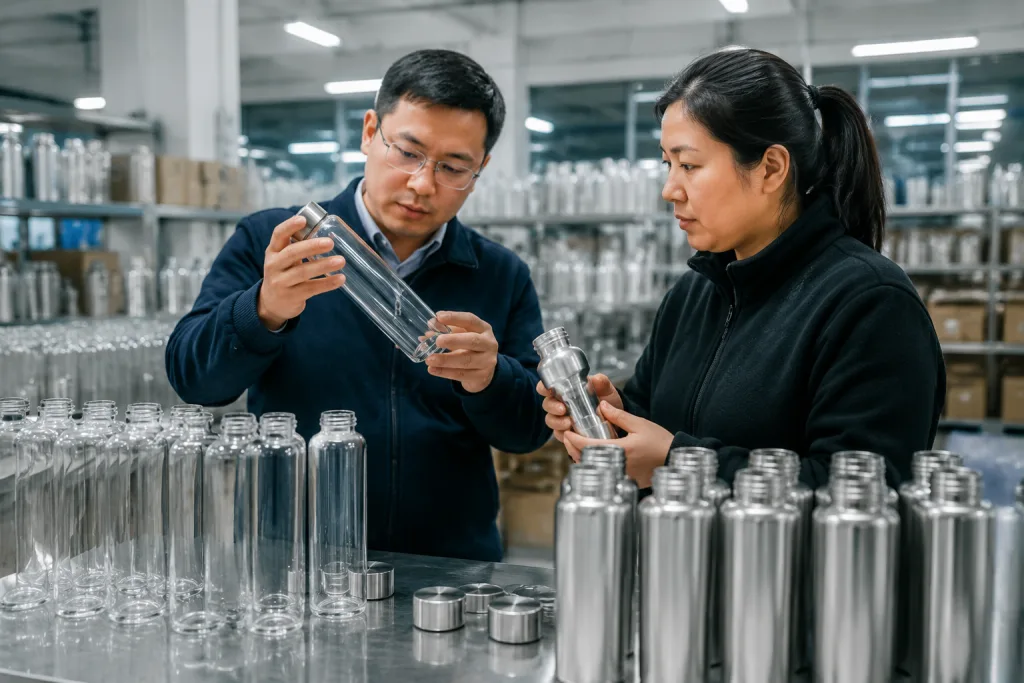
Check the mouth finish first. It should feel smooth under a fingertip, with no sharp seam, chip, or uneven rim. Use a caliper if the rim looks oval; 0.5 mm can change how the lid seats. Then test the lid thread. A 304 stainless steel lid should screw on cleanly without grinding or wobble. Fill the bottle with water, invert it for 30 minutes, then shake it for 30 seconds. Simple test. It is not a laboratory leak test, but it catches weak seals before we run 3,000 pcs. For a customizable glass water bottle with silicone sleeve, check sleeve fit after hot water exposure. Some sleeves relax after 80°C water and rotate if the mold tolerance is loose.
For decoration, compare artwork against a printed Pantone reference, not just a screen image. Glass and silicone take color in different ways. A logo printed on clear glass will not match the same logo on a matte sleeve, and this is the wrong fight to start after packing. If you are a borosilicate glass bottle distributor selling to several accounts, keep one signed golden sample in your office and ask the factory to keep another in the QC cabinet. We write the PO number and approval date on masking tape under the bottle. That stops arguments later when a retail buyer says the bulk order “looks different.”
Sampling lead time from China is usually 7-12 days for existing bottle shapes plus 3-6 days for international courier delivery. New molds add 20-35 days, sometimes 35 days vs 42 days if the mold shop has to re-polish the glass cavity. Your sample approval email should say exactly what is approved: capacity in ml, weight tolerance in g, lid material, sleeve color with Pantone code, logo size in mm, box dieline version, barcode position, and carton markings. Watch the small stuff. Last month a buyer flagged a PO typo where “matte black sleeve” became “matte blank sleeve,” and that email became part of the production file.
Write PO Lines That Protect You
A PO for borosilicate glass bottle bulk should read like a work order for the line, not a friendly email. The more customization you add, the tighter the PO has to be. We have seen a buyer put three sleeve colors and two logos under one “750 ml bottle” line, then QC pulled the sample and found cartons mixed 312 pcs green logo A with blue logo B. That is not one SKU. It is six PO lines, each with its own quantity, artwork file name, packaging code, carton mark, and barcode.
Use PO line items like this: SKU WEL-750-GRN: 750 ml borosilicate glass bottle, clear body, sage green silicone sleeve Pantone sage reference, 304 stainless steel lid, white one-color logo 45 x 18 mm, kraft box, UPC label on box bottom, 1,500 pcs. Then repeat for each color. Short lines cause trouble. If you sell online, write FNSKU or barcode label instructions before we open the packing BOM, not after the 1,500 pcs are sealed in master cartons. Applying FNSKU labels after production means opening cartons with a blade, relabeling one by one, and paying extra packing labor; the math does not work.
Your PO should state Incoterms, usually FOB Ningbo, FOB Shanghai, or EXW factory. FOB is cleaner for most importers because China-side export handling is included, and we ship Ningbo more often for drinkware because the trucking lane from Hangzhou is steady. Payment terms for new customers are commonly 30% deposit and 70% balance before shipment, or before release of original documents. Larger distributor glass water bottle buyers sometimes negotiate different terms after 3 to 5 clean orders, but open account on the first PO is the wrong question to ask.
Add inspection terms. A workable standard is AQL 2.5 major and AQL 4.0 minor, based on ISO 2859-1 sampling. Define critical defects as broken glass, sharp edges, leakage, wrong material, mold contamination, and unreadable barcode. We run the leak test with the bottle inverted for 30 minutes, and the buyer flagged one batch last year because the barcode scanner missed 7 labels under warehouse lighting. For customized glass water bottle retail orders, packaging defects matter too: crushed boxes, wrong insert card, wrong recycling mark, and mixed SKU cartons can cost more than a small cosmetic mark on the bottle.
Control Bulk Production Early
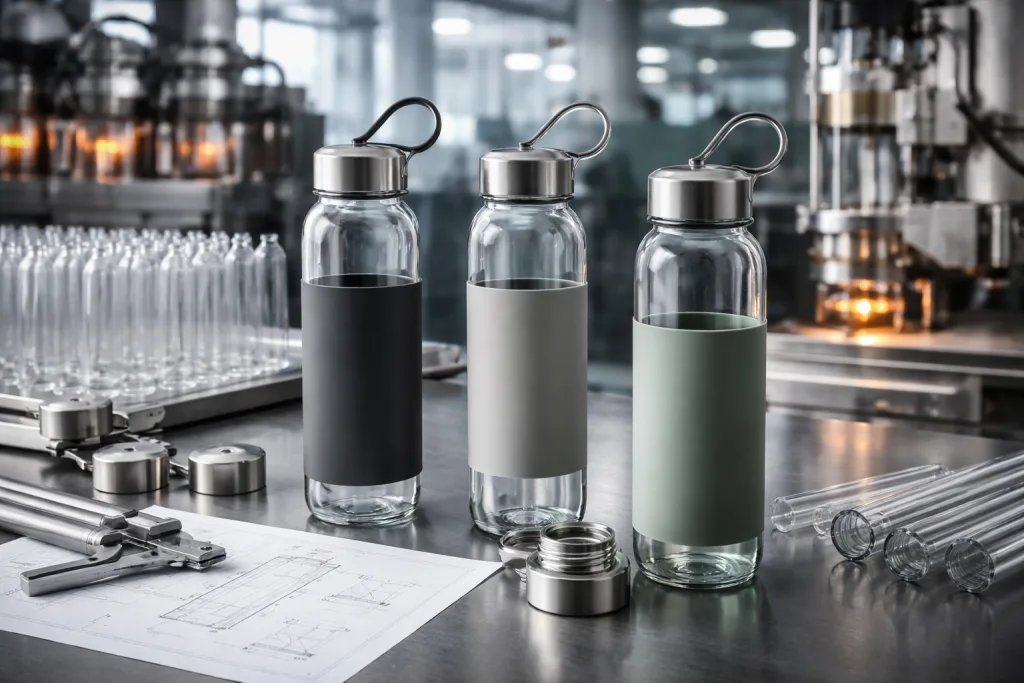
After the deposit lands, we book borosilicate tube, 304 stainless lid parts, silicone sleeves, print plates, inner boxes, master cartons. The line does not run like one magic machine from glass forming to retail box. It is 6 work areas handing parts to the next team, and one late change can stop all 6. Freeze the approved sample, Pantone code, logo size in mm, and carton mark before our planner issues the work order. We have seen this go sideways from one PO typo: “matte black” on the sample sheet, “gloss black” on the purchase order.
For stock shapes, bulk production is usually 30-45 days after deposit and final artwork approval. Before summer retail launches, the same order can move to 50-60 days, mainly when colored sleeves need a new silicone batch or gift boxes need offset printing. If a borosilicate glass bottle vendor promises 15 days for a 20,000-unit customized order, ask what is already sitting in the warehouse and what inspection step got cut. Sometimes the math works. Often it means no incoming material inspection, logo printing with no 3M tape test, or cartons packed before glue and ink have cured for 24 hours.
Ask for three production updates with dates: incoming material photos with carton labels, first decorated unit photos beside a ruler, and packed carton photos before sealing. That is not micromanagement. QC pulled the sample on a 12,000-piece run last month and found the logo 4 mm too low before 300 cartons were sealed. For China export orders, carton markings should include SKU and quantity, gross weight and net weight in kg, carton size in cm, country of origin if required, and any retailer routing code printed exactly as the buyer portal shows it.
For bulk glass water bottle shipments, packaging is engineering, not decoration. We run one bottle in a kraft or color box, add dividers or molded pulp when drop-test risk is high, then pack 24 units per master carton in a five-ply export carton with edge-crush strength matched to pallet stacking or floor-loaded container handling. If you ship to Amazon or a third-party warehouse, confirm carton weight limits before we cut the box dieline. Many buyers prefer master cartons under 15 kg because warehouse teams handle them faster and break fewer glass bottles; the buyer flagged 17.8 kg cartons twice this year, and both orders needed repacking.
Inspect, Ship, And Reorder Smarter
Run final inspection when production is 100% finished and at least 80% packed. Not earlier. We use early line checks for process control, but the final random inspection is what protects the shipment. For a bulk borosilicate glass bottle order, the inspector should check appearance, capacity by measuring cup, lid fit, leakage after 30 minutes upside down, logo adhesion with 3M tape, barcode scanning, carton drop resistance, and SKU count against the PO. For glass, QC should also pull samples under a light box and check bubbles, stones, cracks, sharp points, uneven wall thickness in mm, and stress marks near the neck.
Do not approve a first order from factory photos only. Use your own QC team, a third-party inspection company, or a sourcing office in China that has handled drinkware before. The cost is usually USD 200-350 per man-day; one failed pallet in Hamburg can cost 8-10 times that after sorting, storage, and buyer penalties. If inspection fails, ask for a written rework plan with photos, defect quantity, responsible station, and reinspection of the failed points. We have seen this go sideways when a buyer released goods because the vessel date was 2 days away.
Shipping choice comes down to cash flow and launch date. Air freight works for 200-500 urgent units, but glass is heavy and the math gets ugly fast. Sea freight is usually the only sensible option for borosilicate glass bottle wholesale programs. A 750 ml glass bottle with sleeve and box often lands around 450-650 g per unit packed, so freight cost per unit can jump if the carton grows from 48 cm to 55 cm or leaves dead space on the pallet.
After the first order, reorder planning gets easier if the files are kept clean. Keep the approved artwork, box dieline, golden sample, inspection report, and complaint log in one folder; we label ours by PO number because one buyer once sent back an old dieline with a 1 mm logo position error. If your return rate is under 1.5% and defects are mostly transit-related, fix the insert tray or outer carton before changing the bottle. If leakage appears above 0.5%, review the lid gasket and torque tolerance immediately. A good borosilicate glass bottle supplier in Zhejiang or elsewhere in China should use your first shipment data to make the second PO cleaner, not just repeat the same file.
Send Your Glass Bottle RFQ For Review
Share capacity, lid style, logo, packaging, and target quantity. We will return a practical FOB quote and sampling plan.
Frequently asked questions
What MOQ should I expect for a custom borosilicate glass bottle?
For existing bottle shapes, a realistic MOQ is 1,000 units per logo version if you use standard clear glass, existing 304 stainless steel lids, and simple one-color printing. If you need a custom silicone sleeve color, expect 3,000 units per color because silicone mixing and molding have setup loss. For a fully customized borosilicate glass bottle with a new body mold or special lid tooling, 5,000-10,000 units is more practical. Some borosilicate glass bottle vendors will accept 500 units, but the unit price can be 25-60% higher and packaging choices are limited.
How do I verify the lid is really 304 stainless steel?
Ask the borosilicate glass bottle manufacturer for a material declaration naming 304 stainless steel, not just “stainless.” For larger POs, add a PO clause allowing random third-party testing by XRF or chemical analysis. XRF screening is fast and commonly used for metal grade checks, although formal lab testing gives stronger documentation. Also confirm which parts are 304 stainless steel. Some lids have a 304 outer shell, PP inner thread, and silicone gasket. That structure may be acceptable, but it should be clear before approval, especially for sustainable retailers making plastic-reduction claims.
What certifications matter for Europe and North America?
For Europe, ask about LFGB food-contact testing, REACH compliance for restricted substances, and packaging recycling requirements. For North America, FDA food-contact compliance is usually the baseline, and some retailers may request California Proposition 65 review depending on materials and decoration. Factory-side audits such as BSCI or ISO 9001 can help distributor borosilicate glass bottle buyers, but they do not replace product testing. For first orders above 3,000 units, budget USD 300-900 for targeted lab testing on glass, silicone, plastic inner parts, and printed decoration.
Is borosilicate glass safe for hot drinks?
High borosilicate glass handles temperature shock better than ordinary soda-lime glass, so it is a sensible material for tea, warm water, and wellness drinks. Still, a single-wall borosilicate bottle is not insulated, and the outside can become hot. We normally advise warning text if the bottle may be used with liquids above 60°C. Also check whether the sleeve covers enough surface for hand comfort. The 304 stainless steel lid and silicone gasket must also be rated for the intended temperature range. Do not market the bottle as unbreakable; borosilicate is still glass.
What should I include in my first bulk PO?
Your first PO should include SKU-level quantities, bottle capacity, glass type, approximate wall thickness, lid material, gasket material, sleeve color, logo method, artwork file name, retail box dieline, barcode or FNSKU placement, carton quantity, Incoterms, payment terms, inspection standard, and shipment date. For example, write “AQL 2.5 major / 4.0 minor, FOB Ningbo, 30% deposit, 70% before shipment.” Attach the approved sample photos and signed specification sheet. This prevents the borosilicate glass bottle factory from treating your customized glass water bottle as a generic stock item.