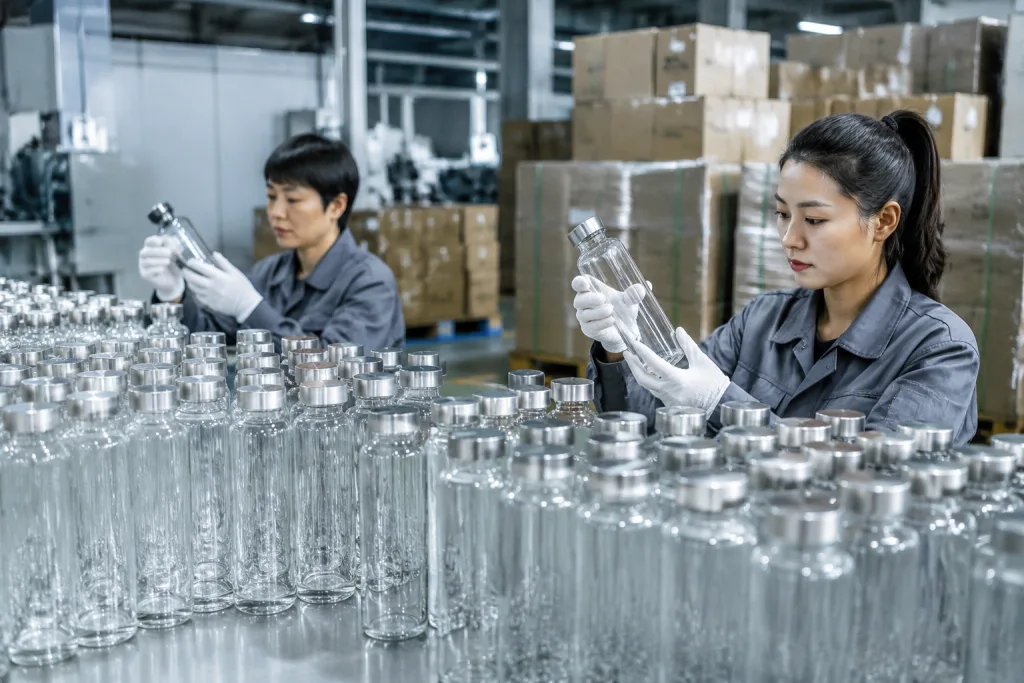
Key Takeaways
- Typical MOQ starts at 1,000 pcs per color, with better unit pricing above 3,000 pcs
- A 500-750 ml borosilicate glass bottle usually lands at USD 1.65-3.80 FOB depending on cap, sleeve, and packaging
- Normal production lead time is 25-40 days after sample approval and deposit
- For retail programs, budget 3-7 days for sampling and 2-5 days for AQL inspection
A custom glass water bottle looks simple on a retail shelf. The cost sheet does not. You are buying borosilicate glass, 304 stainless steel caps, silicone seals, logo decoration, packaging, inspection, and freight risk in one SKU. Last month QC pulled 32 samples from a 1,200 pcs pre-shipment lot because the silicone ring sat 0.6 mm proud of the cap groove; that small miss would have caused leaking complaints and a margin hit.
As a 304 stainless steel borosilicate glass bottle factory in Hangzhou, Zhejiang, we see the same issue with wellness brands and sustainable retailers: nice mood board, no landed cost target. China is still cost-efficient when the buyer locks capacity, cap structure, MOQ, compliance, and carton plan before sampling. If those details wait until after the first sample, the math does not work. We have seen launches slip from 12 days to 18 days just because the PO said “bamboo cap” while the approved sample used a 304 stainless steel inner lid.
What the base bottle really costs
For a borosilicate glass bottle bulk order, the base cost starts with glass tube diameter, wall thickness, bottle height, and forming loss. Standard 500 ml and 750 ml shapes cost less because the molds, cutting jigs, and annealing oven curve are already proven on the line. Less guessing. A basic clear 500 ml bottle with a 304 stainless steel screw cap may start around USD 1.65-2.20 FOB Ningbo or Shanghai at 3,000 pcs. A heavier 750 ml version with thicker glass, a tea infuser, and retail box can move to USD 2.80-3.80 FOB. Last month QC pulled the sample at the flame-forming station because the mouth OD was 0.6 mm over drawing, and that small miss was enough to affect cap fit.
Borosilicate is not the same as ordinary soda-lime glass. Buyers choose it for thermal shock resistance and a cleaner premium hand feel, but selling it as unbreakable is the wrong claim. We have seen this go sideways. For a sustainable retailer, the safer claim is reusable, BPA-free, low-odor, and suitable for normal hot and cold drinks within tested temperature limits. In our drop check, the buyer flagged one cracked shoulder after a 1.2 m carton drop, so we changed the inner tray from 280 g paper pulp to a tighter die-cut insert.
The 304 stainless steel parts change the price more than 8 out of 10 new buyers expect. A thin decorative shell and a true food-contact 304 inner plate do not cost the same. If your cap includes bamboo, carry loop, silicone ring, or a removable stainless steel tea filter, expect USD 0.18-0.75 added per unit. For wellness brands, we usually suggest a 0.4-0.6 mm 304 stainless steel insert and food-grade silicone gasket, then confirm LFGB or FDA food-contact requirements based on market. We run a magnet check first, then the caliper check; one PO even said “SS304 inside” in the notes but showed 201 stainless in the cap drawing, and the math does not work for that spec.
MOQ tiers and price movement
MOQ is where RFQs get messy fast. A borosilicate glass bottle factory can run small batches, but setup time, silk-screen plates, carton artwork, and line changeover still sit on the cost sheet. Last month our line spent 46 minutes changing from black sleeve printing to Pantone 548C, and QC pulled the first 32 bottles for print position check within ±1.5 mm. At our Zhejiang facility, practical MOQ for a custom glass water bottle is 1,000 pcs per color for stock shape, 3,000 pcs for better pricing, and 10,000 pcs or more when private-label efficiency starts to make sense.
For 1,000 pcs, you may pay 8-18% more than a 3,000 pcs order because decoration, packing labor, and inspection are spread across fewer units. The math is simple. At 5,000-10,000 pcs, the saving shows more on color boxes, EVA sleeves, spare lids, and insert cards than on the glass body itself. Glass forming still has gas, annealing, and breakage costs; our last 6,000 pcs run had 2.7% glass loss before packing. The buyer wrote “long-term cooperation” in the email, but that does not reduce furnace cost.
Here is a practical way to think about tiers:
- 1,000 pcs: pilot order for a distributor test or boutique retail launch, usually USD 2.20-4.20 FOB depending on lid, sleeve, and box build; we still open a carton die-line file and check barcode size at 80% scan grade or above.
- 3,000 pcs: normal borosilicate glass bottle wholesale level, with better carton and logo amortization; this is where one silk-screen setup cost stops hurting every single bottle.
- 5,000 pcs: suitable for borosilicate glass bottle distributors selling across Amazon plus offline accounts; packing can move from hand-applied stickers to pre-printed color boxes without making the unit price look silly.
- 10,000 pcs: stronger leverage on packaging, color sleeves, and dedicated production planning; we can block 2-3 line days instead of squeezing the order between stock bottle runs.
If you are a borosilicate glass bottle distributor or distributor glass water bottle buyer, the lowest MOQ is the wrong question to ask. Ask the price at 1,000, 3,000, and 10,000 pcs, then ask lead time as well, because 1,000 pcs may ship in 12 days while 10,000 pcs with printed gift boxes can need 18 days. We have seen this go sideways when a PO typo said 300 pcs instead of 3,000 pcs and the buyer flagged the price jump after artwork was approved. That price ladder tells you whether the borosilicate glass bottle manufacturer controls production or is quoting from a trading spreadsheet.
Customization charges buyers miss
A borosilicate glass bottle custom project usually breaks into four cost buckets: bottle body tooling and glass tube spec, cap system with 304 stainless steel contact parts, decoration process, and export or retail packaging. The bottle body price is often stable, but the buyer sees the brand value on the cap, logo, sleeve, and box. A custom borosilicate glass bottle with a one-color silk screen logo may add USD 0.06-0.15 per unit, plus a screen fee around USD 35-80 per color. Laser engraving on a 304 stainless steel cap looks cleaner for premium wellness brands and usually adds USD 0.08-0.20 per unit depending on logo size; last month QC pulled the sample because a 9 mm logo was approved on the PDF but the PO showed 6 mm. Small typo. Real cost.
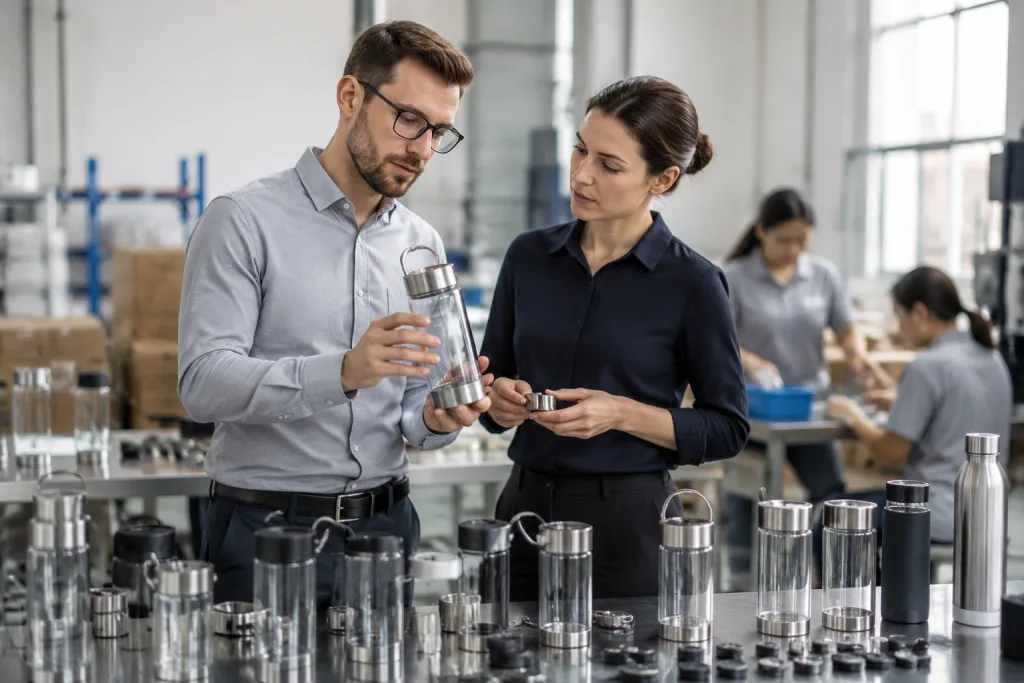
For a borosilicate glass bottle customizable program, the sleeve can move the whole quotation. Silicone sleeves typically add USD 0.35-0.95 each, depending on thickness, coverage, and Pantone matching. A simple 2 mm partial sleeve is not priced like a full-height textured sleeve with debossed branding, and the line needs a different sleeve jig if the wall grip is too tight. We run a trial fit before mass production. If you want a customized glass water bottle with a color-matched sleeve, retail box, and instruction insert, prepare the AI artwork, Pantone code, barcode size, and insert language before RFQ. Vague “eco packaging” requests waste 3-5 days.
Packaging is another quiet margin killer. A plain egg-crate export carton is low cost, but 7 out of 10 sustainable retail buyers ask for an individual kraft box, barcode sticker, suffocation warning if polybagged, and sometimes a retail display carton. A custom box can add USD 0.18-0.65 per unit. If you sell online, add drop-test logic early: 1A carton, inner partition, or molded pulp tray. We ship glass; the math doesn't work if the carton is treated like an afterthought. Glass breakage below 1% is realistic with good packing, based on our 5-layer K=A carton and 12 kg carton weight control; chasing the cheapest carton is how buyers end up with 3-6% transit claims.
Lead time from RFQ to shipment
For a stock-shape customizable glass water bottle, we normally quote and prepare samples in 3-7 days, sample shipping takes 2-5 days, your review takes 3-5 days, and mass production runs 25-40 days after deposit and final artwork approval. If you need a new mold or a non-standard glass profile, add 20-35 days for tooling and trial production. We check bottle mouth OD with a digital caliper before quoting custom caps, because a 0.6 mm mismatch can turn into leaking complaints. China moves fast. Glass does not print overnight.
Our Hangzhou, Zhejiang production network can handle about 450,000 glass bottles per month across standard borosilicate lines, depending on season and decoration load. Before spring and summer retail programs, the line fills fast, and decoration ovens become the bottleneck before glass forming does. Last March, a buyer asked for 80,000 pcs with 12 days production time; the math did not work after silk-screen curing and carton drop test. If you are planning Earth Month, back-to-school, Q4 wellness gifting, or Amazon inventory, start at least 70-90 days before your required warehouse date.
A normal timeline for borosilicate glass bottle customized orders looks like this, assuming artwork is clean and the PO has no cap color typo:
- Day 1-3: confirm capacity in ml, cap type with gasket material, logo method with print area, target FOB price with carton qty, and compliance market such as FDA or LFGB.
- Day 4-10: physical sample or pre-production sample, depending on customization; QC pulled the sample under 6500K light for print position and glass bubble checks.
- Day 11-15: artwork adjustment, Pantone approval with a printed swatch, proforma invoice, deposit; this is where buyers often flag logo size.
- Day 16-45: glass forming on the borosilicate line, cap assembly, logo printing with fixture alignment, packing into export cartons.
- Day 46-50: AQL inspection, carton marking, booking, customs documents; we also recheck gross weight because glass cartons get heavy fast.
Air freight can rescue samples, not bad planning. For bulk glass water bottle shipments, sea freight is normally the right answer because cartons are bulky and glass is heavy. We ship a 24 pcs carton often around 12-16 kg, so the air freight quote can shock new buyers.
Compliance and inspection costs
Wellness brands and sustainable retailers should price compliance into the unit cost from day one. For Europe, buyers ask for LFGB on food-contact parts, REACH for restricted substances, and packaging heavy metal limits on printed boxes or gift tubes. For the United States, FDA food-contact expectations, California Proposition 65 screening, and CPSIA apply when the bottle is sold as a kids’ item. ASTM tests come up with some retail channels, especially when the buyer’s QA form has a fixed test matrix. We had one PO that only said “EU standard”; QC stopped it before deposit because nobody had defined whether the bamboo lid, silicone ring, and 304 stainless strainer were inside the test scope. A responsible borosilicate glass bottle supplier will not say one certificate covers every market forever. That answer is too cheap.
Testing costs vary by lab and scope, but a practical budget is USD 250-900 per material set. If the cap includes 304 stainless steel, silicone, paint, and bamboo, each material needs its own review or written exemption from the buyer. We run a material breakdown sheet before quoting serious orders; one line item for “lid” is not enough for a purchasing file. The lab will ask for part photos, sample quantity, and sometimes 50 g of loose silicone, not just one finished bottle. A borosilicate glass bottle vendor that hides the breakdown is pushing risk onto your side. Ask for stainless steel grade declaration, silicone food-contact statement, and recent third-party reports before you pay a deposit. If the supplier says the old report is “similar,” get the report number and compare the material name.
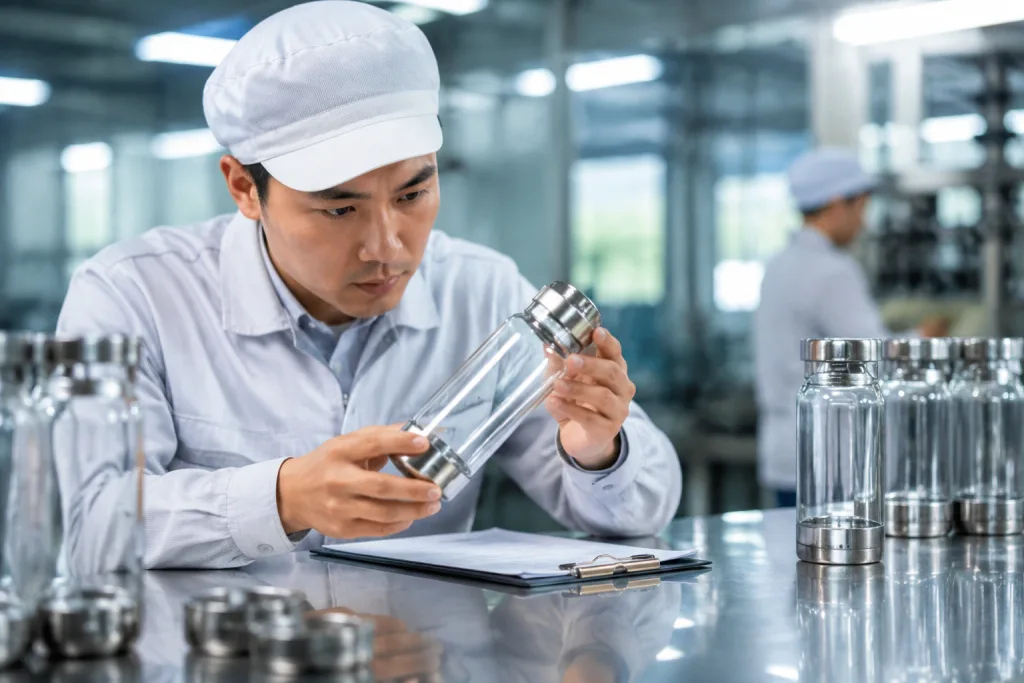
Inspection should be written into the purchase order. For glass drinkware, we usually use AQL Level II with critical defects at 0, major at 2.5, and minor at 4.0, unless the buyer has stricter retail rules. Checkpoints include cracks, sharp edges, cap leakage, silicone fit, logo position, color deviation, barcode scan, carton drop resistance, and gross weight. On the line, QC uses a 0.02 mm caliper for mouth size, a torque check on caps, and a 3M tape pull on printed logos. Last month QC pulled the sample and found 7 bottles in one carton with logo drift over 2 mm; the buyer flagged it before shipment photos went out. Third-party inspection in China often costs USD 180-320 per man-day. It is cheaper than sorting 3,000 pcs in a North American warehouse. The math doesn’t work once warehouse labor and repacking cartons are counted.
Do not accept “we checked everything” as a quality plan. Ask for the defect list, sampling level, and photos from the packed cartons.
Choosing the right supplier type
The terms borosilicate glass bottle manufacturers, borosilicate glass bottle suppliers, borosilicate glass bottle vendors, and borosilicate glass bottle factory get mixed together online. The better question is simple: who controls the process that can fail your order? We see 4 common setups: glass formed in-house with outsourced caps, China assembly using glass blanks from another province, decoration-only workshops, and pure trading exporters. None is automatically wrong. Risk sits in the handoff. Last month QC pulled the sample on a 550 ml bottle because the outsourced lid gasket was 0.6 mm too thin, and the leak only showed after the torque meter hit 8 kgf·cm.
If you need a custom glass water bottle for a wellness brand, choose a supplier that can talk through wall thickness, annealing, cap torque, silicone hardness, logo adhesion, and carton drop testing without sending every question down the line. Short answer matters. A real borosilicate glass bottle manufacturer should show production photos from the furnace or forming area, BSCI or ISO-style audit documents if available, and a defect history with actual numbers, such as 1.8% cosmetic rejects and 0.3% leakage after assembly. For sustainable retailers, ask the buyer-side questions early: recycled packaging content, plastic-free packing options, and FSC certification for bamboo parts if you plan to print that claim. We had one PO where “FSC bamboo lid” was typed, but the approved sample used standard bamboo; the buyer flagged it during artwork sign-off, not after shipment.
For borosilicate glass bottle promotional programs, speed and price often beat deep customization. Retail private label is different. Repeatability wins. If you are comparing a borosilicate glass bottle vendor in China with another quotation that is 25% cheaper, check whether both include the same 304 stainless steel grade, sleeve weight in grams, retail box paper thickness, inspection level, and FOB port. This is where we’ve seen this go sideways. A quote can look cheaper because it removed the 1.2 m carton drop test, changed a 38 g silicone sleeve to 30 g, or priced Ningbo FOB while your routing guide says Shanghai. The math doesn't work if the missing items come back as change charges 12 days before loading.
A practical RFQ cost checklist
A strong RFQ saves 5–7 working days. Put bottle capacity, target dimensions in mm, cap material, sleeve requirement, logo artwork, packaging style, order quantity, destination country, and target ship date in one message. We quote faster when the buyer sends the AI file and a 3D sleeve reference instead of a phone screenshot. If you are buying bulk borosilicate glass bottle inventory for distribution, state neutral cartons or distributor-ready barcodes. If you are launching a customized borosilicate glass bottle under your own brand, include Pantone colors, retail compliance needs, and the carton mark format your warehouse wants.
For cost control, ask your borosilicate glass bottle supplier to quote three clear levels: basic stock, brand upgrade, and shelf-ready pack. The basic stock option can be clear glass, 304 stainless steel cap, one-color logo, and plain box. The brand upgrade can add a 2.0 mm silicone sleeve and kraft retail box. The shelf-ready pack can add insert card, barcode, 1.2 m drop-tested carton, and third-party inspection. This format shows the real cost drivers. The cheapest line on a spreadsheet is often the wrong question to ask; QC pulled the sample last month because the sleeve covered the fill-line mark by 3 mm.
Ask for FOB and EXW pricing separately. FOB is cleaner for international procurement because port handling and export documents are included. For Zhejiang and nearby production, Ningbo and Shanghai are common ports; from our Hangzhou line, Ningbo usually adds 1 day by truck, Shanghai can add 2 days in peak season. If your forwarder consolidates in China, EXW can work, but confirm who handles export customs. One small miss here adds USD 150-400 and 3–5 days, and we have seen it go sideways when the PO says “EXW Ningbo” instead of “FOB Ningbo.”
The best borosilicate glass bottle wholesale projects are not the cheapest on paper. They are the ones where MOQ, material grade, inspection, and timeline are written down before sampling. Write the MOQ as 1,000 pcs, 3,000 pcs, or whatever your launch plan needs. No guessing. That is how a sustainable bottle program protects your margin, not just the factory schedule.
Send your glass bottle RFQ for costing
Share capacity, cap type, logo, MOQ, packaging, and destination market. We will return practical FOB options, not vague factory promises.
Frequently asked questions
What is the normal MOQ for a custom borosilicate glass bottle?
For an existing bottle shape, normal MOQ is 1,000 pcs per color, but 3,000 pcs is the more practical level for stable pricing. If you need a custom silicone sleeve color, retail box, or special 304 stainless steel cap finish, 3,000-5,000 pcs is more realistic. New glass molds usually need 10,000 pcs or a tooling fee, depending on the shape. For a first wellness retail launch, many buyers start with 1,000-2,000 pcs to test sell-through, then reorder at 5,000 pcs once the packaging and customer reviews are proven.
How much should I budget for a 500 ml glass water bottle?
A 500 ml borosilicate glass bottle with a 304 stainless steel cap usually falls around USD 1.65-2.60 FOB for 3,000 pcs if the shape is standard and packaging is simple. Add a silicone sleeve and the price may rise by USD 0.35-0.95. Add a kraft retail box, barcode label, and insert card, and another USD 0.20-0.70 is common. A premium retail-ready bottle can reach USD 3.20-4.20 FOB. Always compare quotations using the same cap grade, sleeve weight, logo method, and carton specification.
Can you make a plastic-free packaging set for sustainable retail?
Yes, but it must be designed carefully because glass needs impact protection. Common plastic-free options include kraft paper retail boxes, molded pulp trays, paper belly bands, and paper tape on master cartons. Expect packaging to add about USD 0.25-0.85 per unit depending on structure and print coverage. We still recommend drop testing before mass shipment, especially for ecommerce. If you remove polybags, the carton design must prevent scuffing on glass and sleeves. For Europe, also check local packaging recycling labeling rules before printing.
How long does a customized glass water bottle order take?
For a stock bottle with custom logo and packaging, plan 35-55 days from RFQ to shipment if feedback is fast. Sampling usually takes 3-7 days, sample transit 2-5 days, artwork approval 3-5 days, and mass production 25-40 days after deposit. If you need a new mold, add 20-35 days. Inspection and booking can add another 2-5 days. For seasonal wellness launches, you should start 70-90 days before your required warehouse arrival, especially if shipping by sea to Europe or North America.
What quality defects should I watch for in bulk glass bottles?
The main defects are cracks, chipped rims, sharp edges, unstable bottle base, poor annealing, cap leakage, silicone gasket deformation, off-center logos, scratched sleeves, and weak retail cartons. For bulk glass water bottle orders, use AQL Level II with critical defects at 0, major at 2.5, and minor at 4.0 unless your retailer requires stricter limits. Ask for leak testing, visual inspection under light, barcode scan checks, and carton drop test records. A third-party inspection in China usually costs USD 180-320 per man-day and is worth it.