Key Takeaways
- A practical custom glass water bottle MOQ starts at 3,000 units per color for sleeve and box work
- Expect 25-35 days for mass production after sample approval and deposit
- Borosilicate glass needs dimensional QC, thermal shock checks, lid leak testing, and carton drop testing
- FOB China pricing for 5,000 units usually changes more from packaging than from a 0.2 mm glass thickness difference
You are not buying an off-the-shelf glass bottle. You are placing a 304 stainless steel borosilicate glass bottle custom order that has to sit straight on a retail shelf, pass a 1.2 m drop carton test, clear FDA or LFGB paperwork, and avoid tying up cash in 37 cartons of slow stock. That is a different job.
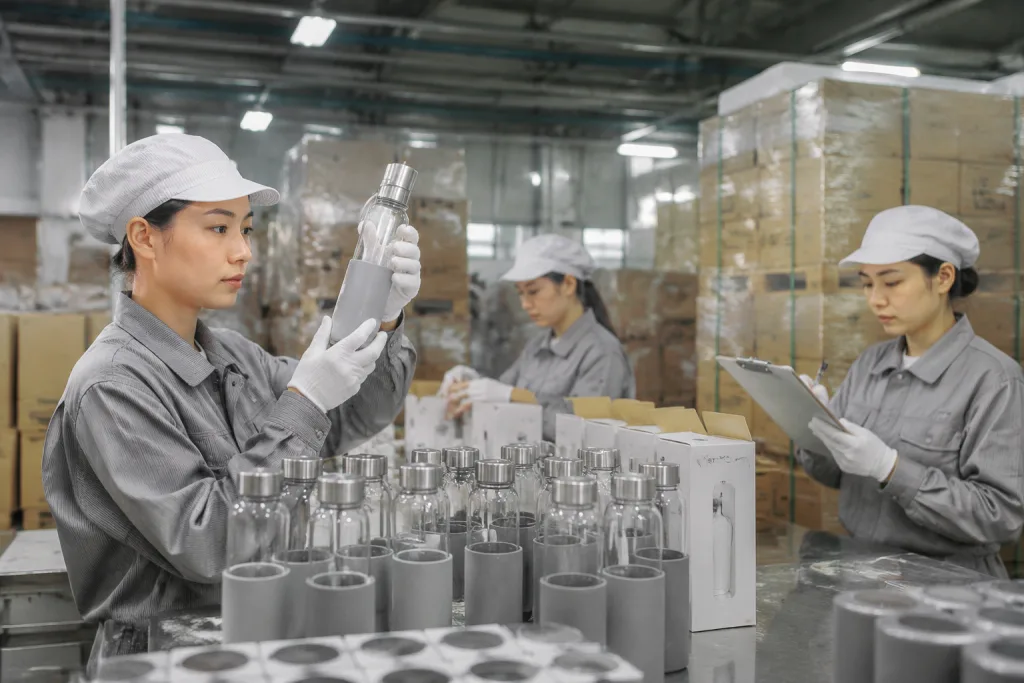
Here is the kind of order we run often for wellness brands and sustainable retailers: 5,000 units, 550 ml capacity, borosilicate body, 304 stainless steel lid, silicone sleeve, logo print, retail box, and export carton. Simple on paper. On the line, QC pulled the sample because the sleeve edge was 1.5 mm higher than the approved drawing, and the buyer flagged it before mass packing. BottleForge Industrial runs glass bottle projects from Hangzhou, Zhejiang, with China-based assembly partners and a monthly drinkware output of about 450,000 units across glass and stainless drinkware lines.
Start With The Retail Brief
Start with a retail brief, not a quote request. Say the buyer wants a clean wellness bottle: transparent borosilicate glass, matte sage silicone sleeve, brushed 304 stainless steel lid, and one-color logo on the sleeve. If that brief is still loose, asking a borosilicate glass bottle supplier for price is the wrong question to ask. We can make the quote look cheap by changing sleeve height, lid structure, glass wall tolerance, or box grade. Then procurement compares 3 offers that look similar in Excel but are not the same bottle. We see this every month; QC pulled one sample last April where the sleeve covered 112 mm on one quote and 148 mm on another.
For this buyer scenario, the working spec is 550 ml capacity, high borosilicate glass body, 2.0 mm nominal wall thickness, 304 stainless steel outer lid, food-grade PP inner structure, LFGB-grade silicone seal, and a removable silicone sleeve around 1.5-1.8 mm thick. The bottle height is about 230 mm, diameter about 68 mm, and finished weight lands near 360-420 g depending on sleeve coverage. Lock these numbers before sampling. On the line, we check body OD with a digital caliper, and a 0.3 mm drift at the mouth can already make the PP insert feel loose after the first dishwasher cycle.
If you sell through sustainable retail, do not call the bottle unbreakable. The buyer may like the word, but the math does not work. Borosilicate handles temperature change better than soda-lime glass, but it is still glass. A safer retail claim is simple: suitable for daily cold drinks and warm beverages, not for microwave use with the lid, and not designed for boiling water poured into a frozen bottle. We had one EU buyer flag this exact claim during artwork approval because their legal team rejected “shatterproof” on the back label.
At BottleForge in Zhejiang, we push buyers to confirm the sales channel before we cut samples. A borosilicate glass bottle promotional order for a gym chain can run a simpler kraft box and lower sleeve coverage. A premium customized glass water bottle for retail may need a printed rigid box, barcode, hangtag, and stronger shelf presentation. Those choices move unit cost faster than most buyers expect; changing from a kraft box to a 1,200 g rigid gift box can add 18 days vs 12 days to packing material lead time. We also ask for the PO carefully, because one typo like “sage” becoming “sand” sends the sleeve color chip in the wrong direction.
Build The Factory Specification
After the retail brief is locked, we turn it into a factory spec sheet. This is where the line can tell a real buyer from a price shopper. Put the hard items on one page: capacity tolerance, material standard, lid construction, gasket material, sleeve Pantone, print method, packaging, test requirements, and Incoterm. We run into trouble when a PO says “500 ml glass bottle” but the sample approved on the bench measures 530 ml to the shoulder with a 15 ml overflow gap.
For a 304 stainless steel borosilicate glass bottle custom order, check the lid first. Some low-price quotes hide 201 stainless steel under a shiny cap, or use a thin metal skin over PP plastic. Fine for a 3-day trade show giveaway, not fine if your product page says 304 stainless. Ask the borosilicate glass bottle factory to write 304 stainless on the PI and material declaration. For export retail, we like 0.4-0.5 mm stainless steel cap thickness, 100 percent silicone sealing ring inspection during assembly, and a torque check on threaded lids. QC pulled one sample last month where the gasket sat 0.6 mm proud and the lid leaked after 12 turns in the shake test.
Specify the glass body as high borosilicate, usually around 3.3 expansion coefficient material for heat resistance. Wall thickness is often 1.8-2.2 mm for daily bottles. Thicker glass sounds safer, but the math does not always work: it adds weight, pushes up sea freight, and can make a 550 ml bottle feel top-heavy in the buyer’s hand. For a 550 ml bottle, 2.0 mm is a sensible starting point. On the line, we check wall thickness with a digital caliper at the mouth, shoulder, and base because the base can hide a 0.3 mm swing.
Do not forget packaging dimensions. Weak cartons punish you before the goods reach your warehouse. A common setup is one bottle in a printed box with E-flute insert or molded pulp tray, then 24 units per export carton. For Amazon-style handling or distributor glass water bottle channels, we usually add a 5-ply carton, edge protection, and 80 cm drop test on the packed carton. We have seen this go sideways: one buyer approved the bottle but left carton size blank, then flagged a 9 kg master carton as “too soft” after the forwarder found crushed corners at loading.
Price The Order Honestly
For 5,000 units FOB Ningbo or Shanghai, we would price this build at about USD 2.40-3.80 per unit from a normal China line. USD 2.40 means a simple silicone sleeve, one basic logo position, and a standard white box packed 24 pcs/carton. USD 3.80 means Pantone-matched silicone, a stronger retail box, barcode labeling, insert card, and tighter carton protection with 5-layer K=A board. If a borosilicate glass bottle vendor quotes USD 1.35 for the same spec, the math doesn't work. Last month QC pulled a “same spec” sample and found a 0.55 mm sleeve instead of the quoted 0.85 mm sleeve.
MOQ depends on which parts are custom. For a stock clear bottle with laser logo on the stainless lid, MOQ can be 1,000-2,000 units. For a custom borosilicate glass bottle with Pantone silicone sleeve and printed retail box, plan on 3,000 units per sleeve color. For a new mold shape, 8,000-10,000 units is more realistic, plus tooling cost. BottleForge usually recommends staying with a proven body shape for the first order unless your brand equity depends on a proprietary silhouette. We run the first mold check with a go/no-go gauge on the mouth thread; 0.3 mm off there becomes leaking complaints, not a design feature.
Price drivers are not mysterious. Sleeve color matching adds setup cost and material MOQ, especially when the buyer asks for 3 sleeve colors but only 1,000 pcs each. A full-wrap sleeve uses about 22-30 g more silicone than a grip band on a 500 ml bottle. A matte box with spot UV costs more than a plain kraft box because the print shop needs another pass, and the buyer often flags scuffed corners during pre-shipment inspection. Individual FNSKU labeling, suffocation warning polybags, and carton labels add labor. If you are buying borosilicate glass bottle bulk for a distributor launch, send the warehouse routing guide before quotation, not after production.
Payment terms are usually 30 percent deposit and 70 percent before shipment for new buyers. For repeat borosilicate glass bottle distributors with stable volume, terms can improve after 2-3 successful orders. Be careful with EXW quotes if you are new to China sourcing. FOB is cleaner because export handling and China port delivery are included, and you can compare offers with fewer hidden costs. We have seen EXW go sideways over a 12 RMB/carton inland handling charge that was not on the PO, and yes, the buyer flagged the typo after the truck was already booked.
Approve Samples Before Tooling
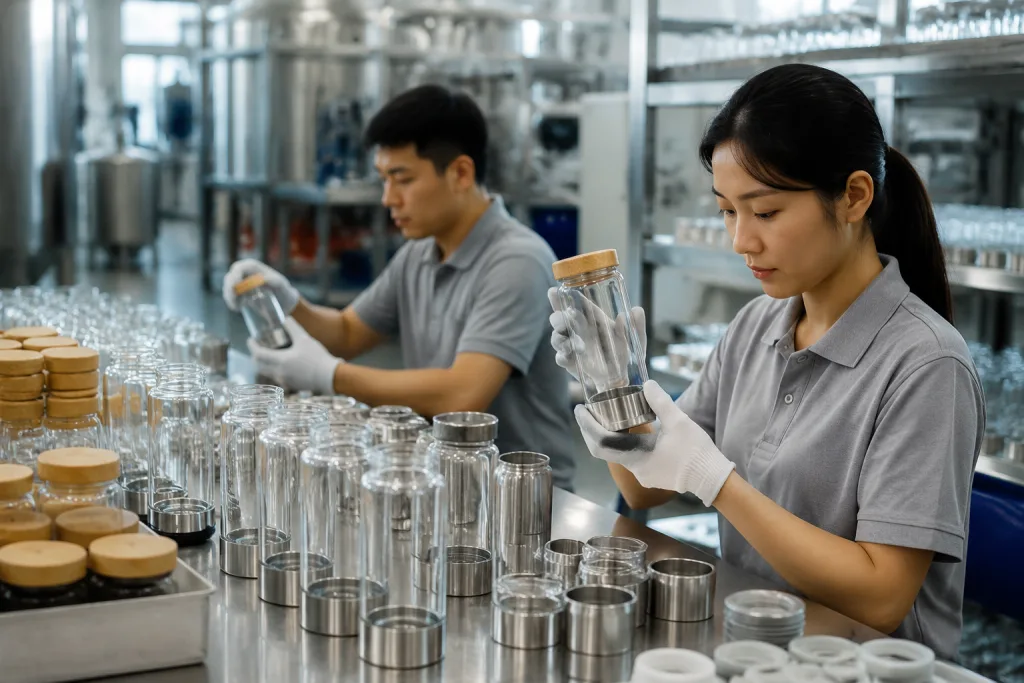
I’ll rewrite the section in-place, keep the HTML structure unchanged, and make it sound like a factory-side sales engineer wrote it.Sampling should prove the bottle, not just make you feel better. For this order, we ask for two sample rounds if the schedule holds. First comes a structure sample with the existing sleeve color and standard packaging. Then we run a pre-production sample with your logo, final sleeve color, retail box artwork, barcode, warning text, and carton mark. One typo on the PO can waste a week, so we check the art files line by line before the line starts.
A borosilicate glass bottle custom sample usually takes 7-10 days when we use existing parts. Custom sleeve color adds 5-7 days because silicone color matching needs trial material and a small mold pull. Printed box samples may take another 5 days. If the bottle is for a retailer line review, give us the meeting date early and ask for courier service at the same time. DHL or FedEx from Zhejiang, China to Europe or North America usually lands in 4-7 working days after pickup.
Check the sample like a buyer, not like someone protecting the logo. Fill it with water and leave it upside down for 4 hours. Open and close the lid 50 times. Smell the silicone sleeve and gasket after washing. Put the bottle into the box and shake it lightly; if it moves, transit damage risk goes up. QC pulled the sample on the bench and measured sleeve fit at 1.5 mm play, which is the kind of thing that saves a claim later. Compare the sleeve color under daylight and store lighting. Take photos of every approved detail and put them into the signed sample approval sheet.
For logo work, screen printing on silicone is the common choice when the mark needs to look soft and cover more area. Laser engraving works on the 304 stainless steel lid, but the effect is subtle. Pad printing can work on some glass surfaces, though adhesion needs testing. If you want a dishwasher-resistant claim, ask for a 3M tape test and alcohol rub test before you approve the decoration method. We’ve seen this go sideways when the buyer skipped the rub test and blamed the ink later.
Run QC Like A Retailer
Mass production usually takes 25-35 days after sample approval and deposit for a 5,000-unit borosilicate glass bottle wholesale order. In that window, broken glass is only one risk. We’ve had QC pull samples for mixed silicone sleeve colors, gaskets sitting 0.8 mm proud, lid scratches from a loose polishing jig, weak box glue, barcodes that would not scan on a Zebra handheld, and cartons crushing after 4-high stacking.
Use AQL inspection. For most retail drinkware orders, buyers use AQL 2.5 for major defects and AQL 4.0 for minor defects. Critical defects should be zero tolerance. Critical issues include glass cracks, sharp edges, unsafe material substitution, serious leakage, mold contamination, and wrong compliance labeling. Major defects include lid not sealing, print shifted more than 2 mm, sleeve tearing, or box barcode failure. Minor defects include small cosmetic marks outside the agreed viewing distance, such as a 3 mm scuff that cannot be seen at 50 cm under normal light.
A proper QC checklist for a customizable glass water bottle should include capacity check with water, body height and diameter tolerance, wall thickness spot checks, lid thread fit, gasket presence, leak test, sleeve fit, logo position, carton weight, carton drop test, and packaging count. For this order, inspect at least 200 units under ANSI/ASQ Z1.4 general inspection level II, unless your retailer requires a different plan. We run the leak test with filled bottles inverted for 30 minutes; if 2 caps sweat at the thread, the line stops and the torque tool comes out.
Ask for production photos, but do not rely on photos alone. Photos miss bad glue, loose lids, and the PO typo that prints “304 stainles steel” on 5,000 color boxes. If this is your first order with borosilicate glass bottle manufacturers, use a third-party inspection company or ask us to coordinate pre-shipment inspection with a written report. Zhejiang and nearby China export zones have enough QC resources; skipping inspection to save USD 180-300 is the wrong question to ask when one rejected container can block a seasonal launch.
Control Compliance And Claims
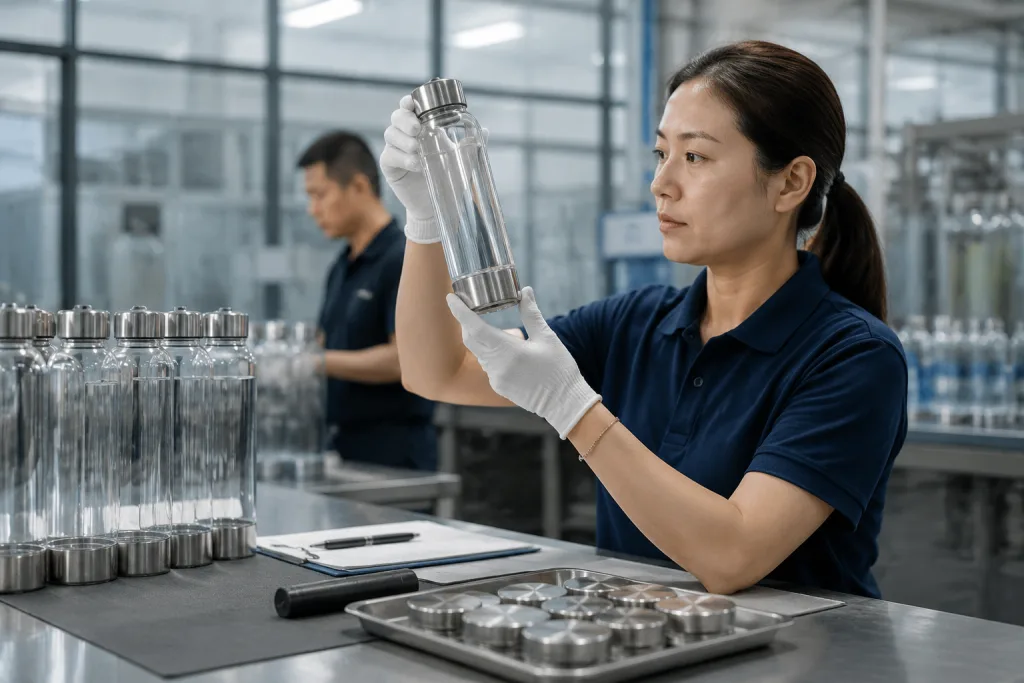
Wellness and sustainable retailers care about materials, but every claim needs paperwork behind it. For the glass body, ask for food-contact documents that match your sales market; our QC desk usually checks the report number against the PO before we release pre-production samples. For the silicone gasket and sleeve, request LFGB or FDA food-contact test reports if the sleeve touches the mouth area or the retailer writes that requirement into the vendor manual. For EU distribution, buyers often ask for REACH SVHC screening on silicone, coatings, inks, and packaging components.
For North America, check whether your sales channel requires a California Proposition 65 assessment. For children-oriented drinkware, ASTM and CPSIA questions get serious fast, but this spec is an adult wellness bottle, not a kids bottle. If you print BPA-free on the box, the PP inner lid material declaration must support it; we have seen this go sideways when a buyer flagged one missing line during final artwork check. Stainless steel should be declared as 304, not just stainless, and QC pulled the sample with an XRF gun when one lid batch came in with unclear coil paperwork.
Sustainability language needs discipline. Borosilicate glass is reusable and does not hold odor like some plastics. Fair claim. Calling it carbon neutral without a verified program is the wrong question to ask because the math does not work on a normal custom run. For stronger shelf positioning, we run FSC-certified paper packaging, soy-based ink when the print house has it in stock, no unnecessary plastic bag, and a spare gasket option to extend product life; for one 3,000-unit order, the buyer accepted the extra gasket after seeing two gasket compression marks in the drop-test carton.
A borosilicate glass bottle distributor may also need country-of-origin marking, importer address, SKU code, and multilingual care instructions. Decide this before artwork approval. Adding a sticker after packing is slow and expensive. On a 5,000-unit order, even USD 0.08 per extra label is USD 400 plus labor delay, and we have had one PO typo on the SKU code hold the line for 12 hours while cartons were already staged near the tape machine.
Ship Without Surprises
After QC signs off, lock the carton marks, pallet plan, and booking cut-off in writing. For a 5,000-unit customized borosilicate glass bottle order with retail boxes, we usually see 8-12 cubic meters on the CBM sheet after the warehouse measures 10 cartons with a tape, because insert height and box flap style change the stack. That ships LCL in most cases, not a full container. At 20,000-30,000 units, FCL starts to make sense because the math on local handling, re-labeling, and broken outer cartons gets cleaner.
Glass hates extra touch points. If your warehouse accepts pallets, palletize at origin and tell us the max pallet height in mm before packing starts. It adds cost and volume, but it cuts carton crushing; we have seen a 17 kg master carton arrive with one corner folded after a loose LCL transfer in Ningbo. For Europe, confirm pallet type and ISPM 15 compliance if wooden pallets are used. For North America, confirm carton label layout, purchase order number, SKU, UPC, and retailer routing rules before the forwarder collects cargo, not after the buyer flagged a missing PO digit on the mark.
If you are a borosilicate glass bottle distributor building a new line, do not open with every color at once. We have watched this go sideways. A cleaner first buy is 5,000-8,000 units across 2 colors, then reorder the color that actually moves. BottleForge can hold approved components and repeat the same spec, but QC still pulls sleeve Pantone cards and box print samples each batch, because one supplier typo on “matte black” became “mate black” on a PO last year. Repeat orders from Zhejiang, China often move faster, usually 20-28 days if materials are already confirmed.
The boring work protects your margin: fixed spec sheet, approved sample, AQL inspection, correct carton, and honest freight planning. On the line, that means one sealed golden sample in the QC room, carton drop notes on the inspection report, and no guessing on gross weight. This is how a borosilicate glass bottle customizable project becomes a repeatable retail item instead of a one-time sourcing headache.
Send Your Glass Bottle Spec For Review
Share capacity, lid style, sleeve color, logo method, packaging, quantity, and target market. We will check feasibility before quoting.
Frequently asked questions
What MOQ should I expect for a custom borosilicate glass bottle?
For a stock bottle with simple logo printing, MOQ can start around 1,000-2,000 units. For a borosilicate glass bottle customized with Pantone silicone sleeve, printed retail box, barcode, and carton marks, 3,000 units per color is a more realistic MOQ. If you need a new glass mold, expect 8,000-10,000 units plus tooling. For wellness retail, we usually suggest 5,000 units because it gives the factory enough volume to control silicone color, packaging print, and assembly cost without forcing you into a full-container commitment.
Is 304 stainless steel necessary for the lid?
If your product page or packaging says 304 stainless steel, then yes, it must be controlled. Some low-price lids use 201 stainless steel or only a thin stainless decorative shell over plastic. For a 304 stainless steel borosilicate glass bottle custom project, ask for the lid material to be written on the quotation, proforma invoice, and material declaration. We normally specify 0.4-0.5 mm 304 stainless steel for the outer cap, PP inner structure, and LFGB-grade silicone sealing ring. QC should include lid thread fit, gasket presence, and 4-hour inverted leak testing.
Can borosilicate glass bottles go in the dishwasher?
The glass body may tolerate dishwasher conditions better than ordinary soda-lime glass, but the complete product is another matter. Silicone sleeves, printed logos, lid adhesives, and stainless lid finishes may not all perform the same. If you want to claim dishwasher safe, test the final customized glass water bottle, not only the glass tube. A practical test is 20-50 dishwasher cycles, followed by logo adhesion check, sleeve deformation check, lid seal check, and visual inspection. Many brands choose safer wording: hand wash recommended to extend print and lid life.
How do I compare borosilicate glass bottle suppliers fairly?
Give every borosilicate glass bottle supplier the same spec sheet: capacity, glass thickness, lid material, sleeve thickness, logo method, packaging, carton count, Incoterm, test requirements, and order quantity. Then compare FOB price, MOQ, sample lead time, mass production lead time, QC plan, and compliance documents. A USD 0.30 cheaper quote is not cheaper if it excludes retail box, uses 201 stainless steel, packs in weak cartons, or has no AQL inspection. Ask each vendor to confirm whether the quote is for borosilicate glass bottle bulk production or only a stock sample with logo.
What defects should I reject before shipment?
Reject critical defects immediately: cracked glass, sharp rim, unsafe material substitution, serious leakage, missing gasket, mold contamination, or wrong compliance labeling. Major defects usually include lid misfit, logo misplacement over 2 mm, sleeve tearing, box barcode failure, badly scratched stainless lid, or wrong carton quantity. Minor defects include small cosmetic marks within agreed limits. For a 5,000-unit borosilicate glass bottle wholesale order, use AQL 2.5 major and AQL 4.0 minor as a normal retail baseline. Inspection should happen before final payment and before cargo leaves the China factory.