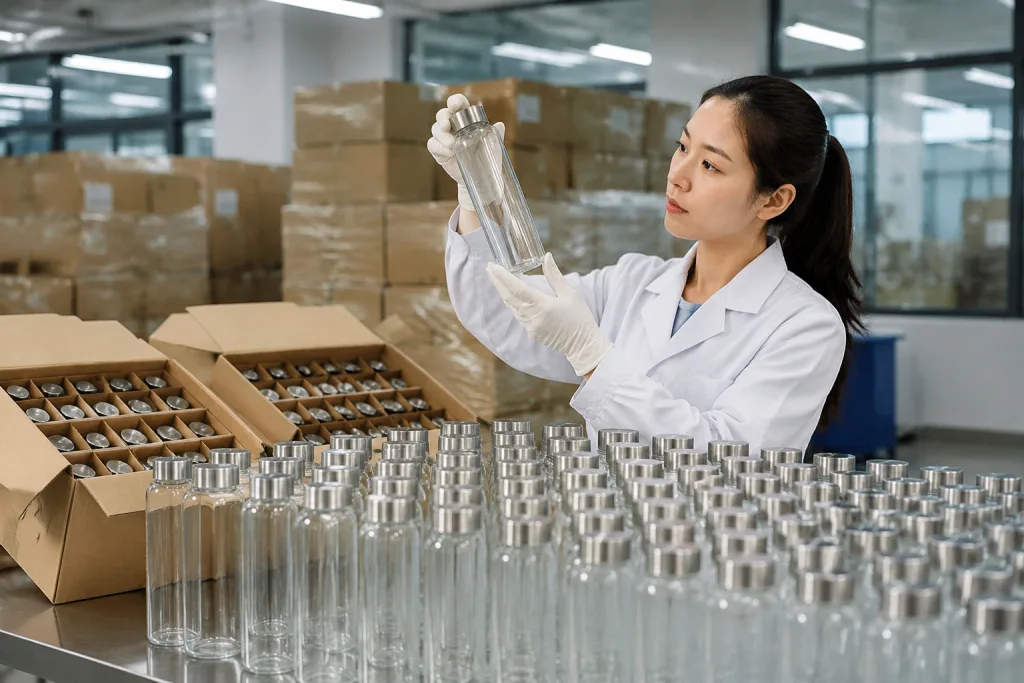
Key Takeaways
- A practical MOQ is 3,000 pcs for standard 500–750 ml glass bottles and 10,000 pcs for private mold work
- Specify 304 stainless steel cap parts separately from silicone, PP, bamboo, and coating components
- Use AQL 2.5 for major defects and AQL 4.0 for minor defects on bulk glass water bottle inspection
- Budget USD 1.85–3.60 FOB China for most customized borosilicate glass bottle orders
A 304 stainless steel borosilicate glass bottle bulk order looks simple until the quotes sit side by side. One borosilicate glass bottle supplier prices a 550 ml bottle at USD 2.15 FOB Ningbo, another at USD 1.72, and both write “same quality” on the PI. They are not the same. We have seen the cheaper cap drop from 22 g to 16 g, the silicone ring fail a smell check after hot-water testing, the glass wall swing by 0.4 mm on a digital caliper, and the export carton split during a 76 cm drop test.
If you buy for a wellness brand or sustainable retailer, the custom glass water bottle has to survive retail handling, sit clean on shelf, and pass EU or North American compliance checks. From our Zhejiang, China production network, BottleForge runs glass bottle programs with 3,000 pcs MOQ for standard molds and 25–35 day mass production after sample approval. The buyer usually asks, “Can we cut another USD 0.10?” Wrong question. If QC pulled the sample for a loose 304 stainless lid insert or a wavy logo print, that USD 0.10 saving turns into a 12-day rework delay fast.
What are you actually buying?
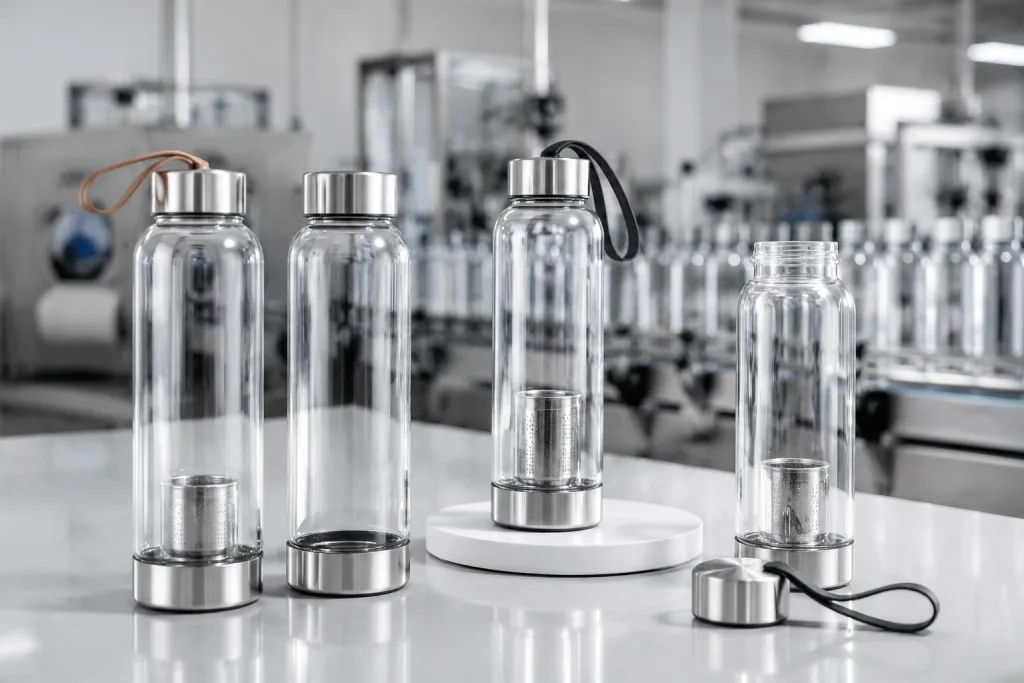
Buyers often ask us for a 304 stainless steel borosilicate glass bottle bulk quote, but they are not buying “just a glass bottle.” It is a mixed-material item. The body is high borosilicate glass, normally 3.3 expansion glass. The lid can have a 304 stainless steel outer shell, PP inner plug, food-grade silicone gasket, bamboo trim, or a carry loop. We had one PO last year that only said “glass bottle with stainless cap”; QC pulled the sample and found a 201 stainless shell under the coating. Cheap substitution starts in loose wording.
A workable spec sheet should name capacity, glass wall thickness, cap build, mouth diameter, gasket material, decoration method, packaging, and sales market. For wellness retail, the common sizes are 450 ml, 550 ml, 650 ml, 750 ml, and 1,000 ml. For a 550 ml bottle, we usually run 2.0–2.5 mm on the body wall, with the base closer to 4.0–6.0 mm depending on shape. Our line checks this with a digital caliper at first-piece approval and again during patrol inspection. Thinner glass saves maybe USD 0.08–0.15 per piece, but the math does not work if breakage jumps in carton drop testing or store handling.
Do not assume every borosilicate glass bottle manufacturer uses the same cap. 304 stainless steel should be written into the BOM, then checked by XRF test for serious orders; our QC team uses a handheld XRF gun before mass packing on repeat programs above 3,000 pcs. If the inner contact part is PP, confirm it is food-contact grade. If you sell in the EU, ask for LFGB or EU 1935/2004 food contact testing. For the US, check FDA food-contact expectations and California Prop 65 risk if your retailer requires it. We have seen this go sideways when the buyer approved the outside finish but never asked what touched the drinking water.
Procurement rule: define every material that touches water, lips, or hands before you compare unit prices.
Buyer questions before any quote
Before you send a bulk borosilicate glass bottle inquiry to China, settle five points with your own team. Boring work. It saves 3 rounds of pricing emails, and our merchandiser does not have to rebuild the cost sheet in Excel after QC pulls the first 550 ml sample from the line.
- Where will it sell? EU, UK, Canada, and the US can require different labeling, testing, and packaging files; one buyer once forgot the UK importer address on the PO, and the carton artwork had to be changed by 2 mm.
- Is it retail or promotional? A borosilicate glass bottle promotional order often works with a plain white box, while sustainable retailers usually ask for shelf-ready cartons, EAN barcode control, and a 5-side drop test report.
- What is the real launch quantity? If you need 1,000 pcs, say it. If your forecast is 20,000 pcs over 6 months, say that too, because the math changes when we run caps by carton instead of by pallet.
- What decoration is fixed? Logo size, Pantone color, sleeve print area, laser mark, and paper insert each affect price; a 35 mm logo is not the same job as a 90 mm wrap print on silicone.
- What claims are you making? “Plastic-free,” “zero-waste,” “BPA-free,” and “dishwasher-safe” need different proof, and the buyer flagged this twice last year after their Amazon listing used stronger words than the test report.
For a borosilicate glass bottle custom program, we split the cost into bottle body, cap, decoration, packaging, testing, and tooling. A standard 550 ml bottle with 304 stainless steel cap may be USD 1.85–2.60 FOB Ningbo or Shanghai in 5,000 pcs. Add a silicone sleeve and printed retail box, and the price may move to USD 2.55–3.60. Add a private mold, and tooling can run USD 1,800–6,000 depending on shape complexity. On the factory floor, we check neck fit with a go/no-go gauge before mass packing; a 0.4 mm cap mismatch is enough to cause leakage complaints.
As a Zhejiang borosilicate glass bottle factory partner, we prefer RFQs with photos, target price, and required certifications. Some buyers hide the target price. This is the wrong question to ask. If your shelf target only supports USD 2.40 FOB, tell us early, because quoting the “safe” version with a thicker sleeve, gift box, and full testing package usually wastes 5–7 days. We have seen this go sideways: the buyer rejects the first quote, our sales team strips the spec, and the sample room has already cut the wrong paper insert die.
Custom options worth specifying
A borosilicate glass bottle customizable project should not become a parts museum. For wellness and sustainable retail, specify the options shoppers notice at 600 mm shelf distance: logo size, 304 stainless steel cap finish, silicone sleeve hand-feel, capacity scale accuracy, box paper weight, and a hang tag story that matches the claim. Hidden tweaks are where we see trouble. Last May, QC pulled 12 samples because a buyer asked for a 0.8 mm thinner glass wall after sampling; the retail price stayed the same, but the breakage risk went up.
For logo work, screen printing is still the safe choice. We run it from 3,000 pcs, it sits well on straight bodies and mild curves, and 1–3 spot colors are manageable if the artwork is clean. Laser engraving belongs on stainless steel caps; on clear glass it disappears under store lighting. Decal printing gives richer color, but the kiln window is tight, and a 15°C firing drift can turn red into brown. For a custom borosilicate glass bottle with a silicone sleeve, choose debossing, embossing, or screen printing based on how much abuse the bottle will take in transit. Pantone matching on silicone works, but the math doesn't work from a phone screenshot; approve a physical chip and allow Delta E variation.
For packaging, a customized glass water bottle program can use a kraft tuck box, white printed retail box, open-window box, or mailer carton for e-commerce. We ship a lot of 350 gsm white card boxes for retail and 5-layer mailer cartons for Amazon-style delivery. If you sell through sustainable retailers, do not write “eco packaging” on the box unless the paper, ink, and coating back it up. A matte laminated box looks premium, but one EU buyer flagged it during pre-shipment review because their recycling claim would not pass internal audit.
Checklist for customization approval
- Logo artwork in AI with outlined fonts, press-ready PDF with vector paths, or EPS without missing links
- Pantone codes from a book, not RGB screenshots copied into the PO
- Print position drawing with millimeter dimensions from bottle base, seam, and cap edge
- Approved golden sample kept by both buyer and factory, signed across the label area
- Carton mark, barcode, FNSKU, or retailer SKU confirmed before packing; one wrong digit can stop a pallet
A borosilicate glass bottle customized only from photos is risky. Approve drawings and a physical sample before opening mass production. We have seen this go sideways when the PO said “matte black cap” but the sample tag read “satin black”; the line packed 18 cartons before QC caught the mismatch with a caliper and color chip.
MOQ, pricing, and lead time reality
About 6 out of 10 new buyers ask for borosilicate glass bottle wholesale pricing at 500 pcs. That is not real wholesale; it is a sample lot or small-batch trading stock. For actual borosilicate glass bottle bulk orders, 3,000 pcs is a workable MOQ when we run an existing mold and a simple logo. At 5,000 pcs, the math starts to make sense because screen setup, carton procurement, and QC labor spread across more units. At 10,000 pcs, we can push harder on cap, sleeve, and color box pricing. We saw one PO last month list “500 pcs bulk price” in the remark line; the buyer flagged the price gap after we broke out the USD 85 screen charge and inner carton MOQ.
Typical BottleForge production planning from Hangzhou, Zhejiang works like this: 5–7 days for plain sample, 10–14 days for decorated pre-production sample, 25–35 days for mass production, and 3–5 days for final inspection and loading. Before Q4 retail shipments, add 7–10 days. No shortcut here. Our coordinated capacity for glass bottle assembly and packing is about 180,000 units/month across approved lines in Zhejiang and nearby China supplier clusters. On the line, QC checks mouth diameter with a digital caliper at 0.1 mm reading, then pulls packed cartons for drop-test review before booking the truck.
For price, a basic bulk glass water bottle with 304 stainless steel cap may sit around USD 1.85–2.30 FOB China at 5,000 pcs. Add 1-color logo and kraft box, roughly USD 2.15–2.75. Add silicone sleeve, premium cap, and printed retail packaging, often USD 2.80–3.60. These are working ranges, not promises. Exchange rate, glass weight, cap complexity, and packaging board price all move the quote. The wrong question is “what is your cheapest bottle?” Ask whether the 304 stainless cap uses a flat silicone gasket, whether the glass body is 95 g or 130 g heavier than your target, and whether the kraft box passes the buyer’s 32 ECT carton requirement.
For Incoterms, most first-time importers compare FOB. If you need DDP for Amazon, retail DC, or a wellness subscription warehouse, say so early. DDP hides freight and duty inside the quote, so supplier comparison gets messy fast. FOB is cleaner for procurement; DDP is easier for landed-cost planning. We ship both, but we’ve seen this go sideways when a buyer sends one RFQ as FOB Ningbo and another as DDP Dallas, then compares the two totals like they came from the same ruler.
How to qualify a factory
A website calling itself a borosilicate glass bottle manufacturer does not mean it owns glass forming lines. In China, we see 4 common setups: true glass plant, cap-and-sleeve assembler, trading company, and mixed factory with outsourced glass bodies. That is not automatically a problem. A solid assembler with fixed partners for the glass body, 304 stainless cap, silicone sleeve, and color box can beat a weak single-process plant. The wrong question is “factory or trader?” Ask who controls the mold, gasket spec, annealing check, and final QC table.
Ask each borosilicate glass bottle vendor for a factory profile, business license name, audit documents, and production photos from current orders, not clean catalog shots with no workers in frame. We run into this often: the buyer asks for BSCI, Sedex, ISO 9001, or a retailer audit, then the supplier sends a PDF with a different company name on page 1. If you sell to retailers, check the audit holder against the PI and invoice entity. Not every order needs every audit, but slow, blurry, or mismatched answers are a warning sign. A serious borosilicate glass bottle supplier should explain incoming glass inspection, cap torque testing with a torque meter, 24-hour leak testing, annealing checks, and carton drop testing from at least 80 cm.
If you are a borosilicate glass bottle distributor or distributor glass water bottle buyer, consistency beats one cheap shipment. Ask how many molds are active, what spare gasket stock is kept, and whether replacement caps can be ordered separately at 500 pcs or 1,000 pcs. Small detail. Big cost. We have seen this go sideways when a reorder arrived with a 1.2 mm thread difference and QC pulled the sample after 6 bottles leaked in the carton. Distributors lose money when a customer reorders and the cap color, box size, or thread fit changes.
Supplier qualification checklist
- Business license and export registration match the invoice entity
- Recent production capacity stated in units/month, not vague “large capacity” language
- Food-contact test reports less than 24 months old for similar materials
- Clear AQL standard offered before order confirmation
- Ability to provide pre-shipment photos, inspection report, and packing list
Good borosilicate glass bottle suppliers answer these points directly, with names, dates, and test methods. Weak borosilicate glass bottle vendors send 18 more catalog pages and hope you stop asking.
QC points buyers often miss
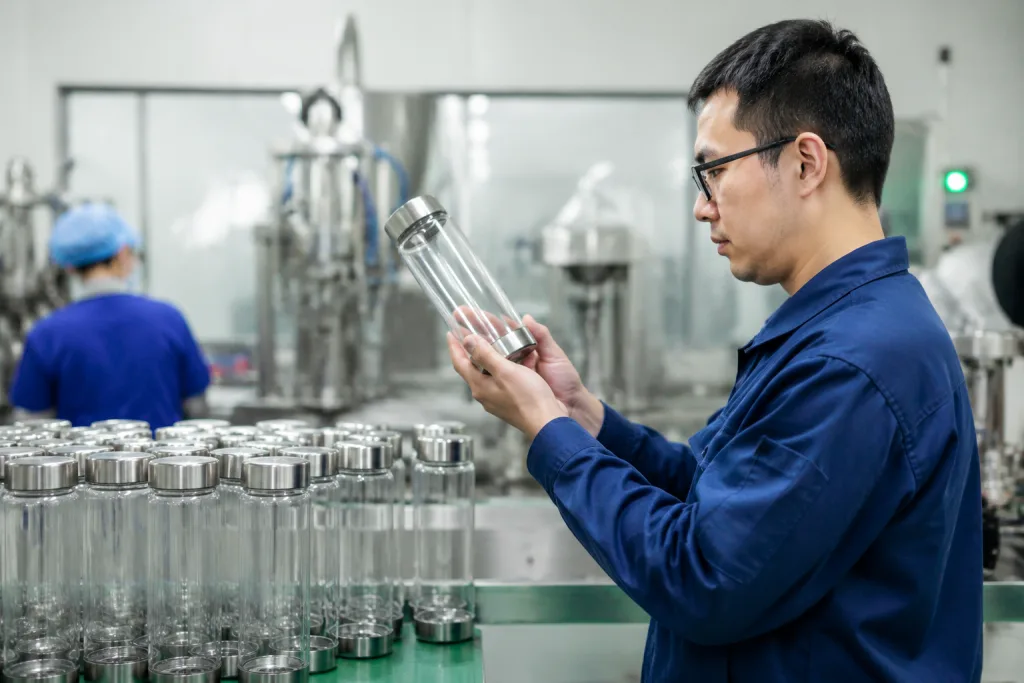
Glass bottle quality issues usually show up before shipment if the checklist is written like a factory checklist, not a buyer wish list. We run AQL 2.5 for major defects and AQL 4.0 for minor defects on standard retail orders. For gift sets above about USD 6.50 FOB, we tighten sampling because one cracked bottle in a magnetic box kills the whole set. QC should check glass defects, cap fit, gasket position, leakage, decoration position in mm, real capacity, inner packing, and carton compression. Last month QC pulled 200 pcs from a 5,000 pcs order and found the logo 3 mm off-center; the buyer would have flagged it on the shelf.
For borosilicate glass, the usual problems are bubbles, stones, scratches, deformation, uneven mouth finish, and a base that rocks on a flat table. Small bubbles are fine only when the limit is written down, such as fewer than 2 bubbles under 1 mm outside the logo area. Mouth defects are a different story. This is where leaks start. We check the rim with a 0.05 mm feeler gauge and run fingers around the mouth because a tiny chip can cut a user or stop the silicone ring from sealing. For caps, check thread engagement, stainless steel surface scratches, rust risk at cut edges, and silicone smell. A 304 stainless steel outer cap should not show magnetic behavior like lower-grade steel, though magnet tests alone are not proof. XRF is better.
Leak testing should match how the bottle will be used. We use room-temperature water, fill to 90%, invert for 30 minutes, then shake 10 times and inspect tissue contact around the cap. Simple test. Hard to fake. If the product is advertised for hot drinks, add thermal shock and pressure checks because most glass water bottles are not vacuum flasks. Do not market them as thermos bottles unless the construction supports that claim; we have seen this go sideways when a PO said “thermal bottle” but the drawing showed single-wall borosilicate glass.
Packaging QC matters because glass gives no second chance. For export cartons, 5-ply corrugated is safer than weak 3-ply for sea freight, especially on 18–22 kg master cartons. Inner dividers or molded pulp trays cut breakage during container vibration. For e-commerce cartons, request ISTA-style drop testing or at least 6-face drop checks from 60–80 cm. The buyer often pushes back on USD 0.08 extra packing cost, but the math does not work after 3% breakage claims. A beautiful customizable glass water bottle becomes a refund problem if the carton is built like a cosmetic box.
Ordering path that avoids drama
The cleanest path for a customizable borosilicate glass bottle order is simple, but it has to be followed in order. We run spec lock first: body volume, glass thickness, sleeve material, cap finish, carton size, and target market compliance. Then we quote with separate lines for bottle, sleeve, cap, color box, master carton, and inland freight. After that comes artwork and packaging dieline approval, then a pre-production sample, then mass production inspection before balance payment. QC pulled one 550 ml sample last month where the sleeve logo sat 1.5 mm off center; small on a desk, ugly in 12,000 pcs. Skip a step and the risk moves from our line to your warehouse.
For payment, 30% deposit and 70% before shipment is common for borosilicate glass bottle wholesale orders from China. For private mold or unusual packaging, tooling is usually paid 100% upfront because the mold shop starts cutting steel after deposit day, not after sales forecast day. For repeat borosilicate glass bottle distributors with predictable volume, terms can improve after 3 or 4 clean shipments. First orders stay conservative. We have seen this go sideways when a PO says “matte black lid” but the approved sample tag says “gloss black”; finance may see a payment term issue, but the line sees a remake.
If you need a distributor borosilicate glass bottle program with multiple SKUs, launching six colors at 3,000 pcs each is usually the wrong question to ask unless you already have sell-through data. Start tighter. Two sleeve colors, one cap finish, and one 550 ml body keeps MOQ realistic and leaves room for reorder math. A buyer once pushed for 18 SKUs on a first run; the carton warehouse filled up before the sales report did. For retail replenishment, keep the bottle body standard and customize sleeve, cap color, or carton artwork. You get brand flexibility without resetting glass production, cap sourcing, and carton tooling every season.
BottleForge is based in Hangzhou, Zhejiang, and works with vetted glass, cap, sleeve, and packaging lines in China. We are practical about what should be custom and what should stay standard. The math does not work if every reorder needs a new cap mold, a new Pantone match, and a fresh drop test. On our side, a 12.8 kg master carton and a checked 304 stainless steel cap insert matter more than a fancy sample photo. If your goal is a sustainable product line, not a trophy sample, that discipline saves money. A customized borosilicate glass bottle should be manufacturable, inspectable, and reorderable at the same spec six months later.
Send your glass bottle spec for a real quote
Share capacity, logo, packaging, market, and quantity. We will return a practical FOB China quote with MOQ, lead time, and compliance notes.
Frequently asked questions
What is the normal MOQ for 304 stainless steel borosilicate glass bottle bulk orders?
For an existing mold, 3,000 pcs is a realistic MOQ for a simple logo order. At 5,000 pcs, you get better pricing on caps, silicone sleeves, and retail boxes. For a private mold, plan on 10,000 pcs minimum and tooling around USD 1,800–6,000. If a borosilicate glass bottle factory accepts 500 pcs with full customization, check whether it is using stock bottles and manual decoration. That can work for pilot launches, but it is not the same as stable bulk production.
Can I claim the bottle is plastic-free if the cap has PP inside?
No, not honestly. Many 304 stainless steel caps use a PP inner plug plus a silicone sealing ring. The water may touch silicone or PP depending on the design. You can say the bottle body is borosilicate glass and the cap uses 304 stainless steel, but “plastic-free” needs a cap design without plastic contact parts. If sustainability claims matter to your retailer, request a full BOM and confirm wording before printing packaging. Fixing a claim after 5,000 boxes are printed is expensive.
Which logo method is best for a custom glass water bottle?
For most custom glass water bottle orders, 1-color screen printing is the best balance of cost, durability, and MOQ. It is usually viable from 3,000 pcs and works well for wellness brands with clean logos. Decal printing is better for multi-color artwork, but it costs more and needs firing control. Laser engraving is useful on stainless steel caps, not for strong branding on clear glass. For a silicone sleeve, debossing or embossing gives a retail-friendly result without ink wear.
How should I compare borosilicate glass bottle manufacturers?
Compare the BOM, not just the final unit price. Ask each borosilicate glass bottle manufacturer to state glass thickness, cap material, gasket material, packaging structure, MOQ, lead time, test reports, and AQL inspection standard. A USD 0.25 difference may come from thinner glass, lower-grade cap parts, weak cartons, or no inspection. For EU retail, ask about REACH and food-contact documentation. For North America, ask about FDA food-contact materials and Prop 65 risk review if required by your customer.
What breakage rate should I expect in sea freight?
With proper inner dividers, 5-ply export cartons, and palletized loading, breakage should usually stay below 1% for sea freight. For courier or parcel delivery, the risk is higher unless you use e-commerce packaging tested by drop checks from 60–80 cm. Ask your borosilicate glass bottle supplier for carton dimensions, gross weight, and packing method before placing the order. If cartons exceed about 15–18 kg, warehouse handling becomes rougher and damage risk can rise.